


Perched on the hill above Naples, Vomero is on many itineraries but rarely explored in depth. Most visitors ride the funicular up, snap a photo from Castel Sant’Elmo, maybe stroll Via Scarlatti’s boutiques, and then head straight back down to the historic center. What they miss is a lived-in neighborhood filled with secret stairways, ordinary apartment blocks hiding extraordinary views, Liberty villas, local markets and cafés where life unfolds at a gentler pace than in the alleys below. Spend a full day or two here and Vomero becomes less of a detour and more of a window into how contemporary Neapolitans actually live.
Get the latest updates straight to your inbox!
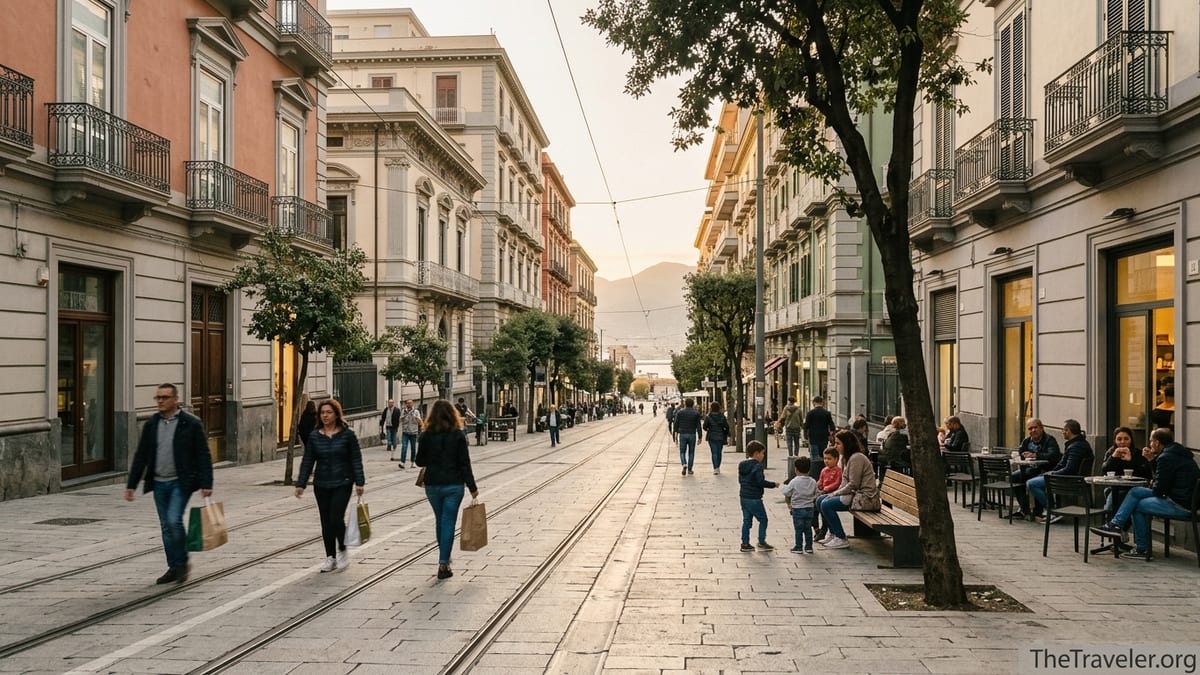
Why Vomero Is More Than a Viewpoint
High on the hill above central Naples, Vomero was once a rural outpost dotted with vineyards and country houses. Today it reads as a middle-class residential district with tree-lined avenues, Art Nouveau villas and long pedestrian shopping streets, but its elevated position still dictates much of its character. The funiculars that climb here from Chiaia, Montesanto and Augusteo are part of the ordinary commuter network, which means that the same cars carrying office workers and students also deliver curious travelers to one of the city’s most livable quarters.
Most guidebooks focus on the obvious highlights: Castel Sant’Elmo, the Certosa di San Martino and the main shopping axis around Piazza Vanvitelli. These are worth seeing, but they tell only part of the story. Venture a few blocks beyond the main square or descend one of the historic stairways and you step into an older Vomero of narrow lanes, vegetable gardens clinging to the hillside and unexpected terraces where washing flaps in the sea breeze. It is here, away from the branded shopfronts and fast-food counters, that the neighborhood reveals its quieter charms.
Because Vomero is primarily a residential area rather than a tourist enclave, daily rhythms shape what you will find open and lively. Mornings bring school runs and shopping at the neighborhood markets, afternoons are slower, and evenings see families filling pizzerias and gelaterie. Prices reflect this local focus. An espresso at a standing bar often costs little more than in the historic center, and a simple lunch of pasta, contorni and water at a neighborhood trattoria can remain surprisingly affordable compared with more touristy areas along the seafront.
To uncover Vomero’s hidden side, plan to walk and climb. The district sits roughly 150 meters above the lower city, and while funiculars and Metro Line 1 make access easy, it is the stairways, shortcuts and sloping backstreets that link its most evocative corners. Good shoes and a willingness to wander off the main grid are more important here than a rigid checklist of sights.
Secret Corners of Villa Floridiana and the Hilltop Parks
Many visitors know Villa Floridiana as the pretty neoclassical villa that houses the Duca di Martina National Ceramic Museum. They step inside, admire the collection of porcelain and majolica, then leave. The real hidden gem lies behind the building in the sprawling park that stretches across the hillside. Once a private estate, this 17-hectare green space is now one of Vomero’s most beloved escapes, with shaded paths, old stone balustrades and lawns where locals picnic on sunny weekends.
Instead of following the most obvious central avenue, seek out the smaller side paths, especially those that angle downhill toward the sea. These lead to quieter terraces where the sound of traffic drops away. From some corners, glimpses of the Gulf of Naples and Vesuvius appear between umbrella pines, and you may find only a handful of dog walkers or students taking a break from nearby universities. Benches here offer space to sit with a takeaway sfogliatella from a local pastry shop and watch the afternoon light shift across the bay.
On the upper edges of Vomero, far fewer visitors make the short bus or taxi ride toward the slopes of the Camaldoli hill. Small viewpoints and suburban parks along this frontier between Vomero and the higher districts give a different perspective on the city. Instead of the postcard-perfect harbor, you see the wider basin of Naples, industrial piers, railway lines and the volcanic ridge that frames the hinterland. It is a reminder that Naples is not only historic churches and baroque palaces but also a working port and modern metropolis.
Practical details matter in these green spaces. Villa Floridiana’s park is normally free to enter and opens during daytime hours, though sections sometimes close for maintenance after heavy rain. Surfaces can be uneven, especially on the less-frequented paths, so take care after showers. There are drinking fountains near main crossroads in the park, but it is wise to bring water, particularly in summer when temperatures on this southwest-facing slope can feel intense by midday.
Historic Stairways and Forgotten Routes Down the Hill
From a distance, Vomero looks almost detached from the older city, a separate plateau reached by tunnels and rail. In reality, older routes knit the hill to the centro storico below. One of the most atmospheric is the Pedamentina di San Martino, a stepped path of hundreds of stone steps that begins near the San Martino viewpoint and corkscrews down toward the Spanish Quarters. Many tourists admire it from above without realizing they can walk it.
Start at Largo San Martino, behind the Certosa, where you will find views that sweep over the dense fabric of central Naples. From here, a narrow lane leads to the top of the Pedamentina. The descent exposes a different face of the city: ancient retaining walls streaked with lichen, small vegetable plots squeezed between staircases, and modest houses with balconies overflowing with potted basil and geraniums. This is not a polished promenade but a working route, still used by locals as a shortcut despite the climb.
Another network of steps, known collectively as the Petraio, threads down the other side of Vomero toward the elegant Chiaia quarter. Less signposted than the Pedamentina, it begins near Via Cimarosa and Via Palizzi and slips quickly behind modern apartment blocks before emerging between old villas and garden walls. As you descend, short side stairways lead to pocket terraces with some of the most intimate views in Naples, where you look sideways across the city at rooftop level rather than down from a distant belvedere.
These routes are not recommended with heavy luggage or in slippery weather, but on a clear morning they are among the most rewarding walks in Naples. Wear comfortable shoes with good grip, keep an eye on uneven stones, and remember that there are few services en route, so bring at least a small bottle of water. The reward is a deep sense of how the city is layered, and how generations have moved between the port and the hill long before tunnels and escalators existed.
Rione Antignano and the Everyday Life of the Market
Behind the polished storefronts of Via Scarlatti and Via Luca Giordano, the older core of Vomero survives in Rione Antignano. Once a rural village on the Roman road linking Naples with the Phlegraean Fields, Antignano still feels like a separate pocket within the modern grid. Low-rise buildings, narrow lanes and small courtyards give the area a village atmosphere, especially in the early morning before shops elsewhere fully open.
The heart of this micro-neighborhood is the Mercatino di Antignano, one of the city’s busiest local markets. Stalls spill along the streets selling budget clothing, household goods, cosmetics and an ever-changing array of seasonal items. Among them, greengrocers display artichokes, bitter greens and crates of tomatoes, while fishmongers offer whatever has arrived that morning from the port. Prices are targeted at residents rather than visitors, so a bag of ripe tomatoes or a simple cotton T-shirt can cost significantly less than in the more fashionable shops closer to Piazza Vanvitelli.
What makes Antignano a hidden gem is not any single “must see” but the chance to observe ordinary routines. Elderly shoppers inspect produce with care, teenagers browse inexpensive streetwear, and café counters do brisk business in cornetti and cappuccini served to people balancing shopping bags. For travelers staying in an apartment, this is the ideal place to stock up on fruit, vegetables and cured meats for a picnic in the park or an easy dinner at home.
The market area is generally busiest in the morning and early afternoon, with many stalls packing up by mid-afternoon and very few operating in the evening. As with any busy market, keep valuables secure and move with the flow rather than stopping abruptly in the middle of narrow walkways. Politely asking before taking close-up photos of vendors or their wares is appreciated and can spark friendly conversation, sometimes rewarded with a slice of peach or a taste of local cheese.
Liberty Villas, Backstreet Cafés and Quiet Viewpoints
Walk ten minutes away from the main shopping streets and Vomero’s residential architecture comes to the foreground. At the turn of the twentieth century, when the hill was being developed as an escape from the dense lower city, wealthy families built villas here in an eclectic mix of styles. Some of these survive on side streets off Via Cilea and Via Belvedere, where ornate iron balconies, floral stucco and curved windows recall Naples’ brief love affair with Art Nouveau.
One noted example is Villa Casciaro, a 1910 residence often cited as a textbook case of Neapolitan Liberty style. While it remains private and not visitable inside, its exterior is visible from the street, where colored tiles, forged ironwork and sinuous lines stand out from more conventional apartment blocks. Nearby, other villas such as Villa Lucia and Villa Belvedere testify to a period when the hill combined rural air with aristocratic privilege. Observing these buildings in context gives a sense of how quickly the area shifted from countryside to commuter district.
Interspersed among these villas are backstreet cafés and pastry shops that rarely feature in English-language guidebooks. On corners away from Piazza Vanvitelli, you will find small bars with only a handful of tables, where regulars watch football highlights on television and discuss the morning headlines. Here, a caffè and small pastry can still cost roughly what locals pay elsewhere in the city, and staff may be curious but welcoming when they realize you are not simply passing through.
For quieter views than the main terrace of Castel Sant’Elmo, explore the residential edges of Largo San Martino and the outlooks along Via Tito Angelini and Via Domenico Cimarosa. Short side alleys sometimes open onto low walls overlooking the historic center, where you can lean on the stone and trace the line of Spaccanapoli far below. These are not official lookout points with kiosks and crowds, just everyday overlooks where neighbors chat and dogs tug at their leashes. As always in residential areas, keep voices low, avoid blocking entrances and treat these small spaces as shared living rooms rather than tourist attractions.
Where to Taste Vomero: From Historic Pizzerias to Neighborhood Bakeries
Vomero’s food scene mirrors its character: a mix of long-established local institutions and contemporary spots catering to residents. While the district does not attract the same pilgrimage lines as the historic pizzerias of Via dei Tribunali, it quietly hosts some of the city’s most respected ovens. One long-standing address on Via Bernini, often mentioned by Neapolitans when discussing serious pizza, serves classic margherita, marinara and a famous folded “ripieno” in a bright, no-frills dining room where families and couples share tables.
A practical advantage of eating pizza in Vomero is the slightly calmer environment. You may still need to put your name down at peak hours, but waits tend to be shorter than in the most publicized spots downtown. Prices are similar across the city: a traditional round pizza and a soft drink often come in at a modest cost compared to many Western European capitals, making it easy to feed a group without stretching the budget. Many places also offer takeaway, which pairs perfectly with an impromptu picnic on a bench near Villa Floridiana or one of the hilltop viewpoints.
Beyond pizza, look out for bakeries and pasticcerie tucked into side streets. Morning shelves are stacked with cornetti filled with cream or jam, sfogliatelle, and local biscuits. Buying a small assortment and a pair of takeaway coffees, then finding a quiet corner of a nearby park, can be an appealing alternative to a sit-down breakfast. In the late afternoon, these same bakeries may set out trays of focaccia and savory pastries that locals pick up for merenda or to tide them over until dinner.
Cafés around Piazza Vanvitelli and along pedestrian Via Luca Giordano still provide the classic standing-bar experience: order at the cashier, take the receipt to the counter, and enjoy your espresso quickly rather than lingering for hours. Prices are often lower at the counter than at a seated table. Observing this routine is part of understanding Vomero’s everyday life, and staff are generally patient if you clearly signal that you are new to the ritual.
Practical Tips for Exploring Vomero’s Hidden Side
Reaching Vomero is uncomplicated. Metro Line 1 connects key central stops such as Garibaldi and Toledo with Vanvitelli station in the heart of the district. Three funicular lines, Centrale, Chiaia and Montesanto, rise directly from the lower city to different corners of the hill, taking only a few minutes and offering fleeting but memorable views through their windows. Single tickets are part of the unified public transport system used across Naples, and many travelers find it convenient to purchase a day pass if combining multiple journeys with museum visits.
Once on the hill, the best way to discover hidden gems is on foot. Distances between Villa Floridiana, Rione Antignano, the Certosa di San Martino and the main shopping streets are short in absolute terms, but the constant ups and downs make them feel longer. Plan regular breaks in cafés or on park benches, particularly in summer. Good walking shoes, sun protection and a reusable water bottle make a big difference, as fountains are available but not on every corner.
Safety in Vomero generally feels more relaxed than in some parts of the lower city, especially late in the evening when families stroll for gelato and students gather in bars. Normal big-city precautions still apply: keep bags closed, avoid displaying valuables and be attentive in crowded areas like markets and on public transport. Stairways such as the Pedamentina and the Petraio are best tackled during daylight hours, when they are more frequented and footing is easier to see.
Because Vomero sits slightly apart from the main flow of tourism, English is less widely spoken in small shops than around the central monuments. A few basic Italian phrases, a willingness to gesture, and patience go a long way. In return, you may find that stallholders add an extra orange to your bag or baristas take time to explain the difference between local pastries. It is these small, unscripted encounters that often become the most memorable souvenirs.
The Takeaway
Vomero is often described as the place you go in Naples for a view, but that undersells its character. Stay a little longer and the hill reveals itself as a lived-in, layered neighborhood where hidden stairways connect centuries of history, local markets drive the daily rhythm, and quiet corners in the park offer respite from the intensity of the centro storico. Its best experiences are simple ones: watching the city wake up from a terrace in Villa Floridiana, chatting with a vendor at the Antignano market, or sharing a pizza at a table surrounded by local families.
For travelers willing to step away from the most publicized circuits, Vomero provides a balance between accessibility and authenticity. It is close enough to the main sights that you can be back at the cathedral or the seafront in half an hour, yet removed enough that evenings feel like they belong to residents rather than visitors. Build at least one unhurried day here into your Naples itinerary and you will likely leave with a richer, more nuanced sense of the city as a whole.
FAQ
Q1. How do I get to Vomero from central Naples without a car?
From the historic center, the simplest options are Metro Line 1 to Vanvitelli station or one of the three funiculars that climb directly to Vomero from Chiaia, Montesanto or Augusteo; both are inexpensive and run frequently during the day.
Q2. Is Vomero a good area to stay in for first-time visitors to Naples?
Yes, Vomero suits travelers who want a quieter base with good transport links; you can reach the main sights within about 20 to 30 minutes while enjoying calmer evenings and a more residential atmosphere.
Q3. Are the hidden stairways like the Pedamentina and Petraio safe to walk?
They are commonly used by locals and generally fine during daylight in good weather, but surfaces can be uneven, so wear sturdy shoes and avoid walking them late at night or in heavy rain.
Q4. What time of day is best for visiting Villa Floridiana’s park?
Morning or late afternoon are ideal, when temperatures are milder and light over the bay is softer; midday in summer can feel very hot on exposed paths despite the trees.
Q5. Where can I experience a local market in Vomero?
The Mercatino di Antignano, a busy neighborhood market in the Antignano area, is the best choice for an authentic experience, especially in the morning when most stalls are open.
Q6. Can I visit the Liberty-style villas in Vomero?
Most villas, such as Villa Casciaro and others along side streets, remain private residences or offices, so you can admire their facades from the street but generally cannot visit the interiors.
Q7. Is Vomero suitable for travelers with limited mobility?
The funiculars and Metro make reaching the district straightforward, but steep streets and frequent stairs can be challenging, so it is wise to plan routes along flatter main avenues and use public transport to avoid major climbs.
Q8. Are restaurants and cafés in Vomero open late?
Many pizzerias and cafés stay open into the late evening, particularly on weekends, but neighborhood bakeries and markets typically close by early afternoon or early evening, so plan food shopping earlier in the day.
Q9. Do I need to book restaurants in Vomero in advance?
For popular pizzerias and weekend dinners, reserving or arriving early is sensible, while smaller trattorias and cafés often accept walk-ins, especially on weekdays outside peak hours.
Q10. Is Vomero worth visiting if I only have one full day in Naples?
If your time is very short, you may focus on the historic center, but even then a half-day in Vomero for its views, parks and markets adds a valuable, more contemporary perspective on the city.