


Most visitors to Lake Averno come for a peaceful walk along the circular path, snap a few photos of the dark water, and leave believing they have “seen” the lake. Yet this small crater in the Phlegraean Fields, a short ride from Naples, hides layers of myth, Roman engineering, quiet vineyards, and volcanic landscapes that rarely make it into a standard day trip. Look beyond the waterline and Lake Averno becomes one of southern Italy’s most atmospheric places, where nature, history, and legend sit almost unnoticed just a few minutes off the main trail.
Get the latest updates straight to your inbox!
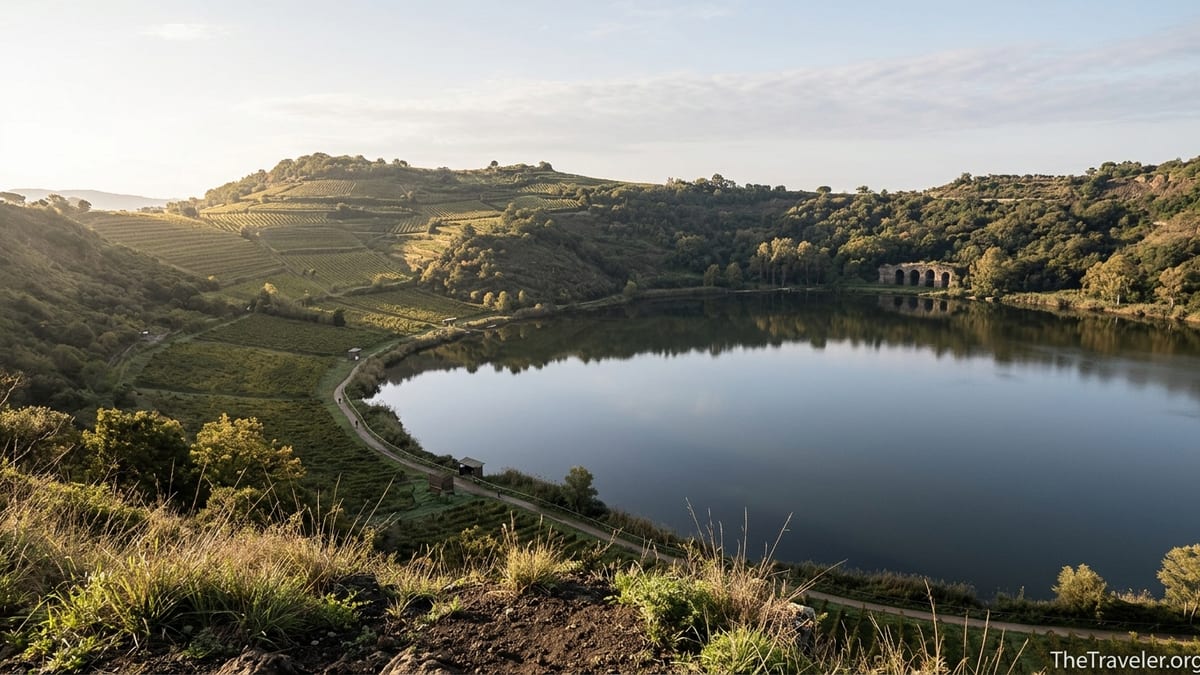
Reading the Landscape: A Volcanic Crater with a Reputation
Standing on the paved lakeside path, it is easy to mistake Lake Averno for a simple countryside pond fringed with reeds and low hills. In reality, you are at the bottom of an ancient volcanic crater at the heart of the Phlegraean Fields, a still-active caldera west of Naples. The hills that frame the water are the crater rim, their gentle lines disguising a violent geological past. Local information boards in Italian mention its volcanic origin, but many foreign visitors walk past without realizing they are inside a volcano.
In antiquity, Roman writers described Avernus as a place where birds fell from the sky, supposedly suffocated by fumes from the water and surrounding woods. While those gases have long since faded, the dark color of the lake and the steep, wooded slopes still create a mood that fits its ancient reputation. On misty winter mornings you can see low fog clinging to the surface, and on quiet summer evenings the air is heavy with the scent of pine and wild herbs, a reminder that the ground beneath your feet is very much alive.
The volcanic story becomes more tangible if you take your eyes off the water and look toward nearby craters like Monte Nuovo, which you can reach on foot in under half an hour. This small cone, created by an eruption in the sixteenth century, shows how quickly the landscape can change here. Compared to the neatly managed lakeside path, the rougher trails around Monte Nuovo give you a better sense of the raw forces that shaped Averno’s basin in the first place.
Because the whole area sits inside a regional park, active fumaroles and thermal springs are never far away. Even if you do not visit the better-known Solfatara crater in Pozzuoli, you may catch a faint smell of sulfur on the wind or see wisps of steam rising in the distance on cooler days. These subtle signs of activity help explain why ancient people found the lake unsettling and why it was a perfect setting for stories of the underworld.
From Underworld Gate to Secret Naval Base
Ancient authors like Virgil placed the entrance to Hades on the shores of Lake Averno, and traces of that mythic role are still visible if you know where to look. A short detour from the path brings you to the remains often associated with Apollo and the Cumaean Sibyl, fragments of walls and arches partly covered by vegetation. Without a guide, many visitors mistake them for a ruined farmhouse, yet they belong to a much older sacred landscape that once linked the lake to the oracle at nearby Cumae.
In the late first century BC, Averno’s role changed dramatically. Marcus Agrippa, admiral and close ally of Octavian, transformed the quiet crater lake into the inner basin of Portus Julius, a hidden naval harbor used in the civil wars. Canals once connected Averno to Lake Lucrino and then to the sea, allowing Roman warships to slip in and out of view. Today those channels are largely silted up or built over, but if you walk toward the low ground between the lakes you can still sense how cleverly the Romans used the natural basins as a layered port system protected by the surrounding hills.
One of the most extraordinary, though currently inaccessible, feats of Roman engineering here is the Grotta di Cocceio, a tunnel of roughly a kilometer cut through the rock to connect Averno directly with Cumae. Its entrance sits discreetly along the lakeshore, half lost among trees and fences. Many people stroll by without realizing that behind the locked gate lies a military road once wide enough for chariots. Even though the tunnel remains closed due to damage and safety concerns, local guides often pause nearby to explain its history, and it is worth seeking out these viewpoints to imagine the traffic of soldiers and supply carts that once flowed beneath the hill.
The military story continues around the wider Phlegraean Fields. If you combine a visit to Averno with a stop in Pozzuoli’s old port, you can see the Macellum, once misidentified as a Temple of Serapis, where marine shells on its columns record centuries of slow ground movements known as bradyseism. These subtle vertical shifts, a hallmark of the volcanic system that also shaped Lake Averno, are still monitored today, adding a contemporary layer of scientific interest to what might otherwise seem like a purely ancient landscape.
Hidden Myths: Tracing Aeneas and the Cumaean Sibyl
Most information boards at Lake Averno mention the underworld in passing, but few visitors take the time to trace the literary and mythological landscape that made this crater famous. In Virgil’s Aeneid, the hero Aeneas comes to the area seeking guidance from the Cumaean Sibyl. Their path, as imagined by the poet, leads through the forest around the lake, past sacred groves and ominous vapors, to a cave that opens onto the realm of the dead. When you step away from the paved path onto the quieter tracks that cut through the woods, it becomes easier to picture that journey.
For a more concrete sense of the mythic geography, pair your walk around Averno with a visit to the Cuma Archaeological Park, a short drive or bus ride away. There, on the acropolis above the sea, you can enter the so-called Antro della Sibilla, a long trapezoidal corridor cutting straight through volcanic rock. Whether or not it was truly the Sibyl’s lair, the atmosphere inside, with dim light filtering in from side openings, echoes the subterranean imagery associated with Lake Averno and the underworld gate on its shore.
Back at the lake, some local guides and small tour operators offer themed walks that link specific spots along the shore with episodes from the Aeneid. You might pause at a quiet bay while your guide reads a few lines in Italian and English, then discuss how Roman readers in the Augustan age would have recognized the landscape. These experiences turn what might be a simple nature walk into a literary pilgrimage, connecting place, text, and history in a way that many casual visitors never experience.
Even without a formal tour, you can create your own myth-focused itinerary. Start at the lakeside ruins often associated with Apollo, continue along the shore to find the blocked entrance of the Grotta di Cocceio, then head on to Cuma to visit the acropolis and forest. By the end of the day, the underworld will feel less like an abstract idea and more like a network of tangible places within a few kilometers of one another.
Vineyards, Local Wine, and Slow Evenings
One of the easiest secrets to miss at Lake Averno lies just beyond the reeds: rows of vines climbing the crater slopes. The area is part of the Campi Flegrei DOC wine zone, known especially for white Falanghina and red Piedirosso grown on volcanic soils. From the lakeside path you can see small parcels of vineyards tucked between farmhouses and orchards. Many day trippers rush back to Naples after their walk, unaware that some of these producers welcome visitors for tastings and simple meals.
Small family-run wineries in the area, often with modest signage at the roadside, typically offer informal tastings by prior arrangement rather than polished, large-scale tours. A typical visit might include a short walk through the vines overlooking the lake, a look at the cellar carved partly into tuff stone, and a tasting of two or three wines paired with local cheeses, salumi, and bread, at a cost that is generally modest compared with more famous wine regions. Because operations are small and seasonal work in the vines is demanding, it is wise to contact producers in advance through their websites or local tourist offices instead of arriving unannounced.
Even if you do not schedule a winery tour, you can still taste the area in a practical way. Trattorias in nearby Pozzuoli and Bacoli often list Campi Flegrei Falanghina by the glass, typically at a manageable price, making it easy to pair a lake walk with an evening seafood dinner on the coast. Ordering a local label rather than a generic house wine turns an ordinary meal into a continuation of your day around Averno’s crater, connecting the volcanic soil under your feet with the glass on your table.
For travelers staying overnight in the area, the vineyards also offer a different way to experience the lake’s atmosphere. As the day visitors depart, the hillsides grow quiet, and the reflection of scattered farmhouse lights shimmers on the dark water. Sitting outdoors with a simple plate of grilled vegetables, local olive oil, and a carafe of Piedirosso, you can appreciate why ancient authors described this region as both ominous and oddly inviting.
Beyond the Loop: Forest Trails, Birdlife, and Monte Nuovo
The well-maintained path circling Lake Averno is roughly three kilometers long, flat, and popular with joggers and families. What many visitors overlook are the side tracks leading into the forest and up toward Monte Nuovo and the surrounding hills. These trails, while not difficult, give access to quieter corners where the lake reveals a wilder character and the crater rim views put the entire Phlegraean landscape into perspective.
Along the northern and western shores you may notice simple wooden platforms and shelters used for birdwatching. The lake hosts both resident and migratory species, and in the cooler months you might spot ducks, coots, and herons resting among the reeds. Bringing a small pair of binoculars or using a zoom lens can turn a short stop at one of these hides into a rewarding pause, especially at sunrise or late afternoon when the birds are more active. These spots are easily missed if you are focused only on completing the loop.
A gentle climb from the lakeside brings you to paths around Monte Nuovo, the youngest volcano in continental Europe, formed in a dramatic eruption in the sixteenth century. The crater rim offers views over Averno, Lake Lucrino, the Bay of Pozzuoli, and, on clear days, the islands of Procida and Ischia. The contrast between the quiet water below and the broad sweep of the coast makes it easier to understand how strategically important this basin once was for Roman fleets and traders. Wear sturdy shoes, as some sections can be uneven or muddy after rain, and bring water in warmer months, since shade is limited on parts of the ascent.
Because these side trails receive far fewer visitors than the lakeside path, they are also a good choice for travelers seeking calm. On weekdays outside peak summer, you may walk for half an hour without seeing anyone else, accompanied only by the sound of wind in the pines and the occasional call of a bird. This sense of solitude, surprisingly close to busy Naples, is one of Averno’s greatest but least appreciated gifts.
Linking Lake Averno with Cuma, Pozzuoli, and Baia
Another thing most visitors miss is how easily Lake Averno can anchor a broader day exploring the Phlegraean Fields. Many people arrive by car or bus, walk the lake, and return directly to Naples, unaware that within a short radius lie some of the most significant archaeological and natural sites in southern Italy. With a little planning, you can connect Averno to Cuma, Pozzuoli, and Baia in a single, rich itinerary.
The Cuma Archaeological Park, located between Pozzuoli and Bacoli, preserves the remains of the first major Greek colony on the Italian mainland. Here you can walk the ancient Via Sacra, climb to the temples traditionally associated with Apollo and Jupiter, and explore the Antro della Sibilla. From the temple terraces, the view stretches back toward the inland lakes, linking visually the oracle’s sanctuary with the basin of Averno below. Entry requires a ticket, and opening hours can vary by season and weekday, so it is wise to check current schedules through regional cultural heritage channels before setting out.
In Pozzuoli, the old center offers its own layers of history, from the Roman amphitheater to the seafront where fishing boats, cafes, and restaurants cluster around the harbor. A short walk inland leads to the Macellum, where the columns famously bear marks left by marine mollusks during periods when the structure was partially submerged. Combined with a visit to Lake Averno earlier in the day, this gives you a clear physical example of how the same volcanic forces that shaped the crater lake continue to lift and lower the local coastline over centuries.
Baia, another short drive away, adds a final dimension. Its archaeological park showcases the remains of sumptuous Roman villas and baths, while the submerged section of the ancient town can be visited by glass-bottom boat or snorkeling tours arranged with local operators. Seen together with Averno’s quiet shore and Cuma’s windswept acropolis, these sites reveal the Phlegraean Fields as a coherent cultural landscape rather than a series of unrelated stops. Most visitors who treat the lake as an isolated walk miss the chance to see how deeply it is woven into the wider story of the Bay of Naples.
Practical Tips: Getting There, Timing, and Staying Safe
Reaching Lake Averno from central Naples is relatively straightforward, but the details matter if you want to enjoy more than a rushed circuit of the path. Many travelers take a regional train toward Pozzuoli and continue by local bus or taxi to the lake area, where parking is also available for those arriving by car. Schedules and routes change occasionally, particularly on weekends and holidays, so it is sensible to verify current public transport options through regional journey planners or at Naples stations shortly before your trip.
The lakeside path is open year-round and does not require an entry ticket, which makes it popular with local residents at all times of day. To appreciate the quieter aspects of Averno, try to visit on a weekday morning or in the late afternoon outside the peak summer months of July and August. Spring and early autumn often offer the best combination of comfortable temperatures, clear light, and active birdlife. In the hottest weeks, shade can be patchy along sections of the path, so bring water, sun protection, and a hat.
Swimming in Lake Averno is generally not part of the local culture and is discouraged both for safety and environmental reasons. The shores are fringed with reeds and private plots, and there are no lifeguards or designated bathing areas. Small boats and kayaks are sometimes seen, especially near rental points or private docks, but organized activities remain limited compared with more conventional holiday lakes. Keeping to the paths and respecting fences, crops, and signage helps protect the delicate mix of agriculture and nature that characterizes the crater.
Because the greater Phlegraean Fields remain a monitored volcanic area, it is wise to stay informed but not alarmed. Occasional small tremors are not unusual, and local authorities track ground movements and gas emissions closely. When you visit, follow any posted instructions, avoid entering clearly closed areas such as the Grotta di Cocceio, and treat the landscape with the same respect you would give to a high mountain environment: beautiful, largely safe, but still shaped by powerful forces over time.
The Takeaway
Lake Averno rewards those who look beyond its tranquil surface. The standard loop around the water offers a pleasant hour in nature, but the real character of the place emerges when you connect the dots: the volcanic crater beneath your feet, the invisible lines of Roman canals and tunnels, the echoes of Aeneas and the Sibyl, the vineyards climbing the rim, and the neighboring acropolis, ports, and baths that together form the Phlegraean Fields.
By slowing down, leaving the main path for a forest trail, pausing at a bird hide, following the shoreline ruins to their stories in Cuma and Baia, or ending your day with a glass of Campi Flegrei wine overlooking the lake, you turn a simple walk into a layered journey. What most visitors miss at Lake Averno is not a single secret site, but the realization that this modest crater holds an entire world of connections, waiting just a few steps beyond the obvious.
FAQ
Q1. How long does it take to walk around Lake Averno?
The main lakeside path is roughly three kilometers long and usually takes about 45 to 60 minutes at a relaxed pace, longer if you stop for photos or birdwatching.
Q2. Can I swim in Lake Averno?
Swimming is not recommended and is generally discouraged. There are no lifeguards, no equipped bathing areas, and the shores are lined with reeds, private properties, and sensitive natural zones.
Q3. How do I reach Lake Averno from Naples without a car?
Most visitors take a regional train toward Pozzuoli and then continue by local bus or taxi to the lake area. Because routes and timetables change, it is best to confirm current options with local transport planners before traveling.
Q4. Is Lake Averno safe to visit given the volcanic activity in the area?
Yes, under normal conditions it is considered safe. The Phlegraean Fields are closely monitored by Italian authorities, and visitors simply need to follow local advice, respect closures, and be aware that minor tremors can occur.
Q5. Are there guided tours that include myths and Roman history at Lake Averno?
Yes, several local guides and small agencies offer themed walks linking Lake Averno with Cuma and other nearby sites, focusing on Virgil’s Aeneid, the Cumaean Sibyl, and Roman engineering such as the ancient tunnel toward Cumae.
Q6. What is the best time of year to visit Lake Averno?
Spring and early autumn are ideal, with mild temperatures, pleasant light, and active birdlife. Summer can be very hot on the exposed sections of the path, while winter often brings atmospheric mists and fewer crowds.
Q7. Can I visit the Grotta di Cocceio tunnel from Lake Averno?
You can see the lakeside entrance of the Grotta di Cocceio from outside, but the tunnel itself remains closed to the public due to structural damage and safety concerns.
Q8. Are there wineries near Lake Averno that accept visitors?
Yes, there are small wineries in the Campi Flegrei DOC area around the lake. Many welcome visitors for tastings by prior reservation, often combining vineyard walks with samples of local Falanghina and Piedirosso.
Q9. Can I combine Lake Averno with visits to Cuma, Pozzuoli, and Baia in one day?
It is possible, especially with a car or pre-arranged driver. A realistic itinerary might include a morning walk around Averno, a midday visit to Cuma, and an afternoon exploring Pozzuoli or Baia, keeping seasonal opening hours in mind.
Q10. Is the path around Lake Averno suitable for strollers and limited mobility?
Much of the lakeside path is flat and relatively smooth, so sections can be manageable for strollers and people with limited mobility. However, some stretches may be uneven, and side trails up toward Monte Nuovo are steeper and not suitable for wheelchairs.