


I arrived at Lake Averno expecting a pleasant lakeside stroll, the kind of easy loop you tack onto a day in Campi Flegrei between a coffee in Pozzuoli and a sunset over the Tyrrhenian Sea. Instead, my walk turned into something far more atmospheric: a slow circuit through steam, silence and stories of the Roman underworld, all within half an hour of central Naples.
Get the latest updates straight to your inbox!
First Impressions of a Volcanic Underworld
Lake Averno does not shout for attention. The crater is low and rounded, the water almost perfectly circular, and the access road slips down from the busy Via Cuma with very little fanfare. Only when you remember that the Romans believed this basin was an entrance to the underworld does the shape begin to feel uncanny. The lake fills a volcanic crater in the Campi Flegrei, a restless caldera west of Naples where the ground is still rising and falling with underground pressure. You do not see lava here, but the place has the quiet intensity of a volcano holding its breath.
Practicalities assert themselves first. There is a small parking strip along the access road and a few designated spaces nearer the shore; midweek in spring I found plenty of room, but on sunny Sundays locals park in a double row and walk in. A basic lakeside bar near the start of the path was open by late morning, offering espresso for about 1.30 euros and cornetti still warm from the oven. It felt like any provincial Italian lake at that point, with plastic chairs, chipped tables and fishermen unloading gear from the back of small hatchbacks.
Then you look more closely. Across the water, the crater walls fold into one another in a near-complete ring, green with oaks, pines and creeping vines. The only breaks are a cut in the rim where a Roman tunnel once led toward Cumae and a modern road climbing toward the vineyards above. The air carries a faint mineral scent, sharper than the sea breeze on the nearby coast. Even without reading a word of mythology, you sense that this bowl has trapped atmospheres for thousands of years.
Walking the Lakeside Path
The loop around Lake Averno is roughly 3 to 3.5 kilometers, an easy hour’s walk at a relaxed pace. The path is mostly flat and well compacted, used by joggers, dog walkers and families pushing strollers. It begins as a paved lane beside small boathouses and slips quickly into packed ash and dirt, the legacy of eruptions that once threw pumice and tuff across this landscape. In dry weather, sneakers are fine; after winter rains, the shaded sections can be muddy enough that lightweight hiking shoes are more comfortable.
On my clockwise circuit, the first section felt disarmingly ordinary. Locals were running intervals, a teenager pedaled past on a squeaking bike, and a couple sat in a parked car scrolling their phones with the lake as a backdrop. Fishing lines arced into the water from simple platforms made of old pallets and stones. You could almost forget that this lake was once ringed with temples and military structures and that ancient writers described vapors so noxious birds supposedly fell from the sky as they crossed.
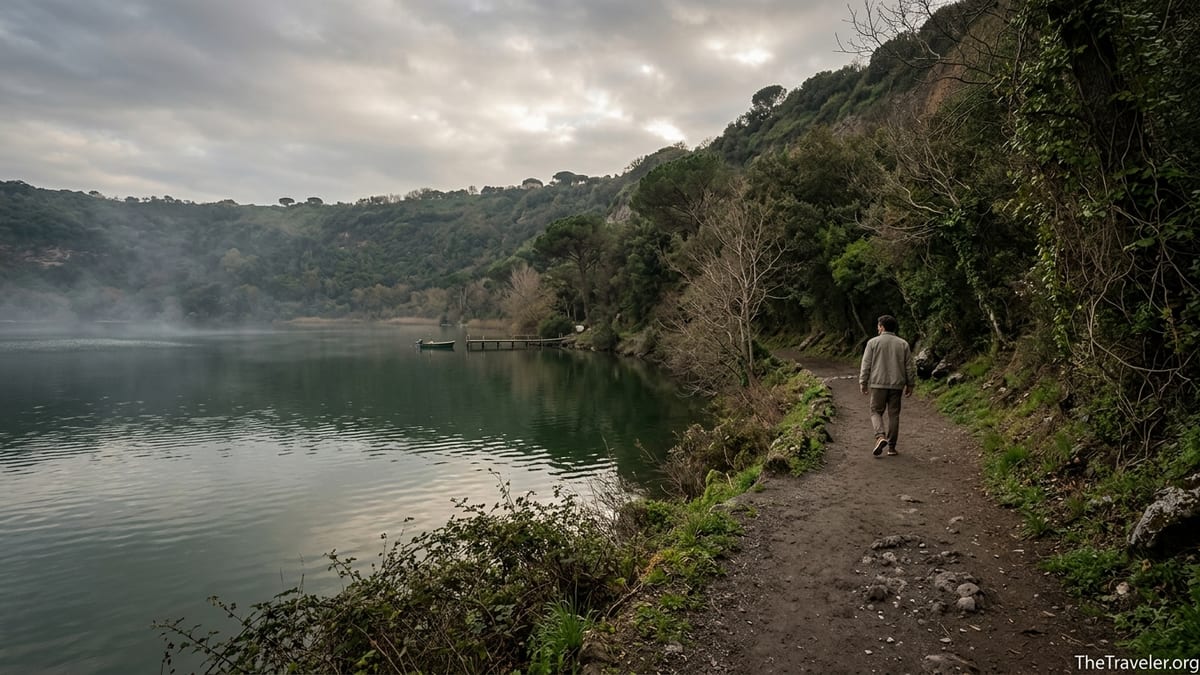
The atmosphere gradually thickened as I moved away from the parking area. The path narrowed and trees leaned in, branches knitting across the sky. On one side, reeds and willows brushed the shore; on the other, the crater wall rose steeply, studded with dark lava blocks that crumbled into powder between the roots. There were long stretches with no one else in sight, despite the lake being only a short drive from one of Europe’s most densely populated cities. In those moments, I could hear every footstep on the ash, every rustle in the undergrowth, and the low, constant lapping of water.
Myth, History and the Roman Shadow
Much of Lake Averno’s atmosphere comes from the stories layered over its geology. In Roman times, this quiet basin was imagined as a gate to the underworld. Virgil set a pivotal scene of the Aeneid here, sending his hero down into Hades from the lakeshore. Walking the path today, with the crater’s rim closing the horizon and the water a dark, opaque green, it is easy to understand why pre-modern visitors sensed a threshold between worlds.
Fragments of that Roman presence still cling to the landscape. Near the northern curve of the trail, you can see the remains of ancient structures built into the crater wall. Brickwork arches half swallowed by vegetation hint at storehouses or baths that once served a port using the lake as a secure anchorage. A little farther away on the slopes above, archaeologists have identified elements of a grand project commissioned under Augustus to link Lake Averno to the sea, turning this volcanic crater into the centerpiece of a naval base.
For a traveler, none of this requires scholarly preparation. Practical details appear in small ways: a signpost describing the lake as part of the Parco Regionale dei Campi Flegrei, a simple panel explaining how gas emissions at the water’s surface fed the myth of deadly vapors. On cooler days, faint wisps sometimes rise from spots along the shore where gases escape through the sediment, a reminder that the myth of a steaming gateway came from real observations of the Earth breathing here.
Geology Beneath the Silence
Even without visible fumaroles by the path, you are surrounded by evidence that Lake Averno belongs to an active volcanic system. The crater is part of Campi Flegrei, an enormous caldera stretching from Pozzuoli to the outskirts of Naples. In recent years, the region has experienced ongoing seismic swarms and gradual ground uplift, a process known locally as bradyseism. Civil protection agencies maintain a yellow alert level for the area, signaling heightened attention but no immediate danger for visitors.
As I walked, I kept noticing the texture of the ground. Each footstep kicked up fine, pale dust that looked almost like flour, the weathered remains of ash from past eruptions. In places the path cut through low banks where layers of pumice and tuff were visible like geologic tree rings, some coarse and pebbly, others as fine as talc. A guide from a local cooperative in Pozzuoli later told me that school groups often visit the lake to see exactly these layers, using the loop as an open-air geology lesson.
The crater walls amplify the quiet. Unlike larger, alpine lakes with open vistas, Lake Averno feels contained, sometimes even slightly claustrophobic. The rim blocks long-distance views, so you are always looking across at another segment of wall, another cluster of trees, another slipway leading nowhere in particular. When the wind drops, sound carries cleanly across the water: the thump of a soccer ball from a field nestled on the rim, the call of a vendor’s van on the road above, the hum of a commuter train heading toward Naples. All of it filtered through the stillness of the lake, as if heard from inside a shell.
Weather, Seasons and a Changing Mood
The day I walked around Lake Averno was typical of early spring in Campania. Low clouds moved in from the sea, casting shifting bands of light and shadow across the water. Temperatures hovered around 15 degrees Celsius, cool enough that breath hung lightly in the air on the shadier side of the crater. The weather did as much as the history to shape the mood. When the sun broke through, the lake looked almost cheerful, the greens bright and the reeds gilded. Under cloud, the water darkened and the crater walls became more ominous, their vegetation turning to a deep, bruised green.
Locals told me that in high summer the path feels completely different. The air becomes heavy and still, cicadas scream from the trees, and the volcanic bowl concentrates heat like a shallow dish in the sun. Families arrive with picnic coolers, teenagers take selfies on the small wooden jetties, and runners circle the lake in string vests. The underworld connection is harder to feel when there are inflatable unicorns tied to the railing and the bar is blending cold lemon granita for a queue of customers.
In winter and on grey, humid days, however, the myth returns. Mist gathers low over the water, especially at dawn and dusk, and droplets cling to the reeds along the shore. On some mornings, fishermen launching their small boats disappear into a band of fog a few meters from the bank, reappearing ghostlike farther along. When the volcanoes of Campi Flegrei make local headlines because of minor earthquakes or small changes in gas emissions, that mist and the tremor of the ground can together make the lake feel unsettlingly alive.
Meeting the Locals at the Water’s Edge
Despite the moody setting, the liveliest part of the walk around Lake Averno is its everyday human presence. Most people you meet are not tourists ticking off a site from a guidebook but residents of the surrounding towns. Elderly couples stroll in practical jackets, discussing grocery lists and football results. Parents push prams while older children dawdle along the edge, poking at the water with sticks. Runners in organized groups pass by at regular intervals, some using the roughly 3-kilometer loop as part of their training for local 10K races.
On weekends, you are likely to encounter small groups from Naples who have come specifically to walk in the Campi Flegrei countryside. Some arrive by Circumflegrea train to Lucrino station and then walk the last stretch on foot, combining the lake with a seafood lunch at one of the simple restaurants along the coast. Others drive in, park near the vineyards above the crater and descend on foot. A guided walk with a local association typically costs a modest amount per person and often includes a stop at a nearby winery on the crater rim for a tasting of Falanghina or Piedirosso, grape varieties closely associated with the volcanic soils of this region.
Conversations along the path can quickly move from the everyday to the existential. When I commented to a fisherman on the stillness of the water, he shrugged and mentioned the news reports about Campi Flegrei’s most recent earthquake swarm. "We live with it," he said, adjusting his line. "The ground moves, the water changes color some years, but the lake is part of us." For him, Lake Averno was not an exotic underworld portal or a geological rarity; it was simply the place he came on free mornings to catch dinner.
Combining Lake Averno With the Wider Campi Flegrei
Part of what makes a walk around Lake Averno feel so unexpectedly atmospheric is its context. This is not an isolated beauty spot in distant mountains, but one stop in a compact region dense with craters, fumaroles and Roman ruins. Within a short drive, you can move from the lake’s quiet path to the hissing vents and sulfur smells of areas like Pisciarelli near the closed Solfatara crater, or to the sea-facing amphitheater of Pozzuoli.
Many travelers base themselves in Naples and visit Campi Flegrei as a day trip, pairing Lake Averno with a stop at Cumae’s acropolis or the Roman amphitheater in Pozzuoli. A typical day might begin with a morning train to Pozzuoli, a coffee on Piazza della Repubblica, a tour of the Flavian Amphitheater, then a taxi or local bus toward Averno for a late-morning walk. After the loop, lunch could be a plate of spaghetti alle vongole at a simple trattoria in nearby Lucrino, where the shellfish come from the local lagoons and fish farms in the bay.
For those with more time, staying one or two nights in an agriturismo or small guesthouse on the crater rim offers a deeper immersion. Rooms in simple farm stays or vineyard accommodations around Campi Flegrei are often more affordable than in central Naples, and waking up with views over a volcanic lake adds a layer of quiet drama to breakfast. Walking the loop in the early morning or late evening, when day-trippers have gone and the light slants low across the water, intensifies the sense that you are visiting a living, breathing geological story rather than just a scenic stop.
Staying Safe and Respectful in a Restless Landscape
Because Lake Averno sits within an active volcanic system, it is worth checking local advisories before you visit. Italian civil protection authorities provide updates on Campi Flegrei’s alert level, and accommodation hosts in Pozzuoli or Lucrino can usually tell you if anything out of the ordinary is happening. At the time of my visit, the official status indicated closer monitoring but no restrictions on walks around the lake, and locals treated the seismic background as part of daily life.
On the ground, the main safety considerations are far more ordinary. In summer, heat can be intense, with the crater walls focusing sunlight and limiting breezes, so water, sun protection and light clothing are essential. In cooler months, the shaded side of the path can be surprisingly damp and slippery, especially where fallen leaves mask mud. Sensible shoes and attention on uneven stretches go a long way. Some sections of the shore drop quickly into deep water, so keeping an eye on small children exploring near the edge is wise.
Respecting the lake’s atmosphere also means leaving it as you found it. While there are occasional trash bins near the more developed sections, much of the loop has no services. Carrying out any litter, from snack wrappers to plastic bottles, helps keep the shoreline clean for the fishermen, runners and dog walkers who use this path regularly. The same applies to noise. Part of what makes Lake Averno special is the quiet; even small groups can preserve that mood by keeping music off speakers and letting conversations blend into the birdsong and soft wash of the water.
The Takeaway
My walk around Lake Averno ended where it began, back near the unassuming parking area and its cluster of cars, fishermen and plastic chairs. Yet the circuit had subtly shifted my sense of Campi Flegrei. What had seemed on the map like a simple green circle, an add-on to a day of ruins and coastal views, revealed itself on foot as a concentrated experience of the region’s personality: volcanic but gentle on the surface, steeped in myth but woven into ordinary routines.
If you arrive expecting alpine drama or postcard-perfect scenery, Lake Averno may initially appear modest. Its crater walls are low, its shoreline partially developed, its facilities simple. The power of the place emerges in smaller details: the way the rim blocks the horizon and holds sound inside the bowl, the layers of ash in the path underfoot, the fishermen casting lines into waters that ancient poets imagined as a gateway to the dead. It is a landscape that asks you to slow down, to accept ambiguity, to hold both the underworld and the everyday in view at once.
That, ultimately, is what made my walk more atmospheric than I had anticipated. I did not see dramatic eruptions or spectacular cliffs. Instead, I spent an hour circling a calm lake that quietly condensed geology, literature and contemporary life into a single, walkable loop. For travelers willing to trade spectacle for mood, and to listen closely to a landscape that whispers rather than shouts, Lake Averno may be one of the most memorable short walks in southern Italy.
FAQ
Q1. Where exactly is Lake Averno and how do I get there from Naples?
Lake Averno lies in the Campi Flegrei area near Pozzuoli, west of Naples. You can reach it in roughly 30 to 40 minutes by car from central Naples, or by taking a regional train toward Lucrino or Pozzuoli and continuing by local bus or taxi to the lake.
Q2. How long does it take to walk around Lake Averno?
The loop around the lake is about 3 to 3.5 kilometers. Most visitors complete it in 45 to 60 minutes at a relaxed pace, allowing extra time for photos and short stops along the shore.
Q3. Is the path around Lake Averno suitable for children and strollers?
The lakeside path is mostly flat and well compacted, so many families walk it with children and strollers. Some sections can be uneven or muddy after rain, so a sturdy stroller and close supervision near the water’s edge are recommended.
Q4. Do I need special hiking gear to walk around the lake?
No special gear is necessary. Comfortable walking shoes or sneakers are usually sufficient. In wetter months, lightweight hiking shoes with better grip can make the muddier sections more comfortable, and in summer a hat and plenty of water are important.
Q5. Is it safe to visit Lake Averno given the volcanic activity in Campi Flegrei?
Lake Averno sits within an active volcanic area that is closely monitored by Italian authorities. At present, the alert level involves heightened observation but allows normal daily life and visits. Travelers should check current advisories and follow any local guidance, but walking the lake is generally considered safe.
Q6. Are there facilities such as cafes or bathrooms near the lake?
Basic facilities exist near the main access point, including a small lakeside bar that serves drinks and snacks when open. Public bathrooms are limited, so many visitors plan ahead or combine the walk with a stop in nearby Pozzuoli or Lucrino where services are more widely available.
Q7. Can I swim or boat on Lake Averno?
Swimming is not a common activity here, and there are no organized bathing areas. Small boats are occasionally used by local fishermen, but rental services are limited. Most visitors experience the lake by walking the shore path rather than entering the water.
Q8. When is the best time of year to walk around Lake Averno?
Spring and autumn are ideal, with mild temperatures and softer light that suit the lake’s moody character. Summer offers longer days but can be very hot inside the crater, while winter can be atmospheric with mist and fewer visitors, provided you are prepared for cooler, damper conditions.
Q9. Can I combine Lake Averno with other nearby sights in one day?
Yes. Many travelers pair a walk around Lake Averno with visits to sites like the ancient city of Cumae, the Flavian Amphitheater in Pozzuoli, or the coastal restaurants of Lucrino. Distances are short, making it easy to build a varied day in Campi Flegrei.
Q10. Do I need a guided tour to appreciate Lake Averno’s history and geology?
A self-guided walk is perfectly enjoyable, especially if you read a little about the lake’s Roman myths and volcanic setting beforehand. However, local guided walks offered by cooperatives or tour companies can add context on geology, archaeology and modern life in Campi Flegrei, enriching the experience for interested travelers.