


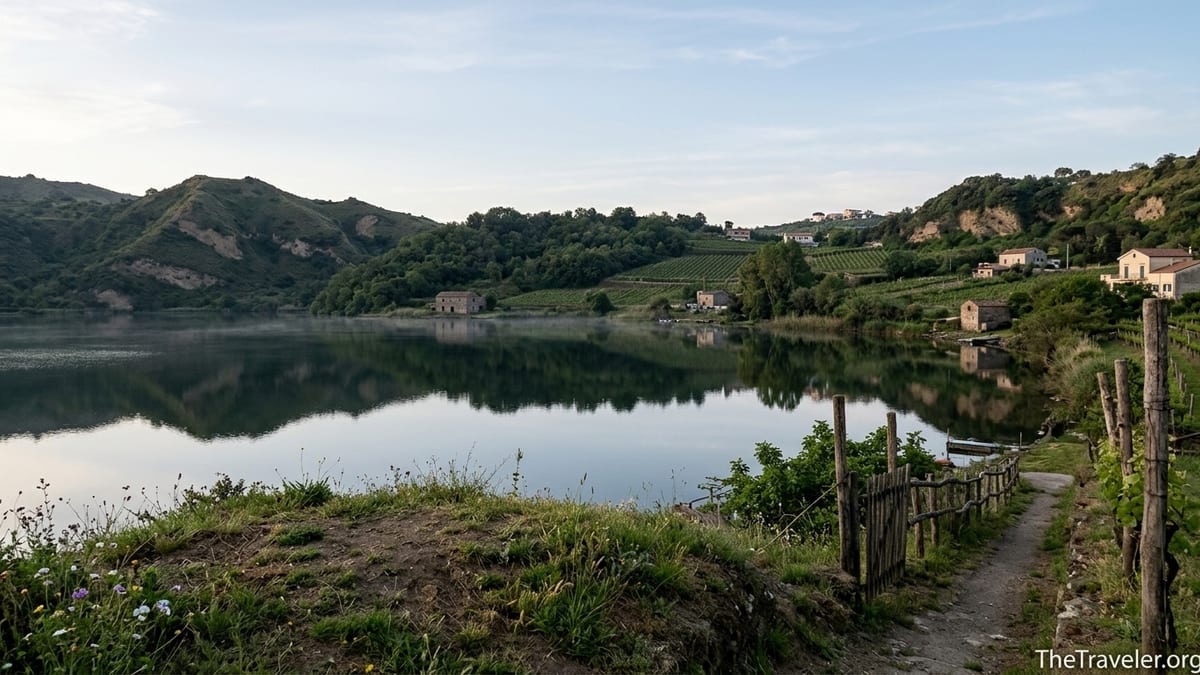
On the surface, Lake Averno looks deceptively peaceful: a still, circular pool framed by vineyards and low wooded hills on the volcanic plain west of Naples. Yet for more than two millennia this dark crater lake has been feared, revered and studied, believed by the Romans to be a literal doorway to the underworld and watched today by volcanologists tracking deep movements beneath Campania. Few places around Naples combine myth, natural drama and everyday life as intensely as Lago d’Averno, making it one of the most mysterious and rewarding natural sites in the region.
Get the latest updates straight to your inbox!
Between Underworld Legend and Everyday Life
Lake Averno’s mystery begins with its shape and setting. The lake perfectly fills a wide volcanic crater on the northern edge of the Campi Flegrei, an active caldera that also includes Pozzuoli, Solfatara and the fumarole fields at Agnano. The basin’s steep walls once held thick forests of evergreen oak and holm oak that kept the water in permanent shadow. Combined with the lake’s unusual depth for its modest diameter, this produced an inky, almost black surface that ancient observers found unsettling.
To the Romans, that unsettling appearance was more than enough to invite supernatural explanations. Ancient writers described sulfurous vapors and lack of birds over the lake, and the very name Avernus is linked to the Greek word for “without birds.” Even today, on still autumn mornings when mist clings to the water and the opposite shore dissolves into haze, it is not hard to imagine how a Roman traveler arriving from sun‑blasted Capua might have seen this dark, smoking bowl as the edge of another world.
Modern visitors, however, arrive to a calmer scene. Joggers loop along the lakeside path, anglers cast lines from the reeds, and local families from nearby Pozzuoli come to walk dogs or cycle in the late afternoon. A small bar by the car park sells espresso and plastic cups of local wine from the surrounding vineyards. The mood is relaxed and local, but the sense of layered meaning is always there: everyday life playing out on the shore of a lake that once terrified an empire.
This coexistence of the ordinary and the mythical is part of what makes Lake Averno so compelling for travelers. You can sit at a picnic table, listening to kids on scooters and the distant rumble of suburban trains, while reading passages from Virgil that describe the same shoreline as the threshold to Hades. There are few places in Italy where such a sharp contrast is visible in a single glance.
Gateway to Hades: Myths Written Into the Landscape
Most visitors first hear of Lake Averno through Roman literature. In Virgil’s Aeneid, the Trojan hero Aeneas travels to Cumae, just a few kilometers from the lake, to consult the Sibyl and descend to the underworld. The poet describes a cave in the hillside and a dark lake whose vapors kill birds, a place where the living can cross the boundary into the realm of the dead. Later Roman authors blurred the distinction between the mythic underworld and this real location, so “Avernus” became almost a synonym for Hades.
Walking here with those stories in mind makes the terrain feel strangely charged. On the western side, a wooded slope rises toward the archaeological zone of Cumae, where the remains of the Greek acropolis and the so‑called Antro della Sibilla, a long trapezoidal tunnel cut into the tufa rock, evoke the original oracular traditions that inspired Virgil. From certain spots along the lake path, you can literally see the hill where the Sibyl’s sanctuary stood and imagine Aeneas making his way down toward the crater basin below.
Even the practical Roman engineering around Averno feeds the mythology. In the late first century BCE, Agrippa turned the lake into part of Portus Julius, a secret naval base for Octavian’s fleet. Canals linked Averno to nearby Lake Lucrino and then to the sea, allowing warships to hide inland behind a volcanic ridge. Today, in the vineyards on the eastern shore, you can still find fragments of Roman brickwork and the ruins traditionally identified as a Temple of Apollo. Guides from local associations in Pozzuoli sometimes lead small groups along unmarked tracks to show how the Roman harbor basin would have worked.
For travelers, these overlapping myths and histories mean that a simple walk becomes a kind of narrative experience. You might start at the lakeside bar with a modern guidebook, follow the path to a signed viewpoint explaining Agrippa’s harbor, then continue to a shaded stretch of shore where local lore still claims that the “breath of Hades” occasionally rises on cold days. None of it feels staged. The signs are modest, the ruins half hidden, and that understatement only adds to the atmosphere.
A Volcanic Crater That Is Very Much Alive
The mystery of Lake Averno is not just literary. It is also deeply geological. The lake sits inside one of dozens of craters that make up the Campi Flegrei volcanic field, a broad depression formed by colossal eruptions over tens of thousands of years. Volcanologists consider this caldera one of the most closely watched in Europe, with dense networks of GPS stations and seismic sensors installed around Pozzuoli and the crater lakes.
Since 2005, this area has been going through a prolonged phase of ground uplift known as bradyseism. Residents of Pozzuoli have seen pavements crack, manholes rise and historic churches gently tilting as the land slowly inflates. Civil protection reports have documented episodes where the ground in the port district has risen by more than a meter compared with mid‑20th‑century levels, accompanied by swarms of earthquakes that occasionally reach magnitude 4 and attract national headlines.
Lake Averno lies just north of the most affected urban areas, but the same forces shaping the caldera work beneath its waters. On quiet days, you may notice faint sulfur smells or tiny gas bubbles rising along parts of the shore. These are reminders that hydrothermal fluids and magma at depth continue to interact with the crater’s groundwater. Local research projects have sampled the lake’s chemistry over the years, tracking subtle changes in temperature and dissolved gases as part of broader monitoring.
For visitors, the practical implications are twofold. First, the ongoing unrest adds another, very modern layer of intrigue to the landscape. You are not just gazing at an extinct volcano but at a system actively studied by Italian and international scientists. Second, it is wise to stay informed. Before planning a day trip here, travelers often check recent bulletins from Italy’s civil protection authorities or the national geophysics institute to understand the current alert level for Campi Flegrei. As of mid‑2026, that level has meant increased monitoring and periodic precautionary measures in Pozzuoli, but daily tourism around the lake has continued, with locals using the path and picnic areas as usual.
Walking the Shore: What a Visit Feels Like
In practical terms, Lake Averno is an accessible half‑day outing from Naples, combining gentle walking with glimpses of ruins and vineyard landscapes. The crater rim is low on the eastern side, where a small access road leads down past farm buildings to a public parking area. From here, a mostly flat track encircles the water for roughly 3.5 kilometers, making for a relaxed stroll of about an hour, longer if you stop frequently for photos or detours.
On a typical Saturday in late spring, you might share the path with locals from Pozzuoli out for a jog, couples pushing strollers, and small groups of hikers using Lake Averno as a starting point for longer loops up toward Monte Nuovo or down to the Lake Lucrino shore. There are a few informal fishing spots where men sit on folding chairs with simple telescopic rods bought in nearby Baia or Naples. The reed beds on the northern edge shelter waterfowl, and you may see herons hunting in the shallows.
Facilities are modest but sufficient. A lakeside café near the main access point normally sells coffee, soft drinks and simple snacks such as panini, with espresso priced similarly to central Naples. Some agriturismi and wineries between Averno and Cumae also offer lunches based on local produce, often featuring seafood from nearby Pozzuoli and wines produced on the volcanic slopes. In recent years, small operators have begun offering guided walks that combine geology explanations with tastings of Falanghina or Piedirosso from vineyards overlooking the crater.
If you prefer to explore on your own, the lack of heavy signage means you should come prepared. Satellite maps on your phone make it easier to spot side paths leading to Roman remains like the so‑called Temple of Apollo, and a detailed paper map of the Campi Flegrei is useful if you plan to link Averno with neighboring sites such as the Arco Felice gate or the archaeological park at Cumae. The atmosphere is largely informal; you rarely encounter large tour groups, which heightens the feeling of discovering something slightly secret.
Wine, Wellness and Rural Calm on a Volcanic Rim
Despite its infernal reputation in texts, the land immediately around Lake Averno is quietly productive. Rich volcanic soils, naturally drained slopes and a mild coastal climate make this part of Campania ideal for vines and orchards. From the path on the eastern shore, you look up at terraces planted with rows of grapes that will become Falanghina dei Campi Flegrei or Piedirosso, two local appellations increasingly present on wine lists in Naples and beyond.
Some estates near the lake accept visitors by reservation, offering simple tastings in converted farmhouses or small terraces with crater views. Travelers might spend an hour walking the lakeshore before heading uphill to a tasting where a winemaker explains how low yields and sea breezes influence acidity in the grapes. Sampling a chilled Falanghina while looking down at the very crater that nourished the vines brings home how intimately geology and agriculture are linked here.
There is also a long tradition of thermal culture in the wider area. Although Averno itself is not a spa, nearby facilities such as the historic baths known locally as the “Stufe di Nerone” use natural hot springs that emerge along the same volcanic system. Travelers often combine a walk at the lake with a few hours in thermal pools or steam grottos, creating a day that moves from the cool, shadowy crater to warm, mineral‑rich water. It is another example of how a landscape once feared for its deadly vapors now supports wellness tourism.
Rural calm is part of the attraction too. Compared with the crowds at Pompeii or the bus tours at Mount Vesuvius, Lake Averno feels low‑key. Tractor engines from the vineyards compete with birdsong; a lone train can be heard in the distance on the line between Naples and Torregaveta. If you arrive at golden hour in late autumn, with grape leaves turning copper and the lake reflecting pale pink skies, the scene is more reminiscent of a countryside retreat than a volcanic hazard zone.
Getting There and Staying Safe
Reaching Lake Averno from central Naples typically involves a combination of suburban train and local bus or a taxi ride. Many travelers take the Cumana railway from Montesanto station toward Torregaveta, getting off at stations such as Lucrino or Arco Felice, then continuing by local bus or on foot. Journey times from Naples to the lake area are generally under an hour, depending on connections. Rideshare taxis from districts like Chiaia or the Centro Storico can be faster but cost more, especially during peak traffic.
Once you arrive, access to the lake path is straightforward: a short side road leads from the main coastal route down into the crater, where informal parking and the lakeside café mark the start of the circuit. Footwear suitable for gravel paths is recommended, especially after rain when some sections can be muddy. In summer, shade is limited on parts of the shore, so a hat and water are essential. There is no ticketed entrance to the lake itself, but some nearby archaeological sites such as Cumae have separate opening hours and admission fees.
As for safety, the key issue is the broader volcanic context of Campi Flegrei. Italian authorities continuously monitor seismicity, gas emissions and ground deformation, and they communicate alert levels through national and local channels. In recent years, phases of intensified earthquake activity have led to school closures in Pozzuoli on certain days and to updated emergency planning for residents. For tourists, the main recommendation is to stay informed and follow any instructions from local authorities or your accommodation, particularly regarding parking zones and evacuation routes.
Everyday risks at the lake are more prosaic. The water plunges to significant depths close to the shore, and swimming is not a major feature of local recreation. There are few lifeguards or formal bathing areas, so families with children typically enjoy the site as a walking and picnic destination rather than a beach. Occasional sections of the bank may be unstable after heavy rain, and some unmarked trails up the crater slopes cross private land, so discretion and respect for fences and signs are important.
Planning Your Visit: When to Go and What to Combine It With
Seasonality changes the lake’s character dramatically. In high summer, daytime heat reflects off the crater walls and the water’s surface, creating shimmering mirages. Mornings and late afternoons are more comfortable then, and you may appreciate the nearby sea breeze if you continue down to Lake Lucrino or the beach clubs along the Gulf of Pozzuoli afterward. Weekends bring more locals, but the site rarely feels crowded.
Many travelers find spring and autumn the most atmospheric times to visit. From March to May, wildflowers dot the path, vines push out fresh leaves and cooler air accentuates the faint mineral smells that remind you this is a volcanic basin. From late October into November, low clouds and early twilights can wrap the crater in muted light that feels made for reading passages from Virgil aloud. Winter visits are possible but can be damp and windy, with shorter days limiting how much you can comfortably combine in one outing.
Lake Averno works well in combination with several nearby sites. To the west, the archaeological park of Cumae preserves Greek and Roman remains on a promontory above the sea, including the atmospheric tunnel associated with the Sibyl. To the east, the cone of Monte Nuovo offers short hikes and views across the Campi Flegrei caldera, useful for understanding how Averno fits into the larger volcanic landscape. Down on the coast, the submerged ruins of Baiae, explored by glass‑bottom boat or local dive operators, extend the theme of landscapes shaped and reshaped by bradyseism.
Even a short trip from Naples can weave these elements together. A practical day might involve taking the train to Cumae in the morning, visiting the acropolis and Sibyl’s tunnel, then walking or driving inland to Lake Averno for a lakeside lunch and circuit walk. In the late afternoon, you could continue down to the thermal baths near Lucrino for a soak before returning to the city for dinner in the Spanish Quarter. Each individual stop is modest, but together they tell a rich story about how myth, geology and daily life intertwine in this corner of Campania.
The Takeaway
Lake Averno is not the most visually dramatic landscape in southern Italy. There are no soaring cliffs or pristine beaches, and the ruins around its shore are fragmented rather than monumental. Yet few sites near Naples compress so many layers of meaning into such a compact space. This is a place where Virgil set a descent into the underworld, where Roman admirals hid fleets, where vineyards now produce mineral‑rich wines, and where scientists quietly watch the ground for the slightest twitch.
For travelers willing to look beyond the obvious highlights of Campania, a visit to Lago d’Averno offers something increasingly rare: a mysterious natural setting that still feels largely uncommercialized, rooted in local routines and long memories. Walking its circular path, you move through two thousand years of stories with every step, from the imagined cries of shades across the Styx to the real shouts of children racing their bicycles. In that contrast lies the lake’s enduring fascination and its claim to be one of the most intriguing natural sites in the region.
FAQ
Q1. Where exactly is Lake Averno and how far is it from Naples?
Lake Averno lies in the Campi Flegrei area, just inland from the Bay of Pozzuoli, roughly 20 kilometers west of central Naples by road or suburban train and bus.
Q2. Why did the Romans consider Lake Averno an entrance to the underworld?
Ancient writers described the lake as deep, dark and surrounded by dense forest, with sulfurous vapors and a supposed absence of birds, which together suggested a gateway to the realm of the dead.
Q3. Is Lake Averno safe to visit given the volcanic activity at Campi Flegrei?
Yes, tourism has continued, but the area is closely monitored for seismic and volcanic activity, so visitors should check recent official bulletins and follow any local guidance.
Q4. Can you swim in Lake Averno?
Swimming is not a major activity here. The lake is deep close to shore, there are few formal bathing facilities, and most people visit to walk, picnic or fish rather than to swim.
Q5. How long does it take to walk around the lake?
The mostly flat path that circles Lake Averno is about 3.5 kilometers long, so a relaxed circuit with photo stops usually takes around an hour.
Q6. What else can I see nearby on the same day?
Popular combinations include the archaeological park of Cumae, the cone of Monte Nuovo, the coastal lake of Lucrino, the thermal baths in the area and the ruins around Baiae.
Q7. Do I need a guided tour to appreciate the site?
A guide is not essential, but local guides can enrich the visit with stories about Virgil’s Aeneid, Roman engineering and current volcanic research; independent travelers can rely on maps and basic information panels.
Q8. When is the best time of year to visit Lake Averno?
Spring and autumn are ideal, with comfortable temperatures, clearer views and fewer crowds; summer visits are pleasant at cooler times of day, while winter can be damp and windy.
Q9. Are there places to eat or drink around the lake?
Yes, there is usually a small lakeside café near the main access point and several agriturismi and wineries in the surrounding hills that offer food and tastings by reservation.
Q10. How can I reach Lake Averno by public transport from Naples?
Travelers typically take the Cumana suburban railway from central Naples toward Torregaveta, get off at a station such as Lucrino or Arco Felice, then continue by local bus or taxi to the lake.