


Airport parking comparison platforms promise big savings with just a few clicks, and ParkVia is one of the biggest names in that space. It appears on airline websites, in booking engines, and in search results for everything from off-site airport parking in Manchester to cruise port parking in Barcelona. Yet many travelers only discover how ParkVia really works when something goes wrong: a delayed flight, a missing shuttle, a confusing address or an unexpected fee. Understanding what ParkVia is, and what it is not, will help you decide whether to use it and how to protect yourself if you do.
Get the latest updates straight to your inbox!
ParkVia Is a Middleman, Not Your Car Park
The first thing most travelers do not realize is that ParkVia is a booking agent, not the company that owns or operates the car park where you leave your vehicle. In its own terms, ParkVia describes itself as a reservation agent and makes clear that responsibility for your car rests with the parking provider, not with ParkVia. In practice, that means ParkVia sells you the space, takes your payment and issues the voucher, but day-to-day control of the site, staff and security sits with a separate company.
This distinction only becomes obvious when something goes wrong. Imagine you book eight days of parking at Frankfurt Airport through ParkVia because it is a few euros cheaper than booking direct with the airport operator. When you arrive, the barrier does not lift or the car park appears full. The staff on site may tell you they cannot see the booking in their system and ask you to pay again. In that moment, ParkVia cannot remotely open the barrier or override the operator’s system. You then have to prove your ParkVia reservation while you are blocking a lane and watching the check-in time tick down.
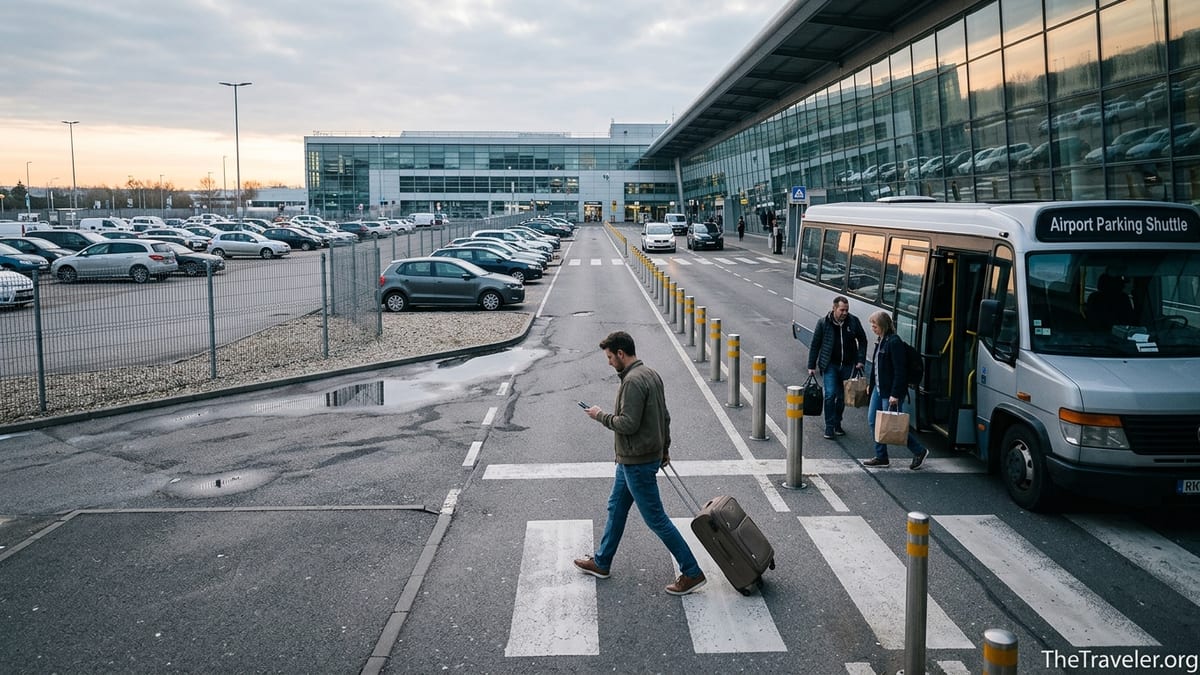
The same applies to service quality. Many ParkVia listings are independent off-airport car parks, sometimes in industrial areas or rough gravel lots rather than multi-level garages. Photographs on the ParkVia listing may show tidy rows of cars and clean shuttle buses, but travelers occasionally arrive to find muddy fields, minimal lighting or improvised reception cabins. Because ParkVia is not physically present, its support team can only act after the fact, usually by contacting the operator or examining whether the service differed from what was advertised.
When you book through any intermediary, you divide the chain of responsibility. With ParkVia, your confirmation email, payment and pre-trip communications come from ParkVia, but access control, staff decisions and any on-site incidents are the responsibility of the local operator. For risk-averse travelers or those parking a high-value vehicle, that is worth weighing against whatever savings ParkVia offers compared with booking directly.
How Pricing Really Works: “Deals” vs Reality
ParkVia markets itself as a way to find the best deal on parking, and sometimes that is true. For instance, a week of parking at a secondary airport such as Milan Bergamo might appear for around 40 to 50 euros on ParkVia when the official airport car park is closer to 70 or 80 euros for similar dates. At busy hubs such as Manchester, Barcelona or Munich, ParkVia often highlights “early bird” or “web only” offers that look significantly lower than the headline rate at official car parks.
Yet “best deal” can be more complex than the headline price per day. Some operators on ParkVia offer very low base rates but add conditions that make them less attractive in real life. One common example is restricted shuttle hours. A car park near a holiday airport might be cheap because its shuttle only operates from 5 a.m. to midnight. If your return flight lands at 1 a.m. after a delay, you could face an expensive taxi ride to retrieve your car. The price looked great on the booking screen but did not account for the practical cost of getting to and from the lot at off-hours.
Another pricing nuance is add-ons at the car park itself. While ParkVia typically shows the total to be paid for the parking period, some independent operators add surcharges on arrival or departure, such as a fee for oversized vehicles, late pickups after a specified time, or mandatory key handling. Travelers who booked a valet-style service at London Gatwick, for example, have reported being asked for extra money because a return time changed or because the operator classified the vehicle as longer than standard. These extras may technically be disclosed in the car park’s own terms, but they are easily missed when you are skimming through multiple options in a hurry.
It is also worth considering that ParkVia’s prices are not always lower than booking direct. Some official airport websites quietly match or beat third-party brokers when you book several weeks in advance. A traveler comparing rates for Dublin or Amsterdam might find that the airport’s own site offers a similar or even slightly better price with clearer policies. ParkVia is strongest where it aggregates many small independent operators, but for official on-airport facilities, the “discount” sometimes disappears once you factor in flexibility or loyalty benefits that only apply to direct bookings.
Cancellation Rules Are Stricter Than Many Expect
In marketing materials, ParkVia often advertises free cancellation on most car parks up to 24 hours before your arrival time. Its help pages state that you need to cancel through your online account or by email, and if you do so more than 24 hours before drop-off you can expect a full refund. That sounds straightforward, which is why a lot of people glance at the message, assume they have flexibility, and move on without reading the details that apply to their chosen car park.
Under the surface, though, individual operators can impose stricter rules. ParkVia’s own FAQ notes that a small number of car parks charge their own cancellation fees, which are then reflected in the Manage My Booking section. Some “non-refundable” or “advance saver” options shown on airline-branded ParkVia pages, such as on a British Airways or Transavia co-branded portal, offer no refund at all if you cancel or change your plans, even if you do so weeks before arrival. Others require more than 24 hours’ notice, for example 7 days before the start time, to qualify for a full refund.
Real-world problems often arise in edge cases. If your airline cancels a flight or rebooks you a day later, ParkVia’s standard position is that changes to onward travel do not entitle you to a refund. The cancellation policy page spells out that refunds are not normally given when flights or cruises are canceled, missed shuttle buses or late arrivals force you to use another car park, or you simply do not show up. That can feel harsh if you are already dealing with the stress of disrupted travel and assumed that flexible parking would follow flexible flights.
Timing is another subtle point. ParkVia measures your cancellation notice period from when its system receives your request, not from when you decide to change plans. If you submit an email request at midnight local time but customer service only opens it late the next morning and your arrival is within 24 hours, it could fall inside the “no refund” window. ParkVia itself advises customers to cancel through the “My Account” or “Manage My Booking” section, where the system timestamps your request immediately, but many travelers do not realize the difference until it is too late.
Voucher, QR Codes and Access: The Practical Friction Points
On paper, ParkVia’s access process is simple: book online, receive a confirmation email and voucher, then present that voucher or QR code at the car park entrance or reception. In practice, a surprising number of complaints center around the very first and very last few minutes of the parking experience, when you need the technology and instructions to work flawlessly while you are racing the clock.
Some partner car parks use automated barriers that read a QR code from your ParkVia voucher, often in combination with your car’s license plate or a ticket from the machine. If the scanner is slow or the timing is tight, as at busy airport multi-story garages, you may have only a short window to flash two codes in succession. Travelers have described situations where the barrier closed or the machine timed out before they could scan the ParkVia code, leaving them stuck in a queue with cars behind them and no on-site staff immediately visible to help.
Another friction point is the delivery and retrieval of the voucher itself. ParkVia sends confirmations by email and often by SMS, but messages can land in spam folders or be mis-typed. If you arrive at an off-site car park near Barcelona or Faro after an early morning drive and cannot find the email with your booking number, staff may not be able to quickly locate your reservation in their own system. In some smaller independent lots, operators rely on printouts or basic spreadsheets rather than fully integrated systems, so resolving mismatched names, license plates or dates can take precious time.
Language and local practices also matter. Booking in English through ParkVia for a small operator in Italy, Spain or Poland does not guarantee that on-site staff speak fluent English or are fully briefed on ParkVia’s procedures. If you do not follow the exact instructions on the voucher, such as calling a mobile number ten minutes before arrival for meet and greet service, you might find no one waiting at the terminal. From ParkVia’s perspective, the service was available but not used according to the instructions; from your perspective, the process feels confusing and unreliable at precisely the moment you need everything to run smoothly.
Customer Service and Complaints: Who Helps When Things Go Wrong
Because ParkVia is the brand you clicked on and paid, it is natural to contact ParkVia first when something goes wrong. The company lists Manchester contact details and an email address for customer service, and its booking terms explain that complaints should be directed to ParkVia in writing. In many cases, especially simple administrative issues such as duplicate bookings or minor timing errors, support staff can resolve matters by adjusting the booking or issuing a partial refund consistent with the operator’s rules.
The difficulty comes with disputes about the quality of the car park or fees charged on arrival. If you arrive at an off-airport lot serving, for example, Rome Fiumicino and find it very different from the photographs, with crowded rows of cars and unclear security, you might immediately want to cancel and park elsewhere. ParkVia’s terms generally place responsibility for the condition and operation of the car park on the provider. That means ParkVia will usually need to contact the operator, review any evidence such as photos or CCTV and then decide whether a refund or credit is appropriate. This process can take days or weeks, and outcomes vary widely case by case.
Public review sites show a split picture. On Trustpilot, ParkVia has built up a large volume of reviews in languages from English to Spanish and Italian, with many users describing smooth, efficient experiences and others posting sharply critical one-star accounts of missed pickups, unanswered phones or surprise charges. Positive reviews often mention friendly shuttle drivers, quick check-in and good value at airports such as Lisbon, Berlin or Budapest. Negative ones tend to focus on communication breakdowns between ParkVia and specific local operators, especially in peak holiday periods when lots are full and staff are stretched.
Travelers who feel mistreated sometimes attempt to raise the issue through other channels such as airline customer service when they booked via a co-branded page on an airline site. Usually, the airline points them back to ParkVia, since the parking transaction is legally separate from the flight. A few determined customers escalate to consumer protection agencies or small claims courts in their home country when disputes over refunds or alleged damage to vehicles cannot be resolved amicably. Those avenues can work, but they require documentation: photos on arrival and pickup, copies of the ParkVia voucher and any receipts or notes from the operator.
Realistic Expectations: When ParkVia Works Best
Despite the horror stories that circulate online, hundreds of thousands of travelers use ParkVia every year without incident. The platform tends to work best in a narrow but common set of circumstances: when you are flying from a large European airport, booking a standard-size car, and choosing a well-reviewed operator with regular shuttle hours that match your flight schedule. Under those conditions, ParkVia can surface independent car parks that you might not easily find otherwise, particularly in crowded markets such as Barcelona, Lisbon, Milan or Manchester.
Frequent users often report that once they find a reliable car park through ParkVia, they stick with it. For example, a family flying several times a year out of Munich might always choose the same ParkVia-listed lot that runs shuttles every 20 minutes and allows free cancellation up to one day before arrival. They treat ParkVia as a discovery and booking layer, then rely on their own positive history with that specific operator rather than assuming every listing on the platform is equally good.
Where ParkVia is less suitable is for trips with high uncertainty or complex timing. If you are flying long-haul with multiple connections, highly weather-dependent routes, or traveling during strike-prone periods, the risk of disruption to your schedule is higher. In those situations you may value true flexibility and direct accountability over saving a handful of euros. Booking directly with the airport’s official car park, or with a provider that explicitly offers refundable or pay-on-exit options, may be the safer choice, even if the upfront price looks a little higher in comparison.
Another factor is your tolerance for hassle at the margins. Independent off-airport lots often involve waiting for a shuttle, navigating less formal parking areas and accepting slightly more variable service standards. If you are traveling with small children, mobility issues or a lot of baggage, the simplicity of parking in a well-signposted multi-story attached to the terminal, even at a modest premium, can easily be worth it. ParkVia does list some official on-airport options, but its strongest savings will usually be with off-site providers that require more effort.
How to Use ParkVia Safely and Avoid Common Surprises
If you decide that ParkVia fits your plans, there are practical steps you can take to reduce your risk of unpleasant surprises. First, treat each car park listing almost like a separate product. Read recent written reviews, not just star ratings, paying attention to mentions of shuttle reliability, staff responsiveness and any extra fees charged on arrival. If several travelers mention that a particular lot near Lisbon or Berlin is difficult to find or slow to answer the phone, take that seriously even if the price looks appealing.
Second, double check opening hours, shuttle times and key handling requirements before you pay. If you have very early or very late flights, ensure the shuttle runs at those times or that the operator offers a 24-hour service. Some lots require you to leave your keys so they can move cars around while you are away; others let you keep them. If handing over your keys makes you uncomfortable, filter those options out. On the booking form, look carefully at whether payment is collected at the time of booking or on arrival, and whether your rate is marked as flexible or non-refundable.
Third, as soon as you receive your confirmation, download or print the voucher and save a copy offline. Keep the address, directions and any special instructions handy in your phone notes or a travel app. If your booking requires you to call a number ten or fifteen minutes before arrival, set a reminder. On the day of travel, aim to arrive at the car park earlier than you would for an on-site airport facility, especially at unfamiliar airports or during busy holiday weekends.
Finally, document the condition of your vehicle when dropping it off and when collecting it, particularly with meet-and-greet services. Quick photos of all sides, the odometer and the fuel gauge can be invaluable if you later need to dispute alleged damage or unauthorized mileage. If staff ask you to sign any paper on arrival or departure, take a clear photo of it. In the event of a disagreement, this record, combined with your ParkVia voucher and any receipts, gives you a stronger basis for complaint to both the operator and ParkVia, and if necessary to your payment provider.
The Takeaway
ParkVia sits in a gray zone between convenience and complexity. It can genuinely save you money and introduce you to independent car parks that offer perfectly good service at busy airports across Europe. For many travelers, booking through ParkVia is a set-and-forget task that delivers exactly what it promises: a place to leave the car, a shuttle to the terminal and a reasonable bill at the end.
Problems arise when travelers assume that ParkVia is the same as booking directly with the airport, or that all operators on the platform share identical standards and policies. In reality, you are dealing with a marketplace of widely varying providers, connected by a broker whose responsibility is mostly limited to processing your reservation and payment. Cancellation rules, on-site conditions, extra fees and customer service quality can all differ substantially from one listing to another.
Before you click “confirm” on a ParkVia booking, decide what matters most for this trip: lowest possible price, maximum flexibility, ease of access or clear accountability. If you are willing to do a few minutes of extra homework on the specific car park, save copies of your documents and build in some buffer time, ParkVia can be a useful tool in your travel planning. If not, you may be better served by paying a little more for a straightforward, directly booked airport car park where the company that takes your money is the same one that holds your keys.
FAQ
Q1. Is ParkVia a legitimate company or a scam?
ParkVia is a long-established booking platform that partners with many airlines and airports, and the vast majority of bookings proceed without major issues. Problems usually stem from individual car parks’ service or policies rather than from the platform itself, but as with any intermediary, you need to understand who is actually operating the car park you choose.
Q2. Why are some ParkVia car parks so much cheaper than the airport’s own parking?
Prices are lower because many ParkVia listings are independent off-site operators with lower land and operating costs, or because they offer more restrictive conditions such as fixed shuttle hours or stricter cancellation policies. The trade-off is that you may have a longer transfer, less polished facilities or fewer options if your travel plans change.
Q3. What happens if my flight is delayed and I pick up my car late?
If you return later than planned, many operators will simply charge you for the extra time at their published daily or hourly rate, which you usually pay on exit. However, some may impose surcharges for very late pickups or for collecting outside normal hours. It is important to check your specific car park’s terms before you travel so you are not surprised by the final bill.
Q4. Can I get a refund if my airline cancels or changes my flight?
In general, ParkVia’s standard policy is that cancellations or changes to onward travel on flights, cruises or trains do not automatically entitle you to a parking refund. Whether you can get your money back depends on the flexibility of the rate you booked and the individual operator’s rules. Flexible options with free cancellation are safer if there is a higher risk of disruption.
Q5. How do I know if a ParkVia car park is safe and secure?
ParkVia listings usually indicate security features such as fencing, lighting, CCTV or patrols, but these descriptions are provided by the operator. To judge real-world safety, read recent traveler reviews mentioning how the site looks and feels, and consider factors like whether the area is well lit, how vehicles are stored, and whether staff are present around the clock.
Q6. Do ParkVia car parks always run 24-hour shuttles?
No, shuttle schedules vary widely. Some car parks run shuttles around the clock, while others only operate between set times or require you to call in advance for pickup. Always check the operating hours and any call-ahead instructions on your voucher against your actual flight times, especially for very early morning or late-night arrivals.
Q7. Is it better to book ParkVia through an airline website or directly on ParkVia?
Whether you book via an airline-branded page or directly on ParkVia, your contract is effectively with ParkVia and the local operator, not with the airline. Sometimes airlines promote specific deals or bundles, but the core terms are similar. Choose the route that offers the clearest information and the flexibility you need, rather than assuming an airline-branded page adds extra protection.
Q8. What should I do if I arrive at the car park and they cannot find my booking?
First, show your ParkVia voucher with the booking reference, car registration and dates. If staff still cannot locate it, note the names of any employees you speak to, take photos of any signs or rate boards, and keep all receipts if you pay again. As soon as practical, contact ParkVia’s customer service with these details and evidence so they can investigate and, if appropriate, arrange a refund or adjustment.
Q9. Is my car insured when parked through ParkVia?
ParkVia does not insure your vehicle itself. Any cover beyond your own car insurance comes from the individual car park’s policies, if they offer it. Check the operator’s terms for how they handle damage, theft or vandalism, and do not assume that booking through a platform automatically adds extra protection beyond what your regular insurance and the car park’s own conditions provide.
Q10. How can I minimize the risk of problems when using ParkVia?
You can reduce risk by choosing well-reviewed operators, reading the specific car park’s terms, confirming shuttle hours and key handling rules, saving your voucher offline, arriving with extra time, and photographing your car at drop-off and pickup. These simple steps give you more control over the experience and stronger evidence if you later need to raise a complaint.