


The period three months before moving to Germany is the point at which a relocation shifts from intention to execution. Decisions and actions taken in this window determine whether the move is operationally feasible, how disruptive it will be to work and family life, and how quickly a newcomer can function in Germany’s highly regulated environment. The following briefing sets out the key activities, lead times, and dependencies that should be addressed approximately 90 days before departure.
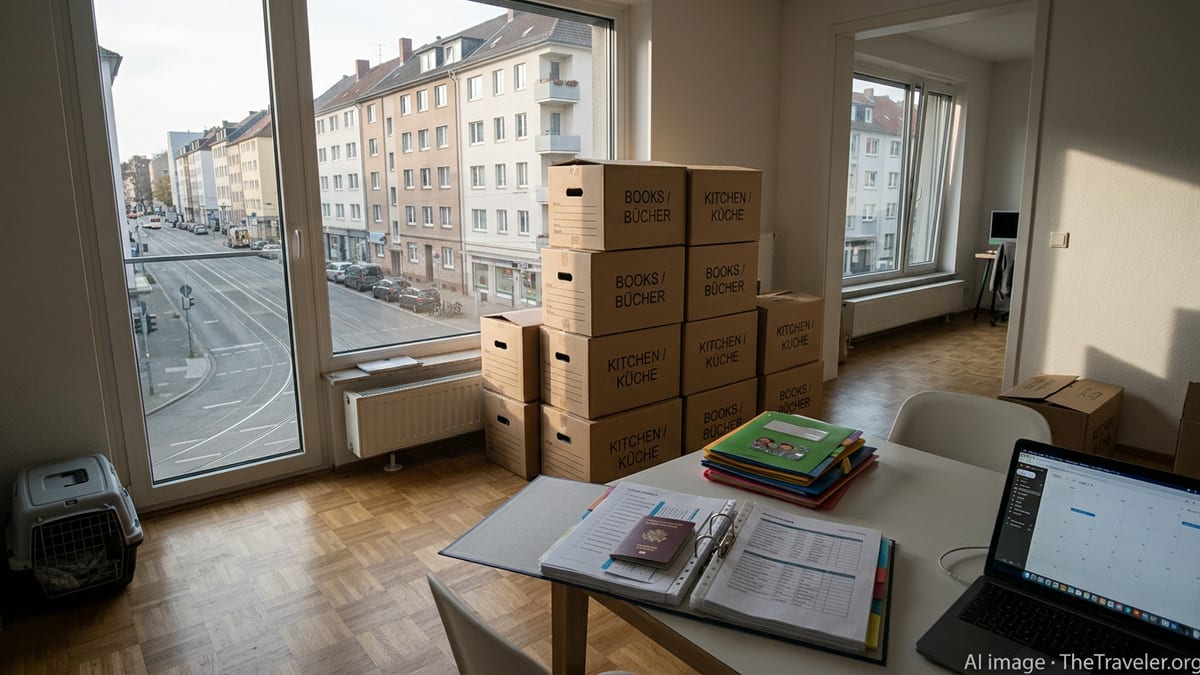
Structuring the Three‑Month Pre‑Move Timeline
Three months before relocation is typically the point where abstract research must convert into a structured plan with dates, responsibilities, and cost estimates. Germany’s administrative systems, landlord expectations, school calendars, and international shipping timetables all work on defined cycles. Missing these cycles can introduce delays of several weeks to several months.
At approximately 90 days before the target move date, most assignees should have a provisional move‑in date in Germany, a likely city of residence, and clarity on whether the move is corporate‑supported or self‑funded. This allows backward planning: shipping bookings, notice periods, school applications, and pet preparations can be sequenced so that critical documents and household goods are available shortly after arrival.
The practical objective of this phase is to eliminate major uncertainties: how and when belongings will arrive, which family members are moving and on what date, where children will be educated, and what budget is required for the first three to six months. The steps outlined below focus specifically on tasks that either must start about three months in advance or are significantly easier if initiated in this timeframe.
Although individual circumstances differ, a structured three‑month plan substantially reduces the risk of gaps such as arriving without essential documents, being unable to take a pet, or facing prolonged periods without furniture or income.
Planning Household Goods Transport and Timing
International shipping to Germany is one of the longest‑lead logistics items and should be addressed no later than three months before departure. Sea freight door‑to‑door from North America or Asia to Germany often ranges from roughly 6 to 12 weeks for a full container and around 8 to 16 weeks for shared consignments, depending on origin, routing, and consolidation times. Air freight is faster, typically around 1 to 3 weeks, but substantially more expensive and usually reserved for a limited volume of priority items.
Three months out, individuals should obtain multiple quotations from international movers, including volume estimates, transit time ranges, insurance options, and any storage fees at origin or destination. For duty and tax relief, many German customs regimes expect proof that household goods have been owned and used for at least several months and that the shipment is linked to a change of primary residence. Some providers specifically note six months of prior use as a typical threshold for importing household goods duty‑free, which affects decisions on purchasing new items shortly before departure.
The timing of shipment collection relative to the departure date is critical. If belongings are collected too early, there may be a gap at origin with no furniture. If collected too late, sea freight may arrive in Germany several weeks after the assignee, requiring temporary furnished accommodation or rental of basic furniture. As a planning guideline, many families target collection around 4 to 6 weeks before their own departure for intercontinental sea freight, and closer to departure for intra‑European moves where transit is shorter.
At this stage, it is also advisable to prepare a high‑level inventory, identify items that cannot be shipped easily (such as large plants, certain electronics, or restricted goods), and decide which personal effects should travel in checked luggage for immediate availability on arrival in Germany.
Document Preparation and Administrative Readiness
German administrative processes are document‑intensive, and reconstructing paperwork from abroad is slow and unpredictable. Approximately three months before moving, individuals should therefore identify, locate, and where necessary legalize or translate core documents that will be required within the first weeks in Germany. These may include birth and marriage certificates, academic diplomas, employment contracts, and custody or guardianship documents for children.
Germany places strong emphasis on official originals or certified copies. Some municipalities or institutions expect documents to be accompanied by sworn translations into German and, in some cases, apostilles or other forms of legalization from the country of origin. As processing times for these steps can run from several days to several weeks, starting them three months out reduces the risk that a missing stamp or translation delays registration, school enrolment, or employment onboarding.
A structured approach is useful. Many relocating professionals prepare a document file divided into sections such as personal identification, education and employment, family and dependants, and property or tenancy contracts. Within each section, documents can be checked for expiry dates, spelling consistency in names, and alignment between passports and other IDs. This is especially important where individuals have multiple nationalities or changed names after marriage.
Finally, three months out is an appropriate time to check the validity of passports and, where required, driver’s licenses. Although the detailed rules for converting foreign licenses to German ones are outside the scope of this article, expired or soon‑to‑expire documents are significantly harder to renew once the holder has left their home jurisdiction.
Children’s Schooling and Education Lead Times
For families, education planning is often the single most time‑sensitive activity three months before moving to Germany. German public schools are generally administered at the state and municipal level, and enrolment is linked to residential catchment areas. International schools and many bilingual schools, by contrast, operate on admission cycles and often require applications several months before the start of the school year.
At around the T‑3 month point, families should have narrowed down a target city or district and should begin direct engagement with potential schools. For state schools, this usually means contacting the local school authority to understand documentation requirements, language‑support options for non‑German speakers, and likely placement based on age and previous schooling. For private and international schools, this phase may involve application forms, entrance assessments, interviews, and payment of registration or deposit fees.
Because Germany’s school year typically starts in late summer, the three‑month lead time has different implications depending on planned arrival. Families arriving close to the start of term need to secure places well in advance. Those arriving mid‑year should clarify whether mid‑term entry is possible and what support exists for students who do not speak German. In both cases, school choices can directly influence residential decisions, as certain schools have long waiting lists and limited transport options.
Practical preparation at this stage includes collecting school reports, vaccination records, and any special needs assessments from the home country. Having these documents available on arrival supports faster placement decisions and a smoother transition for children.
Pets, Health, and Compliance‑Sensitive Timelines
Relocating with pets to Germany involves regulatory requirements that often extend three months or more into the past, making this one of the areas where early action is essential. For dogs, cats, and ferrets entering the European Union from many non‑EU countries, the standard framework includes microchipping, rabies vaccination, and in some cases a rabies antibody (titre) test. Where a titre test is required, regulations typically mandate that the blood sample be taken at least 30 days after vaccination and that at least three months must pass after the sample date before entry. This means that if no prior valid rabies vaccination exists, the full sequence can take roughly four months from the initial vaccination to permitted entry.
Three months before moving, pet owners therefore need to verify the current status of their animal’s vaccinations and, if necessary, start or complete the required sequence with a veterinarian familiar with EU import rules. They should also clarify whether their country of origin is considered higher risk for rabies or other diseases, as this influences whether a titre test and waiting period are required. Airlines and transport companies may have additional carrier‑specific rules, crate standards, and seasonal restrictions that must be planned around.
Beyond regulatory compliance, this period is also the appropriate time to assess whether the pet can realistically travel at the planned time. Factors include the animal’s age, health status, and breed‑specific airline restrictions. If the pet cannot meet entry requirements by the move date, owners must plan either for a delayed relocation of the animal or for temporary care with family or boarding facilities.
On the human health side, the three‑month window is an opportunity to obtain copies of medical records, vaccination lists, and prescriptions. While Germany has a robust healthcare system, continuity of care is easier when new physicians can see prior diagnoses and treatments. Individuals on long‑term medication should discuss with their current doctors how to access an adequate supply for the early months in Germany, when finding and registering with a primary care doctor may take time.
Financial Preparation and Banking Logistics
Although many aspects of German banking will only be finalized after arrival, financial planning three months in advance can significantly reduce friction during the first weeks. Individuals should model their expected cash‑flow needs for the first three to six months, including rent deposits (often equivalent to up to three months’ net cold rent), temporary accommodation, overlapping rent at origin and destination, school fees, and shipping or storage costs.
In practice, this frequently leads to the decision to maintain multiple accounts temporarily: at least one in the country of origin and, if possible, a euro‑denominated account that can be used in Germany from day one. Some international banks and digital providers allow non‑residents to open euro accounts or multi‑currency accounts linked to debit cards. While specific providers are outside the scope of this article, opening such an account before departure can enable payment of initial expenses such as hotel bills or temporary housing in euros without relying solely on foreign‑currency cards.
Three months out is also an appropriate time to review credit limits, international card fees, and the need for additional cardholders. Landlords, relocation agencies, and car rental firms may require deposits or pre‑authorizations that temporarily tie up credit. Ensuring sufficient headroom on at least two separate cards, preferably from different payment networks, reduces the risk of payment issues on arrival.
Finally, individuals should gather financial documentation that may be requested by landlords or service providers in Germany, such as salary statements, employment contracts, or bank reference letters. While detailed credit checks follow German norms and are typically performed after arrival, having clear evidence of income and financial stability can facilitate acceptance for rental housing or service contracts.
Origin Country Off‑Boarding and Overlap Management
The three‑month point before moving to Germany is the optimal moment to map out obligations that must be fulfilled in the origin country and to sequence them relative to the departure date. This includes notice periods for rental housing, utilities, schools, memberships, and employment, many of which require between one and three months’ formal notice. Misalignment between these periods can create cost overlaps where individuals are committed to paying for services they no longer use.
A structured checklist is useful. Typical entries include terminating or transferring mobile phone and internet contracts, closing or freezing gym and club memberships, arranging mail forwarding, and clarifying tax filing obligations for the year of departure. Where household utilities require meter readings or technician visits, these appointments should be booked in advance to align with the handover of the property.
For property owners, three months may be the point at which a decision is made between selling, renting out, or leaving the property vacant. Each option carries different financial and administrative implications that extend well beyond the move date, including possible tax consequences and the need for local property management if the owner is abroad.
Families should also plan social and professional handovers. This includes informing schools, employers, and key contacts of the departure timeline, ensuring that references and certificates of employment can be issued before leaving, and arranging powers of attorney for trusted individuals who may need to sign documents or handle unforeseen issues in the origin country after the move.
The Takeaway
Three months before moving to Germany is the period when planning must become operational. Decisions about what to ship, when to travel, how to manage pets, and where children will study all have long lead times and interdependencies. Addressing these issues at the 90‑day mark significantly reduces the risk of logistical gaps and unexpected costs.
In practice, this phase should produce a dated action plan covering household goods, documentation, education, pets and health, finances, and origin‑country off‑boarding. Each action can then be tracked and adjusted as departure approaches. While some details will inevitably only be finalised closer to the move, establishing this structure three months out provides a realistic basis for assessing whether the planned relocation to Germany is feasible within the desired timeframe.
FAQ
Q1. Why is the three‑month mark important when planning a move to Germany?
Three months before departure aligns with the longest lead‑time items such as sea freight, school applications, pet import rules, and document legalization, allowing enough time to complete them without last‑minute risk.
Q2. How far in advance should household goods be shipped to Germany?
For intercontinental moves using sea freight, many movers indicate typical door‑to‑door transit times of roughly 6 to 12 weeks for full containers and somewhat longer for shared loads, so planning collection around four to six weeks before departure is common.
Q3. Do all documents need to be translated into German before moving?
No, but key documents such as birth and marriage certificates, academic diplomas, and court orders may need sworn translations depending on how they will be used, so it is prudent to clarify requirements and start translations about three months in advance.
Q4. When should families start contacting schools in Germany?
Ideally, families should engage with potential schools around three months before the planned move, or earlier if arriving near the start of the school year, to understand availability, entry requirements, and any assessments or fees.
Q5. Is three months enough time to prepare a pet for entry into Germany?
In many cases it can be, but if a rabies antibody test and three‑month waiting period are required after the blood sample, the full process can exceed three months, so pet vaccination status should be reviewed as early as possible.
Q6. Should a euro bank account be opened before or after moving?
Where possible, opening a euro or multi‑currency account before moving can simplify initial payments in Germany, although a fully local account typically requires completion of address registration and is therefore arranged after arrival.
Q7. What financial documents are useful to prepare three months before moving?
Useful documents include recent salary statements, an employment contract, and where available, letters confirming good standing with banks or landlords, as these can support rental applications and service contracts in Germany.
Q8. How should overlapping commitments in the origin country be handled?
Three months before departure, individuals should list all contracts and obligations with their notice periods and then align termination or transfer dates to minimize paying for housing, utilities, or services that will no longer be used.
Q9. What health‑related preparations are recommended at the three‑month point?
Recommended steps include obtaining copies of medical and vaccination records, reviewing long‑term medication needs with current doctors, and arranging an adequate supply of essential medicines to cover the first months in Germany.
Q10. What is the main risk of delaying planning until closer to the move date?
The main risk is that long lead‑time items such as shipping, schooling, and pet import compliance cannot be adjusted at short notice, which can result in separation from belongings or family members, higher costs, or postponed relocation.