


Ponte alle Grazie is often overshadowed by Florence’s famous Ponte Vecchio, yet for photographers, walkers and anyone who loves river views, it is one of the most rewarding spots in the city. Just a few minutes from the heart of the historic center, this understated bridge offers open vistas of the Arno, classic skyline views, and access to quieter riverside walks that many visitors never find. This guide explains exactly how to use Ponte alle Grazie as your base for the best walks, viewpoints and photo opportunities on both sides of the river.
Get the latest updates straight to your inbox!
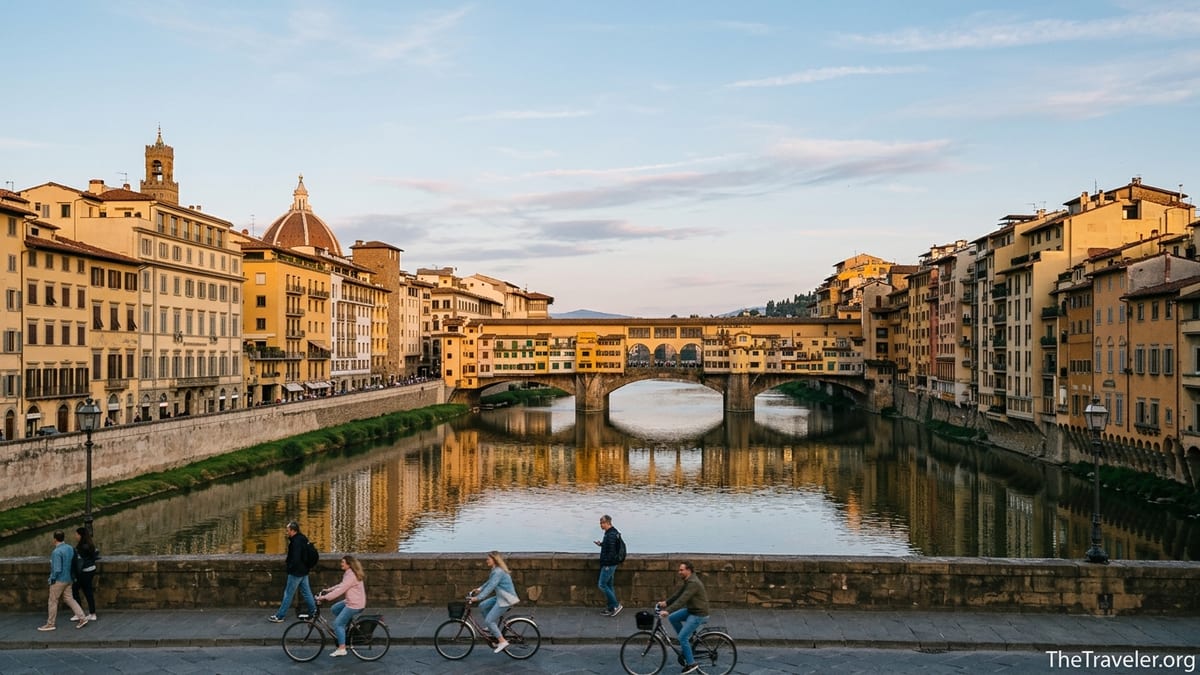
Getting Oriented: Where Ponte alle Grazie Sits in Florence
Ponte alle Grazie crosses the Arno River a short distance upstream from Ponte Vecchio, linking the Santa Croce side of the historic center with the Oltrarno and San Niccolò neighborhoods. On the north side, the bridge connects Via de’ Benci and Lungarno delle Grazie, just a few streets from the Basilica of Santa Croce. On the south side, it runs into Piazza de’ Mozzi and the start of Lungarno Serristori and Lungarno Torrigiani, the quays that lead toward Piazzale Michelangelo and the eastern hills above Florence.
The current bridge is a 20th century reconstruction of a much older medieval structure. The original bridge, known as Ponte di Rubaconte, was completed in the 13th century and was one of the earliest stone bridges across the Arno. It once held houses, towers and even a small chapel, similar in spirit to today’s Ponte Vecchio, before being radically altered and eventually destroyed during the Second World War. Today’s bridge has five concrete arches and a relatively simple profile, but what it lacks architecturally it more than makes up for in the views it offers up and down the river.
For visitors, Ponte alle Grazie is easy to reach on foot. From the Duomo, you can walk down Via del Proconsolo toward Santa Croce, continue to Piazza Santa Croce, then follow Via dei Benci straight to the bridge in roughly 10 to 15 minutes. From the Uffizi Gallery, it is about the same time on foot along the riverside Lungarno. Staying in the Oltrarno near San Niccolò or the lower slopes leading to Piazzale Michelangelo, it is often your most convenient crossing back into the historic center.
Because it sits slightly away from the tight cluster of tourist sights around Ponte Vecchio, Ponte alle Grazie rarely feels crushed with crowds. In high season you may share it with local cyclists, commuters and a steady flow of pedestrians, but there is usually space to stop along the railings, adjust your camera, and wait for the exact light you want without feeling rushed or jostled.
The Classic View: Photographing Ponte Vecchio from Ponte alle Grazie
The main reason many photographers seek out Ponte alle Grazie is its sweeping view of Ponte Vecchio framed by the Arno and the historic skyline. Standing on the western side of the bridge and facing downstream, you get a long perspective that includes the river, the famous goldsmiths’ bridge, the Vasari Corridor and, further back, the tower of Palazzo Vecchio and the dome of the Duomo rising above the roofs. It is a composition that captures several of Florence’s most recognizable landmarks in one frame while avoiding the dense crush of people that you find on Ponte Vecchio itself.
For the most flattering light on Ponte Vecchio, many photographers aim for late afternoon into sunset, especially from spring through early autumn when the sun sets over the city. On clear days, the light warms the stone facades of the bridge and creates reflections in the water that are particularly strong if the Arno is relatively calm. In winter, the sun sets earlier and lower behind the hills, often giving a softer, pastel quality to the scene. If you travel with a tripod, note that Italian cities occasionally restrict their use in very crowded areas, but Ponte alle Grazie is usually relaxed enough that a compact travel tripod does not draw attention, especially if you set up close to the railings and do not block the path.
On most days you can experiment with framing by shifting just a few meters along the bridge. If you move closer to the northern side, you can include more of the Uffizi and the northern lungarno buildings behind Ponte Vecchio. From slightly further south, the Oltrarno facades dominate. Many travelers find that a standard zoom lens in the 24 to 70 millimeter range on a full-frame camera gives enough flexibility to capture both wider context shots and tighter images that focus on Ponte Vecchio itself. Smartphone cameras work well here too, especially newer models with 2x or 3x telephoto lenses that help compress the scene.
Weather can dramatically change this view. After light rain, the stone of the bridge and surrounding palazzi darken and colors become richer, especially if low clouds break to reveal patches of sunlight. In summer, heat haze can soften distant details around midday, which is another reason to favor early morning or evening. Even on overcast days, however, the diffuse light is forgiving for architectural photography, helping avoid harsh contrast between sunlit facades and deep shadow under the arcades.
Best Times of Day and Seasonal Atmosphere
Ponte alle Grazie is one of those locations where the experience changes noticeably throughout the day. Early morning, especially between sunrise and 9 a.m., is usually the quietest period. On clear days you may see warm light on the facades upstream toward San Niccolò, and the river is often at its calmest, giving smooth reflections. Locals walk dogs and cyclists cross to work, but the large tour groups that funnel toward Ponte Vecchio have not yet arrived. This is an excellent time for travelers who want uncluttered images of the river, the north-bank palazzi, or the dome of the cathedral glowing behind the rooftops.
Late morning into early afternoon is brighter and busier. The sun climbs higher and can create strong contrast on the north-facing facades along the river, which may be less flattering for photography but pleasant for a simple riverside stroll. In the warmer months this is when you most notice the difference between Ponte Vecchio and Ponte alle Grazie. While Ponte Vecchio is packed with shoppers, cruise groups and buskers, Ponte alle Grazie often has pockets of open space where you can lean on the stone parapet, snack on a takeaway panino from a nearby deli and watch kayakers or rowers move along the Arno.
Afternoons leading into sunset are the prime time for many visitors, especially from April to October when daylight stretches into the evening. As the sun lowers behind the city, light softens and gradually shifts to warmer tones. On clear evenings you can watch the facades along Lungarno degli Archibusieri and Lungarno Acciaiuoli pick up a golden glow while the sky shifts through oranges and pinks. On partly cloudy days the light can change minute by minute, so it is worth arriving at least 30 to 45 minutes before the official sunset time to watch the progression. Local advice often highlights Ponte alle Grazie as one of the bridges where you can watch the sun set behind Ponte Vecchio and the historic center without standing in a dense crowd.
After sunset, the atmosphere shifts again. Streetlights along the quays and the soft illumination of the bridges reflect in the water, and traffic noise dies down as the evening progresses. If you have a camera that handles low light well or a smartphone with a dedicated night mode, this is an atmospheric moment to capture long exposures of light trails from cars crossing the bridge, or moody shots of the lit arches of Ponte Vecchio downstream. Night is also a good time for couples and solo travelers who want calmer, more reflective walks by the river, with plenty of benches along the nearby lungarni to sit and take in the skyline.
Riverside Walks from Ponte alle Grazie
One of the best ways to use Ponte alle Grazie is as a starting point for slow walks along both banks of the Arno. From the south side of the bridge, you can follow Lungarno Serristori and then Lungarno Cellini toward the east in the direction of Ponte San Niccolò. This stretch is quieter than the north bank and has generous sidewalks, intermittent benches and direct views back to the historic center. On spring and autumn evenings, locals often gather along the low wall overlooking the river, talking, sharing a takeaway drink and enjoying the cityscape without the prices of rooftop terraces.
If instead you turn right after crossing to the south side and follow Lungarno Torrigiani west, you can walk toward the base of the climbs that lead up to Piazzale Michelangelo and the Basilica of San Miniato al Monte. This combination is particularly appealing: watch the light evolve on Ponte Vecchio from Ponte alle Grazie, then continue along the river and climb to Piazzale Michelangelo for a full panoramic view over the city. Many visitors follow this pattern in late afternoon, timing their arrival to the square to coincide with sunset, then descending back via the Rose Garden paths to the river and recrossing at Ponte alle Grazie after dark.
On the north bank, the walk from Ponte alle Grazie west toward Ponte Vecchio along Lungarno delle Grazie and Lungarno Generale Diaz offers a different perspective. Here, you walk with the river on your left and rows of elegant palazzi on your right, many with ground-floor cafes, gelaterie and bars. You can pause at a traditional gelato shop near Santa Croce, then continue gradually to the Uffizi area, watching the arcades of the Vasari Corridor approach. For a longer outing, ambitious walkers can combine this with a loop downstream to Ponte alla Carraia and back, tracing both sides of the river for a few kilometers without ever straying far from the heart of the city.
Travelers staying multiple days in Florence increasingly seek out these riverside walks as a way to balance museum visits and crowded piazzas. A morning might begin with a visit to the Basilica of Santa Croce, followed by a coffee in a nearby bar and a gentle stroll down Via de’ Benci to Ponte alle Grazie. Crossing the bridge, you can continue toward the green slopes below Piazzale Michelangelo or wander the back streets of San Niccolò, where you will find small artisan workshops, wine bars and trattorie that feel more neighborhood focused than the venues around Piazza della Signoria.
Photo Tips and Angles Beyond the Obvious
While the classic downstream view of Ponte Vecchio is the star, Ponte alle Grazie also rewards photographers who look in other directions. Turning upstream toward Ponte San Niccolò, you get a long open view of the river framed by lower, more residential buildings and, in the distance, the hills and towers that mark the eastern edge of Florence. In early morning or on misty autumn days this view can feel almost monochrome, with muted colors and soft edges that suit black-and-white photography or more contemplative travel images.
Looking north from the central span of the bridge, you can compose images that highlight the dome of Santa Maria del Fiore and the bell tower of Palazzo Vecchio rising above the riverside palazzi. This works especially well with a moderate telephoto lens, perhaps in the 70 to 100 millimeter range on a full-frame camera or the telephoto setting on a smartphone, which compresses the distance and makes the skyline feel more layered. Experiment with including elements of the bridge itself in the foreground, such as the stone parapet or a leading line of the sidewalk, to give depth and context.
On the south side, especially at the Oltrarno end of the bridge, you can step slightly away from traffic and photograph the arches and supports of Ponte alle Grazie itself. While the structure is modern, the repeating curves and the reflections in the water can make for strong graphic compositions, particularly in low angled light. Some visitors also like to stand on Lungarno Serristori just east of the bridge, pointing their cameras back to capture Ponte alle Grazie with the northern riverfront buildings behind it.
For handheld shooting at dusk, consider raising your camera’s ISO sensitivity or using your smartphone’s night mode rather than relying solely on long exposures. Street lighting along the bridge and the glow from surrounding buildings provide enough illumination for atmospheric shots without a tripod, especially if you brace your elbows on the parapet. When the Arno is calm, try vertical compositions that include both sky and reflection; when the water is more disturbed, focus on the skyline and bridges instead. Above all, give yourself time. Many of the best images from Ponte alle Grazie come from staying in one place long enough to catch subtle shifts in light, cloud and river traffic.
Pairing Ponte alle Grazie with Nearby Sights and Cafes
One of the pleasures of using Ponte alle Grazie as your base is how easily you can combine it with nearby cultural stops and food breaks. On the north side, you are a short walk from Santa Croce, where you can visit the basilica, pay respects at the tombs of figures like Michelangelo and Galileo, and explore the small leather workshops tucked into the lanes behind the church. Afterward, you might stop at a neighborhood cafe for an espresso at the counter or a simple pastry before wandering down Via dei Benci to the river.
Closer to the water, small bars and gelaterie along Lungarno delle Grazie and the nearby side streets offer casual options for a light lunch or aperitivo. Prices here are often slightly lower than directly on Piazza della Signoria or Piazza del Duomo, especially if you are willing to stand at the bar rather than sit at a terrace table. Travelers on a budget can pick up slices of schiacciata or a takeaway panino from a bakery and eat along the river wall, making Ponte alle Grazie both the dining room and the viewing platform.
On the Oltrarno side, the streets leading from Piazza de’ Mozzi up toward San Niccolò and the base of the hill are lined with wine bars, trattorie and small artisan shops. This is an excellent area for a relaxed evening after sunset on the bridge. You can photograph the last light on Ponte Vecchio from Ponte alle Grazie, then head a block or two into the neighborhood for a Tuscan dinner. Many travelers appreciate that these venues feel less formal and more local oriented than some of the restaurants directly across from the Duomo, with menus that focus on simple dishes like ribollita, pappa al pomodoro and grilled meats.
If you are allocating limited time in Florence, consider grouping your visit to Ponte alle Grazie with a climb to Piazzale Michelangelo or San Miniato al Monte. You might start in the late afternoon at Santa Croce, stroll down to the bridge for golden-hour views of Ponte Vecchio, then continue along Lungarno Serristori and up the steps or ramps to Piazzale Michelangelo for a full city panorama. After sunset, you can descend through the Rose Garden paths and return across Ponte alle Grazie or wander onward to dinner in the Oltrarno. This circuit allows you to experience the river, two different vantage points and both banks of the city in one coherent walk.
Practical Tips: Safety, Crowds and What to Expect
From a practical standpoint, Ponte alle Grazie is straightforward and generally safe to visit at most hours of the day. The sidewalks are reasonably wide, though you should remain aware of cyclists and occasional scooters using the bridge. In peak travel months such as May, June and September, expect a steady flow of pedestrians crossing between Santa Croce and the Oltrarno, but not the shoulder-to-shoulder crowds that can make local bridges feel overwhelming. As with any urban area, keep your camera bag zipped and valuables secured, especially if you are distracted by shooting long exposures or adjusting settings near the parapet.
Weather conditions along the river can be slightly cooler and breezier than in the narrow streets of the historic center. In spring and autumn, bringing a light jacket or scarf for sunset is wise, even after a warm afternoon. In high summer, the exposed nature of the bridge means midday sun can be strong, so a hat, sunscreen and water bottle are useful if you intend to linger. Many visitors schedule their longest stays on the bridge to morning and evening to benefit from both softer light for photography and more comfortable temperatures.
Flooding and river levels occasionally affect the look of the Arno, especially after periods of heavy rain in the hills. When the water runs high and fast, reflections are less pronounced, and the river can appear more turbulent and opaque. This does not usually limit access to the bridge itself, but it is part of the visual character of the scene. On rare days of intense summer heat, haziness can reduce visibility of distant hills and soften details, making black-and-white or more graphic compositions a creative way to adapt to the conditions.
Transport wise, most visitors reach Ponte alle Grazie on foot. Buses that run along the lungarni may stop nearby, and taxis can drop you on either side of the bridge, but parking in the immediate area is limited and subject to local regulations that change depending on time of day and resident zones. For travelers arriving by bicycle, note that while cycling across the bridge is common, Italian traffic rules still apply, so keeping to the right-hand side and respecting lights and crossings is important both for safety and for blending in with local habits.
FAQ
Q1. Why is Ponte alle Grazie a good place for photos in Florence?
Ponte alle Grazie offers a long, open view of Ponte Vecchio and the historic skyline, with fewer crowds than many central spots and ample space to frame the river, bridges and domes in a single scene.
Q2. What is the best time of day to visit Ponte alle Grazie for photography?
Early morning provides quiet conditions and calm reflections, while late afternoon into sunset gives warmer light on Ponte Vecchio and the riverfront buildings, making both times ideal for different moods.
Q3. How do I get to Ponte alle Grazie from the Duomo area?
From the Duomo, walk down Via del Proconsolo to Piazza Santa Croce, continue along Via dei Benci, and you will reach the north end of Ponte alle Grazie in about 10 to 15 minutes on foot.
Q4. Is Ponte alle Grazie very crowded like Ponte Vecchio?
Compared with Ponte Vecchio, Ponte alle Grazie is usually much quieter. You will see regular foot and bicycle traffic, but it rarely feels packed, even in high season.
Q5. Can I see the Duomo from Ponte alle Grazie?
Yes. Looking north from the bridge you can see the dome of Santa Maria del Fiore and the tower of Palazzo Vecchio rising above the riverside buildings, especially on clear days.
Q6. Is it safe to visit Ponte alle Grazie at night?
The bridge and surrounding lungarni are generally busy with locals and visitors in the evening and feel reasonably safe, though normal city precautions with bags and cameras still apply.
Q7. Are there good places to eat or drink near Ponte alle Grazie?
Yes. On the Santa Croce side you will find cafes, bars and gelaterie along nearby streets and lungarni, while the Oltrarno side offers wine bars and trattorie in the San Niccolò area a short walk away.
Q8. Can I combine a visit to Ponte alle Grazie with Piazzale Michelangelo?
Many travelers do exactly that, walking from the bridge along the south bank toward the ramps and steps that lead up to Piazzale Michelangelo for a wider panorama before returning via the Rose Garden or San Niccolò.
Q9. Do I need special camera equipment to photograph from Ponte alle Grazie?
No. A smartphone or basic camera is enough. A standard zoom or telephoto lens helps tighten the view of Ponte Vecchio, and a small tripod is useful for night shots but not essential.
Q10. Is Ponte alle Grazie accessible for travelers with limited mobility?
The bridge itself is level with sidewalks on both sides and curb ramps at the ends, so it is broadly accessible, though cobblestones and occasional uneven surfaces on nearby streets may require extra care.