


For most city breaks and beach holidays, a standard travel insurance policy is more than enough. But as soon as your plans involve high-altitude mountains, remote jungles, polar cruises or politically unstable regions, the calculus changes. In those environments, what matters most is not a lost suitcase. It is who will coordinate a helicopter at dawn on Kilimanjaro, a medevac jet out of rural Nepal, or an extraction if protests turn violent in your destination. That is the niche where Ripcord Rescue Travel Insurance is designed to operate, and where it can make sense to pay more than you would for a mainstream policy.
Get the latest updates straight to your inbox!
What Ripcord Actually Is, And How It Differs From Standard Insurance
Ripcord is a brand of adventure-focused travel protection offered by Redpoint Travel Protection, a company that specializes in medical and security evacuation and rescue for travelers far from home. Unlike big, mass-market insurers that mostly expect you to be in cities and resorts, Ripcord is built around the assumption that you might be on a glacier in Alaska, a liveaboard dive boat in Indonesia or a bush strip in Patagonia. Its flagship product for individuals combines emergency evacuation and rescue with more traditional travel insurance benefits such as trip cancellation, medical expense cover and baggage protection.
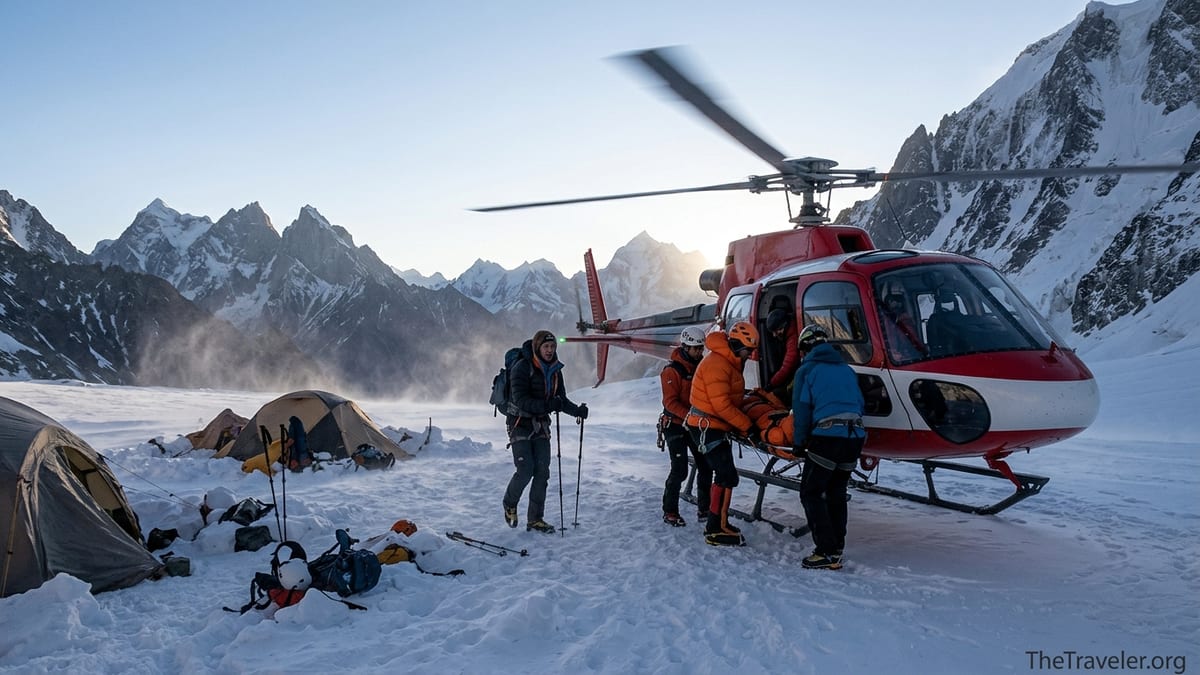
A key distinction is Ripcord’s emphasis on field rescue and evacuation, not just hospital-to-hospital transfers. Many basic travel policies will pay to move you between hospitals once you are in a medical facility, but they do not coordinate or fund the helicopter or overland rescue that gets you off the mountain or out of the jungle in the first place. Ripcord’s marketing and plan summaries highlight search and rescue, medical evacuation to your hospital of choice, and security evacuation in specific crises, which is a core reason adventure travelers consider it.
Ripcord also targets activities that are often excluded or heavily limited elsewhere. Interviews and plan materials highlight coverage for mountain and rock climbing, backcountry skiing, scuba diving and hunting, subject to policy terms. That is very different from many mainstream plans that quietly exclude mountaineering over a certain altitude, off-piste skiing outside marked areas, or diving below particular depths. For an expedition leader booking a 7,000 meter climb or a ski guide running trips in remote British Columbia, those differences can matter more than whether the baggage limit is a few hundred dollars higher either way.
Finally, the pricing and structure reflect the expedition niche. Ripcord is not usually the cheapest option. Quotes for complex trips can be significantly higher than mass-market policies, particularly for older travelers or very expensive expeditions. It is closer to what climbers see from specialist providers such as Global Rescue or IMG’s adventure products than to what you would buy to cover a long weekend in Paris. That premium can be justified, but only when your risk profile and destination match the product’s strengths.
When Paying Extra For Ripcord Actually Makes Sense
The clearest use case for Ripcord is any trip where evacuation and rescue logistics are genuinely difficult. Think of a guided Aconcagua climb out of Mendoza, a remote river expedition in Guyana or a multi-week ski touring trip in Alaska’s Wrangell–St. Elias range. In these settings, you are far from major hospitals, weather can close in fast and local rescue infrastructure may be basic or unreliable. A provider that specializes in coordinating aviation assets, ground teams and international medical transfers is functionally different from an insurer that outsources everything to a generic assistance hotline.
High-altitude climbing is one obvious example. Specialty guides and mountaineering resources discussing insurance costs for expeditions over 6,000 meters routinely list Ripcord alongside Global Rescue as one of the few providers willing to entertain coverage at those elevations, often without the strict altitude caps found in mainstream policies. Approximate sample pricing for multi-week expeditions in the Andes or Himalaya can run from the mid-hundreds to several thousand US dollars per person, depending on age, duration and trip cost. That is not pocket change, but next to a 20,000 to 80,000 dollar Himalayan expedition budget, it is in line with what serious climbers expect to pay.
Remote trekking and adventure travel is another sweet spot. For instance, travelers planning a two-week Kilimanjaro climb plus safari routinely report paying a few hundred dollars for comprehensive policies that specifically include high-altitude trekking and helicopter evacuation as medical benefits. In that price band, Ripcord’s combination of field rescue, evacuation and trip protection is competitive with other high-end options and offers peace of mind for guides who worry about rapidly evacuating clients with pulmonary edema or severe altitude sickness.
Ripcord can also make sense for destinations with limited medical systems or challenging security dynamics. An American family booking a remote-lodge safari in northern Kenya or Tanzania, or a wildlife photographer heading to politically volatile parts of South America, may value a policy that combines emergency medical evacuation with the option for security extraction if unrest escalates. In those scenarios, the additional cost compared with a generic policy is an insurance premium on access to a specialist operations center that deals with complex evacuations as a core business.
Real-World Trip Scenarios Where Ripcord Shines
Consider a 45-year-old climber from Colorado joining a guided expedition to Aconcagua. The trip runs 21 days, costs around 8,000 dollars and ascends to nearly 7,000 meters. On day ten, at about 5,500 meters, the climber develops severe headaches and shortness of breath. The local guide suspects high-altitude pulmonary edema and decides the climber must descend rapidly. Weather is deteriorating, and a ground evacuation to the park entrance would take many hours over rough terrain. With an adventure-focused policy that includes field rescue and high-altitude evacuations, the expedition company can call the insurer’s operations center, request a helicopter once visibility allows and coordinate a direct transfer to a hospital in Mendoza. If the situation worsens, they can then arrange a medical flight back to the traveler’s preferred hospital in the United States once stabilized.
Now compare that to a situation where the same traveler bought a cheaper, mainstream policy that covers emergency medical care and some evacuation but excludes mountaineering over a certain altitude or requires the traveler to be in a hospital before evacuation benefits apply. In the middle of the Aconcagua high camps, the key question is not abstract coverage limits. It is whether anyone will authorize and pay for the helicopter that gets you off the mountain at midnight. That is precisely the gap Ripcord and similar adventure-focused providers are built to fill, provided the activity is within their underwriting appetite.
A second example: a small group of friends books a liveaboard diving trip in Raja Ampat, Indonesia. The vessel is a day or more from the nearest fully equipped hospital, and hyperbaric chambers are few and far between. On the fourth day, a diver surfaces too quickly and shows symptoms suggesting decompression sickness. An adventure-focused policy that combines evacuation and medical benefits can be used to coordinate a rapid transfer by speedboat or helicopter to the nearest chamber, then onward travel to a major medical center if needed. Dive depths, gas mixes and any technical aspects need to match the policy’s terms, but the principle is the same: in remote marine environments, the ability to coordinate multi-step evacuations is crucial.
A third scenario involves security rather than altitude. Imagine a solo traveler on a birding trip in a remote region when large-scale protests erupt in the nearest city, roads are blocked and foreign embassies begin advising citizens to leave. Some high-end policies that partner with evacuation specialists provide a defined “security evacuation” benefit that covers extraction to the traveler’s home country or nearest safe location when certain triggers occur, such as government advisories or civil unrest. While this benefit should never be assumed without reading the fine print, it is another area where a niche company that runs its own 24/7 security operations center can offer more tailored help than generalist insurers.
How Ripcord Compares To Other Adventure-Focused Options
Ripcord does not exist in a vacuum. Adventure travelers also look at providers like Global Rescue, IMG, and high-end policies from AIG or Allianz that include specialist evacuation and adventure sports riders. The exact mix varies: Global Rescue, for example, is often described as primarily an evacuation and rescue membership rather than a traditional insurance product, which means travelers sometimes pair it with separate travel medical or trip cancellation coverage. Ripcord’s flagship offering, by contrast, tends to bundle evacuation, rescue and standard travel insurance under one umbrella, which some travelers find simpler.
On price, Ripcord is usually in the same broad range as other premium expedition products. For a typical two-week high-altitude trekking trip for a traveler under 50, reports suggest comprehensive evacuation plus travel insurance packages often fall somewhere around a few hundred US dollars, depending on trip cost. For long, complex expeditions such as 60-day Himalayan climbs, all of the specialist providers can easily quote into the low thousands per person. In other words, Ripcord is rarely a budget option but is not an outlier within the true expedition insurance market.
Where differences emerge is in underwriting stance and covered activities. Some alpine guide services have publicly noted that certain providers will not cover “the kind of trips” they run, despite marketing language using images of high camps and glaciers. These concerns are not unique to Ripcord and are a reminder that every provider has a threshold for what they consider an insurable risk. For travelers, it highlights the importance of matching your actual itinerary, elevation profile and climbing style with what is explicitly allowed in the policy, rather than assuming all mountaineering imagery means unlimited coverage.
There are also alternatives that combine membership benefits with partial rescue cover, such as national alpine clubs in Europe or the American Alpine Club in the United States, some of which partner with the same underlying evacuation specialists that work with Ripcord. These can be excellent value for climbers who mostly stay within certain regions and only occasionally require full-scale evacuations. However, they often require pairing with separate travel medical insurance and may have comparatively low caps or narrow definitions of what counts as a covered rescue. For big, expensive international expeditions, many climbers still choose comprehensive products from companies like Ripcord because they prefer a single point of contact and higher benefit limits.
Limitations, Fine Print And When Ripcord Is Overkill
For all of its strengths, Ripcord is not a magic shield. There are important limitations and situations where it is either unnecessary or simply the wrong fit. The most basic is geography and eligibility. Certain nationalities cannot buy the product, and pre-existing medical conditions, age and trip length may all affect acceptance and pricing. For instance, Canadian and Australian residents have been explicitly listed in some materials as ineligible for specific Ripcord-branded plans, which means they must look to other providers for adventure-focused coverage.
Activity exclusions and definitions matter just as much. While Ripcord has a reputation for being friendly to mountaineering, rock climbing, and similar pursuits, coverage is always subject to the detailed terms of the policy. There may be distinctions between guided trekking on established routes and unsupported technical climbing, between recreational scuba within standard depth limits and mixed-gas technical diving. Any traveler planning highly technical objectives, such as unclimbed alpine faces or cave diving in remote systems, should expect their itinerary to be scrutinized and should obtain written confirmation that their specific activities are covered.
Ripcord can also be unnecessary overkill for many trips. A weekend of lift-served skiing in Colorado, a hut-to-hut trek in the Austrian Alps on popular trails, or a surf holiday in Costa Rica may be adequately covered by well-chosen mainstream travel insurance plus, where relevant, local alpine club or rescue membership. In these cases, paying a significant premium for a plan built for Himalayan expeditions might not be the most efficient use of your travel budget, especially if your primary concerns are lost gear and flight delays rather than complex evacuations.
Cost is another practical limitation. For young, healthy travelers on moderate-cost trips, an adventure-focused policy can still be relatively affordable. But as age increases and trip costs rise, premiums for comprehensive expedition policies can become significant. There is a point at which the price of insurance begins to materially affect whether an expedition is viable, and not every climber or traveler will decide that a high-end plan is worth the expense. Some experienced alpinists, for example, deliberately self-insure part of their risk, relying on cheaper base policies for routine medical issues and accepting that in a worst-case scenario, they might pay some evacuation costs out of pocket.
Practical Tips For Deciding If Ripcord Is Right For Your Trip
The most useful way to decide whether Ripcord makes sense is to work through your itinerary, risks and alternatives in concrete terms. Start with location. Are you traveling somewhere that lacks reliable helicopter rescue, paved road access or nearby hospitals? A remote off-grid sailing voyage around Greenland, a snowmobile-based ski trip in Arctic Norway or a river expedition in Papua New Guinea raise different questions than a guided hike in Switzerland or a road trip around New Zealand. The more remote and logistically complex your environment, the more a specialist evacuation-focused provider matters.
Next, analyze your activity. Are you trekking on a well-known route like the Inca Trail, or attempting an unclimbed alpine couloir? Are you diving within recreational limits, or planning mixed-gas technical dives on deep wrecks? Many standard policies offer adventure sports riders that comfortably cover trekking up to certain altitudes, recreational diving and on-piste skiing. You only really move into specialist territory when you are above roughly 5,000 to 6,000 meters, far from infrastructure or engaged in inherently hazardous sports that ordinary underwriters are cautious about.
Then, consider cost and consequence. A three-week, 7,000 meter expedition costing 20,000 dollars per person is very different from a 1,500 dollar hiking holiday. If an evacuation could plausibly cost tens of thousands of dollars and your overall trip investment is substantial, paying several hundred to over a thousand dollars for tailor-made protection is defensible. For a budget backpacking trip, it might not be. Talk candidly with your guide service or tour operator about what they have seen in previous seasons: which insurers actually answered the phone at 3 a.m., who funded helicopter rescues without multi-day arguments, and how long evacuations took in practice.
Finally, verify and document everything. If you are booking Ripcord because your guide service recommends it for a specific climb or expedition, ask them for the exact plan name and any altitude or activity notes they have received from the insurer. Before you pay, read the detailed plan summary, including exclusions, definitions of “mountaineering” or “technical climbing,” and the conditions for security evacuation. If anything is unclear, call or email the company, describe your itinerary in plain language, and keep a written record of their responses. In the context of a 10,000 dollar or 30,000 dollar expedition, an hour spent clarifying coverage is a remarkably cheap safeguard.
The Takeaway
Ripcord Travel Insurance is not designed for everyone booking a holiday. It is a specialist solution aimed squarely at people whose trips take them beyond paved roads and into environments where a minor accident can turn into a complex logistical problem. Where it truly makes sense is on high-altitude climbs, remote expeditions, liveaboard dive trips and journeys into regions with fragile healthcare systems or volatile security situations. In those contexts, its blend of field rescue, medical evacuation and travel insurance provides a level of support that generic policies often struggle to match.
At the same time, Ripcord is not a blank check. Eligibility, activity definitions and exclusions all matter, and prospective buyers need to be honest about what they plan to do in the field. For many ski trips, trekking holidays and ordinary adventure tours, a carefully chosen mainstream policy, sometimes paired with regional alpine club rescue membership, will be entirely sufficient. The real decision point is whether your trip falls into the small but important category where a specialist evacuation-focused provider can literally change the outcome of a worst-case scenario.
For adventure travelers planning serious objectives, the right approach is neither to buy the cheapest policy on a price-comparison site nor to assume the most expensive one is automatically best. It is to map your real-world risks against what each policy actually does on the ground, in the dark, in bad weather, when someone is hurt and time matters. If your answers point to remote mountains, long medevacs and complex logistics, that is when Ripcord travel insurance actually makes sense.
FAQ
Q1. Is Ripcord travel insurance worth it for a standard beach vacation?
For a typical beach or city trip with good local hospitals and reliable infrastructure, Ripcord is usually more coverage than you need. A mainstream travel insurance policy that covers medical expenses, trip cancellation and baggage is often sufficient, and significantly cheaper, unless you are adding high-risk activities such as scuba diving in remote areas or backcountry excursions far from help.
Q2. What kinds of trips are the best fit for Ripcord?
Ripcord is best suited to trips where evacuation and rescue are genuinely challenging: high-altitude mountaineering, remote trekking and climbing, liveaboard dive trips, polar cruises, remote safaris and expeditions in regions with limited medical facilities or complex security situations. In those environments, access to specialist evacuation and rescue coordination can matter more than small differences in baggage limits or trip delay benefits.
Q3. Does Ripcord cover high-altitude mountaineering above 6,000 meters?
Ripcord has a reputation for being more open than many mainstream insurers to mountaineering and high-altitude objectives, but coverage always depends on the exact plan and policy wording. Elevation limits, technical difficulty and whether the climb is guided can all be relevant. Before relying on coverage for any expedition above about 5,000 to 6,000 meters, travelers should obtain and read the plan summary carefully and confirm in writing that their specific itinerary and maximum altitude are covered.
Q4. How does Ripcord’s evacuation coverage differ from regular travel insurance?
Many standard policies focus on moving you between hospitals once you are already in a medical facility. Ripcord emphasizes field rescue and evacuation from remote or difficult locations, which can include coordinating helicopters, small aircraft or ground teams to reach you in the field and then arranging onward medical transport. This distinction is crucial for climbers, trekkers and divers in locations where simply reaching a hospital is the hardest part of a rescue.
Q5. Is Ripcord the same as Global Rescue or other evacuation memberships?
Ripcord and companies like Global Rescue operate in a similar space but are structured differently. Some competitors focus mainly on rescue and evacuation memberships, which travelers often pair with separate travel medical or trip cancellation policies. Ripcord’s flagship products tend to bundle evacuation, rescue and traditional travel insurance benefits together. Travelers should compare not just price, but also whether they prefer a bundled solution or a combination of separate evacuation and insurance providers.
Q6. Can I use Ripcord if I am not from the United States?
Eligibility for Ripcord-branded plans depends on your country of residence and other factors. Certain nationalities, including some large markets, have been listed as ineligible for specific products, while others may be able to purchase only particular plan types. Non-U.S. residents should check current eligibility information directly with the provider or a specialist broker before building Ripcord coverage into their expedition planning.
Q7. How much does Ripcord typically cost for an expedition?
Pricing varies by age, trip length, destination, trip cost and coverage level. As a rough guide, comprehensive adventure-focused policies for high-altitude treks or expeditions often cost several hundred dollars per person for trips of two to three weeks, and can rise into the low thousands for long, expensive expeditions such as 60-day Himalayan climbs. While this is more than mainstream policies, it can be a small fraction of the overall expedition budget.
Q8. Do I still need separate travel medical insurance if I have Ripcord?
That depends on which Ripcord product you buy. Some plans focus primarily on evacuation and rescue, while others bundle in travel medical expenses, trip cancellation, baggage and more. Travelers should confirm what is and is not included in their specific plan. If a chosen option does not provide full travel medical coverage, it will usually need to be paired with a separate policy to avoid gaps.
Q9. Are pre-existing medical conditions covered by Ripcord?
Like most insurers, Ripcord has specific rules about pre-existing medical conditions. In some cases, coverage may be available if you meet certain requirements, such as purchasing the policy soon after your initial trip deposit and being medically stable when you buy. Travelers with any history of serious illness, surgery or chronic conditions should discuss their situation with the provider and review the policy’s pre-existing condition clause before purchasing.
Q10. How do I know if my planned activities are actually covered?
The only reliable way is to read the full plan documents and ask direct questions. Describe your itinerary in plain terms, including maximum altitude, type of climbing or trekking, diving depths and whether the trip is guided or unguided. Request written confirmation if you are unsure. Do not rely solely on marketing phrases like “adventure travel” or website photos of climbers. Clear documentation is essential if you ever need to file a claim or request an evacuation.