


Seoul’s Incheon International Airport is no longer a place where you grab a sad sandwich and hope for the best. As one of Asia’s major hubs, it has turned its dining areas into a showcase of Korean flavors and familiar international brands. Whether you want a steaming bowl of kimchi stew before a long-haul flight or a quick ShackBurger between connections, you can now treat a layover at Incheon as a chance for a proper meal rather than just a refuel stop.
Get the latest updates straight to your inbox!
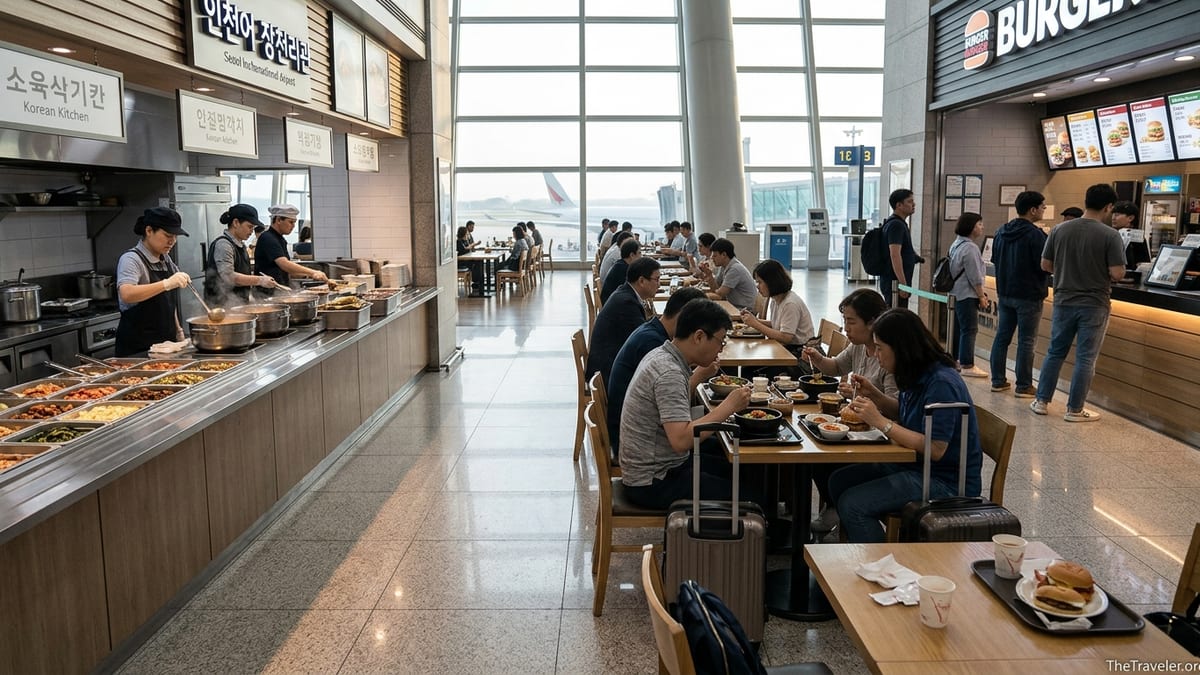
How Incheon Airport’s Dining Scene Is Organized
Incheon International Airport is split into two main passenger terminals, Terminal 1 and Terminal 2, plus concourses and transportation centers below ground. Each has its own mix of food courts, stand-alone restaurants and cafes. For most travelers, the essential distinction is whether you are landside, before security, or airside, after passport control. Serious sit-down Korean meals and larger food courts are concentrated in the public areas and in the main terminal halls, while faster, lighter options cluster around the gates.
Terminal 1, the older and larger building, offers the broadest spread of choices. On the fourth floor you will find a traditional “restaurant street” that feels more like a mall food level than a typical airport, with Korean, Japanese and Western options. Down on the B1 Transportation Center, just above the train platforms, a newer strip of Korean eateries has become a favorite with arriving passengers who want a real meal before boarding the AREX train to Seoul. Several budget-friendly Korean spots and a multi-brand food court are located here, often with simple self-service ordering kiosks.
Terminal 2, home base for Korean Air and SkyTeam partners, has a more modern look and a slightly more curated feel. Dining is spread across the fourth-floor landside area and the airside concourses, with a mix of Korean specialists, trendy chains and a growing list of international brands. A major Korean operator, Lotte GRS, now runs dozens of concessions across both terminals, and in early 2026 the company expanded its Terminal 1 food court with interior design that references hanbok curves and traditional stone walls. This has helped make the terminals feel less like generic transit spaces and more like a soft introduction to Korean culture.
Must-Try Korean Restaurants for a Last Taste of Seoul
If you want your final meal in Korea to feel properly local, start with the Korean-focused restaurants rather than international chains. One of the best-regarded options today is Jayeon Nature, a premium Korean restaurant operated by the Walkerhill hotel group with branches in both Terminal 1 and Terminal 2. Jayeon Nature serves classic dishes such as bulgogi, grilled fish and seasonal banchan in a calmer, hotel-like dining room. Prices are airport-level but still reasonable compared with many international hubs. A typical bulgogi set with rice and side dishes can sit in the range of the equivalent of 15 to 25 US dollars, depending on meat quality and extras.
For something more casual and fast, the B1 Transportation Center in Terminal 1 has become a small cluster of Korean specialists. Recent guides point out Sonsoo Bansang as a reliable example, offering classic home-style sets with rice, soup and multiple banchan. Arriving passengers can roll their suitcase straight off the train escalators and have a tray of grilled mackerel, kimchi stew and rice in front of them within ten to fifteen minutes. Ordering is usually via kiosk with both Korean and English screens. Expect to pay roughly 9 to 13 US dollars for a filling set menu, which is often noticeably cheaper than eating after security.
Korean food courts under brands such as Our Home Food Empire also show up inside the main terminal areas. These typically work like modern Asian food halls. You choose from stalls offering kimchi jjigae, bibimbap, ramyeon or black bean noodles, pay at a central cashier or kiosk, and wait for your number to be called. Reviews note that portions tend to be generous and that you can easily share a stew, a noodle dish and some dumplings between two people without spending much more than 20 to 25 US dollars in total. The trade-off is a noisier environment and more self-service clearing of trays, which many transit passengers find acceptable for the cost savings.
Where to Eat Bibimbap, Stews and Other Korean Classics
Bibimbap is the signature dish many travelers hope to try in Korea, and Incheon Airport reflects that popularity. Various bibimbap-focused counters appear across the terminals, including outlets operated under the Bibigo brand, which is known for fast-casual versions of traditional hot stone dishes. Bowls here typically combine rice, seasoned vegetables, a protein such as beef or chicken and a chili paste sauce on the side. Because portions are designed for travelers, you can usually finish a bowl in twenty minutes and still make it to your gate with time to spare.
Other Korean staples are also easy to find. Many airport restaurants and food-court stalls offer kimchi jjigae, a spicy stew made with fermented cabbage, tofu and pork. It is one of the most warming options if you are flying in winter and need something more substantial than a sandwich. You will also see doenjang jjigae, a soybean paste stew, and simple ramyeon topped with egg or cheese. While you should not expect the complexity of a neighborhood Seoul restaurant, travelers regularly comment that these airport versions are still much better value and more satisfying than typical Western fast food between flights.
If you prefer grilled meats, some sit-down Korean restaurants inside the terminals and hotel-connected complexes near the airport serve simple bulgogi or galbi sets rather than DIY tabletop grilling. For example, hotel restaurants in the nearby Paradise City and major international brands often advertise a “Jeonju-style bibimbap” or beef bibimbap on their all-day menus, sometimes around the equivalent of 20 to 30 US dollars. These venues are useful if you have a long layover and want hotel-level comfort, though they do require going landside and sometimes riding the airport shuttle or maglev.
One detail to remember if you are connecting from a long-haul flight is that spicy dishes at the airport can feel more intense if you are dehydrated. Ordering a milder stew, a non-spicy bulgogi set or a clear soup like seolleongtang can be a safer choice if your stomach is not ready for a chili-heavy meal. Most restaurants will have a few gentler dishes for children or spice-shy travelers, often marked from one to three chili icons on the menu to indicate heat level.
International Chains and Comfort Food Favorites
Not everyone wants kimchi before a twelve-hour flight, and Incheon has responded by adding a wide range of international brands. One of the most talked-about recent arrivals is Shake Shack in Terminal 2, which opened a full branch serving its familiar ShackBurger, crinkle-cut fries and frozen custard. This location also introduced a breakfast menu with items such as Egg N Cheese or Bacon, Egg N Cheese sandwiches and breakfast tots in the mornings. For travelers nervous about trying new foods before boarding, this is a straightforward, familiar option where a burger or breakfast sandwich will feel just like it does in New York or Los Angeles.
Burger chains are well represented across the terminals, with Korean favorites such as Lotteria plus independent burger counters in the larger food courts. In practice, a basic burger meal will usually cost less than a Korean barbecue-style set but more than a simple bowl of ramyeon. Travelers report paying roughly 8 to 12 US dollars for a burger, fries and drink combination. If you value speed over variety, burger and fried chicken counters are often the quickest at peak departure times, particularly in the evening rush.
On top of American-style fast food, you will also find Japanese, Chinese and pan-Asian options like udon, tonkatsu, dumplings and fried rice. Italian-style pasta dishes and pizza slices appear at some Western cafes. While none of these will rival a dedicated restaurant in central Seoul, they are helpful for mixed groups where not everyone wants spicy food. Vegetarian travelers often have better luck at these international counters, where tomato pasta, vegetable pizza or salad bowls may be more readily available than strictly meat-free Korean stews.
For travelers who want to avoid heavy meals altogether, numerous cafes and bakeries sell filled pastries, sandwiches and salads that can double as a light lunch. Korean bakery brands are known for soft milk breads and creative fillings, so you might find items like bulgogi buns, red bean pastries or cream cheese rolls alongside croissants and baguette sandwiches. Picking up two or three bakery items and a coffee can keep you under 10 to 15 US dollars while still giving you a more interesting snack than a packaged airline roll.
Food Courts, Lounges and 24-Hour Options
Food courts remain the workhorse of dining at Incheon Airport. In Terminal 1, the main airside food gardens and landside food courts usually open around 6:00 a.m. and run until late evening, with peak crowds in the morning and late afternoon departure waves. Terminal 2 follows similar hours, though individual outlets may close earlier. Operators have been adding more self-service kiosks and shared seating, which makes it easier to order in English, Chinese or Japanese and then find a table while you wait for your number to be called on overhead screens.
The airport has also been steadily upgrading its lounges, and for some travelers this is now the most pleasant way to eat. Korean Air completed a large renovation program of its Terminal 2 lounges, including new Prestige and Garden lounges that emphasize better dining areas and improved food and beverage selection. In early 2026, a partnership with ramen brand Ottogi even introduced a “ramyun library” concept in one of the premium lounges, allowing passengers to select from a curated range of instant noodles and customize toppings. While access generally requires a business-class ticket, elite status or a paid lounge pass, the improved buffet-style Korean and international dishes can be a good value if you plan to spend several hours working or resting.
Not everyone has lounge access, so around-the-clock options still matter, especially for overnight layovers. Travelers asking about 24-hour dining in Terminal 1 often point to a handful of late-opening cafes and fast-food outlets near the central area and in the transportation zone. Opening hours can change, but it is increasingly common to find at least one coffee shop serving basic pastries and instant noodles deep into the night, and in some cases a fast-food counter operating on a 24-hour or near-24-hour schedule. If you are arriving on a very late flight, check the boards in the terminal for “open” signs rather than assuming every restaurant will still be serving full meals.
In both terminals, note that alcohol service is generally available in sit-down restaurants and some bars, but not every cafe will serve beer or wine. Prices for a draft beer will often sit around the equivalent of 5 to 8 US dollars, similar to what you might pay in central Seoul. Because Korean law and airport rules can limit late-night alcohol sales, do not count on ordering drinks after midnight in every venue, especially on public holidays or during special events.
Practical Tips: Budget, Ordering and Dietary Needs
Compared with many Western airports, food prices at Incheon are high but not extreme. A typical range for a main dish in a sit-down Korean restaurant inside the terminals runs from the equivalent of 9 to 18 US dollars, with hotel-adjacent venues pushing higher for premium beef or seafood. Food-court stalls tend to be on the lower end of that range, while international burger chains sit in the middle. If you are traveling as a family of four and want a proper Korean meal, a realistic budget for main dishes, a shared side and soft drinks might fall between 40 and 70 US dollars, depending on how much everyone eats.
Ordering is increasingly digital. Many restaurants and food-court stalls use touchscreen kiosks, often with language buttons for English and simplified Chinese. You choose your dish, customize spice level or toppings where applicable, pay by card or mobile wallet and receive a ticket. The ticket will show a number that appears on overhead screens or is called over speakers when your food is ready. If you are in a hurry or anxious about the process, watching another customer order first is a simple way to learn the flow without needing to ask staff detailed questions.
Dietary restrictions require some care. Pork, beef and seafood appear in many Korean dishes, and vegetarian or vegan options are still more limited than at some Western airports. If you avoid meat, bibimbap can often be made without beef, but you may need to ask staff to leave out minced meat or egg. The safest choices are usually vegetable bibimbap bowls, simple rice with side dishes, or international salads and pasta. For halal travelers, there are occasionally halal-certified Korean or Middle Eastern counters in the larger food courts, but availability changes, so it is wise to verify signage on-site and treat pre-packaged items with clear labels as a backup.
Travelers with food allergies should be aware that cross-contamination with sesame, soy, seafood and nuts is possible in small kitchens. Menus are improving in terms of allergen labeling, but information may still be basic. When in doubt, sticking to bigger international chains that publish standard ingredient lists, or selecting simpler dishes such as plain rice with grilled fish and kimchi, can reduce risk. Bringing translation cards that list your allergies in Korean can also help staff understand your needs quickly at busy times.
The Takeaway
Incheon International Airport now treats food as part of the travel experience rather than a last-minute necessity. Whether you are after a final bowl of kimchi stew, a carefully prepared Korean set menu or a comfortingly familiar burger, you will find something that fits your taste and schedule in both Terminal 1 and Terminal 2. The mix of hotel-grade Korean restaurants, busy food courts and upgraded lounges gives travelers at almost every budget level a reasonable chance of a satisfying meal.
The key is to match your plans to your connection time. Short layover with a tight boarding window favors quick options in the nearest food court or a grab-and-go bakery. Longer stays justify leaving the secure area for a calmer sit-down restaurant or even a hotel-connected dining room. Whichever route you choose, allow yourself a little extra time to explore. Incheon’s dining scene changes regularly, but the current trend is clear: more attention to Korean flavors, more recognizable global brands and more thoughtful spaces that help you feel like you are already in Korea, not just passing through a generic global hub.
FAQ
Q1. Can I get a proper Korean meal during a short layover at Incheon Airport?
Yes, if you have at least 60 to 90 minutes between flights, you can usually manage a sit-down Korean meal in a terminal restaurant or food court, especially if you head directly to the nearest dining area after clearing security.
Q2. Is it better to eat before or after security at Incheon?
If you want the widest choice and potentially slightly better value, landside options before security offer more variety, but if your time is tight it is safer to eat airside near your gate so you do not risk delays at passport control.
Q3. How expensive is food at Incheon compared with central Seoul?
Meals at the airport typically cost a bit more than similar dishes in the city, but the difference is not extreme, and you can still find filling Korean stews or bibimbap bowls in the equivalent of 9 to 13 US dollars range in many food-court stalls.
Q4. Are there vegetarian or vegan options at Incheon Airport?
Yes, though they are still limited; look for vegetable bibimbap, salads, tomato-based pasta, vegetable pizza or bakery items, and when possible ask staff to leave out meat, egg or fish-based sauces if you follow a strict vegetarian or vegan diet.
Q5. Are there 24-hour restaurants in Incheon Airport?
Opening hours change, but there are usually at least a few late-opening or near-24-hour cafes and fast-food outlets in Terminal 1 and Terminal 2, so you can get basic food overnight even if most full-service restaurants are closed.
Q6. Do I need cash to pay at airport restaurants, or do they take cards?
Most restaurants and kiosks in Incheon Airport accept major credit cards and mobile payment methods, and many do not require cash at all, so you can usually eat comfortably without exchanging large amounts of local currency.
Q7. Where should I go if I want a quieter, more premium dining experience?
Premium Korean restaurants such as Jayeon Nature in the terminals or hotel-connected dining rooms near the airport offer calmer spaces and more elaborate menus, and access to airline lounges can also provide quieter buffet-style dining away from the main crowds.
Q8. Can I find familiar Western chains like burger or coffee shops?
Yes, both terminals feature recognizable international brands including burger chains like Shake Shack in Terminal 2, as well as multiple global-style coffee shops and bakeries serving sandwiches, pastries and espresso-based drinks.
Q9. Is it possible to eat quickly and still make my flight at peak times?
If you are short on time, choose fast-food counters, ramyeon stands or bakeries rather than full-service restaurants, order as soon as you enter the dining area and keep an eye on boarding announcements, as sit-down meals can take longer during peak departures.
Q10. Are menus and ordering screens available in English at Incheon Airport?
Yes, most restaurant menus and self-order kiosks offer English, and staff in busy areas are generally used to serving foreign travelers, so you can usually order by pointing at menu photos or using the language options on touchscreen terminals.