


More news on this day
Operations at Montreal-Pierre Elliott Trudeau International Airport were disrupted on Thursday after an Air Canada jet arriving from Vancouver veered off the paved surface while exiting a runway, prompting a temporary closure and delays, according to early reports and flight tracking data. No injuries were reported among passengers or crew.
Get the latest news straight to your inbox!
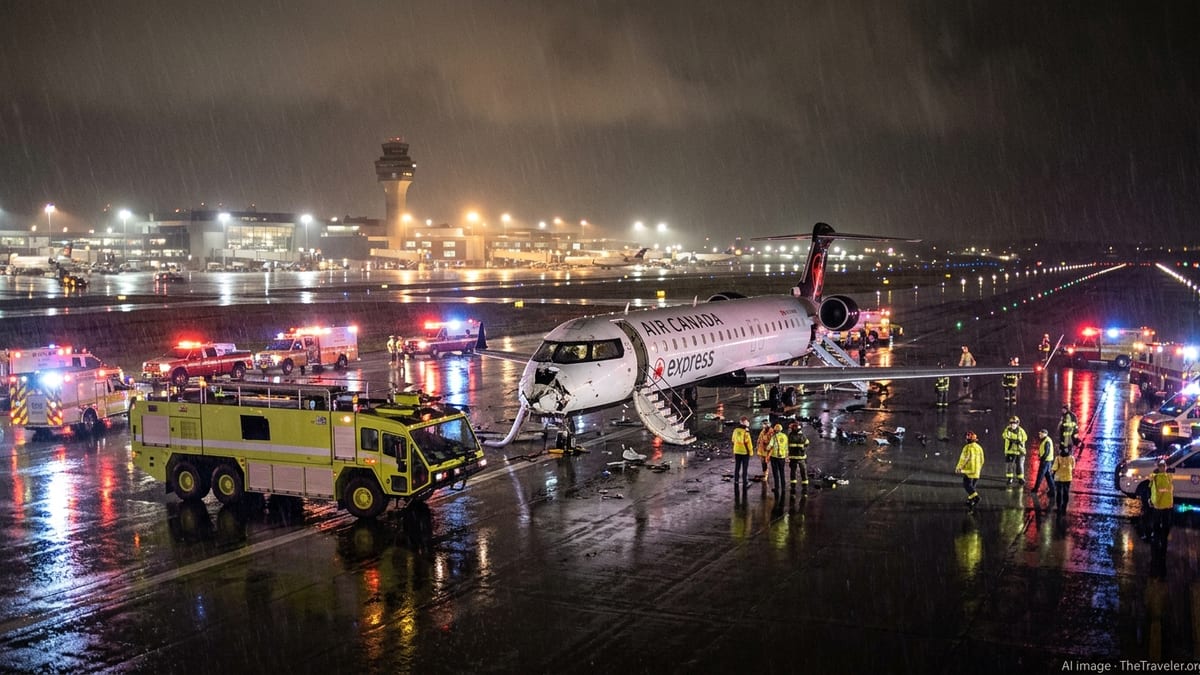
Runway excursion leads to temporary shutdown
Initial information from aviation tracking platforms and eyewitness accounts indicates the incident involved an Air Canada flight arriving at Montreal-Trudeau from Vancouver on Thursday, July 9. The aircraft appeared to leave the paved taxiway and enter the grass while turning off the runway after landing.
Images shared on social media and aviation forums show the aircraft stationary near a high-speed taxiway exit with airport fire trucks and other emergency vehicles positioned nearby. The jet remained upright, with no visible structural damage in early photographs.
Publicly available flight-tracking data suggests that the runway used for landing was taken out of service shortly after the excursion. Arriving flights were seen entering holding patterns or diverting to alternate airports while airport teams assessed the situation and ensured the surface was safe to reopen.
The closure added to an already busy summer travel period at Canada’s second-busiest international gateway, where any disruption can quickly cascade into schedule changes for both domestic and transborder routes.
No injuries reported and aircraft remains intact
Reports from passengers posting online shortly after the landing suggest the event was abrupt but not violent. Travellers described feeling a sharp turn and a swerve before the aircraft came to a stop on the grass adjacent to the taxiway, after which emergency vehicles arrived and the aircraft remained in place for inspection.
There were no immediate reports of injuries among those on board, and information available from public sources indicates the aircraft’s evacuation slides were not deployed. Passengers were reported to be kept on board for a period of time while ground crews inspected the jet and coordinated the next steps.
While full technical details have not yet been released, the absence of reported injuries and the apparent lack of major visible damage suggest the excursion occurred at relatively low speed during the rollout and taxi phase. Such incidents typically focus attention on braking performance, runway or taxiway conditions, and cockpit decision-making in the moments after touchdown.
Air Canada and Montreal-Trudeau airport operators are expected to review onboard data recorders, weather information and crew reports as part of the routine assessment following a runway excursion.
Impact on flights and passenger experience
The temporary runway closure forced adjustments to Montreal-Trudeau’s Thursday schedule, with some arriving flights entering holding patterns and others diverting to nearby airports while the affected runway remained unavailable. Departures using the same runway configuration faced delays as air traffic controllers re-sequenced traffic.
Travellers connecting through Montreal reported missed connections and rebooking queues as airlines worked to reposition aircraft and crews. With many summer flights operating near capacity, re-accommodating affected passengers can be challenging and may extend disruption beyond the day of the initial incident.
Runway availability is a critical factor at Montreal-Trudeau, where regular maintenance and infrastructure projects already limit flexibility on certain days. A sudden closure following an incident often requires rapid coordination between air traffic control, airport operations, airline dispatchers and ground handling teams to maintain safety while restoring throughput.
Passengers are typically advised to monitor their airline’s mobile applications or alert services for updated departure and arrival times when such events occur, as changes can continue even after a runway is formally reopened.
Runway safety in focus after recent high-profile events
The Montreal incident comes in a year when runway safety has drawn renewed attention across North America following several ground collisions and close calls. While the circumstances in Montreal appear less severe, the excursion underscores how quickly routine landings can turn into operational disruptions.
Runway excursions, where an aircraft veers off or overruns the prepared surface, are among the most common types of landing incidents worldwide. They can result from a combination of factors including weather, runway contamination, mechanical issues, or misjudged speeds and braking distances.
Canadian and international safety agencies regularly highlight runway and taxiway incidents as a key area for risk reduction. Investigations into similar events typically examine cockpit workload on approach, communication between pilots and controllers, the condition of the runway and taxiways at the time, and the performance of braking and steering systems.
Although most such occurrences end without serious injuries, they can cause significant damage to aircraft and infrastructure, as well as prolonged closures that affect thousands of travellers.
Next steps and potential investigation
Based on standard practice in Canada, the Transportation Safety Board may review preliminary information about the Montreal runway excursion to determine whether a formal investigation is warranted. Even in cases that do not result in substantial damage or injuries, safety investigators can issue short summaries or recommendations aimed at preventing future occurrences.
Key questions are likely to include the precise point at which the aircraft left the paved surface, the condition of the runway and taxiway, and whether any mechanical or systems anomalies were recorded. Weather data, including wind and runway surface conditions at the time of landing, will also be part of the analysis.
For passengers, the incident may ultimately register as a lengthy and unsettling delay rather than a serious emergency. For aviation regulators, airlines and airports, however, each such event contributes to a larger body of operational data used to refine training, procedures and infrastructure design.
As traffic through Montreal-Trudeau continues to grow, runway safety initiatives and rapid-response protocols remain central to maintaining the reliability that travellers expect from one of Canada’s primary international hubs.