


For many visitors to Great Smoky Mountains National Park, Cosby is the answer to one big question: how do you enjoy the park’s waterfalls and wild trails without the neon and traffic of Gatlinburg and Pigeon Forge? Tucked on the northeastern edge of the park, Cosby feels more like a mountain hollow than a resort town, with small mom-and-pop cabins, forested campgrounds and trailheads just minutes from your porch. This guide breaks down exactly where to stay in and around Cosby if you want cabins, easy trail access and a more peaceful Smokies trip.
Get the latest updates straight to your inbox!
Why Base Yourself in Cosby Instead of Gatlinburg
Cosby sits along Tennessee State Route 32, a quieter entrance to Great Smoky Mountains National Park that feeds directly into the Cosby Campground area, Gabes Mountain Trail and the hike to Hen Wallow Falls. While Gatlinburg and Pigeon Forge are packed with attractions, traffic and bright lights, Cosby feels rural and low-key. There is no strip of chain restaurants, and after dark you are more likely to hear whip-poor-wills than go-karts.
This slower pace is the main reason many Smokies regulars recommend Cosby for visitors who care more about trail time than mini-golf. From most cabins in the Cosby area, you can be at the park’s Cosby entrance in roughly 10 to 20 minutes, then on foot toward Hen Wallow Falls, Snake Den Ridge or the Cosby Nature Trail without ever driving through Gatlinburg. For travelers coming in on Interstate 40 from the north or east, Cosby is also a more direct base than towns further southwest.
Cosby does require some trade-offs. You will not find big resorts, amusement rides or wide restaurant choices minutes from your rental. Groceries, pharmacies and larger services are closer to Newport or Gatlinburg, usually a 25 to 40 minute drive depending on where you stay. If you are comfortable planning a big grocery run at the start of your trip and cooking most meals, Cosby rewards you with darker skies, quieter nights and far less congestion around trailheads, especially on busy weekends.
For many visitors, the ideal plan is to stay in Cosby, spend the bulk of their time exploring local trails and waterfalls, then plan one or two day trips into Gatlinburg or Pigeon Forge for restaurants or attractions. That way you get the full Smokies experience while returning each evening to a cabin where the loudest sound is usually the creek or the wind in the trees.
Staying Inside the Park: Cosby Campground and Tent-Focused Campgrounds
If you want to wake up already inside Great Smoky Mountains National Park, Cosby Campground is your closest option. Tucked under a dense canopy near 471 Cosby Park Road, it offers forested sites within a short walk of trailheads for Gabes Mountain Trail, the Cosby Nature Trail and Snake Den Ridge. The hike to Hen Wallow Falls starts from the picnic area near the campground entrance, so you can leave your car at your site and reach a 90-foot waterfall by mid-morning on foot.
Cosby Campground typically operates as a frontcountry campground with standard tent and RV sites but no hookups. Sites are generally best suited to tents, small trailers and campervans rather than large motorhomes. The atmosphere is quieter than campgrounds closer to Gatlinburg, especially in shoulder seasons like April, early May, late September and October weekdays. Fees change over time, but expect a modest nightly rate compared with commercial RV parks, with reservations strongly recommended during peak periods such as fall foliage and holiday weekends.
Facilities here are simple: picnic tables, fire rings, restrooms with cold water and access to a large picnic area near the trailheads. There are no showers or on-site stores, which helps keep the feel rustic. For many visitors, this trade-off is worth it to walk out of your tent and be on the trail within minutes. It is common for hikers to do an early-morning loop on the Cosby Nature Trail before breakfast, then tackle Hen Wallow Falls or the strenuous climb up Low Gap to the Appalachian Trail later in the day.
Just outside the park boundary you will also find small, tent-focused campgrounds that lean into the “peace and quiet” theme. One example is Shoestring Creek Campground in Cosby, which offers simple cabins and tent sites with no RVs and no hookups, designed for travelers who want forest sounds rather than generator noise. Nightly cabin rates at small outfits like this often start in the low to mid-100-dollar range in shoulder seasons and rise in summer and fall. These campgrounds suit hikers, couples and solo travelers who want a bit of comfort but still prefer a campfire and starry sky to a resort pool.
Creekside Cabins in Cosby: Forest Views and Quick Trail Access
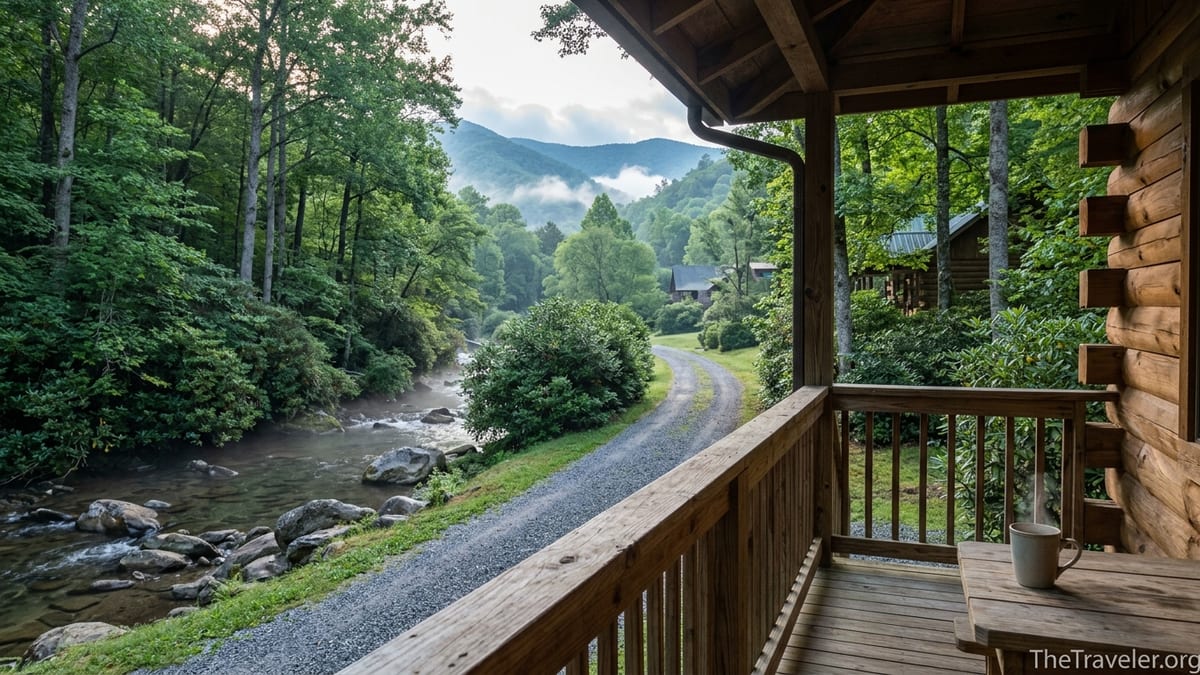
For most visitors seeking peace, the ideal Cosby base is a standalone creekside or ridge-top cabin. These range from rustic one-bedroom log cabins with a woodstove and simple kitchen to modern multi-bedroom homes with hot tubs overlooking the forest. Many cluster along small roads branching off Highway 321 and Highway 32, placing you within a 10 to 25 minute drive of the park entrance while still feeling removed from traffic.
A typical one-bedroom mountain cabin near Cosby might run from around 130 to 200 dollars per night outside of peak dates, rising higher during October foliage or summer holidays. At that price, you can usually expect a full kitchen, a deck or porch, a gas or wood-burning fireplace and Wi-Fi. Larger family cabins with two to three bedrooms, multiple bathrooms and a hot tub often fall in the 250 to 400 dollar per night range, depending on amenities and location. Many of these sit along creeks, so you fall asleep to water sounds instead of road noise.
One advantage of Cosby cabins over rentals closer to Gatlinburg is the likelihood of genuine seclusion. Many properties back onto forest rather than other cabins, and some share private access roads with just a handful of neighbors. It is common to arrive, unload your car and not see another vehicle all evening, even in midsummer. For wildlife watchers, porches often overlook ravines or small clearings where you may see wild turkeys, deer or black bears at a safe distance. As always in bear country, you will need to follow standard food storage rules and never leave trash or coolers outside.
When browsing cabin listings, study maps and descriptions closely. Phrases like “Cosby, Tennessee” can refer to a wide area, and some rentals labeled as Cosby are effectively halfway between Cosby and Gatlinburg. For trail-focused stays, look for homes south of U.S. 321 or along Cosby Highway and Route 32 that specifically mention easy access to the Cosby entrance of the national park or to Hen Wallow Falls and Gabes Mountain Trail. If the listing mentions driving through Gatlinburg to reach the main park, you are likely farther west than you want for a purely peaceful base.
Greenbrier, Pittman Center and Other Nearby Quiet Bases
Cosby itself is small, but the broader area east of Gatlinburg and north of the park offers several other quiet pockets that work well if you want cabin seclusion with slightly more services. Greenbrier, for example, sits along the Middle Prong of the Little Pigeon River and is roughly a 25 to 40 minute drive from Cosby depending on the road you choose. The Greenbrier entrance to the park gives access to river hikes, wildflower walks and less-crowded picnic spots while still keeping you away from central Gatlinburg’s busiest corridors.
You will find a mix of riverside RV parks, small cabin clusters and cottage rentals in these areas, often with direct river access for wading and fishing. A camping cabin at a riverside campground might start around 100 to 150 dollars per night in shoulder seasons, while full-size rental cabins near Pittman Center or along the Greenbrier Road corridor can cost similar amounts to Cosby cabins. These are good options if you want to split your time between Cosby-area hikes like Gabes Mountain and Greenbrier-area trails without relocating mid-trip.
Pittman Center, just east of Gatlinburg along U.S. 321, is another low-profile community favored by travelers who want a quieter base but still need straightforward access to grocery stores and restaurants. From a Pittman Center cabin, you can often reach central Gatlinburg in 15 to 25 minutes for a dinner out, then retreat to a hillside deck afterward. Driving to Cosby’s trailheads from here typically takes 30 to 45 minutes, so it is less convenient if your main goal is hiking Hen Wallow Falls at sunrise but works well for those who want a middle ground between total seclusion and in-town convenience.
When choosing between Cosby, Greenbrier and Pittman Center, consider how much you value quick trail access versus restaurant choices. A traveler who plans to cook most meals and hike daily may be happiest deep in Cosby, while a family who wants a couple of evenings at Gatlinburg attractions might lean toward Pittman Center. Experienced Smokies visitors sometimes book one cabin in Cosby for a few nights of serious hiking, then move closer to Gatlinburg for a night or two focused on dining and shows.
Best Trails and Outdoor Experiences Near Cosby
One major reason to stay in Cosby is the concentration of trails that begin almost at your doorstep. The signature hike is Hen Wallow Falls, a roughly 4 to 4.5 mile round-trip route along Gabes Mountain Trail from the Cosby Picnic Area with around 900 feet of elevation gain. The trail moves through rhododendron thickets and mixed hardwood forest before reaching a tall ribbon waterfall that fans out over mossy rock near the base. In warm months, many hikers pack a picnic to enjoy on boulders downstream of the falls before heading back.
For something shorter and gentler, the Cosby Nature Trail loops through deep forest and along small streams near the campground. It is ideal for families with young children, those adjusting to the Smokies’ humidity or anyone arriving in the afternoon who wants to stretch their legs after a drive. Interpretive signs and footbridges make it a good introduction to the park’s plant life without committing to a long hike.
Stronger hikers often use Cosby as a base for ambitious days out. The Low Gap Trail climbs steeply from Cosby Campground up to the Appalachian Trail, where you can turn toward Mt. Cammerer for expansive views over the Smokies and the Pigeon River Gorge. This is a strenuous outing that typically takes most of a day, but by staying in Cosby you can start early and be back at your cabin or campsite by late afternoon. Snake Den Ridge Trail, starting near Cosby Campground, offers another long, quiet climb toward the park interior with far fewer people than marquee hikes closer to Newfound Gap Road.
Beyond hiking, staying in Cosby opens easy access to scenic drives on back roads toward I‑40, whitewater rafting outfitters on the Pigeon River, and roadside farm stands that appear in warmer months along smaller routes toward Newport and Hartford. Many visitors build a rhythm of hiking in the cool morning hours, returning for a midday rest at the cabin or campground, then taking a short scenic drive or creekside stroll in the late afternoon before dinner on the porch.
What a Peaceful Day in Cosby Looks Like
To picture how staying in Cosby actually feels, imagine waking in a small log cabin above a creek, steam from your coffee visible in the cool morning air. Instead of climbing into the car for a 45-minute battle through highway traffic, your drive to the trailhead is 10 or 15 minutes on empty roads through farm fields and forest hollows. You park at the Cosby Picnic Area, shoulder your daypack and step directly onto Gabes Mountain Trail toward Hen Wallow Falls.
On the way up, you pass a handful of other hikers, mostly couples and families who chose this quieter entrance specifically to avoid crowds elsewhere in the park. Crossing wooden footbridges and passing old stone walls, you reach the falls in late morning, with enough space to sit on a rock, listen to water and have a snack without jostling for a photo spot. By early afternoon you are back at the trailhead and return to your cabin for a late lunch on the deck.
After a rest, you might drive 20 to 30 minutes to a small local restaurant along Highway 321 or Route 32 for a simple dinner, or stay in and cook, using groceries you picked up earlier in the week from larger stores in Newport or Gatlinburg. As dusk falls, the only lights around are likely your porch and a few distant cabins across the valley. On clear nights, skies here can be dark enough to see the Milky Way arching over the ridgeline, something that is harder to appreciate from busier towns filled with streetlights.
Families often find that this pace changes the rhythm of their entire vacation. Without constant car time or lines for attractions, days tend to revolve around shared meals, quiet hikes and evenings with card games or reading by the fire. Couples use Cosby as a base for anniversary trips or low-key elopements, choosing secluded cabins where you can hear owls at night and watch fog lift from the valley each morning. Solo travelers and remote workers sometimes settle in for a week or longer, dividing time between morning hikes and afternoons spent working from a cabin table with the windows open to the forest.
Practical Tips for Booking Lodging in Cosby
Because Cosby is not a large resort hub, availability can be limited at peak times such as June, July and October. It is wise to book several months ahead if you want specific dates, particularly if you need a larger cabin for a family or group. Weekdays usually see more openings and lower rates than Friday and Saturday nights. If your schedule allows, aim for Sunday to Thursday nights in late April, early May or mid-September, when the weather is often pleasant and crowds lighter on most Smokies trails.
When comparing cabins, pay careful attention to driveway descriptions and guest reviews. Many mountain rentals sit at the end of steep, sometimes gravel roads. If you are driving a low-clearance sedan or visiting in winter, look for notes that say “easy access,” “paved all the way” or “suitable for 2WD year-round.” If a listing repeatedly mentions a steep climb or recommends four-wheel drive in certain conditions, treat that seriously, especially during late fall and winter when snow and ice are possible at higher elevations.
Budget realistically for added driving times. Even though Cosby feels close to the park, you may still drive 25 to 45 minutes to reach larger grocery stores, medical care or big-box retailers in towns like Newport, Sevierville or Gatlinburg. For many travelers, this is an acceptable trade-off, but it does mean planning ahead for staples like fuel, firewood, fresh food and any specialty items. Many cabins provide starter supplies of coffee, paper goods and basic cooking oils, but you should not assume a fully stocked pantry unless clearly stated.
Finally, remember that cell service can be patchy around Cosby and in the national park itself. Before you arrive, download offline maps for navigation, hiking apps and any trail guides you plan to use. Print or save confirmation details for your cabin or campsite in case you lose signal before reaching the driveway. Once settled in, lean into the semi-disconnected feel. For many visitors, one of Cosby’s biggest luxuries is the chance to swap constant notifications for humming creeks and cricket sounds.
The Takeaway
Choosing to stay in Cosby rather than in Gatlinburg or Pigeon Forge reshapes your Smokies trip. Your days revolve more around trailheads like Gabes Mountain, Hen Wallow Falls and the Cosby Nature Trail and less around traffic lights and ticket lines. You trade a short list of local restaurants and a longer grocery run for mornings when you are among the first on the trail, and nights when you can hear little more than the wind and the river.
Whether you pick a campsite inside Great Smoky Mountains National Park, a rustic creekside cabin, or a more polished rental in nearby Greenbrier or Pittman Center, the Cosby area gives you that “quiet side of the Smokies” feel without completely disconnecting you from services. It is an especially strong choice for hikers, nature photographers, couples and families who value time in the forest over time in town.
With a bit of advance planning, realistic expectations about driving distances and a willingness to cook more meals at the cabin, Cosby becomes an easy place to settle in for several nights. You arrive, unpack, listen to the creek or the evening cicadas, and quickly understand why so many visitors return to this corner of the park whenever they want the Smokies at their calmest.
FAQ
Q1. Is Cosby a good base for first-time visitors to Great Smoky Mountains National Park?
Yes, Cosby works very well for first-time visitors who are more interested in hiking, waterfalls and quiet time than in amusement attractions. You will be close to excellent trails like Hen Wallow Falls and the Cosby Nature Trail, though you will drive farther for big-box services and major restaurants than if you stayed in Gatlinburg.
Q2. How long does it take to drive from Cosby to Gatlinburg?
Drive times vary with traffic and your exact cabin location, but most visitors should expect roughly 35 to 55 minutes between Cosby and central Gatlinburg. If you are staying deep in Cosby on smaller roads, allow extra time, especially in peak seasons when traffic is heavier near Gatlinburg.
Q3. Are there grocery stores and restaurants in Cosby itself?
Cosby has a handful of small local businesses and eateries, but there are no large supermarkets or big chain restaurant clusters in town. Most travelers do a major grocery run in Newport, Sevierville or Gatlinburg at the start of their stay, then use Cosby-area spots for the occasional meal out or forgotten item.
Q4. What type of lodging is best for a peaceful stay: cabin or campground?
It depends on your comfort level. Cabins provide more privacy, weather protection and amenities like full kitchens and hot tubs while still feeling secluded. Campgrounds such as Cosby Campground or small tent-focused parks offer a closer-to-nature experience with campfires and night sounds, but with simpler facilities. Both options can be very peaceful if you choose locations away from main roads.
Q5. Are the roads to cabins around Cosby difficult to drive?
Some cabins are reached by steep, narrow or gravel roads, while others sit close to main routes with easy access. When booking, read descriptions and reviews carefully and look for notes on driveway steepness or recommendations about four-wheel drive. If you are uncomfortable with mountain roads, focus on properties that advertise paved, less steep access.
Q6. What time of year is best for a quiet trip to Cosby?
Late April, early May, late September and midweek October often balance pleasant weather with fewer crowds compared with peak summer weekends and major holidays. Winter can also be very quiet, but higher-elevation trails may be icy or snow-covered, and some park facilities operate on reduced schedules.
Q7. Can I access popular park highlights from Cosby, like Newfound Gap or Clingmans Dome?
Yes, you can reach major park highlights from Cosby, but drives will take longer than from Gatlinburg. Expect roughly an hour and a half or more of driving each way to places like Newfound Gap or Clingmans Dome, depending on traffic and conditions. Many travelers staying in Cosby plan one or two long day trips to these areas while spending the rest of their time on closer local hikes.
Q8. Is Cosby suitable for families with young children?
Yes, Cosby can be excellent for families, especially those who enjoy nature. Short trails like the Cosby Nature Trail, picnic areas near the campground and easy access to creeks make it family-friendly. However, you will not have walkable amusement attractions, so it suits children who are content with hikes, creeks and cabin time rather than arcades and rides.
Q9. Do I need a four-wheel drive vehicle to stay in Cosby?
Many visitors get around Cosby just fine in standard two-wheel drive vehicles, especially in spring, summer and early fall. Four-wheel drive can be helpful for certain steep cabin driveways or during winter weather, but it is not universally required. Check your specific rental’s access details and consider seasonal conditions when deciding what vehicle to bring.
Q10. How far in advance should I book lodging in Cosby?
For peak times such as June, July and October, it is wise to book several months ahead, especially for popular weekends or larger cabins. For shoulder-season midweek stays or small cabins, you may find options closer to your travel dates, but booking early generally provides better choice and pricing.