


Guavate’s legendary “pork highway” in the Cayey mountains is one of Puerto Rico’s great weekend pilgrimages. Long rows of lechoneras, live music, cool mountain air and views over the Sierra de Cayey make it a tempting stop on almost any island itinerary. Yet most travelers do not actually need to sleep on PR‑184 itself. The smarter question is where it makes sense to base: in San Juan with a rental car day trip, in or around Cayey at 1,500 feet of elevation, or farther south as part of a broader road trip between San Juan and the south coast.
Get the latest updates straight to your inbox!
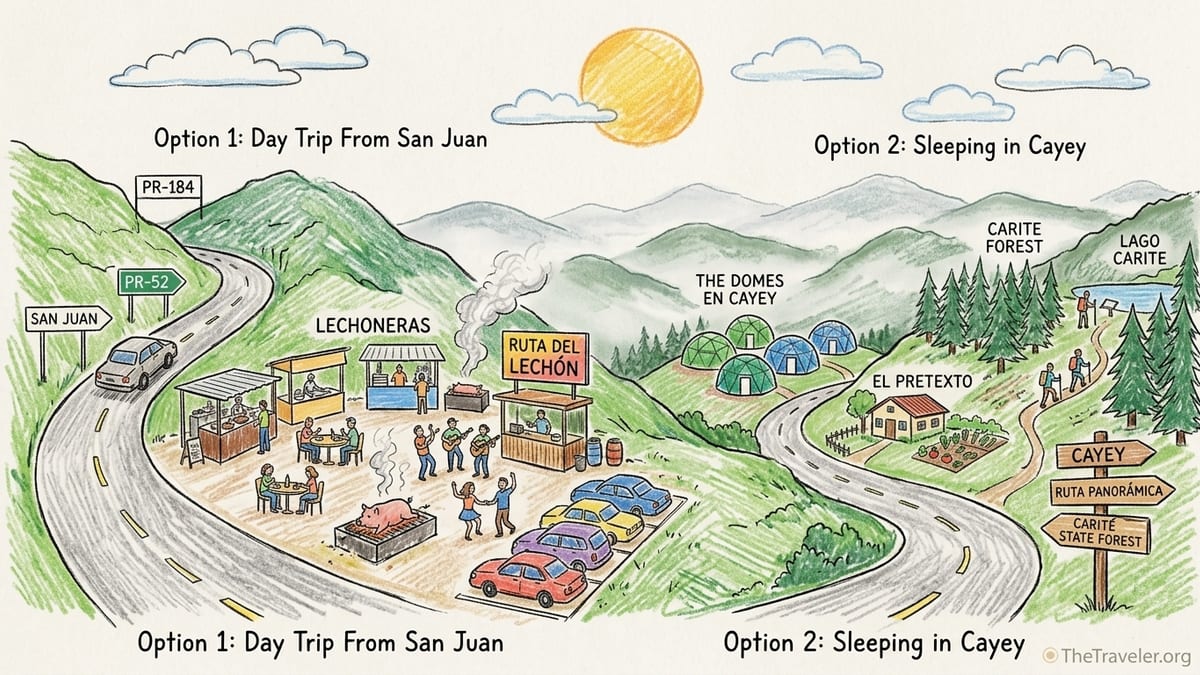
Understanding the Guavate and Cayey Area
Cayey sits in the Sierra de Cayey at roughly 1,500 feet or about 460 meters above sea level, and the Guavate neighborhood climbs even higher along PR‑184 into the Carite highlands. Tourism officials describe Cayey as roughly an hour’s drive from both Luis Muñoz Marín International Airport near San Juan and the city of Ponce under normal traffic conditions, which makes it unusually central for mountain scenery. The area’s reputation rests on its cool weather compared with the coasts, a cluster of lechoneras along the so‑called Ruta del Lechón, and easy access to the Carite State Forest.
Guavate itself is not a single restaurant but a corridor: a winding stretch of PR‑184 lined with pork restaurants, food kiosks and informal bars. Names change as businesses open and close, but staples like Lechonera Los Pinos and El Rancho Original are regularly mentioned by recent visitors for their roast pork, live bands and crowds on weekends. Parking is a mix of small official lots and private properties that charge modest fees, especially on busy Saturdays and Sundays, and street parking near the densest area fills quickly.
The mountain setting is part of the draw. Guavate’s lechoneras sit on a slope between the Caguas Valley and the core of the Sierra de Cayey, with views of pine ridges and misty hills that hint at the nearby Carite Forest. PR‑184 itself continues uphill to connect with the Ruta Panorámica, Puerto Rico’s signed scenic route across the central mountains, which means Guavate can be a simple lunch stop, a full day‑long chinchorreo of hopping between bars and food stands, or a staging point for a longer inland road trip.
Choosing where to stay is less about proximity to a single restaurant and more about your wider plans. The same one‑hour road that delivers San Juan day‑trippers also lets you combine Guavate with a stay in the Caguas Valley, mountain lodges in Cayey, or haciendas and guesthouses along the southern leg of the Ruta Panorámica. To decide between a day trip and an overnight, it helps to look at how Guavate’s atmosphere, driving conditions and restaurant hours shift between daytime and after dark.
Option 1: A Day Trip From San Juan
For most visitors, especially on a first trip to Puerto Rico, basing in San Juan and visiting Guavate as a day trip is the most straightforward strategy. Under normal traffic, the drive from neighborhoods like Condado, Isla Verde or Old San Juan to the Guavate exit on PR‑52 takes around 45 to 60 minutes. From the highway, PR‑184 climbs into the hills for roughly another 15 to 20 minutes, depending on how far you go up the pork highway. The road is paved but narrow and curvy, with frequent speed changes and local traffic on weekends.
A day trip works particularly well if your focus is food and daytime music, not nightlife. Many of the busiest lechoneras open late morning and hit their stride between noon and mid‑afternoon on Saturdays and Sundays, with live bands or DJs and dancing by early afternoon. Several keep serving into the early evening, but energy ebbs as day‑trippers head home. If you leave San Juan in late morning, enjoy a long lunch and a couple of stops, you can still be back in the city before dark, which matters if you prefer to avoid mountain driving at night.
Alcohol is a practical consideration. Guavate’s chinchorreo culture encourages beers, rum drinks and shots alongside generous plates of pork and rice. With a day trip, the safest plan is to designate a driver who drinks minimally or not at all. Local travelers often treat it like any bar‑hopping excursion from San Juan, balancing a full afternoon of food with an early evening return on PR‑52, a divided highway that is considerably easier to drive after dark than the interior mountain roads.
Parking for day‑trippers is manageable with planning. On peak weekends, visitors report that official and private lots near the heart of the pork highway often charge small flat rates, usually just a few dollars in cash, and can fill by mid‑afternoon. Arriving around opening or just after lunchtime gives you a better chance of securing a space close to your chosen restaurant. Because you sleep back in San Juan, you are not dependent on local lodging availability, nor do you need to navigate narrow residential lanes looking for a guesthouse after people have been celebrating for hours.
Morning Atmosphere, Traffic and Safety
One argument for staying overnight in or near Cayey is the morning experience. By 10 a.m., the Guavate corridor still feels relaxed compared with peak lunch hours; mountain mist often lingers over the ridges, and you may find staff setting up grills and music equipment. You can breakfast in town, then arrive early enough to choose your lechonera, wander without crowds and secure front‑row tables before the weekend rush. A San Juan day trip can achieve something similar if you leave the city earlier, but that means an early alarm during what may already be a packed urban itinerary.
Traffic patterns vary sharply by time and day. On popular Sundays and holiday weekends, locals report slow‑moving lines of cars on PR‑184 near the most famous lechoneras, along with congested parking. Police may be present to direct traffic, but maneuvering, especially downhill after rain, can still feel stressful if you are not used to narrow mountain roads. Returning to San Juan means an hour of highway driving after navigating out of this congestion, which can be tiring at the end of a long afternoon of eating and drinking.
Safety on the road hinges largely on visibility, weather and driver fatigue. Mountain showers are common in the Sierra de Cayey, and late‑day rain can leave curves slick. PR‑52 between Cayey and San Juan passes through high ridges with occasional construction zones and truck traffic. While it is a modern expressway, new visitors often feel more comfortable tackling it during daylight, particularly on the northbound return. If anyone in your party plans to drink heavily or you know you tire easily behind the wheel, the equation tilts toward spending the night within 20 to 30 minutes of Guavate.
The flip side is that San Juan offers structured nightlife, pedestrian‑friendly districts and ride‑share options that you do not have in the mountains. A day trip lets you return to the capital for bars in Santurce, music in Old San Juan or a quiet walk on the Condado waterfront, all without needing to figure out rural driving after dark. For many travelers who simply want one plate of lechón, a few photos and a chance to see the pork highway for themselves, sleeping in the city remains the most practical option.
Option 2: Sleeping in Cayey or Nearby Mountain Lodges
Choosing a base in Cayey or its rural barrios gives you cool nights, a slower pace and easy access to Guavate, the Carite State Forest and the scenic segments of the Ruta Panorámica. Tourism officials highlight a handful of distinctive mountain stays near Cayey, including The Domes en Cayey, a small glamping property with solar‑powered geodesic domes tucked into a private hillside, and El Pretexto, a culinary farm lodge built around seasonal dinners and farm experiences rather than walk‑in restaurant service. These sit in the hills rather than directly on PR‑184, preserving a sense of quiet even on busy weekends.
Smaller guesthouses and vacation rentals dot the surrounding ridges. Examples include rural houses marketed as mountain hideaways with Jacuzzis and panoramic views of the Sierra de Cayey, and small inns such as Jajome Terrace in the Jajome area of Cayey. Many of these operate as stand‑alone accommodations without full restaurants, so you will likely still drive into Guavate to eat or into central Cayey for breakfast cafes and bakeries. The trade‑off is waking up to cooler air, birdsong and views rather than city traffic, and being a short, familiar drive from the pork highway for a second round of tasting the next day.
From a practical standpoint, basing in or near Cayey simplifies the drinking and driving question. You can plan a full chinchorreo, moving between several lechoneras and bars along PR‑184 across the afternoon and early evening, and then return to your lodge via a 15 to 30 minute drive on roads you will already have driven in daylight. This still requires a sober or lightly drinking driver, but it reduces the late‑night highway segment between Cayey and San Juan. For large groups renting a whole house in the hills, it also means you can continue your evening on the terrace or by a firepit without worrying about city traffic.
The compromise is nightlife and services. Beyond live music at the lechoneras, Cayey’s evening options are limited compared with San Juan or Ponce. Central Cayey has local bars and casual restaurants, but mountain lodges lean toward quiet nights and stargazing rather than clubs or cocktail bars. If you value mornings in nature and long, cool sleeps, staying local enhances the Guavate experience. If you want to dance until 2 a.m. or hop between multiple urban venues, you may feel constrained once the pork highway winds down.
Access to Carite Forest and the Ruta Panorámica
For travelers interested in hiking or scenic driving as well as food, overnighting in the Cayey area has a clear advantage. Carite State Forest lies in the same mountain range as Guavate, with access roads branching from the higher parts of PR‑184 and the connecting segments of the Ruta Panorámica. The forest protects cloud‑forest ecosystems, reservoirs and bird habitat, and includes picnic areas and short trails near its main recreation zones. Road conditions and open facilities can vary after storms, so it is wise to confirm locally which access points and recreation areas are currently maintained before setting out.
Staying near Cayey makes it realistic to spend a morning in Carite and an afternoon at the lechoneras without feeling rushed. You can start early, when temperatures in the forest are cooler and parking at viewpoints along the Ruta Panorámica is more abundant, then descend toward Guavate for a late lunch as music gets underway. From San Juan this same combination is technically possible in one long day, but much depends on your comfort with several hours of driving in mountain terrain, plus the return to the city in late afternoon or evening traffic.
Travelers following the full Ruta Panorámica across Puerto Rico’s interior often time a night near Cayey to explore the eastern and central segments of the route. Official planning documents note that this scenic network of more than 160 miles of secondary roads crosses the Sierra de Cayey on its way between the southeast and the western mountains, with towns like Cayey serving as reliable stops for fuel, food and lodging. This means a farm lodge or small inn in the Cayey hills can double as both your Guavate base and a practical waypoint on a multi‑day mountain road trip.
Because Carite and the scenic route are subject to changing conditions, from landslides to infrastructure work, overnighting in the area also lets you adapt plans day by day. Local hosts can often advise on which viewpoints are clear, which minor roads are currently in better shape, and where to find open kiosks on quieter weekdays when Guavate itself may be less animated than on weekends.
Option 3: Staying Farther South as Part of a Road Trip
The third approach is to treat Guavate as a stop on a longer journey between San Juan and the south coast, rather than as a day trip or a Cayey‑only base. From San Juan, PR‑52 climbs through the Cayey pass and then descends toward Salinas and Santa Isabel on the Caribbean side of the island. Drivers can exit in the Cayey area for Guavate, enjoy a leisurely lunch and music, then continue south to sleep near the beach or in another mountain town further along the Ruta Panorámica.
For example, a traveler heading from San Juan to Ponce or to coastal stays near Salinas can detour into Guavate around midday, then rejoin PR‑52 after a few hours and complete the drive south in less than an hour under normal conditions. This avoids the need to climb back over the mountains to sleep in San Juan and positions you closer to southern highlights the following day, such as Ponce’s historic center, the dry forest around Guánica or offshore cays reachable from launching points along the south coast.
Another version is to approach Guavate from the south. If you are driving the Ruta Panorámica from east to west, certain segments pass relatively close to Cayey and Carite before dropping down to the coast. You might sleep near Yabucoa or Maunabo, drive the mountainous scenic roads in the morning, loop through Carite and Guavate for an early dinner, then either continue to the Caguas Valley or finish the day in San Juan. In this model, Guavate becomes a flavorful waypoint rather than your main destination.
This road‑trip strategy can reduce late‑night driving through the Cayey highlands because your heaviest eating and drinking fall in midday hours. However, it does require planning around restaurant hours. While specific closing times vary by business and season, many lechoneras concentrate their busier service on weekends and afternoons; relying on a late‑evening weekday visit may leave you with fewer options. If Guavate is a key highlight of your itinerary, ensure you schedule it on a day when multiple restaurants will be open, and leave enough daylight to comfortably reach your next overnight stop to the south or along the mountains.
Parking, Nightlife and Whether Sleeping Nearby Adds Value
Parking is a recurring theme in discussions of Guavate. On peak days, locals report paying modest fees at small private lots along PR‑184 and facing limited street parking close to the best‑known lechoneras. Arriving from San Juan or the south before the main lunch rush mitigates some of this pressure, as does being flexible about walking a short distance along the road from more distant spaces. Travelers who stay in Cayey or nearby lodges can time their visits more strategically, dropping into Guavate once crowds thin in the late afternoon or visiting again the next morning for leftovers and coffee without wrestling with midday gridlock.
Nightlife within Guavate revolves almost entirely around the lechoneras themselves. On busy weekends, some venues host live salsa, plena or merengue bands into early evening, and dancing can continue while kitchens are still serving full plates. Once the grills slow down and the main crowds depart, there is relatively little in the way of standalone bars or late‑night venues along PR‑184. In central Cayey, you will find some local bars and small clubs, but the scene is modest compared with San Juan’s Santurce or Ponce’s historic core. Staying nearby therefore adds value more for slow mornings, mountain atmosphere and convenience than for extended nightlife.
Where overnighting near Guavate makes the biggest difference is for certain types of travelers. Large family or friend groups who rent a whole mountain house gain shared spaces, terraces and kitchens where the celebration can continue after leaving the pork highway. People planning a full chinchorreo, with multiple drinking stops and possibly live music at different lechoneras, reduce their highway time after a long day. Nature‑oriented travelers can connect lechón with hiking in Carite, sunrise views over the Caguas Valley or scenic driving on the Ruta Panorámica without squeezing everything into one fatigue‑inducing loop from San Juan.
On the other hand, if your primary goal is to sample roast pork at one or two famed lechoneras, take photos, listen to a band for an hour and then move on, sleeping in San Juan or on the south coast is often sufficient. The drive times are short enough, under normal conditions, that many Puerto Ricans treat Guavate as a half‑day trip from San Juan, Caguas or Ponce. In those cases, the extra logistics of rural lodging, narrower access roads and fewer evening services around Cayey may not justify a dedicated overnight unless it also serves a broader mountain itinerary.
The Takeaway
Deciding where to stay near Guavate comes down to how deeply you want to experience Cayey’s mountains and how comfortable you feel driving in them after a festive afternoon. A day trip from San Juan fits visitors who want to keep things simple: rent a car, drive roughly an hour to Guavate, enjoy roast pork and music in daylight, then return to the capital for city nightlife, beach walks or an early flight the next day. You trade early‑morning mist and quiet mountain sunrises for the familiarity and services of the metro area.
Staying in Cayey or at a nearby mountain lodge adds value for travelers seeking cooler nights, relaxed mornings, and time in Carite Forest or on the Ruta Panorámica. Lodges like The Domes en Cayey, farm‑focused stays such as El Pretexto, and small rural guesthouses give you access to hiking, viewpoints and a second round of pork without repeating the full drive from San Juan. This option also reduces highway time after drinking, though you still need a responsible driver for the short return from Guavate.
Using Guavate as a waypoint on a broader road trip, particularly between San Juan and the south coast or along the scenic interior, works best for travelers already planning to change bases every night or two. In that scenario, you can time your visit for a long lunch and music, then continue to coastal towns like Salinas or cities like Ponce without retracing your route. You enjoy the pork highway as a highlight among many instead of structuring your entire stay around it.
In practical terms, overnighting nearest to Guavate makes the most sense for large groups sharing a mountain house, anyone plotting a full chinchorreo with multiple bar stops, travelers combining lechón with serious exploration of Carite Forest or the Ruta Panorámica, and visitors who simply prefer to avoid a late, potentially rainy drive back to San Juan or the south coast. For everyone else, especially on a first trip focused on San Juan and a few key excursions, Guavate remains an excellent and very manageable day trip.
FAQ
Q1. Is it better to visit Guavate on a Saturday or Sunday?
Both days can be lively, but Sundays tend to attract more local families and can feel busier along PR‑184. Saturdays may still have music and crowds while sometimes being slightly less congested.
Q2. How long should I plan for a day trip from San Juan to Guavate?
If you leave late morning, a typical visit with lunch, music and a couple of stops runs five to seven hours door to door, including roughly two hours of total driving under normal conditions.
Q3. Do I need to rent a car, or can I use taxis or ride‑shares to reach Guavate?
Ride‑share coverage becomes unreliable in the mountains and regular taxis from San Juan can be expensive for the distance. Renting a car or joining a private tour is generally the most practical approach.
Q4. Are children welcome at the lechoneras in Guavate?
Yes. Many Puerto Rican families bring children, especially at lunchtime. Expect a festive, sometimes loud atmosphere with music and dancing, but not a formal nightclub environment.
Q5. Is parking near the pork highway safe and reliable?
On weekends, a mix of small lots and roadside spaces is usually available, often for a small cash fee. It is wise not to leave valuables visible in the car and to follow any directions from attendants.
Q6. What time of day is best if I want to avoid heavy drinking crowds?
Late morning to early afternoon generally feels more food‑focused and family‑oriented. As the afternoon progresses, the mood becomes more like a party, with more drinking and dancing.
Q7. Can I combine Guavate with a visit to Carite State Forest in one day?
Yes, especially if you stay in or near Cayey. From San Juan it is possible but makes for a longer day of driving. Starting early and checking local road conditions is important.
Q8. Are there vegetarian or non‑pork options in Guavate?
Most lechoneras center their menus on pork, but side dishes like rice, beans, root vegetables and salads are widely available. Some places also serve chicken or other meats; options vary by restaurant.
Q9. Is it necessary to book lodging in Cayey far in advance?
Because many mountain stays near Cayey are small lodges or individual houses, they can book up on popular weekends and holidays. Reserving ahead is strongly recommended if you plan to stay overnight.
Q10. Who really benefits from sleeping near Guavate instead of in San Juan?
Large groups, visitors planning a full day of chinchorreo, travelers combining Guavate with Carite or the Ruta Panorámica, and anyone wishing to avoid a late mountain drive gain the most by staying close.