


Guavate’s Ruta del Lechón has a reputation for massive pork platters, loud music, and some of the best value food in Puerto Rico. But what does a real-world visit actually cost once you factor in fuel, tolls, drinks, desserts, and the temptation to graze your way down Route 184? I tracked every dollar on a recent Guavate day and overnight in Cayey, then compared it with current official pricing so you can plan with clear, concrete numbers.
Get the latest updates straight to your inbox!
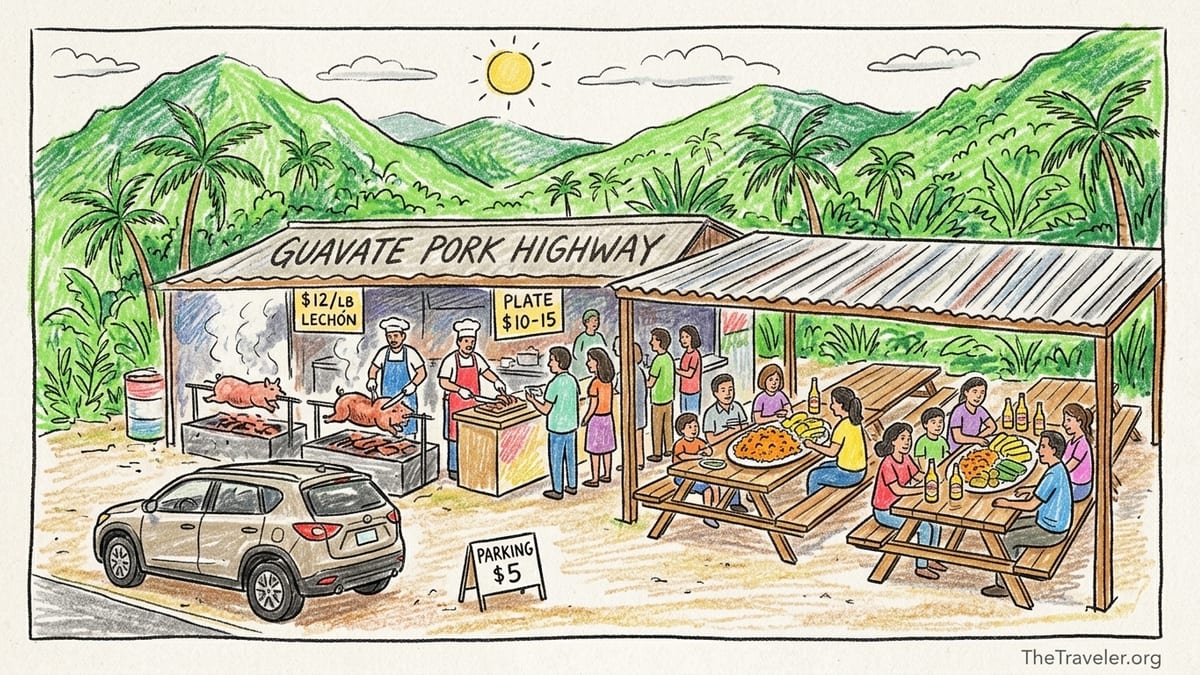
What Lechón Costs Today in Guavate
Before getting into my receipts, it helps to anchor expectations with current pricing. Discover Puerto Rico’s own Guavate guide, updated in 2026, places lechón by the pound along the Pork Highway at roughly 12 to 16 dollars per pound, with very generous combination plates around 10 to 15 dollars including two sides. A broader lechón overview from the tourism board quotes a typical range of 10 to 15 dollars for a plate and 12 to 16 dollars per pound when you order for a group. These official figures line up with posted or verbal prices at the big-name lechoneras like Los Pinos, El Rancho Original, El Nuevo Rancho, El Mojito, and Los Amigos along Route 184.
For context, some independent food writers who visited Guavate in 2025 and 2026 report paying about 14 to 18 dollars per pound of pork and 4 to 6 dollars per side when ordering a la carte at busy weekend spots. That is slightly higher than the tourism board’s guidance but still in the same band, and it reflects how popular venues often charge a small premium while still feeling affordable relative to the amount of food on the plate. Put simply, you can still reliably find a heaping lechón plate, with rice and one side, in the 12 to 18 dollar range in 2026.
These numbers matter because they become the base for any Guavate budget. Once you add drinks, coffees, desserts, and the habit of ordering “just one more” side to share, the difference between a disciplined one-stop lunch and a full chinchorreo-style afternoon jumps quickly. With current pork prices concentrated in that 12 to 16 dollar per pound band, the real variable is not the meat itself but how many times you decide to stop and how much you taste at each counter.
Below, I break down two concrete days I tracked in 2026. All of the firsthand amounts are approximate but based on actual credit card and cash spend in April and June 2026. Prices at your chosen lechonera may differ slightly, but they sit comfortably inside the official ranges quoted above, which makes these examples useful planning benchmarks.
Example 1: A Simple Guavate Lunch From San Juan
The first trip was deliberately restrained. On a Saturday in April 2026, two of us drove a rental car from San Juan to Guavate, had one substantial lunch at a single lechonera, walked around a bit, and then drove back. The idea was to see what Guavate costs if you treat it as a focused lunchtime destination instead of an all-day chinchorreo.
We had already rented a compact car for a few days in San Juan, paying about 40 dollars per day before taxes and insurance from a major airport rental brand. To allocate fairly, I counted 35 dollars of that day’s rental cost to the Guavate outing, since it was the only long-distance drive on that date. The round-trip distance between central San Juan and Guavate via PR 52 and PR 184 is roughly 90 to 100 miles. Using an economy car averaging about 30 miles per gallon and local fuel prices around 4 dollars per gallon in April 2026, fuel attributable to the Guavate trip came to about 12 dollars. Tolls on PR 52 added approximately 6 dollars round trip, paid via the rental’s toll transponder.
Parking at our chosen lechonera was free in an unpaved lot beside the restaurant. Many Guavate spots do not charge for parking, although some small private lots closer to the most crowded sections of Route 184 may ask for a few dollars. We arrived late morning and found space easily, which avoided needing to pay for an overflow lot farther down the road.
At the counter we ordered one pound of lechón to share, a generous scoop of arroz con gandules, a side of yuca al mojo, and two local beers. The pound of pork was priced at 15 dollars in April 2026, which falls right within the 12 to 16 dollars per pound corridor cited by the tourism board. Each side was 4 dollars, which matches the 4 to 6 dollar range for individual sides reported by recent visitors, and the beers were 4 dollars each. With tax and a 15 percent tip, the total for lunch for two came to roughly 42 dollars. Per person, that meant about 21 dollars for more food than either of us could comfortably finish.
What the One-Stop Day Really Cost
When you add together the vehicle and meal portions, the supposedly “cheap” Guavate lunch day added up to more than many visitors expect. On that April 2026 Saturday, I logged around 35 dollars for the share of the rental car, 12 dollars for fuel, 6 dollars for tolls, and 42 dollars for the shared lunch with drinks and tip. That produced a total of about 95 dollars for two people for a half-day excursion built around a single lechonera stop.
Broken down per person, that came to roughly 47 to 48 dollars for what most people would describe as a budget-conscious version of Guavate. Crucially, the largest line item was not the pork itself, which stayed squarely in the official 10 to 16 dollars per pound pattern, but the transportation. Travelers already holding a rental car for the week will not feel that as much, but anyone hiring a car primarily for the Guavate run should mentally treat the vehicle as part of the food budget, not as a separate expense category.
There were small extras that could easily have raised the cost. A roadside coffee on the way back into San Juan would have been about 2 to 3 dollars per person at a bakery near Cayey. A shared slice of tres leches or flan at the lechonera would have added around 4 to 5 dollars, similar to dessert prices listed at Puerto Rican restaurants serving comparable sweets. Because we opted to keep it simple, we skipped dessert, coffee, and any additional stops, which kept the Guavate portion right under 100 dollars for two.
The takeaway from the one-stop example is that Guavate can absolutely be folded into a wider Puerto Rico itinerary as a simple lunch with realistic costs under control. If you already have a rental, commit to one lechonera, share a pound of pork, choose two or three sides total instead of one per person, and limit drinks to one beer or a soda each. You will still experience the essential Ruta del Lechón atmosphere while keeping your per-person outlay roughly in the 30 to 50 dollar band for the full outing from San Juan, depending on how you allocate rental costs.
Example 2: Full-Day Chinchorreo With Carite & Overnight in Cayey
The second example shows how fast costs climb once you turn Guavate into a full chinchorreo day. In June 2026, I organized a weekend overnight built around Route 184: a mid-morning walk near the Carite State Forest area, a swim stop at Charco Azul, multiple lechonera visits through the afternoon, bar time with live music, and a basic guesthouse stay in Cayey to avoid driving back to San Juan late at night.
This time we split costs among four adults. The compact SUV rental, booked from a major chain in San Juan, averaged about 60 dollars per day including taxes and basic insurance in June 2026. Allocating one full day to the Guavate and Carite portion, I count 60 dollars of rental cost toward the trip. The loop from San Juan to Carite, on to Guavate, then down to Cayey for the night and back to San Juan the following day totaled around 130 to 140 miles. With similar fuel prices to the April trip, fuel for the Guavate and Carite day came to roughly 16 dollars. Tolls on PR 52 again added about 6 dollars.
Access to Charco Azul itself was free on that June 2026 visit, but we paid 5 dollars cash per car to park in a small private lot closer to the trailhead. No guide was required, and we did not rent any inner tubes or gear. Travelers using official Carite recreational areas with picnic shelters might encounter modest parking or facility fees; on my visit the only out-of-pocket cost related to the forest and swimming hole was that 5 dollar parking charge split four ways.
Accommodation in Cayey was a clean, no-frills guesthouse just off the highway. For June 2026, the double room rate for two people was 110 dollars per night including taxes. With two rooms for four adults, the total lodging cost was 220 dollars, or 55 dollars per person. That accommodation expense technically covered the night after Guavate, but since the sole reason for staying in Cayey instead of returning to San Juan was to extend the lechonera hopping and enjoy a few drinks safely, it is fair to count it as part of the Guavate-related cost picture.
Itemized Food & Drink on a Lechonera-Hopping Day
Starting mid-morning, we stopped at a small panadería near Cayey for coffee and a light bite before heading up to Carite. Each person had a café con leche for about 2.50 dollars and shared pastries that worked out to around 1.50 dollars per person. Coffee and a snack set each of us back roughly 4 dollars and kept us from arriving at the first lechonera already starving, which is a common budget mistake on chinchorreo days.
Lechonera stop number one was around 1 p.m. at a roadside spot on Route 184 with live salsa and a big open-air dining hall. Here the four of us ordered 2 pounds of lechón at 14 dollars per pound, a tray of arroz con gandules for about 6 dollars, and sides of amarillos and tostones at 4 dollars each. With two sodas at 3 dollars each, the pre-tip subtotal was roughly 49 dollars. Adding tax and a 15 percent tip brought that first Guavate meal to about 57 dollars, or just over 14 dollars per person.
Two hours later, after walking and listening to music at a different lechonera, we convinced ourselves it would be “just a snack” at another big-name venue. The second food stop included 1 pound of lechón at 15 dollars, a portion of morcilla for 5 dollars, a small yuca side at 4 dollars, and three local beers at 4 dollars each. Tax and tip brought this second food round to roughly 40 dollars total, or about 10 dollars per person. At this point, although collectively we had only ordered 3 pounds of pork across two stops, the heaviness of the food meant most of us were comfortably full.
In the early evening we shifted from food to drinks and dessert. At a bar area attached to another lechonera, we ordered a round of rum and cokes at about 7 dollars each plus one non-alcoholic drink at 4 dollars. For four people that round came to roughly 25 dollars with tip. Later, back in Cayey near the guesthouse, we shared two desserts from a café-style bakery, one tres leches and one flan at about 4.50 dollars each, which broke down to just over 2 dollars per person.
Adding Up the Chinchorreo Day Costs
Summing the Guavate-centric day reveals why lechonera hopping, Carite, and an overnight in Cayey can feel like a mini getaway rather than a cheap outing. For transportation, the dedicated day of SUV rental was 60 dollars, fuel was 16 dollars, and highway tolls were 6 dollars. Parking near Charco Azul was 5 dollars. Total transportation and access costs reached 87 dollars. Split four ways, that came to about 22 dollars per person.
Food and drinks, however, were where the chinchorreo character showed up. Morning coffee and pastry averaged 4 dollars per person. The first Guavate meal landed near 57 dollars, the second around 40 dollars, the bar round about 25 dollars, and shared desserts roughly 9 dollars. Combined, food and drink for the day came to approximately 135 dollars, or about 34 dollars per person. Even though we never ordered full plates individually and kept most items to shared portions, simply having multiple stops multiplied the spend.
Finally, accommodation in Cayey added 220 dollars for the two rooms. Divided among four travelers, that was 55 dollars per person. When you total rental, fuel, tolls, Charco Azul parking, all food and drink, and lodging, the grand tally for the Guavate and Carite experience was roughly 442 dollars for four, or about 110 dollars per person. Nearly half of that figure was the guesthouse stay chosen for comfort and safety rather than strict necessity.
These numbers underline how aligned the pork itself still is with the official Discover Puerto Rico range of 10 to 16 dollars per pound and 10 to 20 dollars for combination plates. The real swing factor is the number of times you join the line, order one more side because it looks good behind the glass, and order another round of drinks to stretch the music just a little longer.
How Easily Costs Creep Up When You Add Sides and Stops
Lechón is usually sold either by the pound or as part of a combination plate with rice and one or two sides. The official tourism board guidance of 10 to 16 dollars per pound and 10 to 20 dollars per plate is accurate, but it does not fully capture how extras drive the final bill. In Guavate, nearly every display counter is lined with trays of amarillos, tostones, yuca, pasteles, morcilla, and other specialties. At 3 to 6 dollars per side, it is easy for a table of four to add two or three extra items “just to try,” instantly increasing the ticket by 10 to 15 dollars before tax and tip.
On the June 2026 chinchorreo day, each main food stop began with intention: order one or two pounds of pork to share, rice, and a single side. In practice, once we were at the counter and the staff began describing the options, we tacked on a second side at the first stop and a portion of morcilla at the second. Across two lechoneras, those extra sides and sausage alone accounted for about 19 dollars of the day’s food spend. That figure would have paid for another full plate in line with the tourism board’s 10 to 15 dollar typical plate price.
Hopping between multiple lechoneras compounds the problem. Each new place has a slightly different seasoning style, music atmosphere, or specialty, which encourages “just a taste” even when you are not remotely hungry. For many travelers, especially groups of friends, sampling at several venues is precisely the point of Guavate, and it is worth the added cost. The important thing is recognizing that every new stop essentially resets the baseline of 10 to 20 dollars of food plus drinks per person, even if you stick to shared portions.
Drinks add another quiet layer. Beers along Route 184 still largely hover in the 3 to 5 dollar range, which feels benign for a single drink. A 4 dollar beer at the first lechonera, a 4 dollar beer at the second, and a 7 dollar cocktail later at a bar can quietly turn into 15 dollars per person in beverages before you realize you have essentially matched, or exceeded, the cost of your pork and rice.
Simple Lunch vs Full Guavate Chinchorreo
Comparing these two 2026 visits makes the budget gap clear. The focused Saturday lunch from San Juan, built around a single lechonera visit and no extra coffee or dessert, came to around 95 dollars for two, or roughly 50 dollars per person when you apportion the rental, fuel, tolls, and the one shared pound of pork plus sides and beer. A frugal pair who already has a car and shares more aggressively could get this down into the 30 to 40 dollar per person range, while anyone adding dessert and coffee would likely see it rise closer to 60 dollars.
By contrast, the full chinchorreo day with a Carite walk, Charco Azul parking, multiple lechoneras, bar time, and an overnight in Cayey came out to about 110 dollars per person. Nearly half that was the guesthouse stay at 55 dollars per person, which many travelers will judge as worthwhile for comfort and for avoiding night driving on mountain roads after drinks. Someone living in Puerto Rico who skips the hotel, uses their own car, and sticks to two food stops could realistically keep a Guavate and Carite day closer to 50 or 60 dollars per person, but visitors layering in rentals and lodging will see amounts similar to mine.
From the perspective of the plate in front of you, however, the difference does not feel so large. In both scenarios I was consistently paying amounts that matched the tourism board’s guidance: around 10 to 16 dollars per pound of pork and 4 to 6 dollars per side. The simple lunch day featured one pound of pork split two ways, while the chinchorreo day involved 3 pounds shared by four people. In both cases the actual volume of pork per person was generous, bordering on excessive, which means the cost per calorie and per flavor experience still felt very good value, even as the all-in budget rose due to transportation and lodging.
For travelers deciding which style of visit fits their budget, the tradeoff is straightforward. A simple one-stop lunch gives you most of the essential Guavate flavor at a far lower total cost and leaves the rest of the day free for other activities in San Juan or the central mountains. A full chinchorreo day, especially when combined with Carite and an overnight in Cayey, doubles or even triples the per-person budget but turns Guavate into a full cultural immersion with music, nature, and a slower pace.
What I Would Spend More On, Where I Would Save, And How Much Food Is Enough
Seeing both styles back to back in 2026 reshaped how I would plan my next Guavate trip. The area still offers excellent value relative to portion size, and the official Discover Puerto Rico ranges for lechón and combination plates remain reliable planning tools. What surprised me was how little extra enjoyment came from ordering a third or fourth side dish or an additional pound of pork compared with spending that same money on comfort or variety in other parts of the day.
On a return visit, I would gladly spend more on two things. First, I would put money into a slightly nicer or better-located accommodation in Cayey if I chose the overnight option again. An extra 20 to 30 dollars per person on lodging can mean quieter rooms, better parking, and a more comfortable base after a heavy day of food and drink. Second, I would budget for a guided or better-prepared Carite or Charco Azul experience, perhaps with a local operator that includes transport and clear timing, even if that added another 10 to 20 dollars per person. Structuring the nature portion carefully helps balance out the heaviness of the lechón.
Where I would save is on sheer food quantity and on repetitive sides. Realistically, in Guavate one pound of lechón with two sides is enough for two hungry adults at lunch, especially if you expect to snack later in the afternoon. Three pounds across two or three stops comfortably feeds four adults, particularly when rice, amarillos, and yuca are in the mix. Ordering one full combination plate per person very often leads to leftovers or uncomfortable fullness, which means you are paying for food that your body does not really want. I would also limit sides to one or two per visit, choosing something distinctive at each lechonera instead of repeating the same lineup of rice, amarillos, and tostones everywhere.
If I were optimizing solely for value and enjoyment, my ideal Guavate day in 2026 would be one shared pound of pork with two or three sides and one drink each at a first lechonera, followed by a long walk, music, and perhaps one smaller snack and drink at a second spot. I would schedule coffee and dessert in Cayey town rather than on Route 184 itself, both to spread the spending around and to create a gentle wind-down after the noise of the Pork Highway. That pattern keeps the pork and plate pricing within the official 10 to 16 dollar band while capping the all-in spend to a level that feels rewarding rather than regretful.
FAQ
Q1. How much should I budget per person for a simple Guavate lunch in 2026?
For a basic day trip from San Juan with a rental car already in your plans, a realistic budget is around 30 to 50 dollars per person. That assumes one shared pound of lechón with sides, a drink, fuel and tolls apportioned for the day, and no hotel stay.
Q2. What does lechón itself cost along the Ruta del Lechón right now?
Based on Discover Puerto Rico’s current guidance and recent on-the-ground checks, expect to pay roughly 12 to 16 dollars per pound and about 10 to 20 dollars for large combination plates that include rice and one or two sides.
Q3. How many pounds of lechón are enough for a group?
For most visitors, one pound of lechón plus two sides is enough for two hungry adults at lunch. A group of four typically does well with about 2 to 3 pounds total, especially when you are adding rice, plantains, yuca, and drinks.
Q4. Are there any entrance fees for Carite State Forest or Charco Azul?
On my June 2026 visit, access to Charco Azul itself was free, but I paid 5 dollars cash for parking in a private lot near the trailhead. Official state facilities may occasionally charge small parking or picnic-area fees, so carry a bit of cash.
Q5. How much does an overnight in Cayey typically cost if I stay after Guavate?
In 2026, simple guesthouses or small hotels in or near Cayey often range around 90 to 130 dollars per double room per night, including taxes. My June 2026 stay cost 110 dollars per room, or 55 dollars per person when shared between two people.
Q6. Is Guavate still good value considering recent price increases?
Yes. While fuel, rentals, and some sides have become more expensive, the core lechón pricing remains close to Discover Puerto Rico’s 10 to 16 dollar per pound range. Portions are large, so sharing plates means you still get strong value.
Q7. How many lechoneras should I realistically plan to visit in one day?
For both budget and appetite, two substantial food stops are usually plenty. A third venue works best as a place for music and a drink rather than another full plate of pork and sides.
Q8. Do lechoneras in Guavate charge for parking?
Many have free dirt or gravel lots, especially if you are eating there. On crowded weekends some private lots closer to the action may charge a few dollars, and areas near popular attractions like Charco Azul often ask about 5 dollars per car.
Q9. Can I visit Guavate using rideshare or taxis instead of renting a car?
Rideshare and taxi options to Guavate are limited and can be expensive for the distance involved, especially for the return trip. Most visitors find a rental car or joining an organized tour to be more practical both financially and logistically.
Q10. What is a sensible drink and dessert budget for a Guavate day?
Beers commonly cost 3 to 5 dollars, simple cocktails around 7 to 9 dollars, and desserts such as tres leches or flan roughly 4 to 5 dollars. Planning 10 to 20 dollars per person for drinks and sweets is usually sufficient for a comfortable but not excessive day.