


Renting a car abroad can be the difference between sticking to bus timetables and having the freedom to follow a coastal road just because the sea looks inviting. Localrent.com has become a popular way to book cars from small local companies in destinations from Montenegro to Georgia, Cyprus, Turkey, Spain, Thailand, and beyond. But it is not the ideal solution for every traveler. Understanding who Localrent suits best, and in which situations you might be better with a big international brand, will help you decide how to book your next rental car with fewer surprises at the counter.
Get the latest updates straight to your inbox!
What Localrent.com Is and How It Works
Localrent.com is an online aggregator that connects travelers with small, independent car rental companies in specific countries across Europe, Asia, Africa, and a handful of other destinations. The platform does not own its own fleet. Instead, it carefully selects local providers and lists their cars under a unified booking interface. As of mid-2026, you can find cars through Localrent in popular self-drive destinations such as Montenegro, Georgia, Cyprus, Turkey, Greece, Spain, Portugal, Iceland, the United Arab Emirates, Thailand, and several others. In many of these places, you will see hundreds or even thousands of available cars during peak season.
Unlike many global brokers where you reserve a category like “VW Golf or similar,” Localrent typically lets you book a specific vehicle. For example, in Tbilisi you might see a white 2018 Subaru Forester with 150,000 kilometers, photos of minor scratches, manual transmission, and explicit rules on whether it may be taken on mountain roads. In Crete, you might be able to reserve a particular blue 2021 Hyundai i20 with Apple CarPlay and free child seat, rather than just an anonymous “compact class.” For travelers who care about the exact model or need specific luggage space, this level of detail can be a major advantage.
The booking process is straightforward. You select country, pick-up and return locations and dates, then filter by transmission, fuel type, deposit amount, and insurance options. Localrent usually charges only a small prepayment of roughly 15 to 20 percent of the total rental cost online; the balance is paid directly to the local company at pickup, often in cash in the local currency or by card, depending on the provider. The voucher that arrives by email sets out the final confirmed price and included options. This means that, in principle, the cost should not change when you arrive, as long as you do not add extras or break the stated conditions.
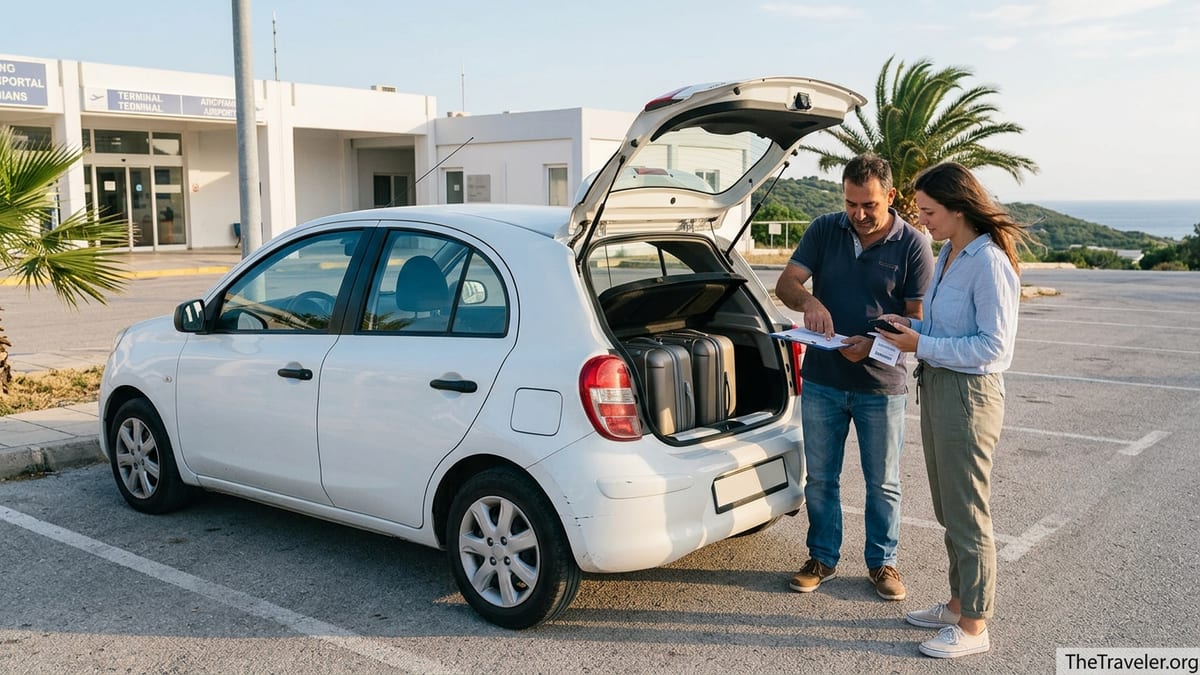
Because Localrent sits between you and a small rental firm, the experience you have on the ground can vary by country and even by individual provider. In Montenegro or Georgia, for instance, some travelers describe having the car delivered to their hotel in Budva or Tbilisi by the owner himself, with a quick walk-around inspection and a paper contract. In Cyprus or Spain, you might pick up at the airport car park from a branded kiosk or a marked meeting point. Localrent monitors reviews and can remove problematic partners, but you are ultimately renting from a local business whose standards, responsiveness, and car condition may be different from a multinational chain.
Travelers Who Benefit Most From Localrent
Localrent’s model tends to favor independent travelers who value flexibility, lower deposits, and personal service over corporate polish. If you are planning a road trip where a car is essential, such as exploring Montenegro’s Bay of Kotor, driving the mountain passes around Georgia’s Kazbegi, or tackling rural routes in Crete, you may find that Localrent offers more practical vehicles at better prices than the big names. For example, in shoulder season in Montenegro it is common to see a compact manual car listed around the equivalent of 25 to 35 euros per day, sometimes with no deposit or a modest 200 to 300 euro deposit, compared with large chains that might require 600 to 1,200 euros blocked on a credit card.
The platform is also attractive to travelers who dislike opaque pricing. Many renters choose Localrent in places like Cyprus or Turkey after being quoted very low lead-in prices by global brokers, only to discover on arrival that they must pay large local insurance supplements or extra fees for using a debit card. Localrent’s listings typically show the total base rate, local insurance level, and deposit size in plain language. While surprises are still possible if you overlook a condition, the intent is that a four-day rental in, say, Tbilisi for 120 euros should genuinely cost roughly that amount, paid partly online and partly at pickup, rather than doubling at the counter.
Localrent can work particularly well for travelers needing specific vehicle types that international brands sometimes price aggressively. A family looking for a seven-seat van in Georgia for a week in August might pay a steep premium with a global company. Through Localrent they could find a slightly older but well-maintained local minivan for a more modest daily rate, with extras like roof racks or child seats included at no or low cost. Similarly, visitors to Tenerife or Antalya wanting a small crossover or SUV with higher ground clearance, but not necessarily a brand-new car, often find more budget-friendly options from local partners.
Finally, Localrent suits people who appreciate human contact and support from regional specialists. The service has gained a following among travelers doing multi-week trips in countries like Georgia and Armenia, where local rental owners are familiar with road conditions, mountain passes, and border rules. A renter might, for example, receive advice not to drive beyond a certain village in heavy snow, or to avoid a particular unpaved shortcut that looks tempting on a map but is unsuitable for a standard sedan. For travelers who want that context rather than a generic brochure, a local provider accessed through Localrent can be advantageous.
Budget-Conscious Travelers and Low-Deposit Seekers
One of Localrent’s main selling points is lower and clearer deposit requirements. Large multinational brands in countries like Spain, Italy, or Portugal routinely block several hundred to a few thousand euros on a credit card. This can be a major burden for younger travelers, digital nomads, or families who are already paying for accommodation and flights. Localrent’s own materials state that their average deposit is around 300 euros and emphasize that they work with many partners who either require a modest deposit or none at all, depending on the car and insurance level selected.
Real-world examples highlight how this plays out. A couple landing in Larnaca, Cyprus, might see a major chain advertising a compact car for about 20 euros per day. On closer inspection they learn at the counter that their debit card is not accepted for the full deposit and that they must either provide a high-limit credit card or buy costly extra coverage that doubles the effective daily rate. In contrast, a similar car on Localrent might cost slightly more per day up front but come with a clearly defined 200 euro cash deposit, refundable on return once the car is checked, with optional full coverage available at a fixed daily cost.
This transparency makes Localrent appealing for travelers who know their own risk tolerance. Someone comfortable with a standard collision damage waiver and a 300 euro deposit can select that option. Another traveler might prefer “full coverage” scenarios where any damage below a certain threshold is covered and no deposit is required, even if the daily rate is higher. In many Localrent destinations, you will find listings advertising “no deposit, full insurance included” for compact or intermediate cars, which can be psychologically reassuring for visitors worried about being charged for every scratch.
Localrent can also be useful to those trying to keep overall trip costs down by renting slightly older vehicles. While an international chain in Iceland or Portugal may focus on nearly new cars with higher daily rates, local providers might offer ten-year-old but mechanically sound hatchbacks at significantly lower prices. These may not have the latest technology or pristine paintwork, but for travelers primarily interested in function and affordability, especially in sun-and-beach destinations, the trade-off can be worthwhile. Localrent’s detailed photos and descriptions of existing cosmetic wear help set realistic expectations before booking.
Independent Explorers and Off-the-Beaten-Path Trips
Localrent tends to shine in destinations where self-drive is the best way to reach scenic or rural areas and where local rental knowledge matters. In Montenegro, for example, Localrent started as a way to connect visitors with local companies around Tivat, Podgorica, and the Adriatic resorts. Travelers heading to Durmitor National Park, Lovćen, or the serpentine roads above Kotor often prefer dealing with a local outfit that understands which mountain routes are suitable for a regular car and which demand a higher-clearance vehicle or experienced driver.
Similarly, in Georgia many travelers use Localrent to arrange cars in Tbilisi for drives to Kazbegi, Kakheti, or the Imereti region. Local providers sometimes include condition notes such as “asphalt roads only” or “not allowed on certain unpaved mountain passes,” which reflect both the company’s insurance constraints and their knowledge of road risks. A traveler comfortable with gravel and minor off-road sections might choose a local crossover explicitly permitted on light dirt roads, while anyone sticking to highways can safely book a compact sedan with strict asphalt-only rules.
In islands like Crete, Rhodes, or Tenerife, Localrent can facilitate one-way rentals between airports and coastal towns or deliver cars directly to accommodations. A family staying in a small village above Chania may find it more convenient to have a local agent bring the car to their guesthouse, run through the paperwork on the terrace, and collect it there at the end. This sort of flexible, person-to-person arrangement is typical of small rental firms and is harder to obtain from big brands constrained by airport counter hours and centralized depots.
However, it is important to understand that “independent explorer” does not mean “unlimited off-roading.” Many Localrent partners specifically prohibit driving on certain unpaved mountain roads even if the car is a 4x4, and some require written permission to cross borders or visit remote regions. For instance, a listing in Georgia may clearly state that the car cannot be driven on particular high-altitude tracks or riverbed routes that are popular with more rugged tour operators. Travelers who respect these conditions, stay within the permitted road network, and document the car’s condition with photos at pickup and drop-off are the ones most likely to have smooth experiences.
When Localrent May Not Be the Best Choice
Despite its advantages, Localrent is not ideal for everyone. Travelers who prioritize uniform corporate standards, brand familiarity, and 24-hour on-site airport desks may be more comfortable booking with major international companies like Hertz, Avis, Enterprise, or Sixt. For example, someone arriving at Barcelona or Fort Lauderdale on a late-night flight, needing guaranteed access to an English-speaking support line and standardized loyalty benefits, might find that a global chain better matches their expectations, even if it comes with higher deposits and more formal paperwork.
Localrent also may not be the best fit for extremely risk-averse travelers who do not want any ambiguity around responsibility for damage, roadside assistance, or claim handling. While Localrent has collected many positive reviews and maintains a solid reputation overall, independent ratings show a mix of experiences. Some customers praise responsive support and straightforward returns, while others complain about local partners charging for pre-existing scratches, insisting on additional insurance, or being inflexible about pick-up delays. With any aggregator, a portion of these issues can come from miscommunication or not reading conditions carefully, but they underscore that the experience depends heavily on the specific local provider.
Travelers who rely solely on debit cards and do not wish to pay deposits in cash may also run into friction. Many Localrent partners are small businesses that prefer cash payments or have limited ability to pre-authorize foreign cards, especially outside the eurozone. A visitor to Georgia or Jordan might be asked to pay the balance and deposit in local currency, which could be inconvenient if they expected everything to be handled by credit card. By contrast, big airport-based companies are generally set up to process card payments smoothly, albeit sometimes with stricter rules and higher authorizations.
Finally, those with very tight travel plans or minimal tolerance for uncertainty should consider whether they are comfortable with the more informal style that can come with small local rentals. Vehicle delivery to a hotel, for instance, may depend on the owner navigating traffic or parking availability and could run 20 or 30 minutes later than the ideal schedule. If your itinerary leaves no room for such delays, or if you need guaranteed standardized policies across multiple countries on a long road trip, a fully international rental chain or a large, well-known broker might offer greater predictability.
How to Decide if Localrent Fits Your Trip
Choosing whether to book through Localrent starts with understanding your specific route, budget, and risk tolerance. Begin by comparing concrete options: search your destination on Localrent for your exact dates and note the daily rates, deposit amounts, insurance details, and car ages. Then check two or three major international brands for similar dates and cars, looking at not just the initial rate but also deposit requirements, card rules, and local insurance surcharges. In many Mediterranean and Caucasus destinations, you will likely find that Localrent offers noticeably lower deposits and more upfront clarity on what is included.
Next, think about the type of driving you plan to do. If you will stay mostly on major paved roads, a standard compact car from a well-reviewed Localrent partner can be an efficient and affordable solution. As an example, a couple flying into Podgorica for a week of coastal touring might book a manual compact with a 250 euro deposit and basic insurance, knowing they will avoid minor unpaved tracks. On the other hand, if you intend to tackle rough mountain routes in Georgia, unpaved scenic roads in Iceland, or remote desert tracks in Jordan, you will need to read each company’s road restrictions carefully. In some cases, you may be better off with a specialized 4x4 rental or guided tour rather than stretching a regular rental beyond its intended use.
You should also evaluate how comfortable you are managing a more personal rental relationship. Localrent often involves direct communication with the local provider via email, messaging apps, or phone before arrival. It is common, for instance, to share your flight number, confirm pick-up location in the airport parking lot, or send photos of your passport and driving license for insurance processing. If you are uneasy about this level of informal communication, or if you prefer everything to happen at a standardized airport counter, that is an important factor in your decision.
Finally, read recent reviews both on Localrent and independent platforms for the specific country and even the specific provider you are considering. A company with consistent positive comments about clean cars, honest inspections, and quick deposit refunds in Cyprus or Montenegro is more likely to deliver a smooth experience than one with frequent complaints about surprise fees or poor communication. Because Localrent can remove consistently problematic partners, focusing on suppliers with many recent, detailed positive reviews will help you leverage the strengths of the platform while reducing risk.
The Takeaway
Localrent.com has carved out a strong niche in the car rental world by connecting travelers with vetted local providers, offering relatively low deposits, and letting users book specific vehicles in popular self-drive destinations. It is especially well suited to budget-conscious travelers, independent explorers, and those who appreciate dealing with smaller companies that know local roads and conditions intimately. In places like Montenegro, Georgia, Cyprus, and various Mediterranean islands, many travelers have found Localrent to be a practical, cost-effective way to secure a car without the shock of a large credit card hold or unexpected insurance add-ons.
At the same time, Localrent is not a one-size-fits-all solution. Because the quality of your experience depends heavily on the individual local partner, it requires a bit more homework: reading conditions, checking reviews, and clarifying payment methods in advance. Travelers who demand uniform global standards, prioritize major loyalty programs, or prefer dealing with a familiar brand may be happier with a traditional international company, even if that means higher deposits and more formal processes.
The decision ultimately comes down to your travel style, budget, and comfort with local-level arrangements. If you are willing to trade some corporate consistency for better prices, more personalized service, and the chance to support small businesses in your destination, Localrent can be an excellent option. If you prefer maximum predictability and the reassurance of a global brand behind every booking, a major rental chain or mainstream broker will likely align better with your expectations. Either way, knowing who Localrent works best for, and where its limits lie, will help you make a more confident, informed choice for your next road trip abroad.
FAQ
Q1. Is Localrent.com a car rental company or just a broker?
Localrent is a broker and aggregator, not a car rental company with its own fleet. It connects travelers with independent local rental firms and facilitates the booking and payment of a small prepayment, while the actual rental contract is with the local provider.
Q2. In which countries does Localrent currently operate?
Localrent focuses primarily on leisure destinations across Europe, Asia, Africa, and nearby regions. Examples include Montenegro, Georgia, Cyprus, Turkey, Greece, Spain, Portugal, Iceland, the UAE, Thailand, and several others. Availability can change, so always check the site for current coverage when planning a trip.
Q3. Who is most likely to benefit from using Localrent?
Independent travelers who value lower deposits, transparent pricing, and personal service from local companies are the main beneficiaries. This includes people planning road trips in places like Montenegro or Georgia, families needing practical vehicles on islands such as Crete or Tenerife, and budget-conscious visitors who are comfortable with slightly older but well-documented cars.
Q4. How much is the typical deposit when booking through Localrent?
Deposits vary by country, provider, and car type, but Localrent emphasizes relatively low deposits compared with many international chains. In many destinations, typical deposits are in the range of a few hundred euros, and some listings offer no-deposit options when higher insurance coverage is purchased. Always check the specific deposit stated on the car’s page before booking.
Q5. Is Localrent suitable for very risk-averse travelers?
It depends on your comfort level. While many travelers report smooth experiences and honest service, Localrent involves dealing with small local companies whose standards can vary. Travelers who want uniform global policies, large corporate support structures, and fully standardized procedures may feel more secure with major international rental brands.
Q6. Can I pay everything by credit card when renting via Localrent?
Not always. Localrent usually takes a small prepayment online, often by card, but the remaining balance and deposit are paid directly to the local provider. Some accept credit cards, others prefer cash in local currency, and some require specific types of cards for deposits. Travelers who need a fully card-based transaction should carefully read the payment section of each listing and, if necessary, confirm with the provider in advance.
Q7. Is Localrent a good option for driving on rough or unpaved roads?
Only if the specific provider and car explicitly allow it. Many Localrent partners restrict driving to paved roads, even for vehicles that appear capable of light off-road use. If you plan to drive on gravel or remote mountain routes, you must choose a car and company whose terms clearly permit such use and understand that additional wear or damage may still be your responsibility.
Q8. How does Localrent compare on price with big international brands?
In many destinations, Localrent can be cheaper overall once you factor in deposits, compulsory insurance, and card-related fees. Local providers often list realistic daily rates that include basic coverage and modest deposits. However, prices vary by season, car type, and demand, so it is worth comparing concrete quotes from both Localrent and major brands for your exact dates and vehicle needs.
Q9. What should I check before confirming a Localrent booking?
Carefully review the car’s condition description, mileage limits, deposit amount, insurance coverage, fuel policy, road and border restrictions, payment methods, and cancellation terms. Also read recent reviews of the specific provider, paying attention to comments about hidden charges, deposit refunds, and communication. Taking photos of the car at pickup and drop-off is also wise in case of later disputes.
Q10. When might I be better off avoiding Localrent and booking with a major brand?
You may prefer a major brand if you are arriving late at night into a big hub airport, need guaranteed on-site desks, rely heavily on loyalty programs, want standardized policies across multiple countries, or feel uncomfortable with more informal local arrangements. In such cases, paying a higher rate and accepting a larger deposit in exchange for a familiar global experience can be the better choice.