


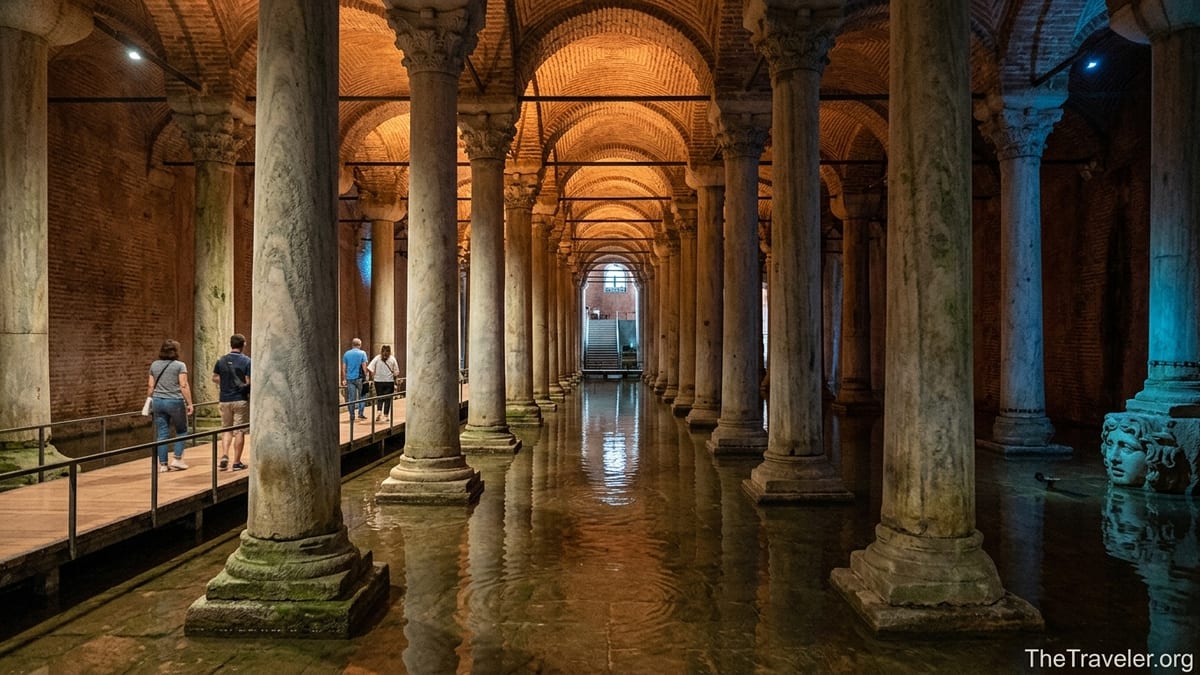
The Basilica Cistern is one of Istanbul’s most atmospheric sights: a vast underground forest of columns, low light and echoing water, a few minutes’ walk from Hagia Sophia. Because it sits at the heart of Sultanahmet, the city’s historic peninsula, it is also an ideal anchor for planning your entire Istanbul itinerary. Organizing your days around a timed visit here helps you beat crowds, manage ticket costs, and link nearby highlights into an elegant route rather than a frantic checklist.
Get the latest updates straight to your inbox!
Why the Basilica Cistern Makes a Perfect Anchor
The Basilica Cistern is not just another stop in Sultanahmet. It is a self-contained, roughly 30 to 60 minute experience that sits about 150 meters southwest of Hagia Sophia, between the Blue Mosque and the old Hippodrome. That central position, right by the T1 tram line’s Sultanahmet stop, makes it a natural pivot point for any day in the old city. You can always bend your plan around it without losing time on transport or backtracking.
Unlike mosques such as Hagia Sophia or the Blue Mosque, the cistern has controlled ticketed entry and a clearly defined path that you follow on a raised walkway. Recent guidance and first-hand reports suggest foreign visitors now pay around 1,000 Turkish lira for daytime entrance, and slightly more in the evening, with no discount from the Museum Pass because the site is municipally run. This combination of a set visit duration and a fixed fee makes it easy to drop into your budget and timing calculations.
Restoration work completed in 2022 improved lighting, walkways and earthquake resistance, transforming the interior into a carefully designed experience while preserving its sixth-century fabric. Soft, colored spotlights play on 336 columns and shallow pools, and curated sound installations are often used for temporary art projects. Because this is all indoors and climate controlled, the cistern is one of the few major sights that feels the same whether you visit on a blazing August afternoon, a windy January morning or in spring drizzle.
Most travelers report that the cistern is the sight they nearly skipped but end up remembering most clearly, precisely because it feels so different from anything above ground. Building your plans around it, rather than treating it as a side stop, ensures you carve out the quiet time it deserves and avoid squeezing it into the last exhausted half hour of your day.
Understanding Tickets, Timing and Crowds
Because the Basilica Cistern is popular with group tours and cruise passengers, timing matters. Lines outside can swell dramatically between about 10:30 and 15:30, especially on days when multiple ships are in port. Independent travelers consistently report two windows that work best: just after opening in the morning, and later in the evening session, when day trippers have peeled away and the lighting is at its most dramatic.
Current practice is to sell tickets on site at the main entrance beside the small park opposite Hagia Sophia, with contactless credit and debit cards processed quickly at the official ticket booths. The official Museum Pass Istanbul does not cover the cistern, and there is no “skip-the-line” access through that pass. Travelers trying to use foreign cash often find staff reluctant or unable to provide change for large euro or dollar bills, so plan to pay in lira by card or smaller notes. Prices for foreign visitors have risen several times in recent years, so treat all quoted figures as approximate and check again shortly before you travel.
The entire visit is self-guided, although you may see guides offering 30-minute walk-throughs outside for an additional fee. Most people spend 30 to 45 minutes strolling the walkways, pausing at the Medusa heads and the so-called Hen’s Eye column with its teardrop carvings. Photography is allowed, and there are occasional small queues for selfies at the most photogenic spots. The route is fairly flat, but the stairs down and up can feel steep and slightly damp, so it is worth wearing shoes with good grip and avoiding bulky bags that are awkward to maneuver on crowded steps.
If you are planning around prayer times at nearby mosques, remember that the cistern is a secular museum space and stays open during prayers, including Friday midday. That makes it a practical place to slot in while the Blue Mosque or Hagia Sophia are closed to sightseeing. In summer, another factor is the heat: descending into the cool, shaded cistern in mid-afternoon can give you a welcome break from strong sun on Sultanahmet Square.
Morning Itinerary: Old Istanbul Around the Cistern
A classic first full day in Istanbul can easily revolve around a morning visit to the Basilica Cistern. One efficient route starts with an early walk through Sultanahmet Square at sunrise, when the domes of Hagia Sophia and the minarets of the Blue Mosque glow softly in the first light and tour buses have not yet arrived. If you are staying in a Sultanahmet hotel, you can simply walk; from Taksim or Karaköy, ride the T1 tram to Sultanahmet and be on the square in 20 to 30 minutes.
After a simple Turkish breakfast of simit bread, olives and tea at a modest café facing the Hippodrome, aim for the cistern shortly after it opens. Queues are typically shortest in the first hour, especially outside peak holiday periods. Spend about 45 minutes exploring the interior, following the walkway to the far end where the two famous Medusa heads support columns in a dark corner. This early underground interlude lets you experience the space quietly and keeps you indoors while the morning sun climbs.
When you emerge back into daylight, walk the few minutes to Hagia Sophia, keeping in mind that as an active mosque it does not charge a ticket but has airport-style security queues and a dress code that requires covered shoulders and knees, with headscarves for women. If it is Friday, try to arrive outside main prayer times so that visitors are allowed in. Plan around 60 to 90 minutes inside, admiring the vast dome, calligraphy medallions and surviving Byzantine mosaics in the galleries.
From Hagia Sophia, cross the square to the Blue Mosque, which often has shorter lines in late morning when big groups have shifted to Topkapı Palace. Entry is free, but certain sections may be cordoned off for worshippers. After half an hour inside and a slow circuit of the courtyard, you can loop back along the Hippodrome, stopping by the Egyptian Obelisk and Serpent Column, and then take a lunch break at a simple lokanta on a side street, where a plate of lentil soup, stuffed vegetables and rice might cost a fraction of what you would pay on the main square.
Afternoon & Evening: Using the Cistern to Pace a Longer Day
For many travelers, centering the Basilica Cistern later in the day works even better, especially if you want to enjoy the enhanced evening lighting and a calmer atmosphere. One realistic pattern is to dedicate your morning to Topkapı Palace, entering as close to opening time as possible. The palace complex, harem and terraces can easily absorb three or four hours, particularly if you enjoy decorative arts and views over the Bosphorus. After that, a late lunch and short rest will reset your energy before you turn back toward the cistern.
From Topkapı’s main gate, it is a short downhill walk through the gardens and past the fountain of Sultan Ahmed III to the area between Hagia Sophia and the cistern. If you time it for late afternoon or early evening, you can often slide into a shorter line as most organized tours have finished. The interplay of artificial light and deeper shadows in the columns is more pronounced as the day darkens outside, and surface reflections in the shallow water are easier to photograph without glare.
Once you re-emerge above ground, you can stroll through Sultanahmet Park as dusk falls, listening to the overlapping call to prayer from several mosques. From here, it is straightforward to continue on foot down the hill to Gülhane Park, the Archaeology Museums or further to the Galata Bridge for a seafood dinner. Alternatively, take the tram two stops to Eminönü, wander the Spice Bazaar, and end your evening with a Bosphorus cruise that departs from the nearby piers.
If you prefer a lighter schedule, build a half-day that starts with the cistern and then focuses on quieter but nearby stops like the Museum of Turkish and Islamic Arts on the Hippodrome, or the Great Palace Mosaics Museum. Both are within a 10-minute walk and are typically less crowded than the headline sights, making them ideal for visitors who tire quickly of lines but still want to stay in the historical core.
Logistics: Getting to the Cistern and Moving Around
Planning around the Basilica Cistern also means exploiting its excellent transport connections. The nearest public transport node is the Sultanahmet stop on the T1 tram line, which runs from Bağcılar in the west through Aksaray, the Grand Bazaar area, Sultanahmet, Gülhane, Karaköy and across the Galata Bridge to Kabataş. With an Istanbulkart, the city’s contactless transit card, you can tap in and ride from central areas like Taksim via the funicular to Kabataş and then the T1 tram to Sultanahmet in one or two linked journeys.
From the Cistern, almost all of Old Istanbul’s major attractions are walkable. Hagia Sophia is a few minutes away, the Blue Mosque slightly farther across the square, Topkapı Palace about 10 minutes uphill, and the Grand Bazaar roughly 15 minutes north-west on foot through Çemberlitaş. This means you can comfortably structure days where you only ride the tram in and out once, with the rest of your exploring done on foot, spiraling out from the cistern as your central reference point.
Taxis are plentiful around Sultanahmet but not always the most efficient option due to one-way streets and traffic restrictions. If you do take a taxi back after dark, agree the use of the meter before you get in and have your hotel address written down in Turkish. Many budget and mid-range hotels in Sultanahmet are less than a 10-minute walk from the cistern, so a short stroll back through well-lit streets is usually simpler and more pleasant than a car ride.
Accessibility is improving but not perfect. The main entrance involves several flights of stairs, and handrails can become slick on damp days. Once inside, the wooden and metal walkways are mostly level, with occasional gentle ramps. Travelers with limited mobility may want to check the latest information close to their trip or contact their accommodation to confirm what is manageable. Crowds also influence comfort: choosing off-peak times is not only about shorter lines but also about having enough personal space to move at your own pace once underground.
Linking the Cistern with Lesser-Known Sights and Neighborhoods
While it is tempting to focus only on the headline monuments, one of the advantages of centering your plan on the Basilica Cistern is how easily you can branch out into quieter corners. A short walk west brings you to the Binbirdirek Cistern, the second-largest in the city, which is less elaborately lit but often nearly empty compared with its more famous neighbor. Stopping here for a brief visit can reinforce your sense of how Constantinople stored and moved water, with far fewer crowds in your photographs.
To the east, passing Hagia Sophia, you can drift into the gardens of Gülhane Park, where locals picnic under plane trees and sip tea at simple kiosks with views of the Bosphorus. Here, the rhythm of the city feels more everyday and less staged for visitors. Using the cistern as your “check-in” point, you might spend the morning underground, then walk to Gülhane to decompress, sit with a glass of freshly squeezed pomegranate juice from a vendor and watch ferries cross from Karaköy to Kadıköy on the Asian shore.
Another rewarding pairing is with the Grand Bazaar and its surrounding streets. After a morning at the cistern and Hagia Sophia, head uphill through Çemberlitaş, where small workshops and jewelry stores line the lanes. The covered bazaar itself can be intense, but if you approach it as a cultural experience rather than purely a shopping mission, it complements the underground world of the cistern. You move from cool, echoing columns and water to warm, crowded alleys filled with the noise of bargaining, copper hammering and the smell of roasting chestnuts.
If you are staying longer in Istanbul, you can even use the Basilica Cistern as a conceptual anchor across multiple days, returning to Sultanahmet from more distant neighborhoods. Spend a day in Beyoğlu exploring İstiklal Avenue, contemporary art galleries and the Galata Tower, then the next day drop back into the old city, mentally orienting yourself by picturing where the cistern sits beneath the modern surface. Thinking this way helps the sprawling city feel smaller and more navigable.
The Takeaway
Building your Istanbul itinerary around the Basilica Cistern is less about turning one monument into an obsession and more about recognizing how well it fits into the physical and emotional landscape of the city. Compact, atmospheric and perfectly located, it gives structure to your days in Sultanahmet and creates natural breaks between crowded, sun-exposed sites above ground.
By deciding in advance when you will visit the cistern, you automatically fix other pieces of your schedule: when to be at Hagia Sophia, how long to give the Blue Mosque, whether to tackle Topkapı Palace in the morning or afternoon, and when to retreat into cooler, quieter spaces. You also give yourself a built-in moment of stillness, surrounded by water, columns and filtered light, which can be surprisingly restorative in a city that rewards non-stop exploration.
Approach the Basilica Cistern not as a quick photo stop but as the quiet heartbeat of your itinerary. Use it to anchor your walks, guide your use of the tram, and connect grand imperial monuments with lived-in side streets and parks. Plan with a little care and the cistern will become the thread that stitches together your experience of Istanbul’s past and present.
FAQ
Q1. How long should I plan for a visit to the Basilica Cistern?
Most travelers find that 30 to 60 minutes is enough time to walk the raised paths, photograph the main features and linger briefly at the Medusa heads. If it is very crowded, allow closer to an hour.
Q2. What is the best time of day to visit the Basilica Cistern to avoid crowds?
The quietest windows are usually just after opening in the morning and in the later evening sessions, when day tours and cruise groups have finished. Midday and early afternoon tend to be the busiest.
Q3. Is the Basilica Cistern included in the Istanbul Museum Pass?
No. The Basilica Cistern is managed separately from national museums, and recent versions of the Museum Pass Istanbul do not cover it. You should budget for a standalone ticket.
Q4. Can I visit Hagia Sophia, the Blue Mosque and the Basilica Cistern in one day?
Yes. All three are within a short walk of each other in Sultanahmet. With an early start and realistic breaks for meals, many visitors comfortably see the cistern plus both mosques and still have time for a stroll through the Hippodrome.
Q5. How do I get to the Basilica Cistern using public transport?
The easiest route is to take the T1 tram to Sultanahmet station. From there it is a short walk uphill toward Hagia Sophia, with the cistern located on a side of the square a few minutes away. Using an Istanbulkart makes tram rides simple and cashless.
Q6. Are photos and videos allowed inside the Basilica Cistern?
Yes, non-flash photography is generally allowed and popular. Tripods, lighting rigs and commercial shoots may require special permission, so check locally if you plan anything more than casual photos.
Q7. Is the Basilica Cistern suitable for travelers with mobility issues?
The interior walkways are mostly level, but access involves staircases that some visitors may find challenging. Handrails are present, though they can become damp. Travelers with limited mobility should seek the latest practical information before visiting.
Q8. What should I wear for a day built around the Basilica Cistern and nearby mosques?
Wear comfortable shoes with good grip for damp steps, and dress modestly enough for mosque visits: covered shoulders and knees, plus a scarf for women to cover hair inside Hagia Sophia and the Blue Mosque.
Q9. Can children enjoy a visit to the Basilica Cistern?
Many children enjoy the atmospheric lighting, echoes and shallow water, though some may find the space dark or slightly eerie. Hold hands on the stairs and stay close on the walkways, which can become crowded.
Q10. How can I combine the Basilica Cistern with less crowded places nearby?
Pair the cistern with quieter spots such as the Museum of Turkish and Islamic Arts, the Great Palace Mosaics Museum, Gülhane Park or the Binbirdirek Cistern, all within about 10 to 15 minutes on foot.