


Ask frequent travelers to name the first hotel brands that come to mind and Best Western almost always makes the list. From road-trip motels on Route 66 to urban boutiques in Stockholm, the brand has embedded itself in the travel landscape over the last seven decades. Today, under the broader BWH Hotels umbrella, Best Western is no longer just a single midscale chain but part of a global portfolio spanning economy to luxury. Yet the blue and yellow sign and the familiar name still resonate with travelers who want something predictable without giving up local flavor. Understanding why Best Western remains so recognizable worldwide reveals a lot about what modern travelers value in a hotel stay.
Get the latest updates straight to your inbox!
From Highway Motels to Global Mainstay
Best Western’s story starts in 1946, when a group of independent motel owners in the western United States began referring business to one another to capture the postwar boom in road travel. The loose referral network soon formalized into Best Western Motels, a name chosen because the early members were primarily west of the Mississippi River. Within two decades, the brand pushed east and briefly marketed properties under a “Best Eastern” label before unifying as Best Western nationwide, giving travelers one consistent name to look for on long cross-country drives.
That simple, memorable name and the gold crown logo that followed made the chain highly visible along American highways through the 1960s and 1970s. By standardizing core expectations like clean rooms, parking, and on-site services at a time when independent roadside inns were highly variable, Best Western became synonymous with reliable car travel. Many North American travelers who are now in their 50s or 60s recall childhood road trips where their parents “always stopped at a Best Western,” creating a sense of generational familiarity that newer brands cannot easily replicate.
Over the decades, Best Western expanded far beyond North American highways. The company’s own overview today describes BWH Hotels as a privately held hospitality group headquartered in Phoenix with a global network of roughly 4,300 hotels in more than 100 countries and territories, many of them flying the classic Best Western flag. This footprint means the brand name appears in settings as varied as small French towns, Canadian ski hubs, and Thai beach destinations, reinforcing recognition every time a traveler spots the logo in a new country.
Despite this growth, the chain has not shed its midscale, accessible roots. A traveler driving from Denver to Phoenix can stay at a traditional roadside Best Western off the interstate one night, then check into a more contemporary Best Western Plus near Phoenix’s Sky Harbor International Airport the next, and still experience familiar touchpoints: a front desk that recognizes loyalty numbers, breakfast options that feel similar, and the same basic brand signage out front.
A Portfolio That Moves Beyond a Single Brand
One reason Best Western remains so visible in the global hotel conversation is that it no longer stands alone. Following the acquisition of WorldHotels and the creation of the SureStay family, the company now markets itself as BWH Hotels, with three main groups: WorldHotels, Best Western Hotels & Resorts, and SureStay Hotel Group. Together they span everything from entry-level roadside properties to upscale urban hotels and independent collections. That breadth allows the company to appear in many more travel scenarios without losing the familiarity of the Best Western core.
Within the Best Western Hotels & Resorts family, the brand portfolio has been carefully segmented. The official brand list includes the classic Best Western, the upgraded Best Western Plus, and the more upscale Best Western Premier. There are also contemporary concepts like Vīb and GLō aimed at design-conscious travelers, extended-stay options under Executive Residency, and soft brands such as BW Premier Collection and BW Signature Collection that bring independent hotels under the umbrella while preserving their individual identities. For example, Hotel Gio in Stockholm, part of BW Signature Collection, looks and feels like a boutique Scandinavian property yet carries the Best Western affiliation that many travelers know.
For travelers, this segmentation turns a single recognizable name into a flexible ecosystem. A price-sensitive family might book a SureStay or traditional Best Western on a road trip across the American Midwest, while the same travelers could choose a Best Western Premier in Paris for a special anniversary weekend. Business travelers might opt for a Vīb property in a tech district, where the lobby doubles as a co-working space with plentiful outlets and fast Wi-Fi. The common thread is that the Best Western name appears somewhere in the booking flow or signage, reinforcing brand awareness across very different trip types.
This structure mirrors what giants like Accor and Marriott have done with multi-brand portfolios, but Best Western’s path is distinctive because it grew from a member-owned cooperative model and retained a reputation for midscale value. Many independent owners who might balk at committing to a luxury-focused group have found the Best Western portfolio a better fit for properties in regional cities and secondary markets. For travelers, that translates into more chances to encounter the brand where other big names have a lighter presence.
Consistency With Room for Local Character
Best Western occupies an interesting middle ground between rigidly standardized chains and completely independent hotels. The company enforces brand standards around essentials like cleanliness, Wi-Fi, safety, and certain amenities, but it allows a fair degree of local character in design and operations. This balance is a major reason travelers remember the brand fondly: stays can feel distinctive without straying into unpredictability.
Consider a traveler driving through the American Southwest who books a Best Western Plus in Flagstaff, Arizona, then a week later checks into a Best Western in a lakeside town in Austria. The properties might differ in architecture and decor, reflecting the local environment. The Arizona property could feature stone fireplaces and desert tones, while the Austrian hotel might offer wood paneling and alpine artwork. Yet both will typically deliver familiar features such as complimentary Wi-Fi, a clear loyalty recognition process at check-in, and rooms equipped with similar in-room coffee setups and bedding standards.
Soft brands such as BW Premier Collection make this hybrid model even more visible. A historic city-center hotel in Rome might retain its original facade and much of its interior charm while joining BW Premier Collection to tap into Best Western’s distribution, loyalty base, and operational support. Guests booking through the Best Western website or app will recognize the brand backing even though the property’s public name emphasizes its unique identity and location rather than the chain.
This approach contrasts with ultra-standardized select-service chains that can feel identical whether you are in Kansas City or Kuala Lumpur. For many travelers, especially those who want a sense of place without taking on the risk that can come with small independent hotels, Best Western’s mix of standards and individuality creates a memorable experience that strengthens brand recognition over time.
A Loyalty Program That Works in Real Life
Best Western Rewards is another pillar of the brand’s enduring visibility. BWH Hotels describes Best Western Rewards as one of the larger hotel loyalty programs in the industry, with coverage across the company’s roughly 4,300 hotels globally. While exact membership numbers are not always front and center, the program’s frequent presence in independent rankings and promotions keeps it in the conversation alongside giants like Marriott Bonvoy and Hilton Honors.
For everyday travelers, what matters is how the program performs on actual trips. Best Western often runs seasonal promotions that can make point earning feel tangible even for those who stay only a few times a year. For instance, a common promotion structure has offered a free night or a large lump-sum points bonus after two qualifying stays within a set period. A family booking a night at a Best Western near Los Angeles International Airport before an early flight, then another weekend stay at a Best Western Plus in San Diego later that month, might earn enough points for a heavily discounted night at a resort-style property in Arizona or Florida.
The program can be especially attractive in destinations where nightly cash rates are modest but point redemption levels remain relatively low compared with more upscale chains. A traveler road-tripping across the Great Plains, booking Best Western properties in towns where nightly rates may hover around a moderately priced range, can accumulate points efficiently and then redeem them in higher-cost markets such as coastal California or Western Europe where the same number of points offsets a more expensive stay. That kind of real-world arbitrage is part of why points enthusiasts and budget-conscious travelers often mention Best Western Rewards as a solid secondary program.
Best Western Rewards also leans on simplicity in some respects. While elite tiers exist with the usual escalating benefits, the baseline member perks are easy to understand: earning points on every eligible stay, access to member-only rates when booking direct, and the ability to redeem across the entire BWH Hotels portfolio. For casual travelers who might find the complex charts and branded credit card ecosystems of major competitors overwhelming, Best Western’s approach feels approachable and keeps them engaged with the brand.
Marketing, Signage, and Everyday Visibility
Brand recognition depends not only on what happens during a stay but also on how often travelers encounter the brand when they are not actively searching for a room. Best Western continues to invest in marketing campaigns and visual identity refreshes that keep its sign recognizable without abandoning its legacy. Recent integrated campaigns tied to Best Western Rewards promotions have updated the look and feel of digital ads, while still prominently featuring the familiar blue logo that long-time customers know.
The most powerful marketing tool, however, may be the physical signage. In many North American towns and along major highways, the Best Western logo appears near gas stations, chain restaurants, and interstate exits where travelers make quick decisions about where to stop for the night. The more often people see the logo in these decision-heavy environments, the more it embeds itself in their mental shortlist. A driver scanning exit signs at 9 p.m. after a long day behind the wheel might choose a Best Western simply because they have seen the sign repeatedly on prior trips and subconsciously associate it with a safe, predictable stop.
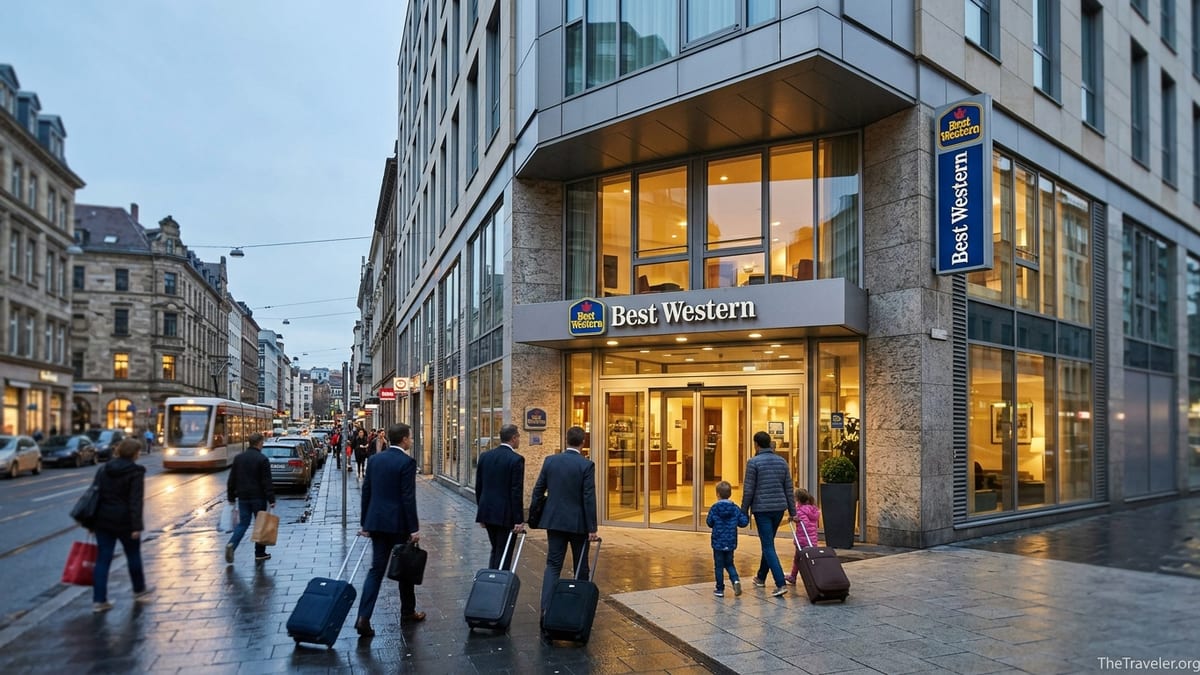
Internationally, the brand’s visibility in secondary cities and transport hubs similarly reinforces recognition. In European rail hubs such as Munich, Milan, or Vienna, it is common to see a Best Western or Best Western Plus within walking distance of the main station, positioned alongside regional chains and independent hotels. In Asian markets like Japan and Thailand, where domestic brands dominate, the presence of Best Western in business districts and resort areas gives international travelers a familiar option among local names that might be harder to evaluate quickly.
Beyond physical signs, digital visibility through major online travel agencies and metasearch platforms keeps Best Western in front of travelers who start their planning with price comparisons rather than brand loyalty. When a filter for “3-star hotels with breakfast included” in a mid-sized city returns multiple Best Western options at competitive nightly rates, travelers who have stayed with the brand before often gravitate toward that known quantity, reinforcing recognition with each subsequent booking.
Balancing Value and Reliability for Different Travelers
Best Western’s place in the global market is defined less by being the absolute cheapest or the most lavish and more by occupying a reliable middle ground. This positioning resonates with a wide variety of travelers: business road warriors, families on school holiday, retirees exploring national parks, and even younger digital nomads looking for dependable Wi-Fi at a manageable nightly cost.
For example, a small business owner driving between client meetings in the American Midwest might routinely choose Best Western because the midscale price point fits their travel budget, parking is straightforward, and breakfast is often included or available at a reasonable cost. Over the course of a year, a dozen such stays can accumulate enough points in Best Western Rewards to offset costs for a family vacation, creating a virtuous cycle that strengthens the traveler’s connection to the brand.
In Europe, where hotel sizes and building ages vary widely, Best Western’s model of affiliating existing properties allows it to be present in historic city centers that newer global brands sometimes struggle to enter. A traveler visiting smaller cities in Germany or Italy might find that the only globally recognizable names among a long list of local hotels are Best Western and perhaps one or two other chains. When traveling with children or older relatives, that bit of familiarity can tip the decision toward Best Western even if a local independent hotel offers a slightly lower rate.
In resort destinations, Best Western and its extended portfolio also provide choices that balance price and amenities. For instance, a beachfront hotel in Southeast Asia might join BW Premier Collection to tap into international distribution while preserving its local design and service style. Travelers searching for a beach stay on a moderate budget might find this property priced below large international luxury brands but above unbranded guesthouses, a sweet spot that aligns with Best Western’s reputation for offering good value without feeling bare-bones.
The Takeaway
Best Western’s enduring recognizability is not an accident or simply a relic of highway travel nostalgia. It stems from a combination of history, global reach, portfolio diversification, and practical value that aligns with how real people travel today. The brand has evolved from a cooperative of Western motels into a key component of a diversified hospitality group that stretches from economy to upscale, yet it still projects a straightforward promise: a good night’s sleep at a fair price, backed by a name you have seen before.
For travelers, that promise translates into everyday decisions. Whether booking a quick airport stay before an early flight, stringing together a series of stops on a cross-country road trip, or choosing a centrally located hotel in a mid-sized European city, Best Western often appears as a comfortable middle option: more personality than some budget chains, fewer complications than some upscale brands, and a loyalty program that works even for occasional guests. Those attributes, repeated across thousands of properties and millions of stays, explain why the blue Best Western sign remains one of the most recognizable emblems in the global hotel landscape.
FAQ
Q1. Is Best Western considered a budget or midscale hotel brand?
Best Western traditionally sits in the midscale segment, offering more amenities and comfort than basic budget hotels while remaining more affordable than full-service upscale chains. Within the broader BWH Hotels portfolio, SureStay targets economy travelers and brands like Best Western Premier and WorldHotels cater to upper midscale and upscale guests.
Q2. How many countries does Best Western operate in?
According to recent company overviews, BWH Hotels, which includes Best Western Hotels & Resorts, has roughly 4,300 hotels in more than 100 countries and territories. Not all of these carry the classic Best Western name, but the brand’s presence is broadly international, from North America and Europe to Asia-Pacific and parts of Africa and Latin America.
Q3. What is the difference between Best Western, Best Western Plus, and Best Western Premier?
Best Western is the core brand, typically offering comfortable rooms and essential amenities at a moderate price. Best Western Plus adds upgraded design touches, enhanced breakfast or food options, and often more spacious public areas. Best Western Premier is positioned higher, with more polished decor, additional services, and a more upscale overall feel while still remaining accessible compared with luxury brands.
Q4. Is Best Western a good option for business travelers?
Yes, many business travelers choose Best Western for its value and coverage in smaller markets. Properties often provide free Wi-Fi, work desks, and convenient parking, and many include breakfast or have on-site dining. The loyalty program can also be attractive to business travelers who stay frequently in midscale hotels and want points that can be redeemed for personal trips.
Q5. How does Best Western’s loyalty program compare to larger programs like Marriott Bonvoy?
Best Western Rewards is generally simpler and more focused on midscale travel than some of the larger, more complex programs. While it may not have the same number of luxury redemption options as Marriott or Hilton, it can be very effective for travelers who stay in regional cities, along highways, and in smaller destinations where Best Western has a strong footprint and points can stretch further.
Q6. Are all Best Western hotels owned by the same company?
Most Best Western properties are independently owned and operated but affiliated under the Best Western brand through franchise or membership agreements. This model allows local owners to maintain some individuality in their hotels while adhering to common brand standards around cleanliness, safety, and core amenities.
Q7. Can I expect the same experience at Best Western hotels around the world?
You can expect a consistent baseline in areas like cleanliness, Wi-Fi, and general service, but design and atmosphere can vary significantly by property and region. A Best Western in a historic European town may feel very different from a newly built roadside hotel in North America, yet both should deliver the essential comforts and reliability associated with the brand.
Q8. Does Best Western have boutique or design-focused hotels?
Yes. Brands such as Vīb, GLō, Aiden, and soft brands like BW Premier Collection and BW Signature Collection are designed to appeal to travelers who value distinctive design and local flavor. These properties often feature contemporary interiors, vibrant lobbies, and neighborhood-focused experiences while still connecting to Best Western’s reservation systems and loyalty program.
Q9. Is breakfast usually included at Best Western hotels?
Breakfast policies vary by property and country. In many North American Best Western and Best Western Plus hotels, a hot or continental breakfast is included in the room rate. In some European and Asian properties, breakfast may be an optional add-on. It is best to check the specific hotel’s inclusions when booking to avoid surprises.
Q10. Why might a traveler choose Best Western over newer hotel brands?
Travelers often choose Best Western because of its mix of familiarity, value, and global reach. The brand has decades of recognition, a loyalty program that rewards regular stays, and a presence in many smaller cities and roadside locations where newer lifestyle brands may not yet have opened. For many guests, that combination of trust and practicality outweighs the novelty of a less established brand.