


Walk any summer evening through Cape May, New Jersey, and you will see it: visitors craning their necks at gingerbread-trimmed porches, pointing phones at pastel “painted ladies,” and wondering what it might be like to sleep in one of the city’s famous Victorian bed-and-breakfasts. Yet just a few blocks off the beach, the house that tells the deeper story of how Cape May became America’s grande dame of seaside resorts often goes unnoticed. The Emlen Physick Estate is not only the city’s best-preserved Victorian home, it is the key to understanding why Cape May looks the way it does today.
Get the latest updates straight to your inbox!
Cape May’s Victorians: A Street Show Most Travelers Think They Know
For many travelers, Cape May is synonymous with color: lilac and teal clapboards, cherry-red gables, and porches wrapped in lace-like woodwork. The entire city is a National Historic Landmark, with more than six hundred preserved Victorian-era buildings packed into less than three square miles. Visitors arriving from Philadelphia or New York often spend their first afternoon doing what locals jokingly call the “veranda shuffle,” wandering the blocks between Beach Avenue and Washington Street just to admire the houses.
Iconic structures such as Congress Hall, the Southern Mansion, and the Queen Anne “painted ladies” around Columbia Avenue appear in nearly every Instagram grid and travel feature about Cape May. Travelers book rooms at classic inns like The Chalfonte or anonymous pastel B&Bs they discover on booking sites, then fill their days with beach time, cocktails on the Washington Street Mall, and maybe a trolley ride past the prettiest porches.
In this swirl of seaside charm, it is easy to assume you are already seeing “the best” of Cape May’s architecture simply by strolling through town. Many visitors never realize that one house, just outside the busiest streets, offers a curated, inside-out explanation of the whole Victorian spectacle. That house is the Emlen Physick Estate, and if you skip it, you miss the very narrative that ties the city’s turreted rooflines and gingerbread balconies together.
Talk to repeat summer renters who have been coming for years and you will often hear the same confession: they have walked or driven past the big brown house on Washington Street dozens of times on their way to the beach or the supermarket but have never gone in. The result is a strange gap. Travelers fall in love with the look of Cape May without understanding the social history, preservation battles, and everyday stories behind those lovingly painted facades.
What Makes the Emlen Physick Estate Different From Every Other Old House
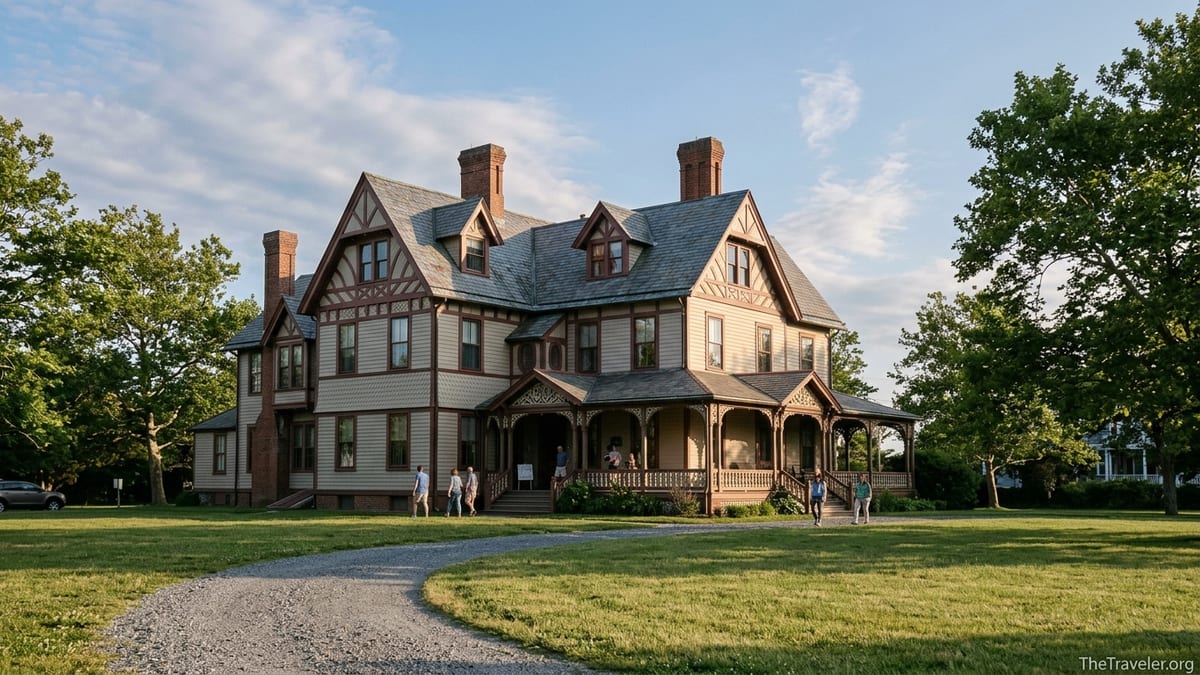
The Emlen Physick Estate is Cape May’s only fully restored Victorian house museum, an 18-room mansion completed in 1879 for Dr. Emlen Physick Jr., a wealthy Philadelphia physician who never actually practiced medicine. Designed by noted architect Frank Furness, the house sits slightly back from the street on a leafy, roughly four-acre property, with a broad lawn and outbuildings including a carriage house and former servants’ quarters.
From the street, it looks substantial but somewhat subdued compared with Cape May’s more flamboyant B&Bs. Instead of candy colors, the house wears a palette of earth tones and deep trim, with a mansard roof, bold brackets, and Furness’s signature oversized dormers. The design leans toward the Stick and Second Empire styles rather than the high-gingerbread Queen Anne look that visitors tend to associate with Cape May. That understated exterior is one reason some travelers underestimate it: it does not scream for attention in quite the same way as a purple turret across town.
Step inside, though, and the estate suddenly feels like the control room of Cape May’s entire Victorian story. Unlike many inns and guesthouses where modern comfort inevitably competes with history, the rooms here are staged specifically to evoke late 19th-century upper-middle-class life. Period-appropriate wallpapers climb the high walls, heavy Eastlake furniture anchors parlors and bedrooms, and display cases show everything from medical instruments to family letters.
Crucially, the house is not frozen in some vague “old-timey” past. Cape May MAC, the nonprofit that operates the estate, rewrites and re-curates the main house tour regularly. One year the focus might be on the domestic lives of the Physicks’ Irish servants; another, on changing ideas of health and leisure in a seaside town. For travelers, that means the estate rewards repeat visits in a way that many historic homes do not.
The Story Most Visitors Miss: How One House Helped Save an Entire Town
In the 1960s, long after the Physick family line in Cape May had ended, the estate was in real danger. Like many grand Victorian houses at the Jersey shore, the property had faded, and demolition was a tempting option for developers in a town where motels and parking lots often seemed more profitable than peeling clapboards. At the same time, a surprising number of Cape May’s older buildings were either neglected or threatened with the wrecking ball.
Local residents, worried that Cape May would lose the very architecture that set it apart from other beach towns, organized to fight for the estate and similar structures. That grassroots movement became the Mid-Atlantic Center for the Arts, now known as Cape May MAC, which took on the ambitious task of restoring the Physick house and using it as a base for broader preservation efforts. Their success bolstered arguments in favor of saving other Victorian buildings around town.
Today, when travelers admire entire streets of intact 19th-century houses, they are seeing the ripple effect of that campaign. Cape May’s eventual recognition as a National Historic Landmark district owes much to activists who insisted that the Physick Estate was worth saving when demolition seemed inevitable. In other words, the city’s current tourism economy, which leans heavily on historic charm and heritage experiences, is built on the back of a house most visitors still drive past without stopping.
For travelers who pay attention to the ethics of where they spend their money, this history matters. Admission fees and tour revenues at the Physick Estate help support ongoing preservation and educational programs throughout Cape May. Choosing to visit is not only an aesthetic decision; it is a small but concrete way to contribute to keeping the town’s Victorian streetscape intact for future vacations.
Planning a Visit: Tours, Tickets, and What to Expect Inside
Practical details are one reason many visitors miss the Emlen Physick Estate. It is a short drive or a fifteen- to twenty-minute walk from the beachfront hotels near Beach Avenue, and it operates on a museum schedule rather than beach-town hours. House tours typically run daily in high season, often from late morning into mid-afternoon, with a mix of guided and audio-assisted options. In shoulder seasons such as April, May, September, and October, the estate tends to be open fewer days per week, and winter openings are more limited, so checking current hours before you plan your day is important.
Ticket prices shift slightly year to year, but travelers can generally expect adult admission to the basic house tour to land in the rough range of a modest restaurant lunch in town, with discounted rates for children and seniors and combination tickets available that pair the house with trolley tours or other attractions. Families on a budget sometimes opt for a package that includes the estate plus a historic district trolley ride, effectively turning an afternoon into a themed deep-dive into Cape May’s past.
Inside, a standard tour usually lasts about 45 to 60 minutes, moving through the main public rooms, several bedrooms, and service spaces such as the kitchen or butler’s pantry. Guides frequently tailor their commentary to the group. A history buff might hear more about Frank Furness’s architectural innovations, while a family with children may get extra anecdotes about the household’s pets, holiday traditions, or the oddities of Victorian etiquette.
Photography rules vary by room and by current exhibit, but hand-held cameras and phones are usually fine as long as flash is off. The estate has made accessibility improvements over the years, particularly in the carriage house that houses the ticket office, gift shop, and Carroll Gallery. The main house, like many 19th-century buildings, still presents stair and threshold challenges, so travelers with mobility concerns should call ahead or stop by the ticket desk first to discuss the best way to experience the property.
Beyond the Front Door: Carriage House Cafe, Carroll Gallery, and Seasonal Events
What sets the Physick Estate apart from many historic houses is that it functions as a small cultural campus rather than a single frozen-in-time interior. The carriage house on the grounds now holds the Carriage House Cafe & Tearoom, where visitors can sit down for lunch or afternoon tea under exposed beams and period-inspired decor. Menus change, but you can typically expect items like quiche, salads with local produce, and tiered stands of finger sandwiches and scones for traditional tea service. Travelers who time it right often make a late-morning house tour followed by tea into a relaxed half-day outing.
In the same building, the Carroll Gallery hosts rotating exhibitions throughout the year. Past shows have included photo- and document-rich displays on topics such as segregated beaches in Cape May and Atlantic City, as well as playful holiday exhibits that turn the space into a winter wonderland. For visitors who like context but do not want to spend hours in a traditional museum, the gallery is a compact, visual way to understand Cape May’s broader social history.
The grounds themselves are another draw, especially for travelers who start to feel hemmed in by crowds along the beach and pedestrian mall. In autumn, the estate becomes the hub for events like Scarecrow Alley, when local businesses and families design whimsical or eerie scarecrows that line the property’s paths. In December, the house often anchors Cape May’s holiday programming, serving as a stop on candlelight house tours where visitors move between decorated historic homes by trolley and on foot.
Because many of these programs are ticketed separately from the basic house tour, they give repeat visitors new reasons to return. A couple who discovered the estate on a rainy August afternoon might find themselves back in October for Halloween-themed lantern tours, then again in December for hot cider on the lawn after a holiday concert nearby. For travelers building traditions with children or grandchildren, the estate can become a seasonal touchstone rather than a one-time stop.
How the Estate Helps You Read the Rest of Cape May’s Streets
Visiting the Physick Estate does more than tick off another attraction. It teaches you how to look at the rest of Cape May. Once you have stood in the estate’s dining room, studied its woodwork, and heard about Dr. Physick’s life, the city’s other houses become more legible. You start to notice which porches follow similar proportions, where brackets echo Frank Furness’s bold curves, or how service wings and carriage houses are tucked discreetly behind the showy public facades.
Guides at the estate often highlight the impact of the devastating 1878 fire that destroyed much of central Cape May and triggered a building boom of Victorian hotels and cottages. Armed with that context, it becomes easier to distinguish pre- and post-fire houses as you walk around town. The compact, earlier structures near the harbor feel different from the more exuberant, eclectic homes closer to the beach that rose in the rebuilding spree.
The estate’s interpretation of domestic life also sharpens your eye for details you might otherwise overlook. After learning how families balanced privacy and display in rooms like the double parlor, travelers often find themselves peeking through open inn doors (when invited) or noting from the sidewalk how interior shutters and stained glass were used to manipulate light and temperature before air-conditioning and blackout curtains.
For architecture enthusiasts, the house is a crash course in the vocabulary of Victorian design. Terms like “Stick style,” “mansard roof,” or “Eastlake furniture” stop being abstract labels in a guidebook and become connected to specific rooms you have actually stood in. That makes walking through the wider National Historic Landmark district feel less like drifting through a pretty backdrop and more like reading a well-illustrated chapter of American architectural history.
Making Time for the Estate on a Short Cape May Getaway
The most common reason travelers give for skipping the Emlen Physick Estate is simple: they run out of time. With only a weekend or long holiday to spare, it is easy to fill the hours with the beach, dolphin-watching cruises, bike rentals, winery tastings, and leisurely dinners along the pedestrian mall. Yet planning for the estate does not require sacrificing an entire day of surf and sand.
For a two-day summer visit, one practical approach is to schedule the house tour for late morning or early afternoon on your second day, when the sun and crowds are often strongest on the beach. Spend a few quieter morning hours near the water, then head inland for the relative shade and calm of the estate’s tree-lined property, followed by lunch at the Carriage House Cafe. You will still be back at your hotel or guesthouse in time for a late-afternoon swim.
Travelers visiting in shoulder seasons, when the water is chilly but the weather is still pleasant, can make the estate a centerpiece of their trip. Pair a house tour with a stroll through the nearby residential blocks of Washington Street and West Cape May, where you can compare the Physick house with smaller cottages and former boarding houses. Stop at a corner cafe along the way, and you will have assembled a full, slow-travel day grounded in local architecture and stories.
Families juggling naps and early bedtimes might find that the estate fits best after breakfast, when younger children are fresher and more patient. While very small kids may not absorb every detail, the novelty of a “fancy old house” with tall ceilings, busy wallpapers, and sometimes slightly spooky corners often keeps them engaged long enough for parents and grandparents to enjoy the tour too.
The Takeaway
Most travelers reach Cape May ready to adore its streetscapes: the candy-colored gables, intricate porch railings, and flower-decked verandas that have earned the city a reputation as one of America’s great Victorian resorts. It is entirely possible to leave happy after nothing more than a few aimless strolls under those gingerbread eaves. Yet doing only that means you experience Cape May mostly as a backdrop, not as a place with a layered history and a preservation story that is still unfolding.
The Emlen Physick Estate changes that. It turns the town’s architecture from scenery into narrative, explaining how one family’s home became the anchor for a broader movement that saved an entire waterfront city from becoming just another strip of motels. For travelers who care about understanding the places they visit, and who like their beach vacations with a side of substance, carving out an hour or two for the estate is one of the most rewarding choices you can make in Cape May.
Next time you find yourself snapping photos of pastel porches or glancing toward the deep, leafy blocks beyond the Washington Street Mall, consider following that curiosity inland. The big, somewhat solemn house on Washington Street will not compete with the brightest painted ladies for your attention. But step inside, and you will discover that almost everything you love about Cape May’s old houses has a thread that leads right back through its front door.
FAQ
Q1. Where is the Emlen Physick Estate located in Cape May?
The estate sits on Washington Street in a primarily residential area slightly inland from the beach, a short drive or a fifteen- to twenty-minute walk from the main oceanfront hotel strip and the Washington Street pedestrian mall.
Q2. How long should I plan for a visit to the Emlen Physick Estate?
Most visitors spend about 45 to 60 minutes on the main house tour, plus additional time if they visit the Carroll Gallery, explore the grounds, or have lunch or tea at the Carriage House Cafe, so planning for roughly two hours is comfortable.
Q3. Do I need to book tickets in advance?
In peak summer and on holiday weekends, advance tickets are helpful, especially for popular time slots or special themed tours, while on quieter weekdays and in the shoulder seasons, it is often possible to buy tickets on arrival, subject to availability.
Q4. Is the Emlen Physick Estate suitable for children?
Yes, school-age children who enjoy stories and exploring unusual spaces tend to like the tour, though parents should be prepared to supervise closely around fragile furnishings and to choose tour times that match their children’s energy and attention spans.
Q5. Can I visit the Carriage House Cafe & Tearoom without touring the house?
In most cases visitors can access the Carriage House Cafe & Tearoom and browse the museum shop or Carroll Gallery without joining a house tour, making it a pleasant stop even for those with limited time, though combining the experiences gives a fuller sense of the estate.
Q6. Are there evening or seasonal events at the estate?
Yes, the estate often hosts seasonal programs such as Halloween-themed tours, Scarecrow Alley displays in autumn, and Christmas candlelight events in December, with specific offerings and schedules varying from year to year.
Q7. Is the estate accessible for visitors with mobility challenges?
The carriage house, which includes the ticket area, cafe, shop, and gallery, has been adapted with accessibility in mind, while the historic main house still includes stairs and narrow passages, so travelers with mobility concerns should contact the site in advance to discuss current options.
Q8. What makes the Emlen Physick Estate different from other old houses in Cape May?
Unlike many Victorian buildings that now operate as inns or private homes, the Physick Estate is a purpose-run house museum with regularly updated interpretive tours, original architectural details by Frank Furness, and a central role in the city’s preservation story.
Q9. When is the best time of year to visit the estate?
Summer offers the most frequent tour times and lively grounds, while spring and fall provide smaller crowds and milder weather; winter openings are more limited but can feel especially atmospheric around holiday events.
Q10. How does visiting the Emlen Physick Estate support Cape May’s preservation efforts?
Revenue from tours, events, and the cafe helps fund ongoing maintenance of the estate and supports the broader work of Cape May MAC in preserving and interpreting other historic sites and traditions around the city.