


The first thing that feels strangely real about Victorian life at the Emlen Physick Estate is the sound. It is not a recorded soundtrack, but the soft creak of floorboards under your shoes, the muffled thud of a docent closing a heavy door down the hall, and the distant chatter of another tour group echoing up the back staircase. In an instant, the 18-room Stick-style mansion at 1048 Washington Street in Cape May stops being a postcard facade and becomes what it once was in 1879: a working home for an unconventional doctor, his widowed mother, and his strong-willed aunt, full of routines, quiet tensions, and small domestic dramas.
Get the latest updates straight to your inbox!
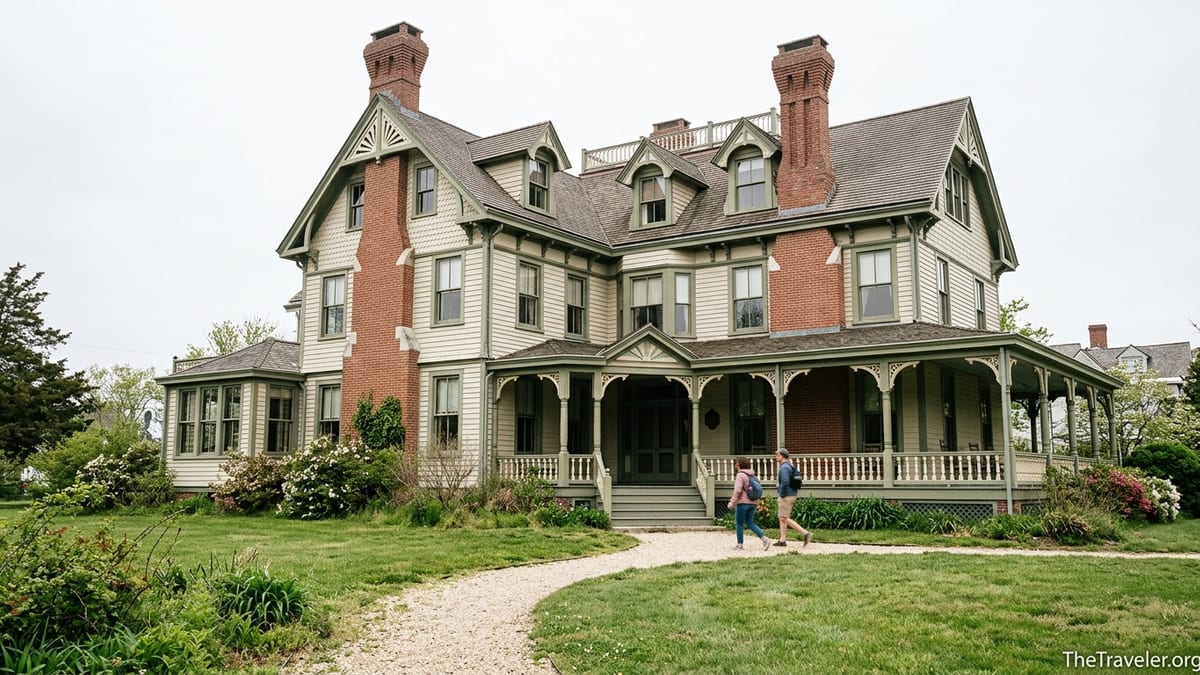
Meeting Dr. Physick at the Front Door
Walking up the long drive of the Emlen Physick Estate, the house seems almost theatrical. Designed in 1879 by Philadelphia architect Frank Furness, its oversized corbelled chimneys, bold stickwork, and hooded dormers loom over the lawn in a style that feels more experimental than quaint. This was not a generic seaside cottage hastily thrown up after Cape May’s 1878 fire. It was a statement house for a wealthy Philadelphia family, built at a time when the resort was reinventing itself as a showplace of Victorian architecture.
On the guided tour, which currently costs around 20 dollars for adults and departs several times a day in peak season, you do not meet Dr. Emlen Physick in person. But you meet him in the way the docents introduce his story. He was a trained physician who never opened a regular practice, a bachelor who shared his home with his mother Frances Ralston and his aunt Emilie, and a man with a taste for dogs, horses, and the slightly eccentric. Hearing this within sight of his portraits and personal objects does something that a textbook would not. It anchors the social world of the 1880s in the life of one very particular family on Washington Street.
Stepping over the threshold, the tour groups are asked to imagine arriving as a caller in the 1880s, when the physician’s name and Philadelphia pedigree already preceded him in local gossip. The docents often pause in the entry hall and invite you to notice the separation between the front rooms, where visitors were received, and the back corridors where the servants moved. This simple division of space, still visible in the layout today, quickly turns the abstractions of “Victorian class structure” into a literal floor plan you can stand inside.
Rooms That Still Smell Like the 1880s
The second-floor landing may be where Victorian life feels most tangible. There is often a faint scent of old wood, polish, and fabric that no modern air freshener can entirely mask. It clings to the carved banisters and the door frames in a way that makes the house feel less like a set and more like a place that has aged naturally since the late nineteenth century.
In the bedrooms, many of which are furnished with period-appropriate pieces and some original items, you find details that undercut any overly romantic vision of the era. On one visit, a guide pointed out a hair wreath, crafted from the locks of loved ones and arranged into delicate floral shapes under glass. It is beautiful at first glance, then unsettling, and ultimately moving when the guide explains it as a way of keeping family literally close at hand in a world where disease and early death were constant threats. The object sits within reach, not behind thick glass in a distant museum wing, and suddenly you understand how private grief and decorative taste intertwined for an upper-middle-class family.
Nearby, in a guest room, the stiff layers of bedding and high, narrow bed frame make it clear that Victorian comfort had its limits. Travelers staying today at nearby historic inns such as the Inn at the Park, just a short walk down Washington Street, may sleep under reproduction wallpaper and antique-style quilts, but they do so on modern mattresses and with central air purring quietly in the background. At the Physick Estate, the heavier, more confined feel of the bedrooms conveys how much of daily Victorian life centered on physical endurance: of heat, of cold, of thick clothing and elaborate sleeping arrangements.
Domestic Rituals in the Dining Room and Kitchen
Many visitors say that the dining room and kitchen are the rooms that finally make Victorian life click. Standing beside the long dining table, set with reproduction china and glassware, you can picture a formal evening meal attended by the family and select guests. Docents sometimes describe the etiquette that would have governed these dinners, from the sequence of courses to expectations about conversation and posture. When you hear that children were often expected to be seen and not heard, and that servants had to move in and out of the room with practiced invisibility, the polished surfaces take on a more complex human context.
In the kitchen, the emphasis shifts from ritual to labor. The big cast-iron stove, the heavy pots, and the modest worktable show how much effort lay behind every carefully staged meal. Guides often point out that the estate’s four-acre property once included various outbuildings that kept farm and household operations running. Today, while not every original structure survives in its nineteenth-century form, the Carriage House and Hill House on the grounds help visitors understand that the estate functioned as a small ecosystem of work, from stable care to laundry to food preparation.
What makes this feel real rather than theoretical is the way the tours tie these rooms to specific people. Visitors learn about the cooks, maids, and coachmen whose names surface in records and oral histories preserved by Cape May MAC, the nonprofit that rescued the property from demolition in 1970 and now manages it as the city’s only Victorian house museum. Hearing about an individual maid’s long days or a coachman’s responsibilities while standing where they once stood narrows the emotional distance between modern travelers and the house’s original staff.
The Carriage House, Tearoom, and the Business of Preservation
No visit to the Emlen Physick Estate is complete without stepping into the Carriage House, the first structure built on the property in the 1870s and now the hub of modern visitor services. On a practical level, this is where you buy tickets for house tours and trolley excursions, browse the museum shop, and, from late April through the end of October, sit down for lunch or afternoon tea at the Vintage restaurant. On a deeper level, spending time here underscores how much effort and creativity goes into making the Victorian experience accessible in the twenty-first century.
The tearoom is a good example. At a typical midday seating, you might find couples sharing pots of loose-leaf tea and tiered stands of sandwiches and scones at tables near the original carriage bays. The setting is historic, but the menu is tuned to contemporary tastes and dietary needs. A docent may explain that in the 1880s, the family would have used this outbuilding for horses and vehicles, not leisurely meals. Yet the modern adaptation feels organic. It demonstrates how historic sites survive financially by blending preservation with hospitality, and it gives visitors a sensory connection to Victorian ideas of leisure and refinement through the ritual of tea.
Exhibits in the Carroll Gallery, also in the Carriage House, often change each season but tend to revolve around Cape May’s architectural history and social life. One recent display featured original architectural drawings and photographs documenting how the city’s ornate houses contributed to its designation as a National Historic Landmark. Another focused on local stories from the resort’s boom years. Seeing the Emlen Physick Estate contextualized among other grand Victorian structures, from nearby boarding houses to the now-demolished hotels that once lined the shore, helps travelers understand that this house was part of a larger cultural landscape rather than an isolated oddity.
Ghost Tours, Nighttime Atmosphere, and the Stories We Tell
By day, the Emlen Physick Estate is a case study in period architecture and domestic life. By night, it is something else entirely. Cape May has cultivated a reputation as one of New Jersey’s most haunted towns, and the mansion appears regularly on lists of local ghostly sites. Evening tours organized by Cape May MAC lean into this history, blending folklore with architectural detail. Guides walk visitors through dimly lit rooms and across the shadowy lawn, sharing stories of supposed apparitions, unexplained footsteps, or the scent of cigar smoke with no obvious source.
Even if you are skeptical, it is hard to deny that the nighttime atmosphere changes the way the house feels. The same oversized chimneys and jerkin-head dormers that look charming under the midday sun appear more imposing when they rise against a dark sky. Inside, the flicker of lamplight on patterned wallpaper and the creak of the stairs under a smaller group of visitors can make the Victorian past seem uncannily close. It is not simply about ghost stories. It is about recognizing how easily a domestic interior can slide from cozy to uncanny when its daily routines fall silent.
For many travelers, combining a daytime architectural or social-history tour with an evening ghost tour creates a fuller picture of the house’s hold on the modern imagination. One visit emphasizes concrete facts about the family, the architecture, and the city’s development as a resort. The other highlights how later generations have reinterpreted those facts through storytelling, tourism, and a fascination with the supernatural. Experiencing both in a single weekend offers a compact lesson in how historic places continue to accrue new layers of meaning long after their original occupants are gone.
Comparing Victorian Immersion Across Cape May
The Emlen Physick Estate does not exist in a vacuum. Cape May’s historic district contains hundreds of late Victorian structures, many of them operating today as bed-and-breakfasts, small hotels, or private homes. A traveler who spends a night in a Second Empire inn like the nearby Thomas Webster House or the former Henry Walker Hand House, now the Inn at the Park, gets to sleep amid mansard roofs, bracketed cornices, and heavily ornamented porches. Walking the streets between these properties and the Physick Estate, you begin to sense how densely layered Victorian life once was on this barrier island.
What sets the Emlen Physick Estate apart is its role as a museum rather than as lodging. In a B&B, the Victorian feel is shaped largely by décor: reproduction wallpapers, Eastlake-style furniture, perhaps a claw-foot tub in a renovated bathroom. At the Physick Estate, the curatorial choices go further, emphasizing original layout, circulation patterns, and period-appropriate finishes uncovered through paint research. Guides may point out how later alterations were reversed to better reflect the early years of the house, or describe how curators used historic photographs and written records to decide how a particular parlor should look.
For visitors, this means you can spend the afternoon immersed in a meticulously researched interpretation of 1880s life, then stroll back to the commercial district along Washington Street for dinner at a contemporary restaurant or a drink at a modern wine bar. The contrast between late-night crowds and the quiet formality of the mansion you just toured can be striking. It helps explain why travelers often describe Cape May as feeling almost too pretty, and at times almost too perfectly preserved, to be real.
Planning Your Own Walk Through the Estate
From a traveler’s standpoint, the logistics of visiting the Emlen Physick Estate are refreshingly straightforward. The property sits a few blocks from the beach and the Washington Street pedestrian mall, and many visitors simply walk or bike over from their hotels. The house is open for guided tours much of the year, with hours that typically run from morning through late afternoon, and extended offerings during peak summer and holiday seasons. Tickets are sold in the Carriage House, and combination packages may include trolley tours that loop through the historic district, offering exterior views of other notable homes along with narration.
Prices can change, but recent seasons have seen adult admission for a standard guided house tour in the range of about 20 dollars, with discounts for children and occasional bundled options that cover multiple attractions managed by Cape May MAC. For families, this can make the estate an affordable half-day outing, especially when combined with a stop at the museum shop for locally made souvenirs or a casual lunch in the tearoom. Travelers on a tighter budget sometimes opt for self-guided walking tours of the grounds using low-cost clue packets that lead you around the exterior of the house and its lawns, offering a different perspective on the architecture without entering every room.
Timing matters. A weekday morning in shoulder season, such as late spring or early fall, often means smaller tour groups and more time to linger in each room. Peak summer weekends and December holiday evenings, when the house is dressed in period-inspired Christmas decorations and hosts candlelight tours, can be more crowded but also more atmospheric. Many repeat visitors plan return trips specifically to see how the estate’s interpretation changes with themed exhibits, new research, or seasonal décor. For travel planners crafting Cape May itineraries, weaving the Physick Estate into a broader circuit that includes the lighthouse, beach time, and local dining gives clients a satisfying mix of history and relaxation.
The Takeaway
In travel writing and tourism marketing alike, the phrase “step back in time” is overused. Yet walking through the Emlen Physick Estate, room by carefully restored room, Victorian life does feel unusually concrete. The architecture by Frank Furness, with its assertive chimneys and stickwork, anchors you in a specific aesthetic moment. The preserved floor plan reveals how class and gender shaped movement through the house. Decorative objects like hair wreaths, stiff formal dining settings, and utilitarian kitchen tools bring personal emotion and physical labor to the foreground.
What makes the experience resonate is not nostalgia but specificity. This is not an abstract Victorian era but the home of Dr. Emlen Physick, his mother Frances, and his Aunt Emilie, situated in a particular resort town that reinvented itself after a devastating fire and later fought to save its architectural heritage from demolition. The docents who walk you through the estate, the tearoom staff serving afternoon tea in the former carriage bays, and the curators rotating exhibits in the Carroll Gallery all participate in a living conversation about how the past should be remembered and presented.
For travelers, the lesson carries beyond Cape May. Choosing to visit a house museum like the Emlen Physick Estate is a way of trading generalized historical knowledge for the textured experience of one family’s life. It is an invitation to listen for the creak of original floorboards, to imagine the weight of a high-collared dress in an unairconditioned summer, and to acknowledge how much work went into maintaining an elegant facade in an age before modern conveniences. In that sense, the estate does more than make Victorian life feel real. It reminds visitors that every grand house, in Cape May or anywhere else, was sustained by the complicated, often invisible rhythms of daily human effort.
FAQ
Q1. Where is the Emlen Physick Estate located in Cape May?
The Emlen Physick Estate stands at 1048 Washington Street, a short walk from the main historic district and within easy reach of many local inns and shops.
Q2. How much time should I plan for a visit?
Most travelers find that a guided house tour plus a look around the grounds and Carriage House takes about 60 to 90 minutes, not counting a longer meal or tea break.
Q3. Do I need to book tickets in advance?
Advance booking is recommended in peak summer, on holiday weekends, and for special evening or candlelight tours, though same-day tickets are often available on quieter weekdays.
Q4. Is the estate suitable for children?
Yes, children are welcome, and many enjoy the glimpse of “old-fashioned” life. Parents should be prepared to supervise closely, as rooms contain fragile objects and narrow passageways.
Q5. Are there accessible options for visitors with mobility challenges?
The grounds and Carriage House are generally more accessible than the upper stories of the mansion, which include stairs. Visitors with specific needs should contact the site in advance to discuss current accommodations.
Q6. Can I take photographs inside the house?
Policies may change, but non-flash photography is often permitted in many rooms for personal use. Tripods and commercial shoots typically require special permission.
Q7. Is the Emlen Physick Estate open year-round?
The estate offers tours most of the year, with the busiest schedule in spring, summer, and December. Off-season hours and offerings can be more limited, so checking current schedules before a visit is wise.
Q8. What is the best time of year to visit?
Late spring and early fall provide pleasant weather and somewhat smaller crowds, while December offers festive holiday decorations and candlelight tours that many visitors find especially memorable.
Q9. Are there other historic sites nearby to combine with a visit?
Yes, the estate is close to numerous Victorian inns, smaller museums, and the wider Cape May historic district, making it easy to build a walking itinerary that includes several landmarks.
Q10. Does the estate host special events or themed tours?
Throughout the year, Cape May MAC organizes themed offerings at the estate, including ghost tours, holiday programs, and rotating exhibits in the Carroll Gallery that highlight different aspects of local history.