


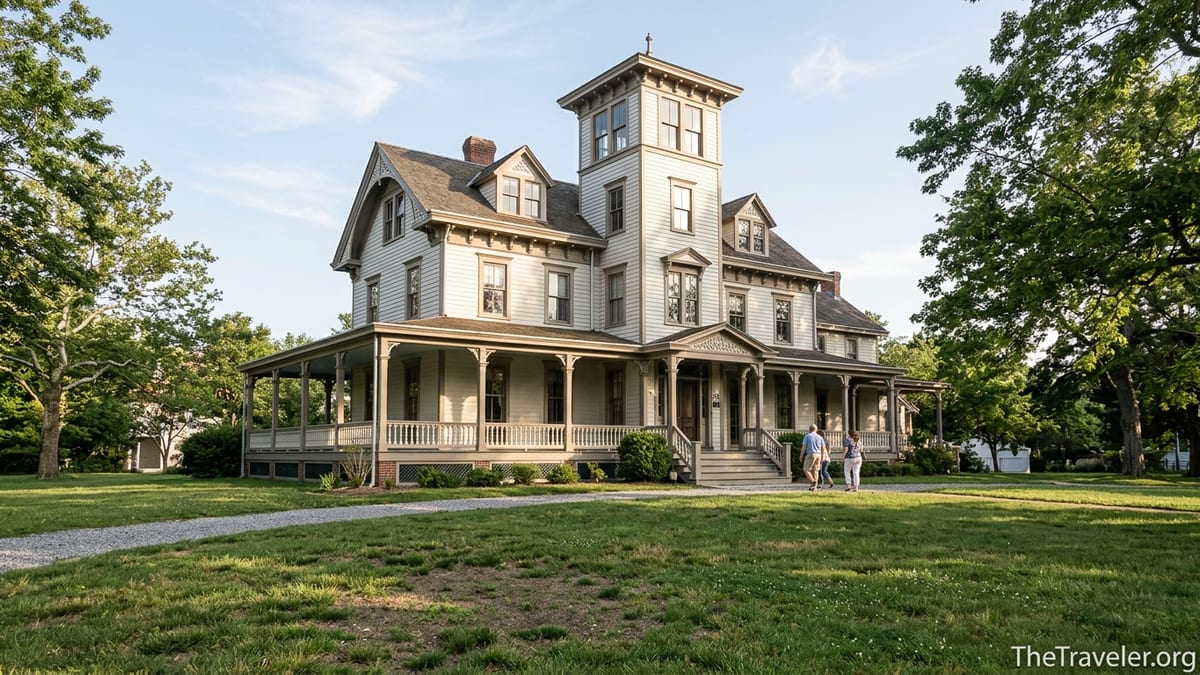
In a town famous for its fanciful gingerbread trim and candy-colored porches, the Emlen Physick Estate still manages to stop visitors in their tracks. Set back from Washington Street behind a sweep of lawn and mature trees, this 18-room Victorian house museum feels like a time capsule from Cape May’s Gilded Age, when prosperous families escaped East Coast cities for salt air, sea breezes and elaborate summer rituals. Today, with its restored interiors, year-round tours and lively calendar of cultural events, the estate offers one of the most immersive ways to experience the city’s 19th-century past.
Get the latest updates straight to your inbox!
A Gilded Age Mansion That Saved a Town
The Emlen Physick Estate was completed in 1879 for Dr. Emlen Physick Jr., a Philadelphia physician who chose Cape May as the setting for his family’s summer home. The house was designed by noted architect Frank Furness, whose bold, idiosyncratic style is visible in the building’s strong lines, oversized chimneys and striking stick-style trim. In a town filled with ornate Victorians, the Physick house stands out for its scale and its confident, almost modern, architectural personality.
By the mid-20th century, the estate had fallen into disrepair, mirroring the decline of Cape May itself as vacation habits shifted away from traditional seaside resorts. In the early 1970s, local preservationists rallied to save both the mansion and the town’s remarkable collection of Victorian architecture. The Mid-Atlantic Center for the Arts & Humanities, now known as Cape May MAC, took on the restoration of the property and opened it as a historic house museum. That decision not only rescued the Physick Estate from possible demolition, it helped establish Cape May as one of the country’s best-preserved Victorian seaside destinations.
Walking up the front path today, it is hard to imagine how close the estate came to being lost. The broad veranda has been carefully restored, the tower windows gleam, and the surrounding outbuildings are back in use as galleries, a café-style restaurant and a visitor center. For many travelers, the estate serves as their first introduction to Cape May’s preservation story, a concrete example of how a single landmark can spark a wider historic revival.
Visitors arriving in summer often encounter more than just a static museum. On event days, food vendors set up under tents on the lawn, musicians play near the carriage house and families lounge on the grass between tours. The grounds feel like a community gathering place, much as they would have during Cape May’s Gilded Age, when a visit to a grand seaside home was as much about being seen as it was about the ocean air.
Inside the House: Daily Life in Victorian Cape May
The heart of the experience is the guided tour of the 18-room mansion, offered most days from spring through late December. Instead of wandering on your own, you move from room to room with a guide who layers in anecdotes about the Physick family, their staff and the routines that structured a Victorian season by the sea. Typical tours last about 45 minutes to an hour, enough time to trace a full circuit of the main floors and glimpse the upstairs spaces where the family lived.
In the formal parlor, heavy draperies, patterned carpets and upholstered furniture make it easy to picture an 1880s afternoon tea, complete with calling cards and carefully managed social visits. The dining room, often set with reproduction china and glassware, captures the strict etiquette of the era, when a summer dinner could run to multiple courses and required a small army of servants moving in and out through side doors. Guides frequently point out specific objects, like ornate sideboards or imported ceramics, that spoke to the wealth and aspirations of Cape May’s seasonal residents.
Upstairs, the bedrooms and sitting rooms reveal a more intimate side of Gilded Age life. You might see a traveling trunk packed for the season, a washstand laid with pitcher and bowl, or a child’s room with period toys. The details are grounded in the historical record but arranged in a way that helps modern visitors understand how a family actually used the house. Instead of abstract explanations about Victorian customs, you hear stories tied to particular pieces of furniture or habits, such as how long it took to get dressed for an evening promenade or why seaside health cures were so fashionable among wealthy Philadelphians.
Because Cape May MAC operates several trolley tours that connect to the estate, many visitors choose a combined experience: a trolley ride through town to see the grand exteriors, followed by an interior tour here. Packages change by season, but it is common to find bundled tickets that cost only a little more than a standalone house tour, which makes it an efficient way to understand how the Physick Estate fits into the broader streetscape of Victorian Cape May.
The Grounds, Carriage House and Seasonal Exhibits
Even if you never set foot inside the mansion, the estate’s grounds repay a slow wander. The front lawn is framed by mature shade trees, with gravel paths leading toward the carriage house and outbuildings. On a typical summer afternoon, you might see school groups gathering near the visitor center, couples taking photos beneath the veranda and cyclists pausing at the gate to check the schedule for the next tour.
The historic carriage house, a separate structure dating from the 1870s, now serves several roles. One wing usually houses the Carroll Gallery, where rotating exhibits explore facets of Cape May history, from the town’s hotel era to its World War II stories. During the holiday season, the gallery often shifts to a Christmas-themed display that draws repeat visitors year after year. Another part of the carriage house operates as a restaurant-style venue for lunch and afternoon tea in the warmer months, giving travelers a chance to enjoy a light meal or a pot of tea in a period-inspired setting just steps from the mansion.
Throughout the year, the estate doubles as a backdrop for craft markets and specialty shows. In May, for example, a Mother’s Day weekend crafts and collectibles event typically brings a cluster of regional artisans selling handmade jewelry, pottery and textiles across the lawns. In early summer, a larger crafts and collectibles show returns, turning the estate into an open-air marketplace where you can browse vintage glassware one moment and locally made candles the next. These events are free to enter, with individual purchases priced much as they would be at any mid-range craft fair, making them an easy add-on to a beach weekend.
For visitors planning a trip in late fall, it is worth checking whether a holiday market or seasonal exhibit will be in place at the estate. While the house tours remain the core attraction, the additional programming transforms the property into more than a museum. It becomes a living cultural center where history, art and community intersect in a distinctly Cape May way.
From Murder Mysteries to Music Festivals: Events That Animate the Past
One reason the Emlen Physick Estate feels so alive is the steady schedule of special events that unfold in and around the house. Rather than treat the mansion as a fragile relic, Cape May MAC uses it as a stage set for immersive experiences that range from family-friendly to intriguingly eerie. Many of these programs are seasonal, so the atmosphere on a June evening can be very different from a chilly October night.
Interactive mystery evenings are a particular favorite. On select dates, the estate hosts “Clueless at the Physick Estate” performances that send guests through the rooms in small groups, encountering costumed characters and collecting clues to solve a themed whodunit. One 2026 iteration, built around the idea of “Liberty and Justice,” invites participants to follow a storyline that touches on questions of fairness and secrets among the Victorian elite. Tickets are typically comparable to the cost of a theater outing, and because space is limited to keep groups small, advance reservations are strongly recommended.
The estate also plays a role in the annual Cape May Music Festival, a six-week series of classical and chamber concerts staged at historic venues around town each May and June. While many performances take place in churches and seaside hotels, select programs are held in the estate’s carriage house or on its grounds, where the acoustics and ambiance suit small ensembles. Imagine listening to a string quartet as twilight settles over the lawn and the outlines of the mansion glow softly in the background; it is one of the more evocative ways to connect music with setting in Cape May.
Autumn and winter bring another layer of programming. Ghost-themed tours, often combining a trolley ride with a candlelit walk through the Physick Estate, lean into Cape May’s reputation as one of America’s more haunted small towns. The content is atmospheric rather than extreme, making it accessible for older children and adults who enjoy a mild scare wrapped in history. Around December, the estate becomes part of Cape May’s holiday celebrations, with candlelight tours that showcase period-inspired decorations and sometimes feature live music or costumed interpreters along the route.
Planning Your Visit: Practical Details and Nearby Experiences
The Emlen Physick Estate sits a short distance from Cape May’s pedestrian-friendly Washington Street Mall, close enough to reach by foot or bike from many inns and guesthouses. For visitors staying farther out, street parking near the estate is generally available outside the most crowded summer weekends, although it can become tight on major event days. If you are arriving during peak season, it is wise to build in extra time for parking and ticketing, especially for morning tours that can fill quickly on clear beach days.
House tour schedules vary by season, but in a typical year you can expect regular daily tours from spring through late December, with slightly reduced hours in shoulder months. Tickets for the guided mansion tour are usually priced in a moderate range compared with other regional attractions, with discounts for children and, at times, combination passes that pair admission with a themed trolley tour or another Cape May MAC site such as the lighthouse or a World War II lookout tower. Because offerings can shift, travelers should check current times and prices close to their visit and consider buying tickets in advance on busy weekends.
Many travelers weave a stop at the estate into a broader day of exploring Cape May’s historic side. A common pattern is to start with a late-morning house tour, have lunch at a nearby café or at the carriage house restaurant when it is in season, then spend the afternoon walking the streets between the estate and the ocean. Along the way, you pass rows of restored Victorian inns, small museums, and shops selling everything from saltwater taffy to locally roasted coffee. For families, pairing the house tour with a visit to the beach or to another history site, such as a living history village just outside town, can keep everyone engaged.
Visitors who prefer quieter experiences may want to plan their tour for a weekday in spring or fall, when crowds are thinner and guides often have more time to answer in-depth questions. In winter, fewer tours operate but those who do visit are rewarded with a more contemplative atmosphere and, around the holidays, the added charm of seasonal decor. Whatever the season, comfortable walking shoes and a light layer are recommended, since you will move between indoor and outdoor spaces and some rooms retain their historic feel with less modern climate control than a contemporary building.
How the Estate Brings Cape May’s Story Into Focus
While the Emlen Physick Estate offers plenty of visual charm, its deeper value lies in how it helps visitors interpret the broader story of Cape May. Through room settings, guided narration and exhibits in the carriage house, the site explores topics that touch on architecture, social history, medicine and tourism. Rather than rely on abstract timelines, the estate uses the choices of a single family and the fate of one property to illuminate bigger themes.
The house tour, for example, naturally introduces questions about class and labor in the Gilded Age. When guides describe the staff moving through back hallways, or point out the separation between family spaces and servant work areas, modern travelers gain a clearer sense of how much unseen effort sustained a seaside lifestyle. The story of Dr. Physick’s career and education reflects period attitudes toward health and leisure, including the popularity of sea air cures for urban residents suffering from industrial pollution.
The preservation narrative is equally instructive. Cape May’s decision to embrace its Victorian architecture instead of replacing it with modern high-rises helps explain why the town looks the way it does today. Interpretive materials at the estate often reference how its restoration in the 1970s was part of a broader movement to protect the city’s historic core, which has since become a major driver of tourism. For travelers, this perspective can transform a simple stroll past ornate porches into a deeper appreciation of the policies and community choices that keep them intact.
Even special events at the estate, such as craft shows and musical performances, can be understood as expressions of continuity. They echo the social role grand houses once played in seaside society, where lawns and verandas served as stages for gatherings, performances and charitable activities. By attending a modern event on the grounds, you are not only enjoying contemporary culture but also participating in a tradition of communal use that stretches back more than a century.
The Takeaway
For many visitors, the Emlen Physick Estate becomes the visit that lingers after the sun, sand and seafood dinners have blurred together. Standing in its parlors and climbing its staircases, you gain a tactile sense of Cape May’s Gilded Age that no photograph or brochure can quite match. The creak of floorboards, the weight of carved woodwork and the filtered light through lace curtains all combine to evoke a world in which a seaside season was as much about display and ritual as it was about relaxation.
Yet the estate is not simply about nostalgia. It also tells a modern story of preservation, adaptive reuse and community identity. By choosing to save and animate this mansion, Cape May residents helped chart a path for their town that values history as an asset rather than an obstacle. Every guided tour, craft market and concert held on the grounds is a reminder that heritage can be both fragile and renewing.
Whether you are a first-time day tripper from Philadelphia, a family returning year after year, or a traveler tracing the Atlantic coast, setting aside a few hours for the Emlen Physick Estate is one of the most rewarding ways to understand Cape May. It is a place where architecture, memory and contemporary life intersect, inviting you to step into the past while remaining very much rooted in the present.
FAQ
Q1. Where is the Emlen Physick Estate located in Cape May?
The estate sits on Washington Street in Cape May’s historic district, a short walk or bike ride from the Washington Street Mall and within easy reach of many inns and guesthouses.
Q2. Do I need to book a tour of the mansion in advance?
Advance booking is strongly recommended during summer weekends, holidays and special events. On quieter weekdays or in the shoulder seasons, same-day tickets are often available, but schedules can vary by time of year.
Q3. How long does a typical house tour take?
Most guided tours of the 18-room mansion last about 45 minutes to an hour, giving guests time to see the main floors, hear family stories and ask questions.
Q4. Is the estate suitable for children?
Yes, children are welcome, and many families enjoy pairing a house tour with a trolley ride or a crafts event on the grounds. Very young children may find the full tour long, so visiting earlier in the day and bringing a stroller for the grounds can help.
Q5. Are there combination tickets with other Cape May attractions?
Frequently there are combination tickets that bundle the Physick Estate with trolley tours or other Cape May MAC sites such as the lighthouse or a World War II lookout tower. The exact combinations and prices change periodically, so it is best to check current offerings before visiting.
Q6. What should I wear when visiting the estate?
Comfortable walking shoes are recommended, as you will be standing and moving through multiple rooms and outdoor areas. A light layer is helpful, since temperatures can differ between the historic interiors and the seaside air outside.
Q7. Is the Emlen Physick Estate open year-round?
The estate typically offers regular tours from spring through late December, with the busiest schedule in summer and special programming in autumn and around the holidays. Winter hours are more limited, so visitors planning trips in January or February should confirm availability in advance.
Q8. Are there food or drink options on-site?
Seasonally, a restaurant-style venue in the carriage house serves lunch and afternoon tea, and special events sometimes feature food vendors on the lawn. At other times of year, numerous cafés and restaurants are located within a short walk.
Q9. Can I attend events at the estate without taking a house tour?
Yes, many events such as outdoor craft shows, markets or certain concerts use the grounds or carriage house and do not require a full mansion tour ticket, though some programs combine both experiences.
Q10. Is photography allowed inside the mansion?
Photography policies can change, but casual non-flash photos are often permitted on tours, while tripods and professional shoots typically require special permission. It is best to confirm current rules with staff before taking photos indoors.