


For travelers facing a crack-of-dawn departure from Rome, the thought of navigating into or out of the city in the middle of the night can feel more stressful than the long-haul flight itself. Increasingly, visitors are sidestepping that headache by spending their last night in Fiumicino, the coastal town that shares its name with Italy’s busiest airport, and combining airport convenience with an unexpectedly relaxed seaside stopover.
Get the latest updates straight to your inbox!
Where Airport Logic Meets the Mediterranean
Fiumicino sits at the mouth of the Tiber River on the Tyrrhenian Sea, a short drive from Leonardo da Vinci–Fiumicino Airport, which handles the majority of Rome’s international traffic and is consistently among Europe’s busiest hubs. The historic center of Rome lies roughly 30 kilometers away, but Fiumicino town is only a few kilometers from the runways, which makes it uniquely positioned for travelers balancing flight logistics with a desire to squeeze in a final glimpse of the coast.
For anyone with a departure before about 9 a.m., staying in the city often means arranging private cars at 3 or 4 a.m., navigating night buses, or worrying about whether early trains or airport coaches will run on schedule. By contrast, a night in Fiumicino cuts that pre-flight journey to as little as a 10 to 15 minute taxi or shuttle ride from many local hotels and guesthouses, with properties such as Rome Airport Inn advertising travel times of around seven minutes to the terminals under normal traffic.
The airport itself has its own railway station connected to the Leonardo Express, the non-stop train linking Fiumicino Aeroporto to Roma Termini station in about 30 minutes. That makes it easy to split a trip: spend most of your time in the city near Termini or Trastevere, then relocate to Fiumicino for the last night. With trains generally starting from Termini shortly before 5 a.m. and airport-bound bus services resuming in the very early morning, travelers can move between urban Rome and the coast without complicated route planning.
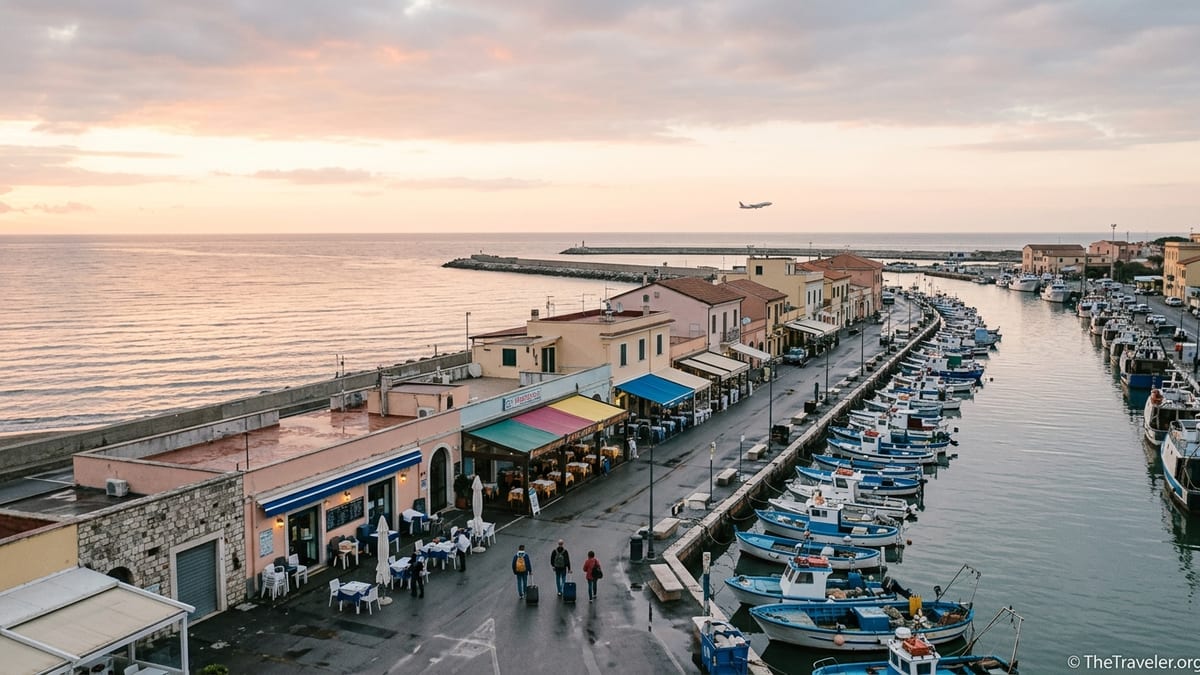
Crucially, Fiumicino is not an anonymous airport strip of chain hotels. The compact center still feels like a working seaside town, with fishing boats tied up along the canal and promenades lined with gelato shops and seafood restaurants. That mix of real life and travel convenience is a large part of its appeal for visitors trying to make the most of their final hours in Italy.
Early Flights Without the Middle-of-the-Night Drama
The most practical reason travelers choose Fiumicino is simple: early flights. A departure at 7 a.m. from Rome’s main international airport usually translates into an airport arrival around 4:30 or 5 a.m. If you are staying in a central neighborhood such as Monti or Trastevere, that can mean arranging a taxi between 3 and 3:30 a.m. and budgeting 45 minutes or more in case of roadworks, checks or unexpected traffic.
By basing yourself in Fiumicino town or the nearby Isola Sacra district, that anxiety largely disappears. Hotels focused on airport travelers, such as Isola Sacra Rome Airport Hotel, publish shuttle timetables that start as early as 4:30 a.m., typically charging a modest per-person fee that is often less than the cost of a central Rome taxi pre-dawn. Other properties near the water or along Via della Torre Clementina can arrange fixed-price transfers that take less than 15 minutes to reach the terminals in light early-morning traffic.
Guest reviews from frequent flyers repeatedly highlight the comfort of waking at 4 a.m., having a quick coffee and pastry in the lobby, and then riding a short shuttle to the airport rather than facing a long city-to-airport journey in the dark. Some smaller bed-and-breakfasts and guesthouses offer basic breakfast from 4 or 4:30 a.m., or provide packaged options to take along for travelers who need to leave even earlier. It is a routine that can be especially attractive for families with children, older travelers, or anyone who knows they do not function well on very little sleep.
Travelers also appreciate that taxis and ride-hailing services in the Fiumicino area are used to airport patterns. A pre-booked cab from a waterfront hotel such as Hotel Tiber or a guesthouse in the old center to the terminal usually feels more predictable than relying on late-night or early-morning connections from the city, when public transport is limited and delays are harder to solve on the fly.
A Seaside Stopover That Feels Like a Bonus Day
Beyond convenience, Fiumicino offers something most airport-adjacent areas do not: a genuine coastal atmosphere. The town stretches along the canal and the sea, with fishing boats and small trawlers moored on the water and a promenade that comes alive in the late afternoon and evening. Travelers often describe arriving at their airport hotel with low expectations, then being pleasantly surprised to find a working port, evening passeggiata, and plates of fresh seafood within a short walk.
The main waterfront strip along Via della Torre Clementina, overlooked by the historic Torre Clementina tower, is lined with casual trattorias, wine bars and ice cream counters. Here you find restaurants such as Cielo FCO, Seconda Riva, Da Romani and Fronte del Porto, serving everything from classic spaghetti alle vongole to mixed fried seafood and grilled local fish. Many stay open late into the night in high season, which means you can land from a domestic flight, check in, and still enjoy a proper Italian dinner within sight of the boats.
For travelers whose broader itinerary did not include a stop on the Italian coast, this final evening by the sea can feel like a small extra holiday. Instead of sitting in an anonymous business park, you might be sipping a glass of Frascati on a terrace with a view of the Tiber’s mouth, watching locals stroll past with their dogs. In summer, some visitors combine an airport stay with a few daytime hours on nearby beaches at Fiumicino or the neighboring Lido di Ostia, reachable by local buses or short taxi rides when time allows.
Even a brief stroll can help reset your mood at the end of an intense city break. After days of crowds at the Colosseum and the Vatican Museums, wandering a quieter seafront town, listening to seagulls and clinking cutlery from outdoor tables, often feels like a decompression chamber before the flight home.
Hotels and Guesthouses Built Around Flight Schedules
Another reason Fiumicino appeals to travelers with early flights is that the local accommodation scene has evolved specifically around airport needs. In addition to the large on-site airport hotel connected directly to the terminals, there is a dense network of small hotels, modern B&Bs and guesthouses within a short drive. Many of these advertise flexible check-in hours, very early breakfast options and reliable transfer services as central parts of their offering.
Properties such as Rome Airport Inn, Isola Sacra Rome Airport and various B&B chains in the area typically provide scheduled shuttles to and from the airport throughout the day, with earlier first departures in busy seasons. For example, some hotel shuttle timetables show first runs at 4:30 a.m., aimed at passengers catching flights between 6 and 8 a.m. The cost is often listed per person rather than per vehicle, which can be economical for solo travelers compared with a private taxi.
Reviews of Fiumicino stays frequently mention that staff are used to odd arrival and departure hours. It is common to find reception desks prepared for check-ins after midnight, and housekeeping teams that do not blink at guests checking out long before sunrise. Some properties will adjust room cleaning so that guests arriving off late transatlantic flights can sleep late and then move to a seaside café for a late lunch along the canal.
Accommodation choice in town also allows travelers to match their priorities. Those who care most about maximum convenience may choose hotels closer to the main road links, while travelers keen on a last evening by the waterbook into small family-run inns or boutique hotels with sea views or rooftop terraces. Because Fiumicino is compact, even waterfront properties are usually only a short ride from the airport, blending atmosphere with practicality.
Cutting Transport Stress Between City, Sea and Airport
Using Fiumicino as a base for an early flight often makes wider logistics simpler. The typical pattern for many visitors is to spend the bulk of their trip in central Rome, relying on the Leonardo Express or regional FL1 trains to move between the city and the airport station. On their final afternoon or evening, they take one last journey from Termini or a neighborhood station out to the airport, then shift to a short taxi or pre-arranged transfer into Fiumicino town.
This approach reduces dependence on late-night intercity travel. Instead of worrying about catching the last bus from Termini around half past midnight or navigating reduced night service options, travelers reach their Fiumicino hotel by dinnertime and settle in. When public transport resumes at full frequency in the early morning, they are already within a small radius of the terminal, with plenty of time to deal with check-in and security.
Some visitors use Fiumicino as the start rather than the end of their itinerary. Landing late at night, they will check into a nearby airport hotel or harbor-side guesthouse for a short sleep, then catch a mid-morning train or coach into Rome, Florence or Naples once rested. For long-haul passengers arriving from North America or Asia, this can help soften the impact of jet lag by avoiding a complicated city transfer immediately after a long flight.
There is also a safety and comfort dimension. Many travelers, particularly solo visitors or families with children, prefer not to arrive at Rome’s main rail hubs in the middle of the night. Fiumicino’s pattern of airport-focused hotels, regular taxi services and visible airport workers heading to early shifts offers a more contained environment when you are tired, carrying luggage and perhaps not yet confident navigating a big city after dark.
Who Benefits Most From Staying in Fiumicino
Not every itinerary needs a night in Fiumicino, but certain types of travelers gain clear advantages from the combination of sea and runway. Families with young children or teenagers often appreciate being able to let everyone sleep a bit later before an early flight, and the chance to use hotel pools or nearby beaches on the last afternoon. Parents hauling large suitcases, strollers and souvenirs may find it easier to manage a 10-minute shuttle than a 45-minute taxi from an inner-city apartment rental.
Solo travelers, especially women or younger visitors, sometimes choose Fiumicino to avoid navigating late-night central rail stations or bus stops. Staying at a hotel accustomed to overnight arrivals and early departures, with established shuttle routines, can feel more predictable and comfortable. Guest reviews often mention front desks offering practical advice about transfer times, or quietly watching for guests to return safely from a late dinner on the waterfront.
Frequent business travelers are another group that gravitates to Fiumicino on the last night. For those flying to early morning meetings in other European capitals, the ability to minimize pre-flight commuting time and sleep in slightly longer is a tangible productivity gain. Some will combine a half-day of remote work with an early dinner at a waterfront restaurant, turning what might have been a sterile airport overnight into a more pleasant pause between commitments.
Finally, anyone who wants to add a small coastal note to an otherwise urban Italian itinerary can use Fiumicino strategically. Travelers who did not manage to visit the Amalfi Coast, Cinque Terre or Sardinia may still end their trip with a plate of local seafood by the water, a walk along the promenade and a sunset over the Tyrrhenian Sea, all within striking distance of their departure gate the next morning.
The Takeaway
Fiumicino’s appeal to travelers with early flights and coastal plans comes down to a rare combination: serious airport efficiency paired with a setting that still feels authentically Italian and distinctly maritime. Where many big-city airports are surrounded by anonymous highways and industrial zones, Rome’s main gateway is bordered by a modest fishing town with waterfront restaurants, working boats and a relaxed promenade.
By shifting the last night of a trip from central Rome to Fiumicino, travelers trade late-night transport worries for short pre-dawn shuttles, familiar taxi routines and hotel staff who understand early departures as part of everyday life. At the same time, they gain a final evening by the sea, with the possibility of fresh seafood, a stroll past the harbor lights and a quieter atmosphere than the capital’s bustling center.
Used well, Fiumicino is more than a practical solution to a scheduling problem. It can be the final chapter of an itinerary that balances city energy with coastal calm, ensuring that the last memory of a journey to Rome is not a stressful scramble to the airport, but the sound of waves and café chatter fading into a good night’s sleep before takeoff.
FAQ
Q1. Is it worth staying in Fiumicino the night before an early flight?
Yes, especially if your flight leaves before about 9 a.m. Staying in Fiumicino usually cuts travel time to the airport to 10–15 minutes, reduces reliance on very early taxis from central Rome, and lets you enjoy a quieter evening by the sea.
Q2. How long does it take to get from Fiumicino town to the airport terminals?
Under normal traffic, most hotels and guesthouses in Fiumicino or Isola Sacra are around 10 to 15 minutes by taxi or hotel shuttle from the airport terminals. In peak summer or during roadworks you should allow a little extra time, but the distance is short.
Q3. Are there hotels in Fiumicino that offer very early airport shuttles?
Yes. Many airport-focused hotels and guesthouses publish shuttle timetables with first departures around 4:30 a.m., aimed at passengers catching flights between 6 and 8 a.m. Some charge a per-person fee, while others include the service in certain room rates.
Q4. Can I still visit central Rome if I stay in Fiumicino on my last night?
Yes. A common strategy is to spend the day in Rome, then take the train or a coach back to the airport in the late afternoon or early evening and transfer to your Fiumicino hotel. You enjoy a full city day and still sleep close to the terminals.
Q5. Is Fiumicino walkable, and are there restaurants near the water?
Fiumicino’s center is compact and largely walkable, especially around Via della Torre Clementina along the canal. Here you will find a concentration of seafood restaurants, wine bars, gelato shops and casual cafés within a few minutes’ walk of each other.
Q6. Is it safe to arrive late at night and stay near Fiumicino Airport?
Most travelers find arriving late and staying near the airport straightforward. Local hotels are used to guests checking in after midnight, taxis queue at the terminal, and airport workers move in and out through the night. As always, use normal city travel precautions and pre-book your hotel and transfers where possible.
Q7. Can I reach the beach easily if I stay in Fiumicino?
Yes. Fiumicino itself has seaside areas, and in warmer months many visitors take short walks or quick taxi rides to nearby beach clubs and free sections of coastline. Some travelers also combine an airport stay with a daytime visit to nearby Lido di Ostia.
Q8. How does staying in Fiumicino compare cost-wise to central Rome for the last night?
Prices vary by season, but many mid-range hotels and B&Bs in Fiumicino are competitive with or slightly cheaper than comparable options in central Rome. When you factor in the cost of an early-morning taxi from the city, staying near the airport often works out similar or better in total.
Q9. Is there anything to do in Fiumicino if I have only a few hours?
Even a short window allows for a walk along the canal, a coffee or aperitivo on the waterfront and a seafood meal. Watching the fishing boats, strolling past the harbor and enjoying a final gelato provide a relaxed contrast to Rome’s busy streets.
Q10. Should I stay in Fiumicino if my flight is in the afternoon?
If your flight is in the early afternoon or later and you are comfortable with city-to-airport transport, staying in central Rome might make more sense. Fiumicino becomes particularly attractive when you have a very early departure, a very late arrival, or you specifically want to add a touch of sea and quiet to your itinerary.