


First-time visitors to Naples usually trace the same arc across the map: the tangled streets of the historic center, a photo stop in the Spanish Quarter, a pizza pilgrimage to a famous name near Via dei Tribunali, and maybe a day trip to Pompeii or the Amalfi Coast. What almost no one does is ride the train fifteen minutes west to Fuorigrotta, a dense, lived-in quarter where the city’s everyday rhythms play out with far fewer souvenir shops and selfie sticks. Choosing to skip it might mean missing one of Naples’ most revealingly authentic faces.
Get the latest updates straight to your inbox!
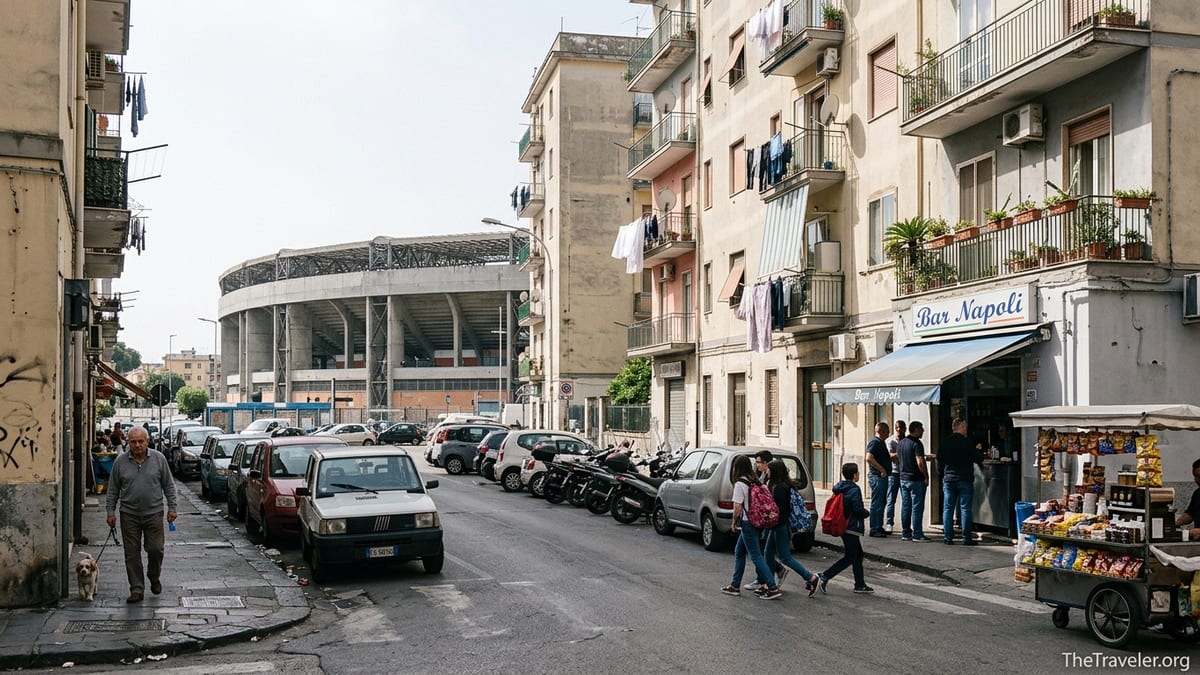
Fuorigrotta: The Working City Behind the Postcards
Fuorigrotta sits on the western side of Naples, on the flat land that stretches toward the volcanic fields of the Campi Flegrei. For centuries it was rural countryside. Only in the 20th century, especially from the 1930s onward, was it transformed with new avenues and monumental complexes such as the Mostra d’Oltremare trade fair. Today it is one of the city’s most densely populated districts, a place of concrete apartment blocks, busy arterial roads and everyday commerce rather than grand historic churches.
Most tourists never see this side of Naples because guidebooks and tour operators focus on the UNESCO-listed historic center and the photogenic alleyways of the Quartieri Spagnoli. Visitors who do venture west often transit straight through Fuorigrotta without noticing it, changing trains at Napoli Campi Flegrei station on their way to Pozzuoli or the beaches near Bagnoli. Yet stepping outside the station and walking along Viale Augusto for even half an hour introduces you to a Naples where grocery stores, hardware shops and tiny bars still clearly serve locals first.
That working-city character is what makes Fuorigrotta interesting. Naples is routinely praised for its authenticity, but in the most central neighborhoods the surge in visitors over the past decade has already shifted the balance toward short-term rentals, souvenir stalls and menus translated into five languages. A tram ride through Fuorigrotta, past schools, social clubs and corner cafes, shows a different texture of daily life where tourism is present but rarely dominant.
Urbanistically, this is a planned district of straight, broad streets laid out around modern infrastructure. It feels very different from the medieval tangle of the centro storico. If you want to understand how Naples expanded in the 20th century, where football fandom concentrates on match days, where students live to be close to the university, and where families do their weekly shop away from postcard views, Fuorigrotta is the place to see it in action.
Getting There: A Fifteen-Minute Ride to Another Naples
Reaching Fuorigrotta from central Naples is simple and inexpensive. From Napoli Piazza Garibaldi, the city’s main rail hub beneath Centrale station, you can take Metro Line 2 toward Pozzuoli and get off at Campi Flegrei, Cavalleggeri Aosta, or even the slightly farther stop at Bagnoli. Line 2 is technically a suburban rail line, but for visitors it works like a metro: frequent trains and an east–west axis that slices underneath the city. Typical single tickets for this ride are in the range of a few euros, similar to an urban metro ticket elsewhere in Italy.
To put the distance in perspective, travel time from Piazza Garibaldi to Campi Flegrei is often around 15 minutes when services are running smoothly. That is less time than many visitors spend in line outside a famous pizzeria in the historic center. Because Line 2 is also part of the regional rail network, trains can be crowded at rush hour, and minor delays are not unusual, so it is wise to avoid peak commuter periods when possible.
Arriving at Napoli Campi Flegrei station, you emerge directly into the heart of Fuorigrotta. The station itself is large by Neapolitan standards, one of the busiest after Napoli Centrale and Afragola, with platforms serving both metro-style Line 2 trains and regional services toward Caserta and Salerno. Step outside and you find bus stops, the occasional taxi, street vendors selling snacks, and the high towers of residential buildings rising in every direction. Within a short walk are the Mostra d’Oltremare fairgrounds, the Diego Armando Maradona Stadium and the surrounding grid of residential streets.
For travelers already comfortable with Naples’ public transport, combining Line 2 with the Cumana and Circumflegrea suburban lines from nearby stations opens up even more local territory: seaside walks in Bagnoli, the cafes of Pozzuoli, or the fumaroles of the Campi Flegrei. In practice, a day exploring Fuorigrotta and its surroundings can be slotted between more classic sights without much extra effort or expense.
Stadium Nights and Street Corners: Everyday Life in Fuorigrotta
Fuorigrotta’s atmosphere can change dramatically depending on the calendar. On a weekday mid-morning, you might stroll down Via Giulio Cesare and see schoolchildren in uniform, retirees standing at counters sipping espresso, and market stalls selling inexpensive household goods and clothing. Prices here tend to be closer to what locals actually pay: a quick coffee can still cost around one euro, and a simple plate of pasta at a no-frills trattoria is often only a few euros more than the cafeteria-style places that serve Neapolitans on their lunch break.
On football nights the quarter transforms. The Diego Armando Maradona Stadium, just a few blocks from Campi Flegrei station, draws tens of thousands of Napoli supporters from across the city. Street vendors appear early, selling blue jerseys, scarves and roasted peanuts. Bars around the stadium fill with fans watching the pre-game broadcast, and snack stands do brisk business in fried pizza, crocchè and other classic Neapolitan street foods at prices that are usually lower than in the most heavily touristed parts of town. Even if you do not have a ticket, standing near the stadium as the crowd sings before kick-off can be an unforgettable window into local passion.
On non-match days these same streets feel almost subdued. You notice the residential life: balconies draped with laundry, neighbors chatting across the street, and small shrines to saints at corner intersections. Unlike the center, where historic facades often house boutique hotels and designer shops, Fuorigrotta’s ground floors are still largely occupied by green grocers, bakeries and service businesses. It is the kind of place where you might walk into a family-run pasticceria that has never been tagged in a viral social media post, order a sfogliatella for a modest price, and watch locals come and go with bags of pastries for Sunday lunch.
There is also a strong student presence in and around Fuorigrotta. Parts of the University of Naples Federico II and other higher education institutions have campuses nearby, and affordable rents compared with the historic core mean that both local and out-of-town students live in the surrounding buildings. The result is a mix of age groups that keeps bars and inexpensive eateries busy in the evenings, but the dominant feel remains residential rather than nightlife-driven. As a visitor, you can sit in a neighborhood bar, order an aperitivo, and listen as conversations unfold almost entirely in Italian and Neapolitan dialect rather than in a dozen tourist languages.
Mostra d’Oltremare and Green Space Where Locals Actually Go
One of Fuorigrotta’s most distinctive landmarks is the Mostra d’Oltremare, a vast complex originally built in the late 1930s as an international exhibition center. It remains one of Italy’s most important trade fair venues and a major hub for events in southern Italy, hosting everything from travel shows and book fairs to concerts and sporting events. Architecturally it is a showcase of rationalist design: wide avenues, monumental facades and open courtyards framed by colonnades, all set in extensive grounds with fountains and gardens.
For travelers, the appeal is twofold. First, if a fair, festival or concert is taking place during your visit, it can be a way to experience Naples as Neapolitans do, attending a regional food exhibition or a contemporary art event that may not be promoted in international tourist brochures. Second, the complex provides unusually generous green space for an otherwise dense urban district. On certain days or during specific events, parts of the park-style grounds are accessible for leisurely walks, children’s play and picnics, offering a break from the narrow, crowded alleys of the city center.
The streets around Mostra d’Oltremare also reveal a side of Naples’ modern history that is easy to miss if you only explore older quarters. The wide Viale Kennedy and Viale Giochi del Mediterraneo, the sports facilities built for past international competitions, and the lingering traces of mid-century planning all speak to a period when Fuorigrotta was envisioned as a showcase of progress and international outreach. By walking between the exhibition pavilions, the stadium and the nearby university buildings, you move through layers of 20th-century ambition that contrast sharply with the medieval churches and Baroque palaces closer to the port.
For families, the area has additional practical advantages. There are playgrounds, casual pizzerias happy to seat groups with children, and supermarkets where you can stock up on snacks or picnic supplies at local prices. Instead of queuing for a table at one of the most publicized pizzerias in the centro storico, you might discover a simple neighborhood place a few blocks from Campi Flegrei where the wood-fired oven turns out classic Margherita pizzas at prices that reflect everyday demand rather than international fame.
Fuorigrotta vs. The Historic Center: Different Faces of “Authentic”
Travel debates about Naples often revolve around the word “authentic.” The historic center and the Quartieri Spagnoli are repeatedly described as the city at its most real: narrow alleys, laundry strung overhead, densely packed bassi apartments, and an energy that can feel almost overwhelming to visitors from more orderly cities. Those descriptions are not wrong, but they capture only one layer of the metropolis, and in recent years those same neighborhoods have seen a marked increase in tourist-oriented businesses, boutique hotels and Instagram-ready experiences.
Fuorigrotta offers a complementary version of authenticity. Here the architecture is more modern, the streets wider, and the street life shaped not by sightseeing but by schools, sporting events and trade fairs. Where the centro storico might offer a centuries-old church filled with art, Fuorigrotta offers a 20th-century parish filled with parishioners; where Via dei Tribunali has pizza queues of international travellers, Viale Augusto has pizzerias whose primary clientele is families from surrounding apartment blocks. Both are authentic expressions of Naples, but they speak to different aspects of its identity.
Concrete examples bring this contrast into focus. In the Spanish Quarter, a coffee at a bar frequented by visitors might cost slightly more and come with an English-speaking server who is used to explaining the difference between caffè and caffè lungo. In Fuorigrotta, you are more likely to stand at the counter beside office workers and students, pay a straightforward local price and exchange a quick greeting with a barista who assumes you understand the routine. In the historic center, the shop next door might sell magnets and T-shirts; in Fuorigrotta it is more likely to be a key-cutting service, a pharmacy or a small grocery.
This is not to say that Fuorigrotta is untouched by tourism. On match days, for example, you will certainly see visitors wearing blue Napoli jerseys and taking photos of murals dedicated to club legends. Some short-term rentals and small guesthouses have appeared to serve football fans and fair visitors. Yet compared with the core, the pace of change feels slower and the overall balance still tips strongly toward long-term residents. For travelers who want to understand how Neapolitans actually live in 2026, that perspective can be just as valuable as admiring Caravaggio in a historic chapel.
Planning a Visit: When and How to Experience Fuorigrotta
The easiest way to explore Fuorigrotta is to devote half a day during a longer stay in Naples. A practical itinerary might begin with a mid-morning Line 2 train to Campi Flegrei, a coffee and pastry at a bar near the station, and a walk around the perimeter of the Diego Armando Maradona Stadium to see murals and fan graffiti. From there, continue along Viale Augusto and nearby side streets to get a feel for residential life, ducking into supermarkets and bakeries as you go. If an event is on at Mostra d’Oltremare and public access is allowed, you can include a stroll through its grounds before returning via metro or by continuing toward the Campi Flegrei volcanic area.
Selecting your timing matters. On major match days, crowds around the stadium can be intense, with road closures and strong police presence. That can be exhilarating if you want to experience the energy of Neapolitan football, but it is less ideal if your plan is a quiet neighborhood walk. Checking the fixture list in advance and planning either to lean into the chaos or to choose a non-match day will make a significant difference to your experience. On weekday mornings, the mood is calmer and you are more likely to see people going about their errands.
Safety-wise, Fuorigrotta shares many of the same characteristics as other working-class urban districts. During the day, the main streets around Campi Flegrei, the stadium and Mostra d’Oltremare see a steady flow of people and feel broadly similar in safety to other busy Neapolitan areas. Late at night, especially on quieter residential blocks far from the stadium and main roads, the streets can empty out quickly. Basic urban travel habits apply: keep valuables secure, avoid displaying expensive items, stay in well-lit areas, and use official taxis or app-based services if you feel uncomfortable walking back to your accommodation after dark.
Language is another point to consider. In central Naples, many businesses that cater to visitors have at least one staff member who speaks some English, French or Spanish. In Fuorigrotta, particularly in very local bars and shops, you are more likely to encounter people who primarily speak Italian and Neapolitan. A few simple phrases, a friendly attitude and a willingness to gesture and smile go a long way. The reward for making that effort is a sense of participating, however briefly, in an everyday neighborhood rather than observing a city that has arranged itself around tourism.
The Takeaway
Skipping Fuorigrotta will not ruin a trip to Naples. You can still tour underground catacombs, walk Spaccanapoli, visit castles and eat excellent pizza without ever seeing the Diego Armando Maradona Stadium or the avenues around Mostra d’Oltremare. For many short-stay visitors, time is limited and the pressure to see headline sights is real. Yet for travelers who value understanding how a city really works, Fuorigrotta offers a compelling argument to expand the map beyond the center.
In this western quarter, Naples sheds some of its theatrical, tourist-facing performance and reveals itself as a contemporary European city of commuters, students, football supporters and families doing their shopping. The architecture may be less photogenic, but the scenes are deeply revealing: kids in team jerseys kicking a ball in a concrete courtyard, fans pouring out of the metro in a sea of blue, neighbors greeting each other outside the bakery on a Saturday morning.
Adding even a few hours in Fuorigrotta to your Naples itinerary is not about chasing a more “authentic” badge than fellow travelers. It is about recognizing that authenticity in a living city has many faces. The Renaissance cloisters and baroque churches of the centro storico show one, the graffiti-covered alleys of the Quartieri Spagnoli another, and the broad streets and stadium lights of Fuorigrotta yet another. Choosing to see all three gives you a fuller, more honest picture of Naples as it is lived in 2026.
So when you plan your days around the Bay of Naples, consider budgeting one metro ticket and an open morning for Fuorigrotta. Stand in the shadow of the stadium, watch daily life unfurl on Viale Augusto, and, if you are lucky, share a coffee with someone whose Naples rarely appears on postcards. You may find that this overlooked quarter becomes one of your strongest memories of the city.
FAQ
Q1. Is Fuorigrotta safe for tourists during the day?
During daylight hours, the main streets around Campi Flegrei station, the stadium and Mostra d’Oltremare generally feel similar in safety to other busy parts of Naples. Normal big-city precautions still apply, such as keeping valuables secure and staying aware of your surroundings, but most visitors who come for events or casual walks do so without incident.
Q2. How long does it take to reach Fuorigrotta from central Naples?
From Napoli Piazza Garibaldi, taking Metro Line 2 toward Pozzuoli typically brings you to Campi Flegrei station in around 15 minutes when trains are running on schedule. Factoring in walking to and from platforms, most travelers can expect the overall journey from the historic center to Fuorigrotta’s heart to take roughly 25 to 30 minutes door to door.
Q3. What is the best time to visit Fuorigrotta?
Weekday mornings or early afternoons are ideal if you want to see everyday life with schools, markets and cafes in full swing. If you are interested in Napoli football culture, coming on a home match evening can be exciting, but be prepared for dense crowds, loud celebrations and a more chaotic atmosphere around the stadium and metro stations.
Q4. Can I visit Fuorigrotta with children?
Yes, many families live in Fuorigrotta, and the area has playgrounds, casual pizzerias and supermarkets that make it practical for children. Parents should pay attention near busy roads and on match days when crowds are large, but outside those peak times a daytime visit with kids to see the stadium exterior or explore green spaces near Mostra d’Oltremare can be very manageable.
Q5. Are there good places to eat in Fuorigrotta?
Fuorigrotta is filled with local bars, bakeries and straightforward trattorias aimed at residents rather than tourists. You can find classic Neapolitan pizzas, simple pasta dishes and pastries at prices that reflect everyday demand. While you may not encounter the internationally famous names of the historic center, the food is often satisfying and offers a more routine slice of Neapolitan dining culture.
Q6. Is Fuorigrotta worth visiting if I only have two days in Naples?
If your time is extremely limited, you may prefer to focus on the historic center and a couple of headline sights. However, if you are the kind of traveler who values understanding local life as much as ticking landmarks, even a two-hour detour to Fuorigrotta can add depth to your impression of Naples. It is especially worthwhile if you are already passing through Campi Flegrei station for a trip toward Pozzuoli or the Campi Flegrei area.
Q7. Do I need to speak Italian to get by in Fuorigrotta?
Knowing some Italian is helpful because fewer businesses here are used to serving non-Italian-speaking tourists compared with the historic center. That said, many visitors manage with basic phrases, gestures and patience. Ordering coffee, buying a ticket or paying for a meal can typically be handled with simple vocabulary and a friendly attitude.
Q8. What should I wear when visiting Fuorigrotta and the stadium area?
Comfortable walking shoes and casual clothing are appropriate, as you will likely be on your feet exploring streets, stadium surroundings and possibly fairgrounds. On match days, many people wear Napoli colors or scarves, but visitors are not required to dress in team gear. As always in cities, avoid flashing expensive items and consider a small crossbody bag or money belt for valuables.
Q9. Is Fuorigrotta a good base for accommodation in Naples?
Fuorigrotta can work as a base for certain travelers, especially football fans, students, or visitors attending events at Mostra d’Oltremare, thanks to its transport links and more residential pricing. However, those who prioritize walking access to classic sights, major museums and historic streets may still prefer to stay nearer to the centro storico or along central transit lines and visit Fuorigrotta as a half-day excursion.
Q10. How does Fuorigrotta compare to the Spanish Quarter in terms of authenticity?
Both areas are authentic, but in different ways. The Spanish Quarter offers older architecture, tight alleys and a growing tourist presence, while Fuorigrotta presents a more modern, working-city feel centered on the stadium, fairgrounds and everyday services. Experiencing both gives you a broader understanding of how different communities within Naples live and interact with the city.