


Fuorigrotta rarely appears on the front of postcards from Naples. It sits west of the historic center, beyond the tunnels that pierce the Posillipo hill, and many visitors only glimpse it from a train window on the way to Pozzuoli. Yet this working Neapolitan district is home to the Diego Armando Maradona Stadium, the Mostra d’Oltremare exhibition grounds, Edenlandia amusement park and some of the city’s biggest concerts. Whether it is worth visiting depends a lot on what you want from your time in Naples. Here is a clear-eyed look at Fuorigrotta today, what it offers travelers, and when it makes sense to add it to your itinerary.
Get the latest updates straight to your inbox!
Getting Oriented: What and Where Is Fuorigrotta?
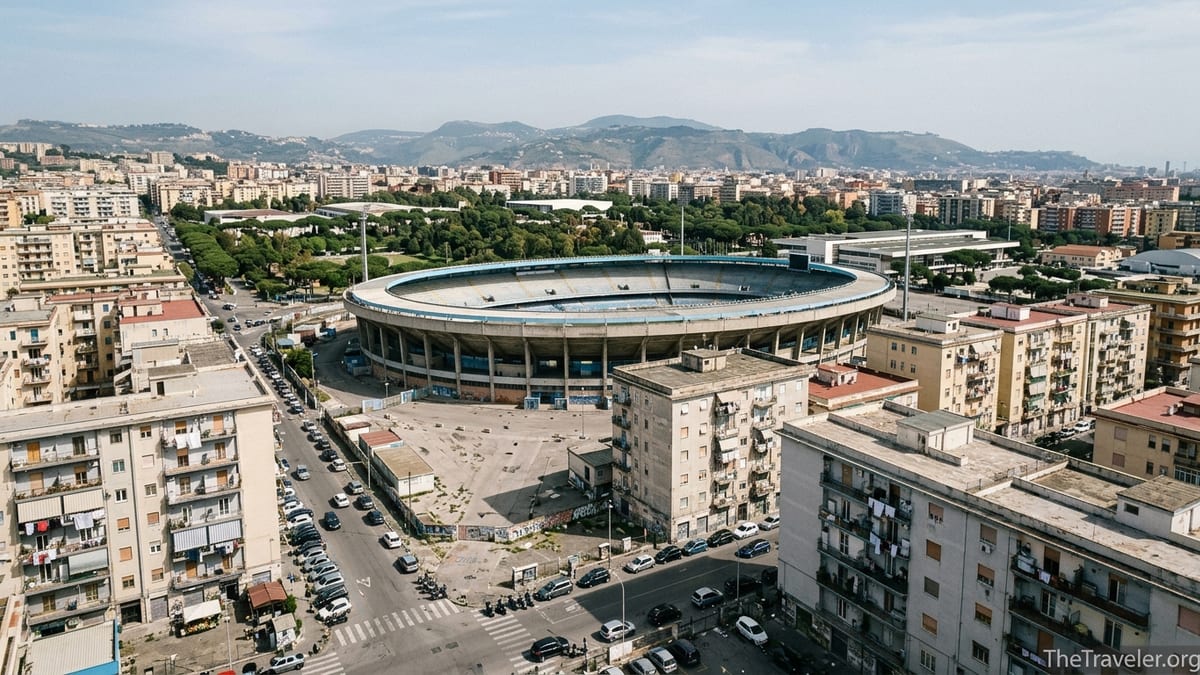
Fuorigrotta is a largely residential district in the western part of Naples, roughly 5 to 6 kilometers from Piazza del Plebiscito and the historic center. It grew rapidly in the 20th century and today feels more like everyday Naples than a curated historic quarter. You will see mid-rise apartment blocks, busy traffic, small local shops and pizzerias, plus two major university campuses. It is not pretty in a postcard sense, but it is very alive and distinctly local.
For visitors, the main reference points are the Campi Flegrei railway and metro station, the Diego Armando Maradona Stadium a short walk away, and the Mostra d’Oltremare fairgrounds, which include gardens, fountains, a zoo and the summer Arena Flegrea open-air theater. Nearby, the Edenlandia amusement park and the Zoo di Napoli form a compact leisure area that is especially popular with local families on weekends.
Fuorigrotta is well connected to the rest of Naples. Metro Line 2 runs from Campi Flegrei to central stops like Piazza Cavour and Garibaldi, and the Cumana railway line links Fuorigrotta with the seaside district of Bagnoli and the town of Pozzuoli. For many travelers, the area is first encountered while changing trains or heading to a football match. Deciding whether to stay longer is mostly about matching what you find here with your own interests.
Why Travelers Choose Fuorigrotta: Football, Fairs and Concerts
The strongest reason to come to Fuorigrotta is football. The Diego Armando Maradona Stadium, formerly Stadio San Paolo, is SSC Napoli’s home and one of Italy’s most atmospheric grounds. On match days, especially for big Serie A or Champions League games, the whole district gears up several hours in advance. Bars around Piazzale Tecchio fill with supporters in blue shirts, kiosks sell scarves and flags, and Via Giambattista Marino and the surrounding streets become a sea of people heading to the turnstiles.
If you have tickets for a Napoli home game, staying near the stadium can be very practical. You can walk to and from the match instead of relying on packed metro trains, and many hotels and guesthouses in the area are accustomed to late post-game returns. Even if you are not a die-hard fan, experiencing a match here is a uniquely Neapolitan event, and for that alone Fuorigrotta can be worth a dedicated half day.
The second big draw is events at the Mostra d’Oltremare and the Arena Flegrea. The exhibition complex hosts trade fairs, comic and game conventions, food festivals and travel shows throughout the year, plus large summer concerts and cultural events at the Arena. If you are attending something specific, such as a wine fair or a concert at Arena Flegrea, staying within walking distance spares you a late-night journey back to the center and lets you drop into your hotel between sessions.
Fuorigrotta also hosts some of the largest stadium concerts in southern Italy, from Italian rock legends to international pop tours. When artists schedule multi-night runs at the Maradona Stadium, thousands of fans pour into the district. Hotels, B&Bs and short-term rentals fill quickly and prices rise. If your trip coincides with a major concert, you may decide either to embrace the atmosphere and stay there, or to avoid the area completely during event evenings because of traffic restrictions and crowds.
Daytime Atmosphere: Everyday Naples, Not a Showpiece
Outside event days, Fuorigrotta feels like a normal peripheral district of a large Italian city. Via Giulio Cesare and Via Leopardi are lined with cafes, bakeries, household shops and phone stores. In the morning you will see parents rushing children to school, students heading to the university and older residents chatting on benches in small squares. English is less widely spoken here than in the historic center, and menus often cater to locals first.
Travelers looking for “authentic” Naples sometimes find this appealing. You can drink an espresso at a standing bar for roughly 1 to 1.30 euros and pick up a slice of pizza al taglio or a frittatina di pasta from a neighborhood fry shop for a couple of euros. Traditional sit-down pizzerias in Fuorigrotta tend to be busy with locals at dinner but do not draw the international queues that famous central pizzerias endure. If you enjoy slipping into everyday city life, this can feel refreshing.
At the same time, Fuorigrotta is not particularly rich in historic architecture or polished public spaces. The Mostra d’Oltremare complex has some noteworthy rationalist-era buildings and a monumental fountain, but most residential streets are visually anonymous. Graffiti, traffic and slightly worn infrastructure are part of the landscape. Visitors who picture Naples only as the timeless lanes around Spaccanapoli may find Fuorigrotta surprisingly modern and unromantic.
Shoppers interested in local clothing chains and household goods stores will find plenty to browse, but this is not a district for high-end boutiques or traditional artisan workshops. If your main goal is to wander pretty streets and photograph churches and palaces, your time is generally better spent in the historic center, Chiaia or the seafront around Castel dell’Ovo.
Key Sights in Fuorigrotta: What You Can Actually See and Do
The single most famous sight is the Diego Armando Maradona Stadium. When games or major concerts are not on, it can look rather quiet from the outside, but walking around the perimeter still gives a sense of scale. On match days, the experience is transformed by fans, banners and chants, especially around the Curva A and Curva B entrances. Formal museum and tour offerings inside the stadium have been limited and somewhat inconsistent in recent years, so it is best to check locally or through official channels if you hope for an organized visit to the stands or changing rooms.
Next to the stadium stretches the Mostra d’Oltremare, a 72-hectare fairground park that combines exhibition pavilions with gardens and open spaces. Inside, you will find long palm-lined avenues, lawns where locals picnic, and the Fountain of the Esedra, a large fountain complex that is particularly attractive in the evening when illuminated during events. Parts of the park may be closed or ticketed during fairs, while on some days you can enter paying a modest fee to access the green areas. It is not a must-see on a short first trip, but if you are in Fuorigrotta for another purpose it is a pleasant place to stroll away from traffic.
On the western edge of the Mostra d’Oltremare lies Edenlandia, a compact amusement park that was extensively renovated and reopened in the last decade. Its rides are not on the scale of the largest European theme parks, but you will find a Ferris wheel, small roller coasters, family rides and carnival-style games. It appeals mainly to local families with younger children, and for visitors staying nearby with kids it can fill an afternoon or evening. Next door, the Zoo di Napoli offers a relatively small but evolving collection of animals and is gradually upgrading enclosures and educational displays.
Fuorigrotta is also a practical departure point for exploring the wider Campi Flegrei volcanic area to the west. From Campi Flegrei station you can board the Cumana railway to the seaside neighborhood of Bagnoli, the archaeological sites around Pozzuoli, and eventually to coastal towns further along the bay. In this sense, even if you do not linger long in the district itself, you may pass through it on day trips to the surrounding region.
Staying in Fuorigrotta: Who It Suits and Who It Does Not
Accommodation in Fuorigrotta ranges from basic business hotels and sports-focused properties near the stadium to apartment-style guesthouses and student-oriented rentals. Prices are often lower than in the historic center or Chiaia, especially midweek outside major events. Travelers on a tight budget who do not mind a residential environment sometimes base themselves here to save on hotel costs while relying on the metro for sightseeing.
Fuorigrotta works best as a base for certain types of trips. If your main reason to visit Naples is a specific football match, a series of concerts, or a multi-day fair at Mostra d’Oltremare, staying within walking distance is highly convenient. You can return to your room between sessions, avoid late-night cross-town travel, and easily drop off any purchases or event materials.
On the other hand, first-time visitors with just a couple of days in Naples usually find it more rewarding to sleep closer to the places they will spend most of their time. From Fuorigrotta, a metro ride into the historic center can take 20 to 30 minutes depending on connections and wait times. Over a short stay, that commute back and forth for lunch, sightseeing and dinner adds up. Guests who dream of opening their window onto narrow lanes and baroque churches will be disappointed by the view of busy main roads and modern blocks.
Noise is another consideration. On match days and during big stadium concerts, the area around the Maradona Stadium can remain noisy late into the night, with fans singing, traffic honking and informal street parties. If you prefer quiet evenings and early nights, you may want to book away from the immediate stadium zone or choose a different district altogether.
Safety, Practicalities and Local Etiquette
Fuorigrotta shares the same general safety profile as much of urban Naples. Petty crime exists, especially around crowded transport hubs and during large events, so usual city precautions apply: keep valuables secured, avoid displaying expensive watches or large amounts of cash, and be attentive on crowded trains and platforms. Many foreign students attend nearby universities and live in the area, and locals commonly describe most of the district as reasonably safe in everyday life, while still acknowledging that theft and some organized crime are part of the broader city reality.
At night, the main streets around Campi Flegrei station, Via Giulio Cesare and the stadium remain fairly lively on event days, with plenty of people out and about. On quieter evenings, side streets can feel dimly lit and less animated, which some visitors may find uncomfortable more for atmosphere than actual risk. If you are returning late, prefer main routes, consider walking with others and use reputable taxis or ride-hailing services from well-lit stands when needed.
Transport practicalities are generally good. Metro Line 2 and the Cumana rail line both stop at Campi Flegrei, and during major matches or concerts extra trains are often scheduled to help disperse crowds after the event. Buses and taxis are readily available along the main arteries. That said, traffic can become heavily congested before and after games or stadium shows, and the city sometimes introduces temporary road closures around the stadium to manage flows, so plan more time than usual for transfers on those dates.
As in the rest of Naples, a few words of Italian and a friendly attitude go a long way. Staff in smaller bars and bakeries may not be used to international tourists, so speaking slowly, being patient and using simple phrases helps. It is polite to order and pay for your coffee at the cashier before approaching the bar counter, and when buying slices of pizza or fried snacks, be prepared for quick service and a lively, informal atmosphere.
How Fuorigrotta Compares to Other Naples Districts
When deciding whether Fuorigrotta is worth visiting, it helps to compare it directly with other parts of Naples you might be considering. The historic center offers dense clusters of churches, underground archaeological sites, and classic streets like Spaccanapoli and Via dei Tribunali, with famous pizzerias and crowded nightlife. Chiaia and the seafront around Via Caracciolo give you elegant shopping, sea views and a promenade that feels more polished. Vomero, on the hill above, mixes residential streets with viewpoints, castles and a slightly calmer, more middle-class feel.
Fuorigrotta, by contrast, is more about specific venues than general charm. If you draw a map of what actually pulls visitors here, it would highlight the Maradona Stadium, Mostra d’Oltremare, Edenlandia and perhaps the Zoo di Napoli, with everything else serving as background. It lacks the scenic bay views of Posillipo, the UNESCO-listed palazzi of the center or the nightlife density of Quartieri Spagnoli. That does not make it unworthy, but it does mean you should be honest about your priorities.
For sports enthusiasts, music fans and trade fair attendees, Fuorigrotta can be the heart of their Naples experience. A supporter traveling primarily to see Napoli play might combine a stadium tour or museum visit in the city with a match night, dinners in local pizzerias and a walk through the Mostra gardens. A family attending a children’s fair at Mostra d’Oltremare could weave in a few rides at Edenlandia and a simple trattoria meal without ever venturing far from the district.
If your primary image of Naples involves wandering ancient streets, tasting pastries in historic cafes and taking funiculars to hilltop viewpoints, Fuorigrotta is better treated as a targeted side trip of a few hours rather than a place to linger. You might come for an afternoon match or evening concert, but base yourself in a more central neighborhood that aligns with the rest of your plans.
The Takeaway
So, is Fuorigrotta in Naples worth visiting during your trip? The answer is a conditional yes. For many travelers, the district’s appeal is narrow but strong. If you are coming for Napoli football, a stadium concert, a major trade fair or a family outing to Edenlandia or the zoo, Fuorigrotta suddenly becomes a pivotal point of your itinerary, and staying nearby can make practical sense.
If you have limited time and no specific reason to be there, Fuorigrotta is rarely essential. Naples offers more visually striking, historically rich and atmospherically distinctive neighborhoods closer to the city’s main attractions. In that case, dedicating your energy to the historic center, seafront areas and the surrounding Campi Flegrei or Amalfi Coast will likely bring more reward.
The district can, however, add an interesting dimension to a longer Naples stay. Dropping into Fuorigrotta for a high-energy match night or a summer concert at Arena Flegrea gives you a glimpse of contemporary, everyday Naples that sits alongside the baroque churches and ancient ruins. Approach it with realistic expectations, a sense of purpose and the same streetwise awareness you would bring to any large southern European city, and Fuorigrotta can be a vivid, if not conventionally beautiful, chapter in your Neapolitan story.
FAQ
Q1. Is Fuorigrotta safe for tourists during the day and at night?
Fuorigrotta is generally as safe as many busy urban districts in Naples, especially along main streets and around transport hubs. Petty crime such as pickpocketing can occur, particularly near stations and during big events, so keep valuables secure and stay aware of your surroundings. At night, stick to well-lit routes, avoid very quiet side streets and consider taxis if returning late after a match or concert.
Q2. How far is Fuorigrotta from the historic center of Naples?
Fuorigrotta lies roughly 5 to 6 kilometers west of the historic center. By Metro Line 2 from Campi Flegrei station to central stops, the journey usually takes about 15 to 20 minutes, plus any walking and waiting time. By taxi, the trip can be similar or longer depending on traffic, particularly before and after stadium events.
Q3. Is Fuorigrotta a good area to stay in for first-time visitors?
For most first-time visitors with only a few days in Naples, staying closer to the historic center, Chiaia or the seafront is usually more convenient and atmospheric. Fuorigrotta can be a good base if your main reason for visiting is a specific match, concert or fair, or if you find significantly better accommodation value and do not mind commuting for sightseeing.
Q4. What are the main attractions in Fuorigrotta?
The main attractions are the Diego Armando Maradona Stadium, home of SSC Napoli, the Mostra d’Oltremare exhibition and park complex, the Arena Flegrea open-air theater, the Edenlandia amusement park and the Zoo di Napoli. Beyond these, the district is more focused on everyday life than traditional tourist sights.
Q5. How do I get to Fuorigrotta from Naples Central Station?
From Napoli Centrale or Piazza Garibaldi, you can take Metro Line 2 in the direction of Pozzuoli and get off at Campi Flegrei station in Fuorigrotta. Travel time is typically around 15 to 20 minutes. Alternatively, taxis are available outside the station, though they may take longer and cost more, especially during rush hour.
Q6. Is Fuorigrotta suitable for families with children?
Fuorigrotta can work well for families, particularly if you plan to visit Edenlandia, the Zoo di Napoli or a family-friendly event at Mostra d’Oltremare. The area is not as scenic as central Naples but offers kid-oriented activities and relatively straightforward transport. Just take the usual precautions with children in busy urban areas and crowded public transport.
Q7. What is the atmosphere like in Fuorigrotta on Napoli match days?
On Napoli match days, Fuorigrotta becomes very lively. Streets around the stadium fill with fans wearing blue, vendors sell scarves, flags and snacks, and bars play club songs and match coverage. Expect heavy foot traffic, strong emotions and a festive yet intense atmosphere before and after the game. It can be thrilling for football fans but may feel overwhelming if you dislike large crowds.
Q8. Are there good places to eat in Fuorigrotta?
Fuorigrotta has plenty of local pizzerias, trattorias, bakeries and snack bars that primarily serve residents, students and match-goers. While it lacks the international reputation of some historic-center addresses, you can find solid Neapolitan pizza, fried street food and simple home-style dishes at generally reasonable prices, especially away from the immediate stadium streets.
Q9. Is Fuorigrotta a good base for exploring the Campi Flegrei area?
Yes, Fuorigrotta can be a convenient jumping-off point for the wider Campi Flegrei. From Campi Flegrei station, the Cumana railway takes you quickly to Bagnoli, Pozzuoli and other stops along the volcanic coast. If your itinerary includes several excursions in this direction, staying in Fuorigrotta can reduce travel time compared with sleeping further east.
Q10. Would you recommend Fuorigrotta for a short weekend city break?
For a short weekend focused on classic Naples sights, Fuorigrotta is usually not the first choice. You will spend extra time commuting to and from the historic center and main museums. It becomes a strong option only if your weekend is built around a particular match, concert or fair held in the district. In that case, combining your event with a few central sightseeing excursions can make for a balanced stay.