


Walk into an Ibis in Berlin, Barcelona or Brussels and you will likely recognize the formula immediately: compact but functional rooms, the same red logo by the door, a quick check in, and a price that often undercuts many local independents. In a continent filled with historic pensions, guesthouses and big-name hotel chains, Ibis has quietly become one of Europe’s most recognisable budget hotel brands, shaping how millions of people now experience affordable travel.
Get the latest updates straight to your inbox!
From French Experiment to European Benchmark
The Ibis story begins in 1974, when French group Accor opened the first Ibis in Bordeaux as one of the world’s earliest fully standardised economy hotel brands. At a time when budget accommodation in Europe often meant uneven quality and basic roadside motels, Ibis set out to do something different: offer predictable comfort at a reasonable price, wherever you were on the map. Over the following decades, that simple promise resonated with both business travellers and holidaymakers who were tired of gambling on unknown budget hotels.
By the late 2000s, Ibis had reached roughly 800 hotels worldwide and had already become a reference in the European economy segment. Accor doubled down, investing heavily in opening and rebranding properties under the Ibis name across France, Germany, Spain, the UK and beyond. In 2013, the group’s mega-brand strategy, bundling Ibis, Ibis Styles and Ibis Budget under a single family, helped Ibis become the leading hotel brand in Europe by number of rooms and properties. Today, Accor operates thousands of Ibis-branded hotels worldwide, with Europe as its heartland and densest market.
For travellers, this long expansion shows up in practical ways. It is now common to step out of a train station in cities like Lyon, Warsaw or Hamburg and see a familiar red Ibis sign within a few minutes’ walk. Airport perimeters such as Paris Charles de Gaulle or Berlin Brandenburg also show how far the brand has penetrated: clusters of Ibis, Ibis Styles and Ibis Budget properties sit side by side, each targeting a different price point but all trading on the same reputation for functional, affordable stays.
The rise of low-cost airlines and rail promotions across Europe has further fuelled Ibis’s growth. As flights on carriers such as Ryanair, easyJet and Wizz Air made spontaneous weekend trips a mass-market habit, demand grew for similarly predictable, cheap beds on the ground. Ibis, already positioned around standardised comfort, was perfectly placed to capture this traffic, particularly near secondary airports, motorway exits and transport hubs.
A Three-Tier Family That Covers Most Budgets
One reason Ibis has become so visible in Europe is its three-tier structure, which lets the brand cover most of the budget and lower midscale market without confusing travellers. The classic Ibis sits at the core: simple, modern rooms, usually between 14 and 18 square metres, with a private bathroom, desk, and the chain’s trademark Sweet Bed by Ibis mattress. These hotels typically appeal to business travellers, couples and small families willing to pay a little more for comfort and convenient locations, such as the Ibis Berlin Mitte or Ibis London Blackfriars.
Ibis Budget targets the ultra-price-sensitive end of the market. In many European cities, it is one of the cheapest branded options available that still offers private rooms and en-suite facilities rather than hostel-style dorms. Travellers might find an Ibis Budget room on the outskirts of Madrid or just off the ring road around Vienna from roughly 40 to 70 euros per night outside of peak dates, undercutting many independent hotels while offering a big-brand safety net. Properties such as Ibis Budget Berlin Airport or Ibis Budget Paris Porte de Montmartre illustrate how the brand tends to favour locations near highways, airports and suburban metro stops where land is cheaper.
Ibis Styles, by contrast, is positioned as the playful cousin in the family. It targets travellers who still care about price but want more character and design. Each Ibis Styles property has its own visual theme, often tied to the local area. In Lisbon, an Ibis Styles near Avenida Liberdade might use tram motifs and azulejo-inspired patterns, while an Ibis Styles in Krakow incorporates graphic illustrations of the city’s Old Town into its lobby art. For a price often only slightly higher than classic Ibis, guests receive breakfast and Wi-Fi included, plus family-friendly touches like kids’ corners and more colourful public spaces.
This three-way segmentation allows Ibis to compete effectively with different sets of rivals. Ibis Budget can go head to head with hostels, roadside motels and no-frills domestic brands. Classic Ibis competes directly with chains such as Holiday Inn Express, B&B Hotels and Premier Inn in markets like Germany and the UK. Ibis Styles overlaps with trendier design-led budget concepts, appealing to younger travellers and families who might otherwise pick a quirky independent hotel if the price were right.
Standardised Comfort That Reduces Travel Risk
Consistency has arguably been the most powerful factor behind Ibis’s popularity in Europe. In practice, this means that a traveller arriving late at the Ibis Gare de Lyon in Paris after a delayed train, or checking in to an Ibis in Rotterdam before an early ferry, can reliably expect the same basic experience: a clean, compact room, a firm mattress, blackout curtains and decent soundproofing from the corridor and outside noise. While details vary by property age and refurbishment cycle, the overall feel across the network remains reassuringly similar.
Accor has spent years refining the room design to suit short stays and tight urban footprints. The Sweet Bed by Ibis concept, rolled out widely across the brand, focuses on a thick mattress, supportive topper and quality linens. This is an important differentiator at the budget level, where uncomfortable beds and lumpy pillows are still common in some small independent hotels. A guest who has slept well at the Ibis in Brussels Midi is more likely to book another Ibis in Milan or Prague rather than gamble on an unknown bargain option.
Bathrooms follow the same logic. Even at Ibis Budget, bathrooms are compact but functional, often designed as prefabricated modules that can be cleaned quickly and replaced over time. Showers tend to have good water pressure and straightforward controls, a small but important detail for weary travellers. The uniformity also means that people with mobility issues or families with children can reasonably anticipate how the layout will work before they arrive, reducing uncertainty around their stay.
Crucially, this standardisation travels well across borders. A French family driving to Italy for summer holidays might stay at an Ibis in Clermont-Ferrand on the way down, then at an Ibis Budget outside Turin as a midway stop, confident that both will deliver similar room layouts, parking arrangements and breakfast offerings. For business travellers who hop between European capitals, that familiarity reduces cognitive load: instead of researching dozens of local hotels, many simply look for the closest Ibis to the meeting venue or train station and book.
Prices That Track Local Demand Without Losing Value
In the real world of trip planning, Ibis’s reputation rests as much on what it costs as on the shape of its rooms. The brand uses dynamic pricing, just like airlines, which means rates can swing sharply during trade fairs, holidays or big events. But across a large sample of European cities and dates, Ibis properties tend to sit in a sweet spot: rarely the absolute cheapest, but frequently the cheapest option that still offers a fully private, branded hotel experience with a 24-hour reception.
Consider a midweek stay in low season in a secondary city, such as Lille or Zaragoza. Travellers often find Ibis Budget properties around 45 to 65 euros per night, classic Ibis around 70 to 100 euros, and Ibis Styles somewhere in between but with breakfast included. In capitals such as Rome or Amsterdam during shoulder season, those bands shift upward, but Ibis often undercuts international rivals by a noticeable margin, particularly in outlying districts with good public transport connections.
For travellers watching the bottom line, these price bands become a mental benchmark when scanning booking sites. If an Ibis Budget near Munich’s S-Bahn line is selling for 85 euros on Oktoberfest weekends while nearby small hotels charge over 150 euros for older rooms, the Ibis may still feel like reasonable value. In off-peak months, when classic Ibis rooms in cities like Budapest or Porto dip below 80 euros, they can be a clear upgrade over cramped, unbranded budget properties at similar prices.
Importantly, there is usually a transparent trade-off between rate and location. Hotels branded as Ibis often occupy central or near-central spots: overlooking train stations, just off ring roads or within walking distance of business districts. Ibis Budget hotels skew more suburban or peripheral, such as near Berlin Brandenburg Airport or alongside motorway junctions in northern Italy. That clarity allows travellers to decide whether they prefer to save a little by staying outside the centre or pay more for an Ibis right in the thick of things.
Everywhere You Need a Bed: Locations and Last-Minute Reliability
The density of the Ibis network in Europe is another major reason it has become a default choice. Accor has methodically placed Ibis properties along key travel corridors: ring roads around metropolitan areas, business parks on the edges of cities, service areas on major autoroutes in France, and spots within a short walk of main railway stations. For travellers planning multi-stop journeys by car or train, this network coverage turns the brand into an easy planning tool.
A concrete example can be seen along the Paris to Mediterranean corridor. Drivers leaving Paris late in the day frequently overnight in cities such as Clermont-Ferrand, Valence or Nîmes, each of which has one or more Ibis or Ibis Budget properties just off the motorway. The promise is simple: arrive late, park easily, check in quickly, sleep, then get back on the road after a basic breakfast. A similar pattern plays out in Germany on the Autobahn network and in Spain along routes linking Madrid, Valencia, Barcelona and Bilbao.
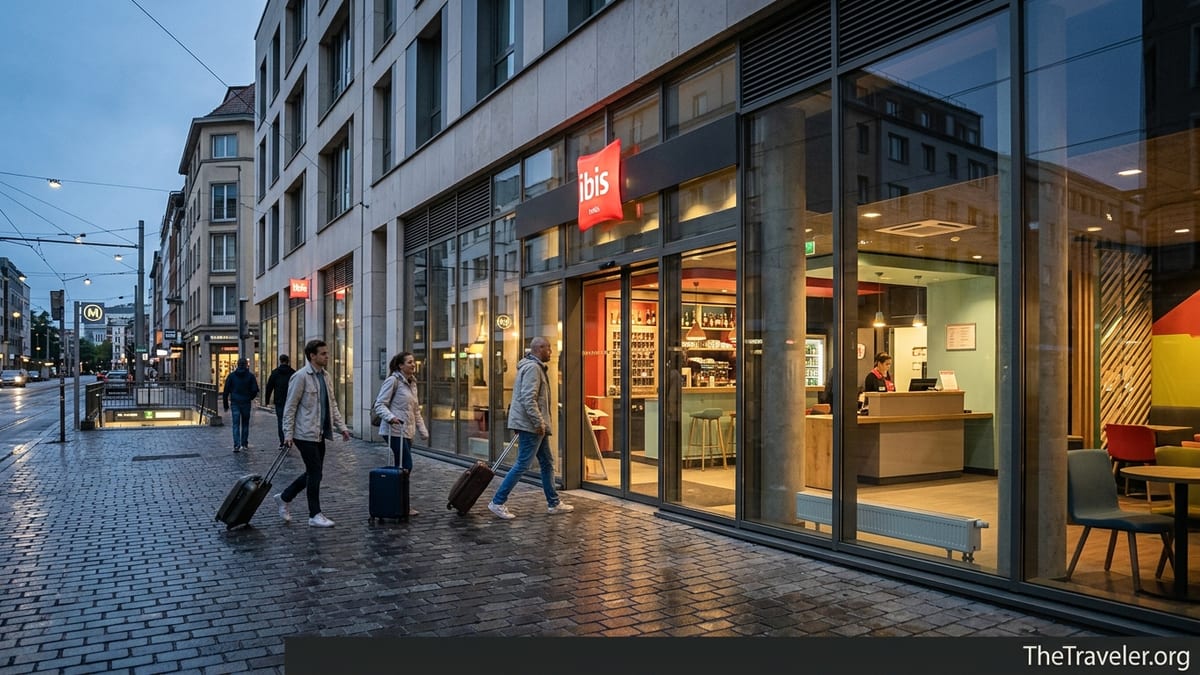
Rail hubs are equally important. Stations like Paris Gare de Lyon, Milan Centrale, Vienna Hauptbahnhof and Brussels Midi either have an Ibis directly attached or within a short walk. For travellers arriving on late trains or leaving early, this proximity often wins out over cheaper, more distant options. It is not unusual to see passengers wheeling suitcases straight from the platform into a nearby Ibis, especially in winter when walking far with luggage is less appealing.
This ubiquity means Ibis frequently becomes the “plan B” when other arrangements fail. Travellers who find their short-term rental double-booked in Barcelona, or who miss a last train connection in Frankfurt, often open a booking app and search for the nearest Ibis knowing that the odds of securing a same-night room are relatively high. That reliability in emergencies reinforces loyalty over time and helps explain why so many European travellers can recall at least one night spent at an Ibis, even if they do not consider themselves brand loyalists.
Modernising the Budget Experience: Design, Tech and Sustainability
While Ibis built its reputation on basic consistency, its ongoing popularity owes much to quiet but persistent upgrading of the budget experience. Over the past decade, Accor has refreshed room designs, public spaces and technology across many European properties to match changing expectations. In cities like Copenhagen, Warsaw and Lyon, recent openings and refurbishments feature open-plan lobbies that combine reception, bar and co-working corners, with USB charging, casual seating and sometimes table football or board games.
Technology has improved too. Online check-in and mobile keys are rolling out across more hotels, and Wi-Fi quality, once a common complaint at cheap hotels, has become a selling point. Many Ibis and Ibis Styles properties now promote fast, free connections that can handle video calls and streaming, a must for remote workers and digital nomads. Self-service kiosks at reception, already familiar in France and the Netherlands, further speed up arrivals during peak times.
Sustainability is another area where Ibis has tried to keep pace with shifting traveller values. Within the wider Accor group, the number of hotels with third-party eco-certification has risen quickly, and Ibis properties across Europe are increasingly part of that push. Examples include hotels piloting EU Ecolabel standards on the French Atlantic coast, where combined Ibis Styles and Ibis Budget complexes have introduced water-saving fixtures, eco-labelled cleaning products, reduced single-use plastics and improved waste sorting. For budget-conscious guests who still care about environmental impact, staying at a known brand that is publicly reporting its progress can feel more reassuring than choosing an unknown independent.
Smaller touches also play a role in keeping the brand current. Breakfast buffets in many European Ibis hotels have expanded to include more plant-based options, gluten-free bread or regional items like German pretzels or Spanish tortilla alongside the standard cereals, yoghurts and cold cuts. Ibis Styles properties, in particular, use local design agencies and artists to avoid a “copy-paste” look, which helps attract guests who might otherwise head to boutique hotels or lifestyle brands.
Loyalty, Recognition and the Power of Habit
Ibis’s parent company, Accor, has invested heavily in its loyalty ecosystem, now branded as ALL (Accor Live Limitless). For frequent travellers within Europe, especially those who stay in both budget and upscale hotels, this program makes Ibis more attractive by tying cheap nights to broader rewards. A consultant who alternates between Mercure, Novotel and Ibis hotels on a work circuit across Germany and Poland can pool all those stays into one account, earning points that can later be redeemed for free nights or room upgrades.
This matters in practice. For many business travellers operating under strict corporate travel policies, Ibis is an approved brand that fits within nightly rate caps while still accruing points. Over time, that relationship can become habitual: when planning yet another midweek visit to Brussels or Lyon, the path of least resistance is to book an Ibis where status benefits such as welcome drinks, late check-out or slightly better rooms may be available, depending on membership level and hotel occupancy.
Brand recognition is strong outside the loyalty sphere as well. In consumer surveys in France, Ibis has repeatedly ranked among the country’s favourite hotel brands, topping lists for affordability and reliability. This public awareness doesn’t stay within borders; French travellers driving through Belgium, Spain or Italy bring that trust with them and often seek out Ibis first. Similar patterns can be observed among German and British travellers who meet the brand at home and then re-encounter it abroad.
The end result is a kind of quiet network effect. Each successful stay at an Ibis in one city increases the likelihood that the next night away from home will also be booked with the brand. Over time, this compounding effect has helped Ibis secure a dominant presence in the European budget segment, even as new players such as citizenM, Motel One or various hybrid hostel brands have entered the market.
The Takeaway
Ibis did not become one of Europe’s most popular budget hotel brands by chasing trends or promising luxury on the cheap. Instead, it focused on something more durable: eliminating much of the uncertainty around affordable travel. By offering standardised comfort, clear pricing tiers, and a dense network of locations, it reduced the risk of being disappointed by a budget hotel, whether you checked in at midnight near a motorway exit or arrived early for a conference in a European capital.
Over time, that reliability has been reinforced by thoughtful upgrades in design, technology and sustainability, along with the glue of the Accor loyalty program. Travellers today can choose from an ever-growing array of boutique hostels, apartment rentals and lifestyle hotels, yet many still gravitate toward the red Ibis sign when the priority is a straightforward, fairly priced place to sleep.
For anyone planning a trip through Europe, understanding how Ibis positions its three brands can turn the brand into a useful tool rather than just a familiar logo. Ibis Budget can help shave costs on long road trips, classic Ibis offers solid value in business districts and near stations, and Ibis Styles adds personality without straying too far from the budget bracket. Together, they explain why Ibis has become not just a hotel chain, but a default choice for millions of European journeys.
FAQ
Q1. What is the main difference between Ibis, Ibis Budget and Ibis Styles?
Ibis is the classic core brand with simple, comfortable rooms in practical locations. Ibis Budget is cheaper and more stripped back, often in suburban or roadside spots. Ibis Styles is design-led, usually slightly pricier but often includes breakfast and has a distinct visual theme tied to the destination.
Q2. How much does a typical night at an Ibis cost in Europe?
Prices vary by city and season, but in many European destinations you might see Ibis Budget from roughly 40 to 70 euros per night, classic Ibis from around 70 to 120 euros, and Ibis Styles slightly above that, particularly in major capitals or during busy periods.
Q3. Are Ibis hotels usually in city centres or on the outskirts?
Classic Ibis and Ibis Styles are often in or near city centres, transport hubs and business districts. Ibis Budget hotels are more frequently found on the outskirts, close to motorways, airports or suburban rail links where land is cheaper and parking is easier.
Q4. Is breakfast included at Ibis hotels?
At many Ibis and Ibis Budget hotels, breakfast is an optional extra added to the room rate. Ibis Styles typically includes breakfast and Wi-Fi as part of the standard rate, which can make it good value for families or anyone who prefers a predictable morning routine.
Q5. Are Ibis hotels a good option for families with children?
Yes, especially Ibis Styles and some larger Ibis properties. Many offer family rooms, sofa beds, interconnecting rooms and kids’ play corners in the lobby. Ibis Budget rooms are more compact, so they work best for short stays or smaller families comfortable sharing limited space.
Q6. How do Ibis hotels compare to hostels for budget travellers?
Ibis and especially Ibis Budget are usually more expensive than a bed in a shared hostel dorm but provide private rooms, en-suite bathrooms, 24-hour reception and greater privacy. For couples, families or travellers who value quiet and predictability over social atmosphere, that trade-off often feels worthwhile.
Q7. Do Ibis hotels participate in a loyalty program?
Yes. All three Ibis brands are part of Accor’s ALL loyalty program. Guests can earn and redeem points across the group’s hotels, from budget to luxury, and frequent travellers may receive small perks such as welcome drinks, late check-out or preferred rooms, depending on status and availability.
Q8. Are Ibis hotels suitable for business trips?
They are widely used for business travel in Europe. Classic Ibis and Ibis Styles properties typically offer reliable Wi-Fi, desks in rooms, early breakfasts and locations near offices, trade fair grounds or transport hubs. Some also have small meeting rooms or access to facilities at nearby Accor hotels.
Q9. How reliable is the quality across different Ibis hotels?
Quality can vary slightly with building age and refurbishment, but one of Ibis’s core strengths is standardisation. Guests can generally expect clean, functional rooms, comfortable beds and similar service standards whether they stay in Madrid, Warsaw or Amsterdam, which reduces the risk of unpleasant surprises.
Q10. Are Ibis hotels taking steps to be more sustainable?
Many Ibis properties in Europe are adopting eco-certifications, installing water and energy-saving systems, reducing single-use plastics and improving recycling. Some hotels also highlight local food products at breakfast and share information about their environmental initiatives with guests at reception or in-room materials.