


For years, I treated budget hotels as a last resort: a compromise you tolerated to keep your trip on budget. Then I checked into an ibis, expecting the usual thin pillows and fluorescent lighting, and something unexpected happened. The stay felt affordable, yes, but also thoughtfully designed, social, and surprisingly comfortable. It did not feel like settling. That single experience sent me down a rabbit hole of ibis properties around the world and completely changed how I see budget hotels.
Get the latest updates straight to your inbox!
From Bare Minimum To Thoughtful Comfort
My turning point with ibis began with one simple detail: the bed. Accor, the group behind ibis, spent years developing its signature Sweet Bed by ibis, a custom mattress and bedding concept that rolled out across its economy brands to guarantee a consistently good night’s sleep. It sounds like marketing speak until you lie down after a late flight and realize this bed could easily belong in a midscale hotel. In practical terms, I found that at an ibis in Lyon I was paying under 110 euros a night for a room where sleep quality genuinely rivaled some four-star properties I had stayed in before.
The difference becomes more obvious when you compare ibis with older-generation budget chains that still rely on ultra-thin mattresses and rigid foam pillows. In places where a generic roadside motel might charge over 120 dollars for a sagging double bed and dated decor, many ibis properties in secondary European cities still come in around 70 to 100 euros on typical weeknights, depending on season and city demand, while putting real money into the one thing most travelers care about: a quiet, dark room and a supportive mattress.
Comfort at ibis also goes beyond the bed. Most newer or renovated hotels offer soundproofing that genuinely tames street noise and corridor chatter, along with blackout curtains and individual climate control. In a practical sense, that meant I could book a conveniently located ibis near a train station in Barcelona, pay well under what nearby boutique hotels were charging, and still feel rested enough to catch an early AVE train the next morning. That kind of reliability is what first made me rethink what “budget” could mean.
Even in the stripped-back ibis budget brand, which intentionally keeps room sizes tight and amenities minimal, there is a clear effort to make design choices that support sleep and functionality. You still get the Sweet Bed concept in many properties, but in a more compact room that might start at 12 square meters instead of 18. It is not luxurious, but it is purposeful, and that alone separates it from many low-cost options that seem cheap simply because corners were cut everywhere.
Lobby As Social Hub, Not Waiting Room
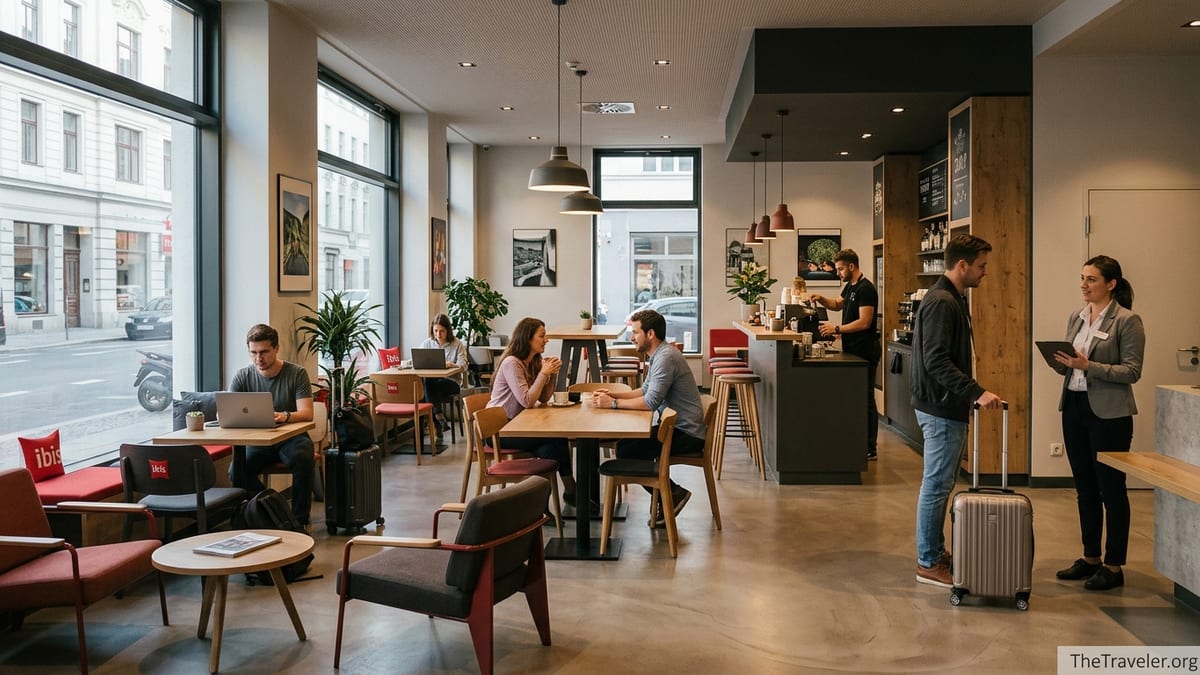
The second thing that changed my view of budget hotels was what happened when I walked out of my room. Traditional economy properties often treat the lobby as a dead space: a row of plastic chairs, a pot of coffee, a fixed check-in desk. Ibis has spent the past several years turning that idea on its head, introducing a new generation of design concepts such as Agora, Plaza and Square, where the lobby functions as a social hub open to both guests and locals.
At ibis Barcelona Plaza Glories, for example, the Agora concept reimagines the ground floor as an urban café. Instead of a stiff desk, you find mobile staff with tablets, communal tables, and flexible seating where people work, sip coffee, or chat. The design uses neutral tones with graphic patterns and local art to create something that feels more like a neighborhood living room than a transit lounge. During my stay, I watched a mix of digital nomads working on laptops, families playing card games in the evening, and a few locals dropping by for a drink. It felt closer to a coworking space than the fluorescent lobbies I associated with budget brands.
In Brussels, the Plaza concept at ibis Brussels Centre Châtelain pulls the energy of the city indoors. Instead of rigid rows of sofas, the lobby layers raised platforms, plant-filled corners, and custom shelving that works as both decor and practical storage. The idea is to reflect the surrounding streetscape and encourage guests to linger, not just pass through. When you can comfortably spend an hour in the lobby replying to emails or sharing a drink, suddenly your 90 or 100 euro nightly rate feels like it includes an informal workspace and living room.
Even ibis budget, historically the most stripped-down expression of the brand, is shifting in this direction. The Reboost concept, which Accor has begun rolling out across new ibis budget hotels, creates an open, cafe-like living area where breakfast, snacking, and work all coexist. Instead of a single long table and a vending machine, you see colorful stools, flexible nooks, and plug points everywhere. These may sound like small tweaks, but they change how it feels to stay in a budget hotel. You are no longer hiding in your room; you have a space where lingering with a laptop and a coffee feels completely natural.
Smart Design In Small Spaces
Budget travelers are used to compromises: narrow rooms, awkward bathrooms, nowhere to put a suitcase. Ibis does not magically add square meters, but the way space is used often makes those constraints feel deliberate rather than punitive. In Münster, Germany, for instance, a recently redesigned ibis budget uses circles and arches across the lobby and guest rooms to create a playful, unified look. Built-in furniture doubles as seating and storage, and colorful accents draw the eye away from the room’s compact footprint. You still know you are in a small room, but it feels functional instead of cramped.
In many newer ibis and ibis budget rooms, the bed becomes the central island: a place to sleep, work on a laptop, or watch a movie, with a narrow ledge or fold-out table serving as a desk. Wall-mounted shelves replace bulky wardrobes, and the television is flush to the wall. In practice, this meant that when I stayed at an ibis near Zurich Airport for a one-night layover, I could open my suitcase on a luggage bench, hang a few items, and still move around without zigzagging around furniture. For solo travelers and couples, that level of efficiency is often more valuable than a larger but poorly planned space.
The same design logic applies in the bathrooms. Instead of fighting to fit a full tub and heavy vanity into a tiny footprint, many ibis budgets opt for simple walk-in showers with glass partitions, wall-hung sinks, and good ventilation. Fixtures are basic but robust, which matters more than complicated mixers that break after a year. For travelers, this translates into a quick hot shower with adequate water pressure and a space that dries out quickly, even in a tiny room. It is another small way budget no longer has to feel like a downgrade in everyday comfort.
Importantly, ibis gives owners some latitude to localize interiors while still respecting core comfort standards. That is why an ibis in Singapore’s Bencoolen district, for example, can feel distinctly urban and Asian in its art and color palette, while an ibis in a French provincial town leans into warmer, home-style touches. This flexibility cuts against the old stereotype of budget chains as soulless clones, yet guests still recognize familiar elements such as the bed, the breakfast layout, and the overall room logic.
Value In Real Numbers, Not Just Slogans
Hotel brands love talking about value, but ibis is one of the few budget labels where the math often holds up in real itineraries. In parts of Australia, for instance, it is common to find standard ibis rooms between about 80 and 120 Australian dollars on regular weekdays, while many midscale competitors in the same cities push closer to 160 or 200 dollars, especially in peak business seasons. In Western Europe, travelers regularly report finding ibis or ibis budget stays under 70 or 80 euros a night in secondary cities when booking a bit in advance, at times when independent hotels in the same area charge above 120 euros for rooms that are less modern.
These numbers are not fixed, of course. Major events, trade fairs, and summer weekends can drive ibis rates well into three figures in hotspots such as Amsterdam, Paris, or Geneva. Yet the baseline positioning remains visibly lower than midscale chains in the same neighborhoods. In Singapore, for example, travelers often mention ibis Singapore on Bencoolen or an ibis Styles near the city center as realistic options in the 100 to 150 US dollar range, when many full-service hotels nearby start closer to 200 dollars or more per night.
What matters is not just the nightly rate but what you actually receive for that price. With ibis, the package typically includes free Wi-Fi strong enough for video calls, climate control, an ergonomic bed, and some form of on-site food and beverage, whether it is a simple 24-hour snack selection, a bar serving light meals, or a full restaurant at certain properties. For digital nomads and short-break travelers, this ecosystem can replace the need for daily coworking passes or constant cafe-hopping, which adds quietly to the value equation.
At the extreme budget end, ibis budget competes with roadside motels and simple hostels. Here, you may find nightly prices under 50 euros in some European locations during off-peak periods. You lose certain comforts such as larger rooms, full wardrobes, or extensive amenities, but you retain key essentials like good beds, private bathrooms in most locations, and front-desk staffing. When compared with hostels charging 30 to 40 euros per person for a dorm bed in major European capitals, an ibis budget room shared between two or three people can suddenly look like a very rational choice.
Reframing Expectations Around “Budget”
What really shifted my perspective was realizing how ibis is trying to “premiumise” the economy segment without abandoning its price-conscious audience. Instead of piling on services that most budget travelers do not use, the brand focuses on a short list of essentials: sleep, cleanliness, connectivity, and a welcoming social area. This is a subtle but important redefinition of what budget hotels are for. They are no longer just crash pads on a highway; they are compact bases for city exploration, business trips, or digital work weeks.
This philosophy shows up in the brand architecture itself. Ibis occupies the core economy space, ibis Styles adds design-led individual character and often includes extras such as breakfast in the room rate, while ibis budget strips the offer down to the barest essentials for price-sensitive stays. In practice, that gives travelers an internal ladder of choice: pay a bit more for a quirkier ibis Styles in a creative neighborhood, or pare things back with ibis budget on nights when you simply need a place to rest between trains.
The shift in attitude is also visible in how staff interact with guests. In several of the newer ibis hotels I have stayed in, traditional check-in counters have disappeared, replaced by roaming hosts with tablets who greet you near the entrance or at a table. It feels more like being welcomed into a cafe than queuing at a bank teller window. Many properties now also host small-scale events, from local band performances in the bar to trivia nights or football screenings, all of which encourage guests to see the hotel as a place to spend time, not just sleep.
For me, that was the real change of mindset. Budget no longer meant accepting low lighting, faded carpets, and suspiciously thin walls. It meant embracing a stripped-down but contemporary version of hospitality, where design and social energy filled the gaps that used to be covered poorly by unused amenities and faux luxury touches.
When Ibis Is The Smart Choice, And When It Is Not
None of this means ibis is always the answer. There are situations where paying more for a different brand or property type makes sense. If you are planning a once-in-a-lifetime honeymoon in the Maldives, for example, a compact city ibis clearly is not the dream. Likewise, if you value on-site spas, extensive room service, or large suites, you will likely be happier in midscale or upscale hotels. Ibis is at its best for short to medium stays in cities where location, reliability, and price matter more than indulgence.
Quality can also vary between individual hotels, especially in older buildings that have not yet undergone the newest design renovations. While Accor sets brand standards, local ownership and management make a difference. Reading recent guest photos and reviews remains essential. Travelers occasionally report ibis or ibis budget properties being used for longer-term housing or feeling worn, particularly on city outskirts. These are reminders that no global brand is perfectly consistent and that some local due diligence will always pay off.
Another honest limitation is breakfast. While many ibis hotels offer generous morning buffets with items like fresh bread, cold cuts, cereals, and fruit, travelers frequently note that the additional charge, often around 10 to 16 euros per person in Europe, does not always feel like strong value. In cities with excellent bakeries or cafes a short walk away, skipping the buffet and grabbing coffee and a pastry elsewhere may be both cheaper and more memorable. Recognizing this helps set realistic expectations and preserve the sense of value that ibis generally offers.
Finally, there is the matter of character. Some travelers want quirky architecture and hyper-local design in every stay. While ibis Styles aims to deliver more personality, the core ibis and ibis budget hotels are intentionally consistent. If you crave the surprise of a one-off guesthouse each night, their standardization may feel dull. For many of us, though, that trade-off is worth it when landing in an unfamiliar city late at night and knowing almost exactly what kind of bed, shower, and Wi-Fi we are walking into.
The Takeaway
My first stay at an ibis did not involve a dramatic upgrade or unexpected luxury. Instead, it delivered something more important in the budget world: a reliable, comfortable, and thoughtfully designed base at a fair price. The Sweet Bed concept turned sleep from a gamble into a given, the lobby felt like a modern social hub instead of a holding pen, and the compact room layout made smart use of every square meter. None of that matches the fantasy of high-end hotels, but it quietly resets the standard for what “budget” can and should mean.
Since that trip, ibis has become one of the first names I check when pricing out city breaks or work travel in Europe and Asia. Not because it is always the cheapest, but because it often strikes the best balance between cost and comfort. In an era when some mid-tier hotels charge eye-watering rates for tired rooms, ibis proves that affordable does not have to mean joyless or rough around the edges.
Ultimately, that is the one thing ibis changed for me: it turned budget hotels from a necessary compromise into a strategic choice. With the right brand, price-conscious travelers can demand more than just a clean bed and a lock on the door. They can expect smart design, welcoming social spaces, and a level of comfort that once belonged only to pricier tiers of hospitality. Once you experience that, it becomes much harder to accept less.
FAQ
Q1. What is the main difference between ibis, ibis Styles, and ibis budget?
Ibis is the core economy brand with standard rooms and services, ibis Styles adds more design and local character, and ibis budget focuses on very basic, no-frills stays at the lowest price point.
Q2. Are ibis hotels really cheaper than midscale chains?
In many cities, ibis rates are noticeably lower than midscale competitors in similar locations, especially outside major events or peak seasons, though prices always vary by demand and date.
Q3. Is the Sweet Bed by ibis actually comfortable?
Most travelers report that the Sweet Bed offers support and comfort comparable to many midscale hotels, which is a significant step up from traditional budget mattresses.
Q4. How small are ibis and ibis budget rooms?
Standard ibis rooms are compact but functional, while ibis budget rooms can be very small, often around 12 square meters, using built-in furniture and clever layouts to save space.
Q5. Is breakfast at ibis worth the extra cost?
Breakfast can be convenient, but in many European cities the buffet price feels high compared with local bakeries or cafes nearby, so value depends on your priorities and schedule.
Q6. Are ibis hotels safe for solo travelers?
Generally yes, as they offer staffed receptions, secure access to guest areas, and consistent brand standards, though solo travelers should still take normal precautions and review recent guest feedback.
Q7. Do ibis hotels work well for remote work or digital nomads?
Many newer ibis properties have strong Wi-Fi, numerous plug points, and social hub lobbies suitable for working a few hours, though they are not a full substitute for dedicated coworking spaces.
Q8. How do ibis hotels compare with hostels on price?
In some cities, an ibis budget room shared by two or three people can rival or beat the per-person cost of hostel dorm beds, while adding privacy and an en-suite bathroom.
Q9. Are all ibis hotels recently renovated to the new design concepts?
No, the design refresh is ongoing, so some properties feature the latest Agora or Plaza-style lobbies while others still reflect older layouts; checking recent photos helps set expectations.
Q10. When should I choose a different hotel brand instead of ibis?
If you want large rooms, extensive amenities like spas and full restaurants, or highly distinctive design for special occasions, a midscale or upscale hotel will usually be a better fit than ibis.