


Ponte alle Grazie is rarely the first bridge visitors seek out in Florence, yet it quietly offers some of the city’s most rewarding views of the Arno River and the historic skyline. Come here at the right time, stand in the right spots and combine it with the right nearby stops, and this functional 20th‑century bridge becomes one of the best vantage points in town. This guide walks you through exactly how to visit Ponte alle Grazie without missing its finest river panoramas.
Get the latest updates straight to your inbox!
Why Ponte alle Grazie Is Worth Your Time
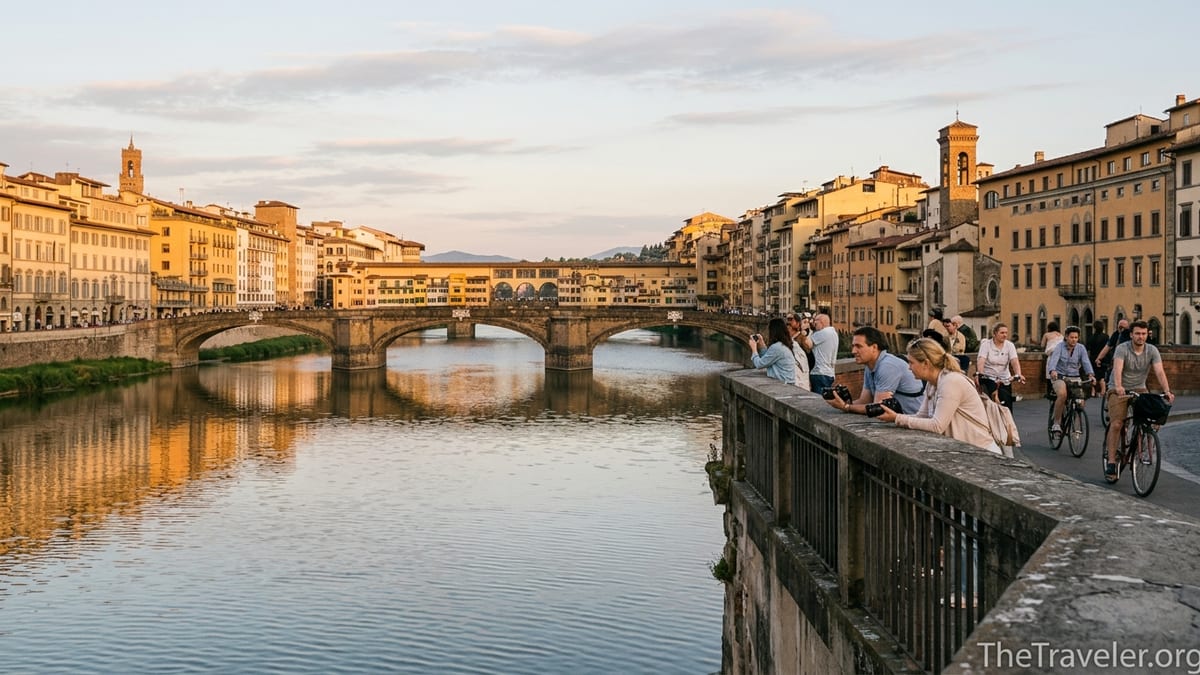
Most visitors arrive in Florence with Ponte Vecchio at the top of their list, but Ponte alle Grazie, a few hundred meters upstream, gives you the view everyone later wishes they had captured. From its five concrete arches, you can frame Ponte Vecchio itself, the Uffizi side of the river and the line of ochre palazzi that glow at sunset. The bridge may look modern, yet it sits in the heart of the UNESCO‑listed historic center, between Via de' Benci on the north bank and Piazza dei Mozzi in the Oltrarno.
The original structure here dates to the 13th century and was once the longest bridge in Florence, crowded with chapels and small dwellings. It was blown up in 1944 along with most of the city’s crossings and rebuilt in the 1950s with a clean, understated profile. That simplicity is part of its charm today. The low parapets and uncluttered sidewalks make it easy to lean over, line up a shot toward Ponte Vecchio or San Niccolò and actually see the water, something that is surprisingly difficult from the more crowded bridges.
Because it is part of a busy road linking the Uffizi area to the Oltrarno residential districts, Ponte alle Grazie is still used heavily by locals. You will see commuters on bicycles, schoolchildren crossing to the swimming pools and rowers gliding below from Circolo Canottieri di Firenze. Visiting here, especially outside peak hours, offers a more everyday slice of Florence than the tourist‑packed streets a five‑minute walk away.
Getting There Without the Stress
Ponte alle Grazie is easy to reach on foot from almost anywhere in the historic center. From Piazza della Signoria, it is roughly a 7‑ to 10‑minute walk: follow the narrow Via dei Neri or Borgo dei Greci toward Santa Croce, then continue down Via de' Benci until the street opens onto the Arno. You will see the bridge straight ahead, with Lungarno Generale Diaz running along the river. This route keeps you largely on flat streets and avoids the heaviest tour‑group congestion around the Uffizi arcades.
If you are coming from the Oltrarno side, perhaps after a visit to the Basilica of Santo Spirito or the artisan workshops around Via Maggio, walk east along Lungarno Guicciardini and then Lungarno Soderini toward the low green slopes of San Niccolò. Once you pass Ponte Vecchio and Ponte Santa Trinita, stay on the river promenade until you reach Piazza dei Mozzi, where the southern end of Ponte alle Grazie begins. This approach is particularly pleasant in the late afternoon, when the stone façades along the Arno pick up warm light.
Public transport is limited inside Florence’s compact center, but several bus lines stop close to the bridge, useful if you are staying farther out. At the time of writing, local ATAF routes serving nearby stops such as Zecca Vecchia or Cavalleggeri typically cost around 1.70 to 2 euros per 90‑minute ticket when purchased in advance from a tabacchi. From Santa Maria Novella train station, it is usually quicker and more scenic to walk 20 to 25 minutes following the river eastward than to wait for a bus, unless you are carrying luggage or traveling with small children.
Timing Your Visit for the Best Arno Views
To make the most of Ponte alle Grazie’s river perspectives, timing matters as much as location. Early morning, roughly between 7:30 and 9:00 in spring and autumn, gives you soft, angled light from the east and relatively empty sidewalks. This is the moment to set up on the western side of the bridge, facing downstream toward Ponte Vecchio, when the facades on the north bank melt from blue to gold and rowing shells carve smooth lines along the Arno.
By mid‑afternoon in summer, the sun moves higher and the light can become harsh, bouncing off the pale pavements and making photography tricky. If this is the only time you can visit, consider using the shaded section of Lungarno Generale Diaz just north of the bridge. From there you can still enjoy the view back to Ponte Vecchio without staring directly into the sun. A lightweight polarizing filter on a camera lens can help cut glare on the water; even for smartphone shooters, a simple clip‑on polarizer purchased for under 20 euros can noticeably deepen the sky and reduce reflections.
Sunset is the marquee moment here. On clear evenings from roughly April to October, the sun drops behind the cluster of bridges to the west, lining up, from your vantage point on Ponte alle Grazie, almost directly over Ponte Vecchio. Plan to arrive at least 20 to 30 minutes before actual sunset time, especially in peak months like June and September, when small groups of photographers tend to stake out the best spots. In winter, shorter days mean you may catch a dramatic, low orange light as early as late afternoon; bring a scarf or hat, as the wind funneled along the river can feel noticeably cooler on the bridge.
Where to Stand: The Exact Viewpoints Not to Miss
Once you reach the bridge, the difference between a forgettable crossing and unforgettable views often comes down to where you pause. For the classic postcard view, walk to the midpoint of Ponte alle Grazie and stand on the upstream side closest to the historic center, roughly above the third arch from the north bank. From here, face west. You will see Ponte Vecchio centered in the distance, framed by the more understated Ponte Santa Trinita and Ponte alla Carraia behind it, with the dome of Florence’s cathedral rising over the rooftops on a clear day.
For a quieter, more reflective perspective, cross to the downstream side of the bridge and walk slightly closer to the Oltrarno end. Looking east, you can frame the Pescaia di San Niccolò weir and the low hill of Piazzale Michelangelo, topped with its bronze David, with pastel houses climbing the riverbank. Early in the day, you may see locals jogging along the lungarno here, and, after rainfall, the Arno’s surface takes on a textured, milky green tone that photographs particularly well in side‑light.
Do not overlook the approaches at either end of the bridge. On the north bank, just before stepping onto Ponte alle Grazie from Via de' Benci, move a few meters along Lungarno Generale Diaz toward the Uffizi. From the low stone wall beside the traffic lights, you can capture a wider sweep that includes the entire bridge structure, the river and the tree‑lined Oltrarno shore. On the south bank, stand in Piazza dei Mozzi beside the modest stone church of San Niccolò Oltrarno. Here, you can shoot back toward the bridge with the historic center silhouetted beyond it, a useful angle if you like to place your subjects walking along the parapet.
Combining the Bridge With Nearby Sights
To truly appreciate Ponte alle Grazie, it helps to treat it not as a single destination but as part of a broader riverfront walk. Many travelers naturally combine it with the Uffizi Gallery or Piazza della Signoria. One simple loop starts in Piazza Santa Croce, where you visit the basilica and perhaps stop for a coffee in one of the quieter bars on the side streets, then continue down Via de' Benci to the Arno. After crossing Ponte alle Grazie to Piazza dei Mozzi, you can wander a block or two into the Oltrarno’s antique shops before continuing uphill toward San Niccolò and ultimately Piazzale Michelangelo.
Piazzale Michelangelo is Florence’s grandstand viewpoint, and linking it with Ponte alle Grazie gives you both intimate river‑level scenes and a sweeping city panorama in a single, manageable outing. From the southern end of the bridge, follow the signs for the ramps and stairways climbing toward the terrace. Most reasonably fit visitors make the climb in 15 to 20 minutes. If you aim to be at Piazzale Michelangelo for sunset, visit Ponte alle Grazie an hour or so earlier, enjoy the changing light over Ponte Vecchio, then continue up for the city‑wide view as the street lamps flicker on.
Just downstream from Ponte alle Grazie on the north bank lies the riverside garden of a long‑established rowing club. While the grounds are private, their boats and docks add a sense of motion and life to photographs taken from the bridge. On warm evenings, the embankments near Piazza Mentana, a 5‑ to 7‑minute stroll away, fill with locals sitting on the low walls with takeaway pizza or gelato from nearby parlors. You can easily structure a relaxed evening around an early walk over Ponte alle Grazie, a riverside picnic and then a nightcap back in the lively streets behind Santa Croce.
Photography Tips: Making Your Shots Stand Out
Ponte alle Grazie rewards both casual smartphone photographers and those traveling with more serious gear. If you are using a phone, tap to expose for the sky when shooting west at sunset, then brighten the shadows slightly afterward to avoid losing detail in the buildings. Use the bridge’s clean, horizontal lines to anchor your composition; placing the horizon on the lower third of the frame and letting the sky dominate often works well in Florence, where cloud patterns over the hills change quickly.
Travelers carrying a mirrorless or DSLR camera might consider a moderately wide lens, something in the 24 to 35 millimeter range on a full‑frame body. This allows you to include both the bridge and its reflections without excessive distortion. A compact travel tripod can be helpful for blue‑hour shots when the lamps along the lungarni glow and longer exposures smooth the river. However, be mindful of pedestrian traffic; set up as close to the parapet as possible and avoid blocking the narrowest sections of the sidewalk.
Weather plays a bigger role than many visitors expect. After heavy rain, the Arno can swell and turn a muddy brown, which may look flat in photographs but offers opportunities for abstract reflections, especially in the calmer eddies near the pillars. On clear winter days, the lower humidity can produce exceptionally crisp views of distant bell towers and the dome of San Miniato al Monte above the opposite hill. Do not be afraid to revisit the bridge at different times during your trip; even a short stay in Florence can include a bright midday crossing, a soft‑light morning walk and a dramatic, color‑saturated evening visit.
Practicalities: Safety, Traffic and Accessibility
Although Ponte alle Grazie is primarily a road bridge, it is generally safe and comfortable for pedestrians who exercise basic city awareness. There are sidewalks on both sides, separated from the roadway by a low curb. The main hazards are bicycles and scooters, which can appear quickly from behind. Walk on the inner side of the sidewalk when possible, glance over your shoulder before stepping closer to the parapet for photos and avoid lingering directly beside the pedestrian crossings where flows of people and vehicles converge.
The bridge is level and surfaced in asphalt, which makes it more accessible than some of Florence’s cobbled streets. Wheelchair users and travelers with strollers can approach from both banks without encountering steps, although the curb cuts at the ends of the bridge can be narrow. If mobility is a concern, the north‑bank approach along Lungarno Generale Diaz tends to have smoother pavements than some sections of the Oltrarno embankment, which may have more irregular stone and parked scooters partially blocking the path.
Street lighting along the bridge is adequate for evening strolls, but as with any urban area, keep an eye on personal belongings. Pickpocketing is far less common here than around the Duomo or on the packed central stretches of Ponte Vecchio, yet it is sensible to carry bags with zippers, keep cameras secured on straps and avoid setting items down on the parapet while framing a shot. Solo travelers often find Ponte alle Grazie a comfortable place to linger at dusk because locals continue to use it steadily until late, so you are rarely alone.
The Takeaway
Visiting Ponte alle Grazie is about slowing down and seeing Florence’s river from a more thoughtful angle. Where Ponte Vecchio places you inside the postcard, Ponte alle Grazie lets you step back and admire the whole scene: arches, reflections, the layered silhouettes of bridges and church towers, and the everyday life of a city that still orients itself around the Arno.
If you give yourself a small pocket of time, choose your moment carefully and know exactly where to stand, this workmanlike bridge reveals some of the most atmospheric views in Florence. Pair it with nearby neighborhoods, frame your photographs with intent and let the rhythm of cyclists, rowers and walkers pass around you. In a city crowded with icons, Ponte alle Grazie offers a quieter, more spacious way to experience Florence’s beauty without missing its finest river views.
FAQ
Q1. Where exactly is Ponte alle Grazie in Florence? Ponte alle Grazie crosses the Arno River just east of Ponte Vecchio, linking Via de' Benci on the historic‑center side with Piazza dei Mozzi in the Oltrarno district.
Q2. What is the best time of day to visit Ponte alle Grazie for views? Sunset is ideal for dramatic colors and silhouettes of Ponte Vecchio, while early morning offers softer light, fewer people and calm water for reflections.
Q3. How long does it take to walk to Ponte alle Grazie from the Duomo? Walking from the Duomo area to Ponte alle Grazie usually takes about 15 to 20 minutes at a relaxed pace through mostly flat streets.
Q4. Is Ponte alle Grazie safe to visit at night? Yes, it is generally safe in the evening, with steady local foot and vehicle traffic, though you should still use normal city precautions and guard valuables.
Q5. Can I see Ponte Vecchio from Ponte alle Grazie? Yes. From the midpoint of Ponte alle Grazie, facing west, you get one of the best unobstructed views of Ponte Vecchio and the line of bridges behind it.
Q6. Is Ponte alle Grazie accessible for wheelchairs and strollers? The bridge is level with sidewalks on both sides and no steps, so it is reasonably accessible, though some curb ramps and nearby pavements can be narrow.
Q7. Are there good photo spots near the bridge besides the sidewalks? Excellent viewpoints include Lungarno Generale Diaz just north of the bridge and Piazza dei Mozzi on the Oltrarno side, both offering wider angles on the river.
Q8. Can I visit Ponte alle Grazie and Piazzale Michelangelo in one outing? Yes. Many visitors cross Ponte alle Grazie, then continue uphill via San Niccolò to Piazzale Michelangelo, combining river‑level views with a panoramic city overlook.
Q9. Is there an entrance fee to visit Ponte alle Grazie? No. Ponte alle Grazie is a public road and pedestrian bridge, so crossing it and enjoying the views is completely free at any time of day.
Q10. How crowded does Ponte alle Grazie get compared with Ponte Vecchio? It is significantly quieter than Ponte Vecchio. You will encounter regular local traffic, but it is rare to find the bridge packed shoulder‑to‑shoulder with tourists.