


Ponte alle Grazie is often the bridge Florence visitors walk across without really seeing. Yet this understated crossing, just upstream from the famous Ponte Vecchio, offers some of the most atmospheric river views, quiet moments and local-life encounters in the historic center. Used thoughtfully, it can become the anchor of a memorable Florence walking route rather than a simple way to get from one side of the Arno to the other.
Get the latest updates straight to your inbox!
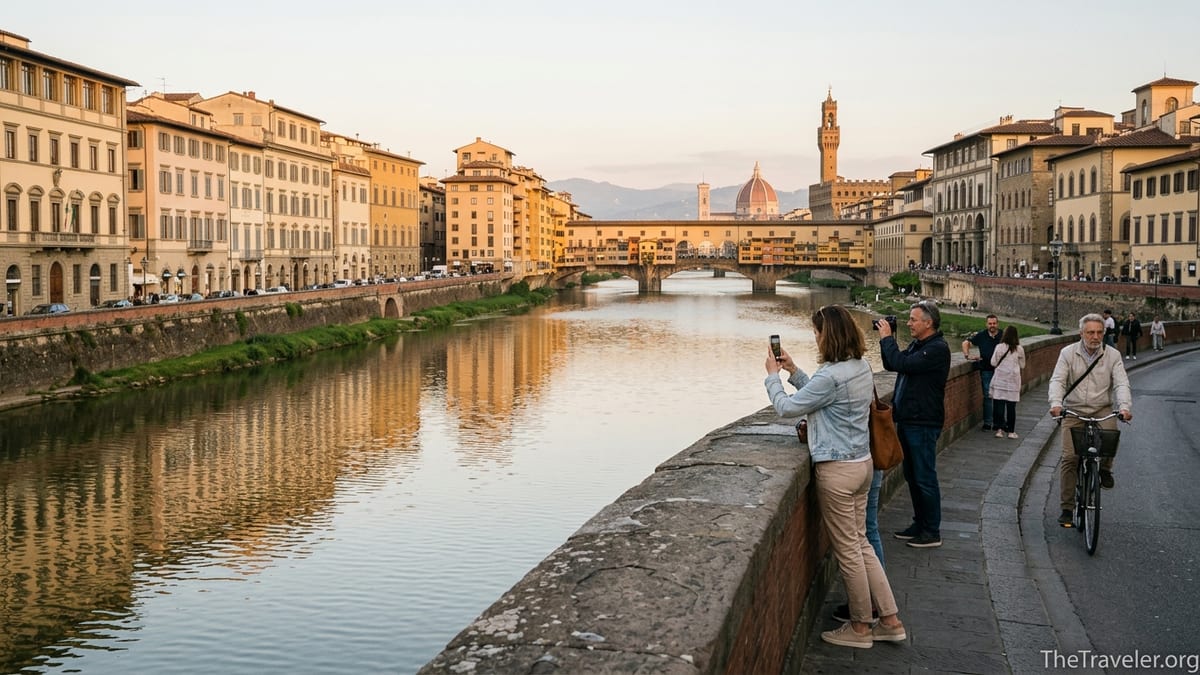
Understanding Ponte alle Grazie in the Flow of Florence
Ponte alle Grazie sits a few hundred meters upstream from Ponte Vecchio, linking Via de' Benci on the historic center side with Piazza de' Mozzi and the San Niccolò quarter in the Oltrarno. The current five-arch structure dates from the 1950s, rebuilt after the Second World War, but it follows the line of a much older bridge that has connected these banks since the 13th century. Today it is one of the most practical crossings in the city, carrying car traffic, buses, cyclists and pedestrians all day long.
Originally known as Ponte di Rubaconte, after the Florentine podestà who ordered its construction in 1237, the bridge once had as many as nine arches and was lined with houses, workshops and chapels, much like the medieval Ponte Vecchio. Over time, a chapel dedicated to Santa Maria delle Grazie gave it the name that remains today. Knowing this backstory as you step onto the bridge changes the experience: it is easier to imagine you are walking through a layered palimpsest of Florence, rather than along a purely modern structure.
Because Ponte alle Grazie is functional rather than overtly scenic in its own right, it tends to attract more locals than tour groups. Office workers cross at lunchtime, residents walk dogs at dusk, and students from nearby neighborhoods stream over on bicycles. This lived-in character makes it a useful counterpoint to the more theatrical Ponte Vecchio and a smart stop on any walking tour that aims to go beyond postcard Florence.
From a practical perspective, Ponte alle Grazie is a strategic hinge in the city. It connects Santa Croce and the eastern side of the centro storico with the green slopes leading up to Piazzale Michelangelo and the artisan streets of the Oltrarno. Used well, it allows you to design loops that include both the grand museums north of the river and the more relaxed, workshop-filled lanes to the south without retracing your steps.
Designing a Walking Route Around the Bridge
One of the best ways to experience Ponte alle Grazie is to build your entire walking route around it. A classic loop begins near the Duomo or Piazza della Signoria, threads through the Santa Croce district, reaches the river at Lungarno delle Grazie, crosses the bridge toward San Niccolò, and eventually returns to the center via Ponte Vecchio or Ponte Santa Trinita. This creates a natural progression from monumental squares to quieter neighborhoods and back again.
A practical example: start your morning at Piazza Santa Croce, perhaps with a coffee at a bar on Via dei Benci. From the basilica, walk down Via dei Benci to the river. Within five minutes you reach Lungarno delle Grazie, where the Arno suddenly opens in front of you with Ponte alle Grazie on your left and Ponte Vecchio in the distance to your right. Crossing here early, around 9 or 10 a.m., usually means softer light on the water and fewer crowds, ideal conditions for both photography and reflection.
Once across, continue straight into Piazza de' Mozzi and the San Niccolò area. From here, you can angle right along the river toward the stone tower of Porta San Niccolò and the ramps that climb to Piazzale Michelangelo, or you can wander uphill immediately on Via San Niccolò into a web of narrow streets lined with small restaurants, wine bars and artisan workshops. Later in the day, you can loop back on the opposite bank, approaching the Uffizi and Ponte Vecchio along Lungarno Diaz for a change of perspective.
Independent travelers can follow this circuit on their own using an offline map, but many guided walking tours now incorporate Ponte alle Grazie as a deliberate viewing stop. Some Oltrarno-focused itineraries, for instance, meet in the Santo Spirito area and end by crossing Ponte alle Grazie back into the historic center at golden hour, when the stone facades along Lungarno Serristori catch the light and the traffic noise drops a little.
Photographing the Arno from Ponte alle Grazie
Ponte alle Grazie is widely regarded by photographers as one of the best vantage points in Florence for capturing Ponte Vecchio without the crush of people that usually accompanies it. Facing west from the mid-point of the bridge, you get a full, unobstructed view of the old bridge framed by the Uffizi on one side and the pastel Oltrarno facades on the other. On clear evenings, the sunset slides down behind the buildings, casting warm reflections into the water and creating a natural leading line toward the horizon.
If you are serious about photography, plan to arrive 20 to 30 minutes before sunset to secure a comfortable spot along the upstream side of the bridge. A compact mirrorless camera or DSLR with a 24 to 70 millimeter lens works well here, allowing you to shoot both wide cityscapes and tighter compositions of Ponte Vecchio and its hanging shops. Travelers using smartphones can take advantage of portrait mode for vertical shots that emphasize the arches and their reflections in the river.
Morning light has a different character. In early hours, typically before 9 a.m., the Arno can be still and glassy, especially in cooler months. From the downstream side of the bridge, looking east toward the weir at San Niccolò and the distant Tuscan hills, you can capture soft, misty scenes that feel a world away from the busy main streets a few blocks inland. This direction is also good for photographing rowers and small boats, which often train on this stretch of the river.
For night shots, consider returning after dinner. The streetlamps along the lungarni cast long ribbons of light onto the Arno, and Ponte Vecchio glows like a floating village. A lightweight travel tripod is useful if you want longer exposures, but many visitors simply brace their camera or smartphone on the bridge parapet. Because traffic continues late into the evening, take care to stand well inside the pedestrian zone and keep camera bags away from the curb.
Connecting with the Oltrarno and Local Neighborhoods
Crossing Ponte alle Grazie is one of the most efficient ways to step from the museum-heavy north bank into Florence’s more residential south side. As soon as you step off the bridge onto Piazza de' Mozzi, the pace slows. The square is framed by palazzi, including Palazzo Mozzi, and side streets begin to climb toward the neighborhoods of San Niccolò and the lower slopes of the hills leading to Piazzale Michelangelo.
Turning left after the bridge and following Lungarno Serristori, you stay close to the river while moving through a part of the Oltrarno that many short-stay visitors skip. Locals stroll here in the late afternoon, and you often see families stopping for gelato at small neighborhood shops rather than headline-making destinations. Benches along the lungarno give you a chance to sit and watch the reflections of the north-bank palazzi and church towers flicker in the water.
Heading straight uphill from Piazza de' Mozzi along Via San Niccolò or the nearby alleys takes you into a more bohemian pocket. Here you find wine bars with a handful of outdoor tables, artisan workshops producing everything from leather accessories to gilded frames, and modest trattorias that serve seasonal Tuscan dishes at comparatively reasonable prices. It is not unusual, for example, to find a plate of fresh pasta for a little over 10 euros and house wine by the glass for a few euros more, slightly less than around Piazza della Signoria.
Using Ponte alle Grazie as your entry and exit point also makes it easier to time a visit to Piazzale Michelangelo. One common strategy is to cross the bridge in the late afternoon, climb via the ramps and stone staircases to the panoramic terrace in time for sunset over the city, and then descend back toward the river, crossing again at Ponte alle Grazie or Ponte Vecchio once the lights of the historic center are fully illuminated.
Adding River Experiences: Cruises and Renaioli Boats
Standing on Ponte alle Grazie gives you a commanding view of the Arno, but some of the most memorable experiences place you on the water itself, using the bridge as a navigation point. Seasonal boat trips typically operate from late spring through early autumn, and many of them start or pass directly beneath the bridge, offering unusual angles on Florence’s riverfront architecture.
One traditional option involves small wooden boats piloted by local boatmen sometimes referred to as renaioli, a nod to the sand workers who once dredged the Arno. These excursions often begin near the dam just downstream from Ponte alle Grazie, then glide quietly under the bridge and follow the river toward Ponte Vecchio. Commentary usually covers the history of the bridges, the role of the lungarni embankments and snippets of local legend. While prices and schedules vary by operator and season, travelers can expect to pay in the range that is typical for small-group city boat tours in Italy, often comparable to a guided walking tour lasting an hour to ninety minutes.
For travelers on foot, combining a short cruise with a walking tour can be an efficient way to see both river and streets without rushing. A sample day might involve a two-hour guided walk covering the Duomo, Piazza della Signoria and Santa Croce in the morning, some free time for lunch near Via dei Neri or Borgo dei Greci, then an evening river excursion departing near Ponte alle Grazie. You finish with a slow stroll back across the bridge, watching the lamps along the Arno come on one by one.
Independent visitors who prefer not to join an organized boat trip can still use the bridge to connect with the river. The walk along Lungarno delle Grazie and Lungarno Diaz from Ponte alle Grazie toward the Uffizi is mostly flat and offers frequent access points where you can descend closer to water level. Early morning runners often use this stretch as part of a loop that includes crossing Ponte alle Grazie at one end and Ponte della Vittoria or Ponte alla Carraia further west at the other.
Timing, Safety and Practical Tips on the Bridge
Because Ponte alle Grazie carries regular traffic, a few simple habits will make your visit smoother and safer. Stick to the sidewalks on either side rather than walking close to the roadway, especially when pausing for photos. Cyclists often use the bridge, and local drivers may accelerate when the light turns green, so stepping back from the curb gives you room to adjust. If you are traveling with children, keep them on the inside of the sidewalk, away from the traffic edge.
In terms of timing, mid-morning to early afternoon are generally the brightest periods for clear views up and down the Arno, although the overhead sun can be harsh in summer. Early morning offers more tranquility and cooler temperatures, while late afternoon and early evening deliver the warmest, most flattering light. In high summer, the period just before 8 p.m. often brings a soft glow along the river, while in spring and autumn the best light might arrive an hour earlier.
Weather can change the mood of the bridge dramatically. On crisp winter days, the air above the Arno feels almost crystal clear, and you can see the distant hills east of the city in sharp detail. On humid summer afternoons, light haze and higher water levels create a softer, more painterly scene. After heavy rain, parts of the riverside can be muddy and the current stronger, so it is wise to keep a respectful distance from any low banks and avoid leaning too far over the parapet for photographs.
There is usually no need to worry excessively about petty crime on the bridge itself, but common sense applies. Keep cameras and phones attached to straps or securely in hand when leaning over the parapet, and avoid placing bags on the ground while you take photos. As with any busy urban space, it is best not to leave valuables unattended on benches or low walls along the lungarni approaches.
The Takeaway
Experiencing Ponte alle Grazie well is less about ticking off a single sight and more about using the bridge as a lens on Florence. It becomes the point where you step from the formal grid of the historic center into the looser fabric of the Oltrarno, where you pause between museums and hillside viewpoints, and where you learn to see Ponte Vecchio as part of a broader river landscape instead of an isolated icon.
By building a walking route that uses Ponte alle Grazie as a hinge rather than a shortcut, you gain both practical efficiency and a deeper sense of place. The bridge gives you space to breathe between big-name attractions, to watch locals go about their routines, and to tune in to the changing light over the Arno from morning until night. Whether you cross it quickly on your way to a sunset at Piazzale Michelangelo or linger over photographs as boats slip quietly underneath, it is one of the most rewarding vantage points in the city for travelers willing to slow down.
FAQ
Q1. Where exactly is Ponte alle Grazie in Florence?
Ponte alle Grazie crosses the Arno just east of the historic center, connecting Via de' Benci near Santa Croce with Piazza de' Mozzi and the San Niccolò area in the Oltrarno.
Q2. Is Ponte alle Grazie pedestrian only?
No, it carries cars, buses, bicycles and pedestrians. Sidewalks on both sides make it comfortable to walk, but you should stay clear of the traffic lanes when stopping for views or photos.
Q3. What is the best time of day to visit Ponte alle Grazie?
Late afternoon and early evening often offer the most atmospheric light, especially for west-facing views toward Ponte Vecchio, though early mornings are quieter and cooler in summer.
Q4. Can I include Ponte alle Grazie in a self-guided walking tour?
Yes. A simple DIY route links Santa Croce to the Oltrarno via Ponte alle Grazie, then returns to the center across Ponte Vecchio or another bridge, creating a scenic loop along both sides of the Arno.
Q5. Are there good photo spots on the bridge?
Yes. The middle section on the upstream side gives a classic view toward Ponte Vecchio, while the downstream side looks east toward the weir at San Niccolò and the hills beyond.
Q6. Is the area around Ponte alle Grazie safe at night?
The surroundings are generally active and feel reasonably safe, with locals walking dogs or returning home. Normal city precautions apply, such as keeping valuables secure and staying in well-lit areas.
Q7. How can I combine Ponte alle Grazie with a visit to Piazzale Michelangelo?
Cross the bridge toward San Niccolò, follow the river or side streets to the stone tower at Porta San Niccolò, then take the ramps and steps uphill to Piazzale Michelangelo for sweeping city views.
Q8. Do guided walking tours usually stop at Ponte alle Grazie?
Many Oltrarno or river-focused tours include a pause on Ponte alle Grazie for views of Ponte Vecchio and the lungarni, even if the bridge is not advertised as the main highlight.
Q9. Can I take a boat tour under Ponte alle Grazie?
Seasonal river excursions in small boats often start or pass near the dam below the bridge and glide underneath it en route toward Ponte Vecchio, offering a different angle on Florence’s riverside.
Q10. Are there cafes or restaurants close to Ponte alle Grazie?
Yes. On the north side you are a short walk from bars and eateries around Santa Croce and Via dei Benci, while on the south side the streets of San Niccolò and the wider Oltrarno offer numerous trattorias and wine bars.