


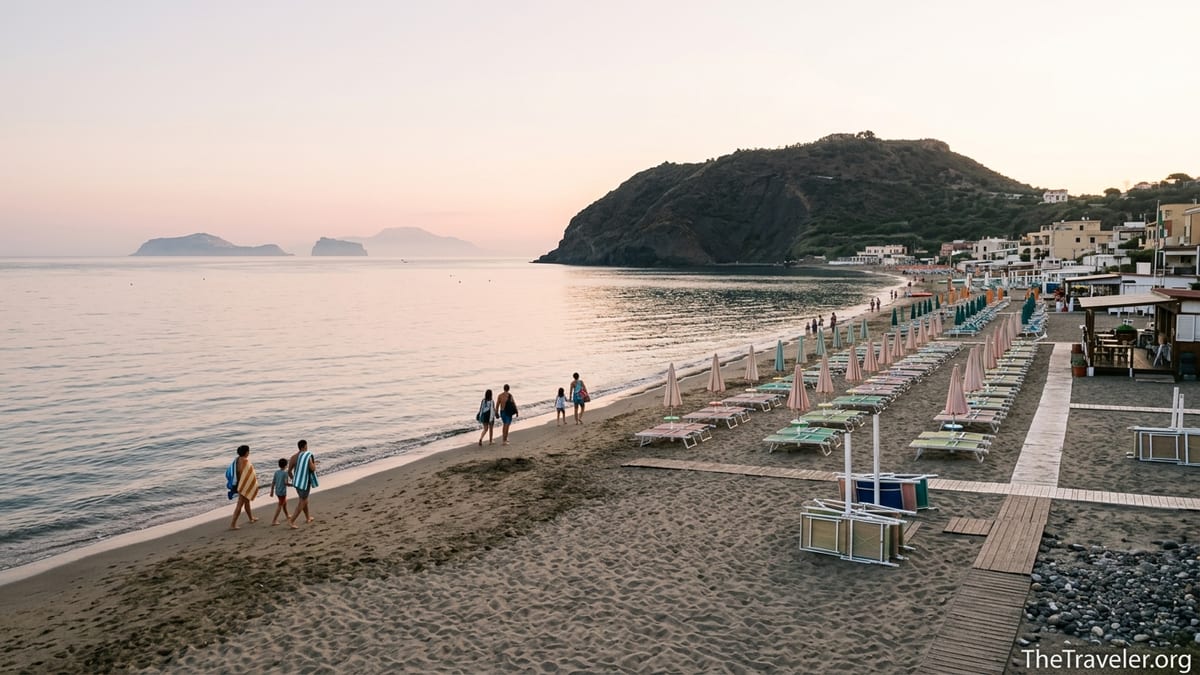
Ask people in Naples where they escape when summer hits and many will quietly point you past the chaos of the historic center and the crowds of the Amalfi Coast, toward the soft curve of sand at Miseno. On the far edge of the Phlegraean Peninsula, this small seaside district of Bacoli blends long, swimmable beaches with volcanic headlands, lake views and a lived-in local atmosphere. It is not a place of spectacle so much as a place of habit: Sunday umbrellas in the same spot every year, families with coolers, teenagers buying gelato on the promenade and retirees watching the sunset over Procida.
Get the latest updates straight to your inbox!
A Local’s Seaside: What Miseno Really Feels Like
Miseno is technically just a frazione, a neighborhood of the small municipality of Bacoli on the western edge of the Gulf of Naples, but in summer it feels like the city’s unofficial beach club. Instead of luxury hotels and designer boutiques, you get mid-rise apartment blocks, low-key bars and a continuous strip of sand shared between stabilimenti balneari and free stretches. It is the sort of place where baristas recognize regulars, lifeguards chat in dialect and most of the license plates in the parking lots are from the Naples area.
Locals come here because the setting is beautiful without being intimidating. On one side you have the gently curving Spiaggia di Miseno and Spiaggia di Miliscola, some of the longest sandy beaches on the Campania mainland, running for roughly 2 kilometers between Capo Miseno and Monte di Procida. Behind the shore sits the Miseno lake and the low town of Bacoli, while offshore you look toward the pastel houses of Procida and the green outline of Ischia. The volcanic origins of the headland give the coastline a soft, rounded shape rather than sheer cliffs, so the landscape feels enveloping and easygoing.
The rhythm of the day here is also very Neapolitan. Mornings are for families with children, carrying inflatable toys and parasols; mid-afternoon sees teenagers playing beach volleyball or sipping iced coffee at kiosk bars; golden hour belongs to couples and groups of friends lingering over aperitivo while the light fades behind Procida. Tourists certainly come, but Miseno still feels like a place organized around local schedules and priorities rather than a visitor’s bucket list.
Why These Beaches Beat the Amalfi Crowds
When Neapolitans compare beaches, Miseno and nearby Miliscola are often mentioned in the same breath as the islands. The main difference from the Amalfi Coast is practical: here you get long, flat, sandy shore instead of narrow strips of pebbles under steep cliffs. For families, that means more space to spread out and shallow, generally calm water that stays relatively warm through late summer. Guides aimed at families frequently list Spiaggia di Miseno among the most child-friendly beaches reachable from central Naples in under an hour, precisely because little kids can wade in slowly rather than face an abrupt drop-off.
Another reason locals favor Miseno is cost. On busy August weekends, a basic package of two sunbeds and an umbrella at a mid-range lido along Via Miliscola might run in the region of 25 to 35 euros for the day, with higher prices at the most fashionable clubs and lower ones at simpler operations or on weekdays. That is still not cheap, but it is significantly less than many Amalfi Coast lidos, where similar setups can climb much higher at peak times. Importantly for local budgets, Miseno also preserves spiagge libere, free public sections between the private concessions. Regulars often arrive early with their own umbrella and chairs, grab a coffee and cornetto at a bar near the promenade, and settle in for an entire day at very low cost.
Space and accessibility also matter. While places like Positano are spectacular, they are reached by hairpin roads and packed ferries. Miseno, by contrast, is designed around people driving in from the city or arriving by suburban train and bus. Parking near Piazzale Miliscola can still fill up quickly in July and August, but midweek in June or September it is usually possible to find a spot if you come before mid-morning. For many residents, the ability to leave Naples after breakfast, swim by 10 a.m. and be home before dinner without complex logistics is the key reason this shoreline remains their default beach choice.
Sea Views Framed by Capo Miseno and the Islands
What makes Miseno distinctive even for jaded Neapolitans is the way the sea views unfold around Capo Miseno. This promontory marks the northwestern edge of the Gulf of Naples and the boundary with the Gulf of Pozzuoli. From the waterline, you see the headland closing the bay like a protective arm, while beyond it lie Procida, Ischia and, in the distance on clear days, the silhouettes of Capri and the Sorrento Peninsula. Stand at the tideline in the late afternoon and the sun often drops behind Procida, turning the waves into silver strips and backlighting the island’s fishermen’s houses.
Climb higher and the panorama becomes even more impressive. A small road winds up from the village toward the lighthouse at Capo Miseno, built in the 19th century on the site of an older watchtower and rebuilt several times after damage in the 20th century. From around 79 to 80 meters above sea level, near the lighthouse and the summit paths, you look out over what many locals consider one of the most complete views in Campania: Vesuvius and the curves of Naples to one side, the full arc of the Phlegraean coast, then the islands dotted across the Tyrrhenian Sea. Hikers sometimes follow short trails near the so-called bird sanctuary area above the cape for this view before descending for a swim.
Even if you do not venture up the headland, the coastline itself frames the sea in a rewarding way. Beach clubs like Lido Virgilio, set along Miliscola, promote their uninterrupted views of Procida and Ischia from neat rows of sunbeds on golden sand. In practice, this view is not reserved for paying customers: anyone walking the water’s edge at Miseno or Miliscola can look up and enjoy the same skyline. For locals living in densely built neighborhoods of Naples, that combination of open horizon, islands and volcanic silhouettes offers a psychological reset hard to find inside the city.
Beach Clubs, Free Sand and Everyday Coastal Life
Miseno’s waterfront is a patchwork of lidos and free sections, and locals navigate it almost by instinct. Long-time visitors know exactly which stabilimento has the friendliest staff, which one keeps the music low, and which has a good pizzeria attached. In high season, some more polished beach clubs along Via Miliscola provide changing cabins, hot showers, waiter service to sunbeds and full restaurant menus. These are popular with groups of friends celebrating birthdays or office outings, and it is common to see birthday cakes carried onto the sand as the sun sets.
For more casual days, residents gravitate to the free zones such as the spiaggia libera areas signposted between the concessions. Here the scene is wonderfully democratic: retirees play cards under striped umbrellas, university students bring portable speakers and a ball, and families unroll tablecloths for packed lunches of homemade pasta salads and frittata di maccheroni. Lifeguard coverage may be lighter than at the organized lidos, so locals keep an eye on conditions, especially on days with stronger winds, but in normal summer weather the beach is perceived as welcoming and manageable for confident swimmers.
Behind the sand, coastal life feels anchored in everyday routines rather than tourism. On Via Miseno and the small streets leading to the port, you find old-fashioned bars serving strong espresso, bakery counters selling sfogliatelle and cornetti, and simple seafood trattorias where fried anchovies, spaghetti alle vongole and grilled local fish dominate the menus. Prices can be significantly lower than in central Naples or on the islands. It is not unusual to find a plate of spaghetti with clams for a moderate price at a neighborhood trattoria, especially if you move a block away from the waterfront and into the more residential backstreets of Bacoli.
Getting There: How Neapolitans Actually Reach Miseno
Locals have several tried-and-tested ways of getting from Naples to Miseno, and which one they choose often depends on whether they are hauling beach gear or just going for an evening stroll. Drivers typically follow the ring road toward Pozzuoli and then continue through the Phlegraean Fields area toward Bacoli and Miseno, a journey that can take around 45 to 60 minutes in light traffic but considerably longer on hot weekends. Residents pay attention to parking regulations around Piazzale Miliscola and other seafront lots, as wardens patrol regularly in peak season. Many prefer to arrive early, park once and stay all day rather than risk circling in the heat.
For those without a car, public transport is part of the ritual. A common route is to take the Cumana suburban railway from the central Montesanto station in Naples out to Torregaveta, the line’s terminus by the sea. From there, local buses such as routes toward Miseno and Miliscola connect directly to the beaches. Regulars talk about simply riding the Cumana to the end of the line, stepping off into sea air, and catching the bus that stops close to the sand. Travel times vary with connections, but an hour to an hour and a half from central Naples is considered normal and acceptable for a day out.
In recent summers, local authorities in Bacoli have also experimented with additional seasonal services to ease congestion, including “Bus del Mare” routes linking hill neighborhoods of Naples like the Vomero directly to Capo Miseno, and shuttle buses from inland areas such as Cuma down to the Miliscola and Miseno beaches. Schedules change year by year, but the principle remains the same: make it easy for residents to leave cars at home and still enjoy the sea. For Neapolitans used to busy city buses, these seaside routes, crowded with beach bags and umbrellas, are part of the pleasure of the outing rather than an inconvenience.
Volcanic Landscapes, Roman Echoes and Sunset Rituals
Part of Miseno’s charm lies in its layers of history and geology, which locals absorb almost subconsciously. The headland of Capo Miseno is the remnant of an ancient volcanic complex in the Phlegraean Fields, its crater forming a broad semicircular basin that is still clearly visible from the sea or From Monte di Procida. Beneath and around the cape, archaeological remains recall the Roman naval base of Misenum, once the home port of the imperial fleet. While many visitors come purely to swim, locals are aware that they are sunbathing in a place that figures in Latin poetry and Roman imperial history.
These layers subtly shape daily rituals. For example, some residents like to hike or drive up toward the promontory in the late afternoon, pausing at panoramic bends or at small lookout points beneath the lighthouse to watch the light change over the islands and the Gulf of Naples. Others stay at beach level but relocate from the main lidos to quieter stretches of sand near the port, where fishing boats rock gently and the atmosphere becomes more tranquil as day visitors pack up. Children dig in the still-warm sand while adults chat about football, politics or family news, glancing up as the sky turns from gold to pink.
Even off-season, when swimming is rare, locals come to Miseno for this sense of space and continuity. On mild winter Sundays, you might see groups walking the shoreline in jackets and scarves, stopping for a coffee at a bar overlooking the lake or the port, then driving up to a viewpoint over Capo Miseno or Monte di Procida to admire Vesuvius under a crisp sky. For many, knowing that this landscape is close at hand throughout the year, not just in beach season, deepens the emotional connection to the place.
When to Go and How to Match the Local Pace
Neapolitans tend to structure their year around the sea, and Miseno is central to that mental calendar. Late June through early September is high season, when schools are closed and locals settle into regular beach routines. On August Sundays and public holidays, every lido is packed, traffic backs up into Bacoli, and families stake out the free beach areas from early morning. If you want to experience the destination as locals do but with slightly fewer crowds, aim for weekdays in late June, the first half of July, or the first half of September, when the water is still warm but many people are at work or back in school.
Time of day also shapes the vibe. Early morning before about 10 a.m. is calm and almost contemplative, with mostly older residents walking the shoreline, swimmers doing steady laps parallel to the coast and fishermen preparing their boats. Late morning through mid-afternoon is family time, noisy and animated but good if you want to feel the full local energy. After around 5 p.m., as the sun drops and the haze softens, the mood becomes more relaxed and sociable. Many people who work in Naples drive out just for a couple of evening hours, combining a quick swim with an aperitivo at a bar looking toward Procida.
To fit into this rhythm, visitors often adopt a pattern common among locals: arrive by late morning, rent an umbrella or claim a free spot at the waterline, break for a simple seafood lunch or a panino from a bar, spend the hottest hours resting or swimming, then stay through sunset before heading back to the city. Dressing is casual, even at nicer beach clubs, and there is little pressure to look polished. The goal in Miseno is not to be seen, but to feel at ease by the water.
The Takeaway
Miseno’s appeal for locals rests less on grand attractions than on familiarity and balance. It offers what many Neapolitans crave on their days off: real sand underfoot, calm water suitable for everyone from toddlers to older swimmers, and sweeping views of islands and volcanoes that remind them how close they live to the sea. At the same time, it remains embedded in everyday life, with modest apartment blocks behind the lidos, family-run bars, and bus routes that fill with beach bags every summer morning.
For travelers deciding how to allocate time around Naples, Miseno will not replace a first visit to the city’s historic core or the drama of the Amalfi Coast. But for those who want to understand where Neapolitans themselves go to breathe, to cool off and to watch the sun disappear behind Procida, a day or two here provides valuable insight. The relaxed coastal vibes, layered landscapes and unpretentious routines of this corner of Bacoli offer a quietly compelling counterpart to the more famous destinations nearby.
FAQ
Q1. How far is Miseno from central Naples and how long does it take to get there? From central Naples to Miseno is roughly 25 to 30 kilometers by road, and in light traffic the drive can take about 45 to 60 minutes. Using the Cumana suburban railway to Torregaveta plus a connecting bus to Miseno typically takes around an hour to an hour and a half, depending on connections and waiting times.
Q2. Is Miseno suitable for families with small children? Yes, Miseno and neighboring Miliscola are popular with local families precisely because the sand is soft and the sea usually remains shallow for several meters from the shore. Many beach clubs provide lifeguards, changing facilities and on-site bars or snack options, while free beach areas allow families to set up their own umbrellas and picnics at lower cost.
Q3. Do I need to reserve a spot at a beach club in advance? In peak season, especially weekends in late July and August, it is advisable to contact a preferred lido in advance if you want front-row sunbeds or a large area for a group, as locals often book recurring spots for the entire season. On weekdays in June, early July or September, you can usually walk in before late morning and still find space, or simply use the free beach areas between concessions.
Q4. Are there free public beaches in Miseno or is everything private? Miseno is a mix of private beach clubs and public access zones. Between many of the stabilimenti balneari, signed spiaggia libera sections remain open for anyone to use at no cost. These areas are popular with locals who bring their own shade and chairs. Facilities are basic in the free sections, but bars, kiosks and small grocery shops are usually within a short walk.
Q5. What is the water quality like at Miseno? Water quality along the Miseno and Miliscola shoreline is generally considered good enough for regular swimming and is closely monitored by local authorities in summer. Conditions can vary after heavy rain or during periods of unusual sea currents, so residents pay attention to official notices and beach flags indicating any temporary restrictions or caution.
Q6. What should I budget for a day at a Miseno beach club? Prices vary by establishment and season, but a basic package of two loungers and an umbrella at a mid-range lido in high summer might cost in the region of 25 to 35 euros for the day, with discounts sometimes available on weekdays or for half days. Food and drinks are extra, and many locals control costs by having a coffee and snack at the bar while bringing water and some food from home.
Q7. Can I visit the Capo Miseno lighthouse or viewpoints above the beach? The interior of the working lighthouse itself is not generally open to the public, but roads and paths near Capo Miseno allow you to reach viewpoints overlooking the Gulf of Naples, the islands of Procida and Ischia, and the Phlegraean coast. Locals often drive or walk up in the late afternoon to enjoy the panorama before descending to the beach or into Bacoli for dinner.
Q8. Is Miseno crowded all year or only in summer? The busiest period is from late June through early September, with peak crowds on sunny August weekends and holidays. Outside this window, Miseno is much quieter. Spring and autumn can be ideal for peaceful walks along the shore and scenic drives around Capo Miseno, while winter weekends see mostly locals strolling, fishing or having lunch with a sea view rather than sunbathing.
Q9. What should I wear and bring for a day at Miseno? Dress is informal. A swimsuit, light cover-up or T-shirt, flip-flops and a hat are standard, with a light sweater for evening sea breezes outside midsummer. Sunscreen, a reusable water bottle, and a small bag for valuables are useful. If you plan to use the free beaches, bringing your own umbrella or beach tent and a simple picnic will make you more comfortable and closer to how many locals organize their day.
Q10. Are there restaurants and bars within walking distance of the beach? Yes, the streets behind Spiaggia di Miseno and along Via Miliscola host numerous bars, gelato shops, pizzerias and seafood trattorias. Many beach clubs also have in-house restaurants or snack bars where you can order coffee, sandwiches, salads, fried seafood or pasta dishes. It is easy to spend the entire day at the beach and then stay on for an early dinner or aperitivo without moving your car or leaving the neighborhood.