


In a city as sun-drenched and lively as Nice, it can be surprisingly hard to find a neighborhood that feels both peaceful and genuinely central. Ask people who live here where they would choose to settle for the long term, and one name comes up again and again: the Quartier des Musiciens. Just north of the famous Promenade des Anglais, this elegant pocket of Belle Époque buildings and tree-lined streets has become a favorite among locals who want quiet nights without sacrificing the ability to walk or hop on a tram to almost anywhere in the city.
Get the latest updates straight to your inbox!
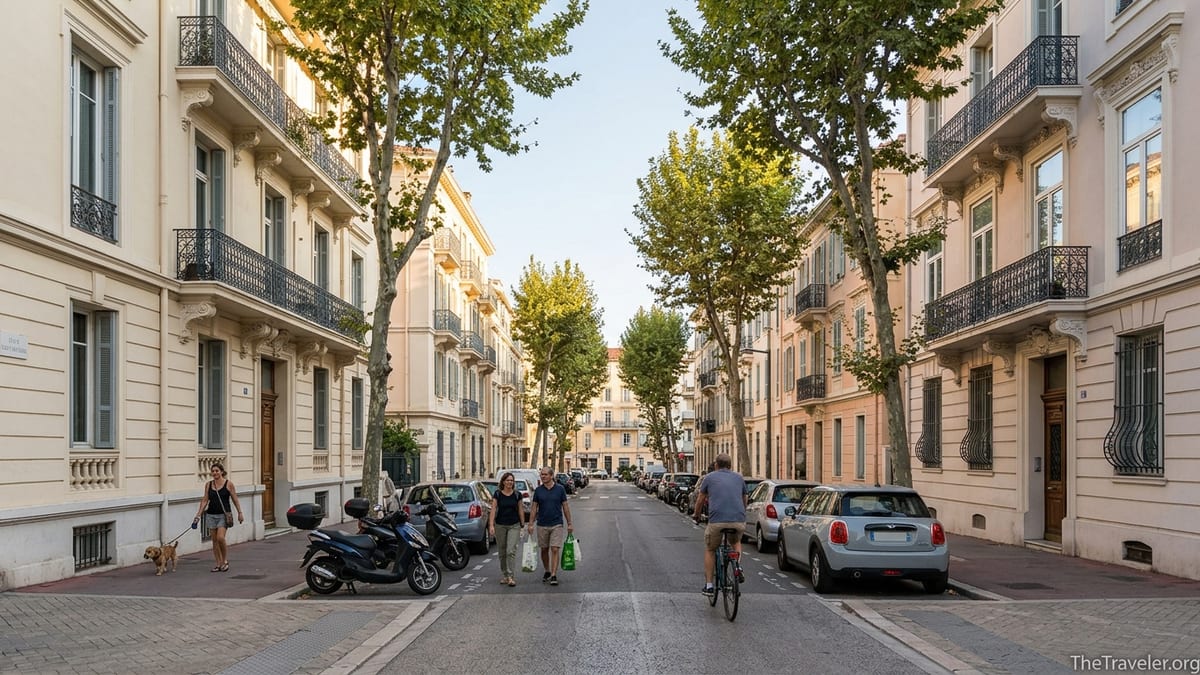
Where Exactly Is the Musiciens District, and What Makes It Different?
The Quartier des Musiciens sits between the main railway station Nice-Ville to the north and boulevard Victor Hugo and rue de France to the south. East to west, it stretches roughly from avenue Jean Médecin and its tram lines toward boulevard Gambetta. On a map, it looks like a compact rectangle set just back from the seafront, yet within 10 to 15 minutes on foot you can reach the Promenade des Anglais, the shopping artery of avenue Jean Médecin, or the leafy Coulée Verte park that leads to the Old Town.
What sets Musiciens apart is how quickly the atmosphere softens as you step off the main avenues. While the wider city center buzzes with shoppers, buses and scooters, the interior streets of the district feel almost residential in the old-fashioned sense: wide pavements, ornate façades, mature plane trees and a slower pace. Locals often describe it as living in the heart of Nice without feeling like you are living in a tourist postcard, and that balance is a big reason people stay for years.
The neighborhood gets its name from its street grid: many of the roads are named after classical composers, from rue Rossini and rue Berlioz to rue Verdi and place Mozart. For residents, these names are not just decorative. They help carve the area into micro-quarters that people identify with: someone might say they live “near Berlioz” or “by Mozart” rather than use a generic city-center label, which reinforces the sense of a coherent neighborhood inside the wider downtown.
Locals also appreciate that Musiciens is administratively considered part of central Nice, yet property prices and rents here tend to be a notch lower than in the adjoining Carré d’Or closer to the sea. That means long-term residents, not just investors or seasonal landlords, can realistically afford to buy or rent in buildings that would be out of reach if they were a few blocks further south.
Calm Streets in the Heart of a Busy City
For all its centrality, day-to-day life in Musiciens is notably quieter than in many neighboring districts. There are several reasons locals cite when you ask why. First, the streets are mostly residential and through-traffic is relatively limited. Apart from a few busier axes like rue de France at the southern edge or boulevard Gambetta to the west, the interior streets such as rue Rossini, rue Gounod or rue Berlioz are used mainly by people who actually live there. This cuts down the constant stream of cars that characterizes other central areas.
The building stock also contributes to the quiet feel. Much of the housing consists of bourgeois and Belle Époque apartment blocks with thick stone walls, high ceilings and internal courtyards. These older constructions often insulate better against street noise than newer, lighter structures. Residents who move from livelier parts of Nice, such as the Old Town or the pedestrian zone around place Masséna, often comment on the difference when they go to bed: less echo from late-night bars, fewer motorbikes bouncing off narrow facades, and more of a steady, background hum.
The nightlife profile of the district is another factor. Musiciens is not a bar or club destination. There are a few wine bars, hotel lounges and casual brasseries on streets like rue de France or around boulevard Victor Hugo, but the neighborhood does not draw the late-night crowds that gather in the Old Town or around the port. For locals, this is a selling point rather than a drawback. They know they can walk 10 to 15 minutes to find buzzing terraces and cocktail bars when they want them, and then retreat to a quieter base afterwards.
Even the daytime rhythm feels less hectic. Schools, doctors’ surgeries and small offices bring a regular flow of people, but you rarely get the packed-tour-bus effect. On a weekday morning you are more likely to share the pavement with residents heading to work, parents walking children to school, or retirees doing their shopping than with large sightseeing groups, which keeps the overall noise level low while still feeling lived-in.
Central Connections: How Locals Move From Musiciens
One of the biggest reasons locals choose Musiciens is how easy it is to get around without relying on a car. To the north of the district, Nice-Ville station is roughly a five to ten minute walk from many addresses on streets like rue Rossini or rue Gounod. From there, frequent trains run along the coast to Cannes, Antibes and Monaco, and further afield to Marseille or Ventimiglia. For residents who commute to offices in Antibes or Monaco, it means they can live in a calm neighborhood and still be at their desk within an hour using public transport.
Tram connections are equally important. The city’s Line 2 runs between the airport and the port, with an underground station at Alsace-Lorraine on the western edge of Musiciens and another busy interchange at Jean Médecin to the east. From typical Musiciens streets it rarely takes more than five to eight minutes on foot to reach a stop. That puts the airport at roughly 20 to 30 minutes away door to door, a huge advantage for residents who travel frequently for work or welcome guests regularly.
Buses along boulevard Gambetta, boulevard Victor Hugo and rue de France offer additional links to neighborhoods that are not directly on the tram lines. Locals often use the bus to reach Cimiez on the hill or to get to the western beaches beyond Magnan. Many residents make a daily routine of walking instead: within a 10 to 12 minute stroll you can be on the pebbles of the Promenade des Anglais, and the mainly flat terrain makes it comfortable for older residents and families with strollers.
For everyday errands, centrality pays off in smaller ways too. From most parts of Musiciens, the large Nice Étoile shopping mall and the full stretch of avenue Jean Médecin are within about 10 minutes on foot. The tram also links directly to the new line serving the port area, making it straightforward to reach the trendy restaurants and bars opening there without having to navigate city traffic. Locals frequently say that living here allows them to keep a car for weekend trips into the hinterland rather than for daily city commuting.
Architecture, Everyday Amenities and the “Village” Feel
Part of the appeal of Musiciens lies in its architecture. The neighborhood grew up in the late nineteenth and early twentieth centuries, when Nice was booming as a winter resort. Developers built elegant palaces and apartment houses to attract wealthy European visitors, and many of those Belle Époque buildings survive today, complete with wrought-iron balconies, carved stone façades and high, airy windows. Some corners, like the intersection of boulevard Victor Hugo with rue Baquis or rue Rossini, are lined with these classical buildings that give the area a quietly grand backdrop.
Inside, apartments often have features that locals prize: parquet floors, decorative moldings, French windows opening onto small balconies and, in some cases, original “cage” lifts with ornate metalwork. Newer constructions do exist, often set back from the main corners, providing more modern conveniences such as underground parking and larger terraces. This mix allows Musiciens to appeal both to people who dream of a traditional Niçois apartment and to those who want contemporary living but still in a central location.
Despite its grand facades, the neighborhood has a practical, everyday side that residents rely on. You find a solid spread of bakeries, greengrocers, pharmacies and small supermarkets dotted along streets like rue de France, rue de la Buffa and the surrounding avenues. Prices at local bakeries or cafés are typically in line with the wider city center: a morning espresso at the counter usually costs around one to two euros, and a simple lunch menu at a neighborhood brasserie might run to about 15 euros, slightly lower than right on the seafront.
Local services also play a role in the “village in the city” atmosphere. Within short walking distance you will find doctors’ surgeries, dentists, language schools and a scattering of small offices. Many residents rarely need to go far for daily needs, and they tend to build habits around a particular boulangerie, café or newsagent. Over time, this regular contact with the same shopkeepers and neighbors fosters a sense of belonging that is sometimes missing in more transient, tourist-heavy parts of Nice.
Who Lives Here: A Local-Focused Neighborhood, Not Just for Tourists
Unlike some coastal strips of Nice that empty out in the cooler months, Musiciens remains busy and lived-in year-round. The resident profile is mixed: you will see families with school-age children, professionals who commute along the coast, retirees who have downsized from larger homes inland, and an increasing number of international residents who work remotely and appreciate being central without being in a party zone.
This diversity shapes the rhythm of the streets. At school drop-off and pick-up times, certain corners briefly fill with parents and children, giving the area a family-oriented feel. Around lunchtime on weekdays, local office workers and residents gather at simple bistros on rue de France or in small side-street restaurants for one of the daily specials: perhaps a plate of grilled fish, a pasta dish or a salade niçoise, generally priced a bit more gently than tourist menus on the Promenade.
Long-term rentals and owner-occupied apartments are still more common here than in some seafront zones where short-term holiday rentals dominate. That stability tends to encourage neighborly behavior: residents know they will see the same faces in the staircase or at the corner bakery for years. When disagreements arise, they are usually about practical matters such as building works or shared courtyards rather than nightlife noise, which is comparatively rare.
For newcomers, the neighborhood’s reputation as safe and relatively quiet is reassuring. While it remains a city center and you will see occasional street noise or scooters passing through, many locals specifically describe Musiciens as a good compromise for those who want to be close to the action without the intensity of the Old Town or around the main station. Families in particular appreciate that they can walk home from the beach or from central events in the evening without having to negotiate bar crowds all the way back.
Costs, Accommodation and What Travelers Can Expect
From a local perspective, one advantage of Musiciens is that, while it is definitely not a budget neighborhood, it can be slightly less expensive than the prestigious Carré d’Or just to the south. In the property market, asking prices per square meter for apartments here typically sit a little below those of sea-view or promenade-adjacent buildings, even though the walking distances are similar. For residents, that price difference can translate into a second bedroom, a better-maintained building or a balcony large enough for outdoor meals.
For travelers, the accommodation mix reflects this balance between comfort and calm. You will find a scattering of mid-range hotels on the main edges of the neighborhood, especially closer to boulevard Victor Hugo and rue de France. Many of these offer double rooms in the range that is typical for central Nice: outside the peak of July and August, nightly rates can often fall somewhere in the mid-hundreds of euros, depending on category and season, and they tend to emphasize quiet rooms and easy access to tram stops.
Short-term rental apartments are common too, often carved out of traditional buildings on streets like rue Rossini, rue Gounod and nearby lanes. A typical one-bedroom apartment with a small balcony might rent for nightly prices comparable to a mid-range hotel but with the benefit of a kitchen and more living space. Travelers who choose these units often report that they sleep better here than in the Old Town, where bars and restaurants often stay busy late into the night, especially in summer.
Because the area is primarily residential, you will not find rows of souvenir shops or aggressive tourist menus. Instead, the ground floors of buildings are more likely to contain hairdressers, dry cleaners or small offices. For visitors, this makes Musiciens feel more like living alongside locals than staying in a tourism bubble. It also means that even in the height of summer, when Nice is crowded, the interior streets of the neighborhood can feel surprisingly calm once you step away from the coastal strip.
Everyday Pleasures: How Locals Actually Use the Neighborhood
Ask a local why they like living in Musiciens, and the answers usually focus on small, everyday pleasures rather than big attractions. Many mention the simple joy of walking under trees on rue de France in the early evening, then cutting up a side street lined with Belle Époque façades to reach home. Others highlight how quickly they can be at the beach for a sunrise swim before work or join evening gatherings on the Promenade, yet still return to streets that quieten down as night falls.
Food shopping is another routine that anchors residents here. A typical Saturday morning might involve picking up warm baguettes and pastries from a bakery on rue de France, then stopping at a nearby greengrocer for seasonal produce. Small supermarkets dotted through the area handle the rest. Locals often note that because the neighborhood is compact and flat, errands that would require a car in other cities can be done in 20 or 30 minutes on foot, which encourages a healthier, more relaxed lifestyle.
The proximity to cultural and leisure spots also matters, even though most are technically just outside the district boundaries. Within a short walk, residents can reach the waterfront museums and the landscaped Promenade du Paillon, where children play in fountains and locals lounge under trees. The combination of living on quiet backstreets and being able to access these public spaces without a long commute is a major quality-of-life advantage for people who choose Musiciens over outlying suburbs.
For people working from home, the neighborhood offers a particularly attractive setup. The presence of cafés that are busy but not overwhelmingly touristy makes it easy to change scenery for a few hours with a laptop, and the tram connection to the airport opens the possibility of regular short trips without the stress of long transfers. Residents talk about feeling both anchored and mobile, and that dual feeling is one of the subtle reasons locals grow attached to the area.
The Takeaway
Locals do not love Nice’s Musiciens district because it has the city’s most famous sights or trendiest venues. They value it because it offers something rarer in a Mediterranean resort city: genuinely quiet streets woven into a central, well-connected location. The neighborhood’s Belle Époque buildings, leafy avenues and composer-named roads give it character, but what keeps people loyal is the lived reality of calmer nights, easy walks to the sea and reliable tram and train links in almost every direction.
For travelers, staying in Musiciens offers a chance to experience Nice from the vantage point of residents rather than day-trippers. Mornings begin with the sound of shutters opening and scooters heading to work rather than late-night revelers; evenings end with a short stroll back from the Promenade or city-center restaurants to buildings that largely go quiet after dinner. If your idea of a perfect base is a place where you can step into the city’s energy whenever you wish, then retreat to serene, elegant streets afterwards, it is easy to see why locals quietly consider the Quartier des Musiciens one of Nice’s best-kept open secrets.
FAQ
Q1. Is the Musiciens district in Nice really quiet compared with other central areas?
The Musiciens district is generally calmer than the Old Town, the port or streets immediately off place Masséna, thanks to its mainly residential streets and limited nightlife. You still hear normal city sounds, but late-night bar noise is much less of an issue.
Q2. How far is the Musiciens neighborhood from the Promenade des Anglais and the beach?
From most streets in Musiciens, it takes about 10 to 15 minutes on foot to reach the Promenade des Anglais and the beach, walking mostly on flat terrain along tree-lined avenues.
Q3. Is it easy to get to Nice Airport from Musiciens without a car?
Yes. Tram Line 2 connects the city center to the airport, with stops such as Alsace-Lorraine and Jean Médecin within a short walk of the neighborhood. The journey from those stops to the airport typically takes around 20 to 30 minutes.
Q4. What kind of accommodation is available in the Musiciens district?
The area offers a mix of options, including mid-range hotels on main avenues and many short-term rental apartments in Belle Époque buildings. Travelers can choose between traditional high-ceilinged flats with balconies and more modern residences with lifts and parking.
Q5. Are there good shops and restaurants in Musiciens, or do I need to go elsewhere?
Musiciens has plenty of everyday amenities: bakeries, small supermarkets, greengrocers, pharmacies and neighborhood cafés and brasseries. For a wider choice of restaurants or nightlife, locals typically walk to nearby areas like the Old Town, the port or around place Masséna.
Q6. Is the Musiciens neighborhood safe for families and solo travelers?
The district is widely regarded by residents as a safe, comfortable central neighborhood. As in any city center, normal precautions apply, but many families and solo professionals choose to live here precisely because it feels calm and secure.
Q7. How does staying in Musiciens compare with staying in Nice’s Old Town?
The Old Town offers more historic charm and dense nightlife, but it can be noisy and crowded, especially in summer. Musiciens is more residential, with quieter evenings and wider streets, while still allowing easy access to the Old Town in 15 to 20 minutes on foot or a short tram ride.
Q8. Do locals consider Musiciens a convenient place for commuting along the French Riviera?
Yes. The neighborhood’s proximity to Nice-Ville station makes it practical for daily train commutes to Antibes, Cannes or Monaco. Combined with easy tram access, this central position is one of the key reasons professionals choose to live here.
Q9. Will I feel like I am staying in a tourist zone if I book a place in Musiciens?
Probably not. While some buildings host holiday rentals, the area is primarily residential, with many long-term residents. You are more likely to share the streets with locals going about daily life than with large tour groups.
Q10. Is the Musiciens district a good base for a first visit to Nice?
For travelers who value quiet nights, walkability and easy public transport, Musiciens is an excellent base. You are close to major sights and the sea without being in the densest tourist crowds, which makes it especially appealing for longer stays or off-season visits.