


On a peninsula already blessed with beautiful coves, Plage de la Garoupe still manages to feel special. Tucked into the eastern side of Cap d’Antibes between Nice and Cannes, this small crescent of pale sand and luminous turquoise water has long been a favorite of Antibes residents, yacht crews and Riviera regulars who know its moods across the seasons. While visiting cruise passengers head for the nearest city beach, locals make the short hop to Garoupe for water that stays astonishingly clear, a sheltered bay that feels almost private, and an atmosphere that is Riviera without the clichés.
Get the latest updates straight to your inbox!
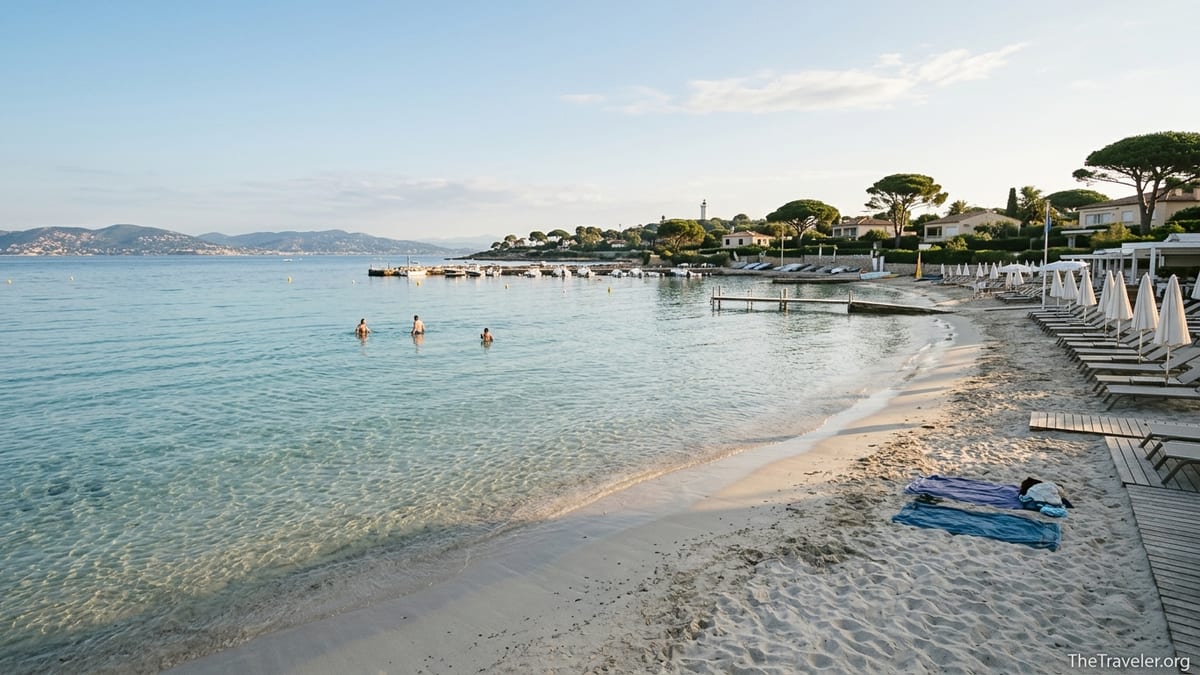
A Sheltered Bay With Remarkably Clear Water
What first strikes most visitors at Plage de la Garoupe is the color of the sea. The bay is shallow for a good distance out, with a sandy bottom that acts like a natural reflector, turning the water an intense turquoise on sunny days. On clear mornings you can see individual ripples of sand and bits of seashell on the seabed even when you are chest deep, something that surprises travelers used to the darker pebble beaches of nearby Nice.
The shape of the bay helps explain the clarity. Garoupe sits in a sheltered curve of Cap d’Antibes, partly protected from strong swells and boat traffic by rocky headlands and a string of small jetties. There is less churning up of sediment, so even in August the water often looks more like an oversized swimming pool than an open sea. Locals talk about how, after a mistral wind has blown through and scrubbed the air clean, visibility in the water feels almost unreal.
For families, that shallow gradient is a big part of the appeal. Children can wade out gradually, and parents can stand knee-deep near the first line of buoys while still being able to see the sandy bottom beneath their feet. Lifeguards are typically present in high season on the public section, but many residents will tell you they come here precisely because the bay feels naturally protective compared with more exposed stretches along the Riviera.
Regular swimmers also have their routines. You will often see locals arriving early, before 9 a.m., dropping a towel on the public sand and swimming slow laps between the rocky point at one end and the buoys near the beach clubs. By the time the first restaurant coffee machines hiss into life, they are already drying off on the promenade, confident they have had one of the cleanest swims you can find this close to a major resort town.
Soft Sand and Riviera Charm in a Compact Package
Unlike many Côte d’Azur beaches that are made up of rounded pebbles, Plage de la Garoupe is mostly fine, pale sand. It is deep and soft enough that locals often go barefoot from the parking area straight to the shoreline, something you cannot comfortably do on the stone beaches of Nice. Families from Antibes and nearby Juan les Pins bring simple folding chairs and plastic buckets rather than the thick foam mats you see elsewhere, confident that a towel alone is enough on this sand.
The beach itself is compact, which is part of its charm. In summer, much of the shoreline is occupied by private beach clubs with neat rows of loungers, leaving two small but cherished stretches for the public. These free areas are not large, but they share exactly the same backdrop: the creamy villas of Cap d’Antibes behind you and the curved line of the bay in front. Locals who know the routine arrive early, especially in July and August, to claim a patch of sand before the day-trippers from Cannes and Nice filter in.
Even at the height of the season, Garoupe feels more like a Riviera village beach than a city one. There is no tall modern skyline, only low-rise houses screened by umbrella pines and oleander, and the faint outline of the Alps far across the Baie des Anges on clear days. Regulars will point out the white mass of the Phare de la Garoupe lighthouse up on the plateau and explain how its beam once guided sailors home to Antibes. It is this combination of natural setting and quiet human-scale surroundings that many residents say they find missing on more developed stretches of coast.
Out of season, the scale changes again. From late September through May, when the beach clubs remove most of their infrastructure, Garoupe reverts closer to a simple local strand. Dog walkers, joggers and retirees with thermos flasks take over the promenade, and you can often find only a handful of people on the sand at midday. For people living in Antibes year-round, this is the Garoupe they talk about with affection: empty, crystalline, and framed by a winter light that makes the water look like glass.
Private Beach Clubs the Locals Actually Use
Part of Garoupe’s allure is its cluster of long-established beach clubs that manage to feel relaxed rather than ostentatious. While names and ownership occasionally change, the formula stays broadly the same: a row of sunbeds on wooden decking, a dining terrace just above the sand, and staff who remember returning guests from previous summers. Locals who want a day of uncomplicated comfort often book a lounger here rather than experimenting somewhere new.
On a typical summer day, a standard sunbed with umbrella on one of these clubs might cost in the region of 30 to 45 euros, depending on row and date, with front-row spots near the water at the higher end of that range. For someone based in Antibes, this is a planned indulgence rather than a casual daily expense, but it is one many repeat several times each season. Residents talk about the pleasure of ordering a simple salade niçoise or grilled sea bass, then lingering for hours as the light shifts across the bay, knowing they do not have to think about beach gear or shade.
The atmosphere tends to be more old-school Riviera than party-oriented. You are more likely to hear quiet conversations in French and Italian over carafes of chilled local rosé than loud music or bottle service. Families might reserve the front two loungers while grandparents settle in the second row, and children shuttle back and forth between the warm shallows and plates of melon on the terrace. For visitors, joining this scene for a day is a quick way to experience how locals actually use the beach, rather than just passing through for an hour.
At the same time, there is no obligation to buy into the club experience. The public sections sit immediately adjacent, and it is perfectly normal to see a group of Antibes teenagers setting up inexpensive folding chairs next to the neat lines of rental loungers. Many residents alternate: a free morning on the public sand with a picnic from the boulangerie in town, then a reserved bed at a club for a special Sunday or when hosting relatives.
Public Sand, Local Rituals and Everyday Life
Although the private sections are highly visible, the modest public zones of Plage de la Garoupe are what anchor it in local life. These slices of sand, open to everyone, are where Antibes residents come for spontaneous swims after work, for quick morning dips on a hot weekday, or for simple family outings that do not revolve around restaurant reservations.
In practice, this looks very everyday. On a July evening, you might see a group of friends arrive straight from the SNCF station, still wearing office clothes, with a shared towel and a cloth bag holding a baguette, cherry tomatoes and a bottle of sparkling water. They will leave phones in the sand and walk directly into the sea for ten minutes, chatting waist-deep while looking back at the curve of the bay. For many locals, this is the essence of living near Garoupe: the ability to reach transparent water in under twenty minutes from the center of Antibes without planning.
Weekend mornings follow a similar pattern. Parents spread a simple cotton fouta on the public sand and unpack plastic containers of fruit and croissants, while children dart to the waterline with inflatable rings bought from a supermarket in town. There may be no loud organized activities, but plenty of low-key rituals: a father teaching a child to snorkel along the rocks at one end of the bay, or an older couple who always bring the same striped parasol and paperback novels.
These habits are why many residents will tell you that Garoupe is not only a postcard place but part of their routine. People use it in small, frequent doses rather than only as a once-a-year showpiece, and that familiarity softens the posher edges of Cap d’Antibes. Even if they never rent a lounger, locals still talk about “our” bay, our winter storms, and the particular way the light falls on the lighthouse on spring evenings.
Views, Coastal Walks and a Sense of History
Another reason Plage de la Garoupe is loved by locals is what surrounds it. Lift your eyes from the sand and you see a panorama that stretches from the ramparts of Antibes across the Baie des Anges to the hills behind Nice. On exceptionally clear winter days, snow-dusted Alpine peaks seem to float beyond the turquoise water, a contrast that even long-term residents say still catches them off guard.
Just above the beach rises the plateau of La Garoupe, crowned by the white Phare de la Garoupe lighthouse and the historic Notre-Dame de la Garoupe sanctuary. Locals know you can drive or hike up from the other side of the cape to reach this viewpoint, where small plaques and votive offerings recall a long maritime history. For many, a perfect off-season Sunday combines a bracing swim at Garoupe, a coffee at one of the beach cafés, and then a short drive or walk up to the lighthouse for a final look back at the bay from above.
The coastline here also links into one of the Riviera’s most beloved walking routes, the sentier du littoral around Cap d’Antibes. Starting near Plage de la Garoupe, this path hugs the rocks around the peninsula, passing below gated villas and along wave-splashed stone walkways. Residents walk it in trainers and simple sunhats, carrying small backpacks rather than heavy hiking gear, and many include a quick swim at Garoupe at the beginning or end of the loop. That easy combination of walking and swimming in clear, accessible water is a major part of the beach’s appeal.
A sense of layered history underpins it all. Old photographs in local bars show Garoupe as a simple fishermen’s cove, and you still see traces of that in the modest stone jetties and boat moorings. Stories of artists, writers and Hollywood-era visitors drift around the peninsula, but for people who live here, the enduring narrative is quieter: generations of Antibois learning to swim in the same shallow curve of sand-colored sea.
Practicalities: Getting There, Costs and When to Go
From central Antibes, reaching Plage de la Garoupe is relatively straightforward. Many locals with cars simply follow the coastal road around Cap d’Antibes, passing Plage de la Salis and a string of small coves until the bay opens up on their right. There is a public parking area slightly set back from the beach, and while it can fill quickly in peak summer, outside of July and August locals often find a space without too much circling. It is worth checking signage carefully, as some roadside stretches have time limits or overnight restrictions.
Those without a car have options as well. In recent years local Envibus routes have connected Antibes with Cap d’Antibes, and residents also make liberal use of regional buses and on-demand services that cover the peninsula. Schedules change seasonally, so Antibes locals typically check an updated timetable or transport app before setting out in high season. For particularly keen walkers, it is even possible to stroll from the old town via Plage de la Salis and the coastal road, although in summer heat this is more appealing as a morning or late afternoon activity than a midday march.
Costs at Garoupe vary significantly depending on how you choose to use the beach. A purely public day can be almost free: a return bus ticket from Antibes might be a few euros, and a picnic of bread, cheese and fruit picked up at Marché Provençal in the old town can feed two or three people for under 15 euros. At the other end of the spectrum, a couple reserving two loungers and an umbrella at a private club, ordering a shared starter, two main courses and a bottle of rosé, can easily spend between 150 and 250 euros over the course of the day. Many locals find their own balance between these extremes.
Timing matters too. Residents often recommend late May to late June or September for the best combination of warmth and space. In June, the water has usually warmed to comfortable swimming temperatures, yet the beach is still quiet enough that you can arrive mid-morning and find a spot on the public sand without difficulty. In September, the sea retains summer heat while the crowds thin, and you will notice more French spoken around you as second-home owners head back to Paris and Lyon and the coast returns to a more local rhythm.
How Visitors Can Enjoy Garoupe Like a Local
For travelers, the appeal of Plage de la Garoupe is not only its beauty but the chance to slip into the same patterns that keep locals coming back. One simple adjustment is to think in shorter, more frequent visits rather than one long, all-day stay. Antibes residents often stop by for an hour’s swim either early or late, when the light is soft and the sand is less crowded. Visitors can copy this by planning a morning at the Marché Provençal and old town ramparts, followed by a late-afternoon swim at Garoupe when the sun is lower and the colors richer.
Another tip is to travel light. Locals rarely arrive with full coolers and heavy bags. Instead, they bring a single lightweight tote with a fouta towel, sunscreen, a bottle of water and perhaps a paperback. Anything else can be picked up en route in town. This makes it far easier to change plans if the beach is busier than expected or if wind conditions are better at another nearby cove such as Plage des Ondes. It also encourages a more spontaneous relationship with the bay, closer to how people living in Antibes actually use it.
Respect for the setting is also key. Because Garoupe’s charm depends on its natural clarity and gentle scale, locals are quick to notice when visitors treat it like a disposable resort backdrop. Simple gestures go a long way: using the rubbish and recycling bins placed along the promenade, avoiding glass bottles on the sand, keeping music low enough that only your group can hear it, and staying behind marked ropes that protect small dune areas or plantings. On windy days, residents often collect stray plastic bags or cups as they leave, a practice that visitors can easily adopt.
Finally, consider combining Garoupe with the wider Cap d’Antibes rather than treating it as an isolated destination. A morning swim followed by the coastal path, a lazy lunch at a café back in Antibes’ old town, and an evening return for a sunset paddle is a rhythm that many locals follow in summer. Seen this way, the beach becomes a recurring note in your stay rather than a single box to tick, and its quiet Riviera charm has more chance to sink in.
The Takeaway
Plage de la Garoupe is one of those rare Riviera beaches that manages to balance postcard beauty with a lived-in, local feel. Its clear, shallow water and soft sand explain the practical side of its popularity, while the sheltered bay, views to the Alps and easy access from Antibes make it a natural part of daily life for people who live nearby. Beach clubs provide comfort without overwhelming the shoreline, and small public sections keep the place grounded and genuinely shared.
For visitors, understanding why locals love Garoupe means looking beyond the sunbeds to the quiet rituals that happen here every day: early swims before work, simple picnics after school, winter walks along the promenade when the water is icy-blue and almost empty. Approach the bay with that same unhurried attitude, and you will find not just a beautiful corner of Cap d’Antibes, but a clear window into Riviera life as it is actually lived.
FAQ
Q1. Is Plage de la Garoupe suitable for young children?
Yes, the water is shallow for quite a distance and usually very calm, which makes it popular with local families. Parents still supervise closely, but many choose Garoupe specifically because small children can paddle in clear, sandy shallows rather than on pebbles or near strong waves.
Q2. How can I reach Plage de la Garoupe from central Antibes without a car?
You can use local Envibus routes that serve Cap d’Antibes, or combine a short bus ride with a walk along the coastal road from Plage de la Salis. Schedules vary by season, so most people check a current timetable or transport app on the day. In cooler months, fit walkers sometimes choose to walk the whole way from the old town.
Q3. Do I have to pay to use the beach, or is there a free area?
There are two small but fully free public sections of sand where anyone can lay a towel without charge. The rest of the shoreline is occupied by private beach clubs that rent loungers and umbrellas for a fee. Locals switch between the two depending on budget and occasion.
Q4. How expensive are the private beach clubs at Garoupe?
Prices fluctuate, but in high season a standard sunbed with umbrella typically costs somewhere around 30 to 45 euros for the day, with premium front-row spots more expensive. Food and drinks are extra. Many visitors keep costs down by sharing dishes and alternating club days with simple public-beach visits.
Q5. When is the best time of year to visit Plage de la Garoupe?
Locals often favor late May to late June and September. In these shoulder months, the sea is usually warm enough for comfortable swimming, but the sand is less crowded and it is easier to find space on the public areas or reserve loungers without booking weeks ahead.
Q6. Is the water at Garoupe always clear, even in peak summer?
The bay is known for its clarity, thanks to its sheltered position and sandy bottom, but conditions can vary. After strong winds or heavy boat traffic nearby, the water may be slightly cloudier for a day or two. On calm, sunny days, especially in the morning, visibility is often excellent even in midsummer.
Q7. Are there showers, toilets and other facilities on or near the beach?
Yes, in high season there are usually basic public facilities such as showers and toilets near the beach, and the private clubs offer their own amenities to paying guests. Several cafés and restaurants line the back of the beach, so it is easy to find snacks, drinks and sit-down meals without leaving the bay.
Q8. Can I walk from Plage de la Garoupe to the coastal path around Cap d’Antibes?
Yes, Garoupe is one of the main access points for the sentier du littoral around Cap d’Antibes. From the beach area you can follow signs to the path, which runs along the rocky shore beneath villas and offers dramatic sea views. Wearing sturdy shoes and checking local advice about sea conditions is recommended before setting out.
Q9. Is parking available near the beach, and do I need to pay?
There is a public parking area near Plage de la Garoupe and additional street parking along nearby roads. In high season, spaces fill up quickly, especially late morning and early afternoon. Some parking is free, while certain areas may be regulated or time-limited, so drivers pay close attention to local signs and, when possible, arrive early.
Q10. What should I bring if I want to experience Garoupe like a local?
A light cotton towel or fouta, good sunscreen, a reusable water bottle, simple beach shoes for walking on the promenade, and perhaps a paperback or magazine are usually enough. Many locals pick up a baguette, fruit and cheese in Antibes before coming, which keeps the day relaxed and avoids relying entirely on restaurant meals.