


The first time many travelers see Baie des Anges, it is through an airplane window as the runway of Nice Côte d’Azur Airport seems to float on the Mediterranean. The curve of the coastline, the pale pebbled shore, and the soft pastel skyline of Nice appear almost painted. Yet this bay between Nice and Antibes is very real, and it has quietly become one of the defining images of the French Riviera. Baie des Anges is not just a backdrop. It is the stage on which Riviera life plays out, from Belle Époque promenades and luxury hotel terraces to early-morning swimmers and plane-spotters lingering over a coffee by the sea.
Get the latest updates straight to your inbox!
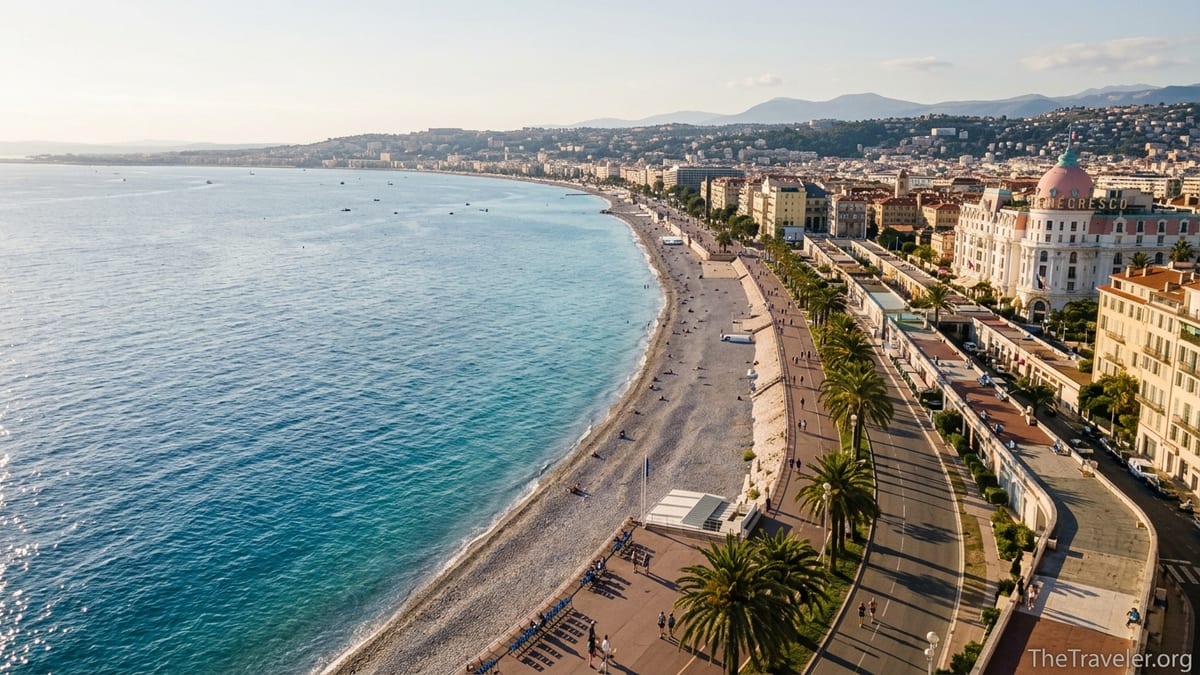
A Natural Amphitheatre of Sea, City, and Mountains
Viewed from the air or from the higher floors of seafront hotels like Le Negresco or the Hyatt Regency Palais de la Méditerranée, Baie des Anges reveals its most striking quality: scale. The bay stretches roughly 20 kilometers from the headlands of Nice in the east to the outskirts of Antibes in the west, forming a wide crescent of sea bordered by city and low-lying resorts. On clear days, the water shifts from pale turquoise at the shoreline to a deep sapphire further offshore. Behind the city, foothills and Alpine peaks rise in soft layers, giving the impression of a natural amphitheatre where the Mediterranean is the stage.
For travelers, this geography creates rare depth in a coastal view. Stand on the pebbly beach in front of the Hotel Le Royal on the Promenade des Anglais and you will see, in a single sweep of your gaze, the curve of the bay, aircraft landing at Nice Côte d’Azur at its western tip, the ochre facades of Old Nice to the east, and snow-capped mountains in late winter on the horizon. It is a view that feels cinematic, yet you can experience it with something as simple as a takeaway espresso from a promenade kiosk and a seat on the public blue chairs facing the sea.
The pebble beaches themselves add to the distinct character of Baie des Anges. Unlike the sandy coves of nearby Cannes or Saint-Raphaël, the rounded grey and white galets create a sharper line between land and sea. In practice, this means clearer water and a particular soundscape: the clatter of stones as the surf pulls back, which you will hear during an evening walk in March as clearly as on a crowded afternoon in August. Locals often bring thick beach mats rather than towels, and many private beach clubs on the Promenade invest in thicker mattresses precisely because of these pebbles.
Because the bay is open to the south, light plays across it almost all day. In summer, early mornings around 7 or 8 am are marked by a silvery glow and relatively calm seas, making it a favorite hour for stand-up paddleboarders launching near Carras beach, west of central Nice. By late afternoon, the sun sinks behind the Esterel hills in the distance, casting a warm, sideways light that photographers and Instagram-focused travelers seek out from viewpoints such as the Colline du Château park above Old Nice.
The Promenade des Anglais: The Bay’s Living Balcony
No element frames Baie des Anges more effectively than the Promenade des Anglais, the seven-kilometer seaside boulevard running along the heart of the bay in Nice. Originally developed in the 19th century by wintering British aristocrats, the “Prom” is now one of Europe’s most recognizable seafronts. It is this wide, palm-lined ribbon, with its cycle lanes, joggers, rollerbladers, and classic blue chairs, that turns the bay from a pretty stretch of coastline into a lived-in, constantly animated stage.
Visitors encounter the Promenade in very practical ways. A traveler staying in a modest three-star hotel one block inland can walk two minutes to the seafront, buy a scoop of lemon sorbet from a glacier opposite the beach, and sit watching the curve of Baie des Anges for the price of a few euros. At the other end of the spectrum, guests at five-star addresses like Le Negresco or Hôtel La Pérouse book sea-view rooms and suites whose nightly rates in high season can easily climb into several hundred euros, precisely because they offer uninterrupted views along the bay through classic French windows or private terraces.
The Promenade also gives the bay a strong sense of ritual. Early each morning, before the first cruise excursion buses arrive, you will see locals walking small dogs without leashes, office workers in trainers getting their run in before swapping to dress shoes, and elderly Niçois reading newspapers on the same blue chair they choose every day. In the late afternoon and evening, couples stroll in their holiday best on their way to dinner, students gather with takeaway pizzas on the beach, and flight crews from long-haul airlines, identifiable by their uniforms and wheelie bags, stretch their legs after landing at Nice Côte d’Azur.
Cities such as Cannes and Monaco have glamorous waterfronts, but few match the uninterrupted relationship between city, promenade, and sea that Baie des Anges offers in Nice. There is no railway or major road separating the city from the water along most of the Promenade. Instead, the bay seems to lap almost directly at the foundations of the Belle Époque facades, which is why even a simple second-floor balcony can feel like a front-row seat on the Mediterranean.
Iconic Arrival: The Runway on the Water
Another reason Baie des Anges has become one of the French Riviera’s most iconic coastal views is the way travelers first encounter it. Nice Côte d’Azur Airport, France’s third-busiest, is built partly on reclaimed land that extends directly into the western end of the bay. On approach, particularly when landing from the east, aircraft appear to skim the water before the runway materializes at the last moment on a narrow platform between sea and city. For many passengers, this is their first close-up view of the bay’s curve, framed by airplane windows.
Plane-spotters and aviation enthusiasts sometimes choose hotels specifically to enjoy this combination of aircraft and sea. Mid-range hotels near Carras and the western Promenade offer sea-view rooms where guests can watch planes take off and land against the backdrop of the bay all day long, without ever having to leave their balcony. Cafes in the Saint-Augustin and Arenas districts, just inland from the airport, double as informal viewing points, particularly in summer when traffic to and from seasonal destinations is high.
For the average traveler, the airport’s seaside position has more subtle benefits. The tram line that links the terminals with the city center runs parallel to the bay, so a visitor arriving on a budget can ride from the airport to stops like Magnan or Alsace-Lorraine and see the water within minutes of stepping off the plane. Even a short layover can turn into a mini Riviera experience: with a carry-on bag, it is possible to leave the terminal, cross the main road, and reach the public beach near the western Promenade for a quick swim or a picnic overlooking Baie des Anges.
The unusual presence of a major international airport at the very edge of the bay reinforces its symbolic role as a gateway. Travelers flying in for the Cannes Film Festival, the Monaco Grand Prix, or summer yacht charters all arrive over the same stretch of water. When images of celebrities stepping off private jets at Nice or boarding helicopters for Monaco appear in the media, they often carry the bay’s pale blue in the background, subtly reinforcing Baie des Anges as the Riviera’s front door.
A Landscape Layered with History and Myth
While many visitors associate Baie des Anges with modern tourism, its name and landscape are steeped in older stories. Several explanations exist for the origin of the name “Bay of Angels.” One links it to angelsharks once caught by local fishermen in these waters, nicknamed “angels of the sea” for their wing-like fins. Another, rooted in Christian tradition, tells of angels guiding a boat carrying the relics of Saint Réparate to these shores, a story still referenced in Nice’s cathedral dedicated to the saint.
This layering of myth and history continues along the shoreline. On the eastern end of the bay, the Colline du Château overlooks both the harbor of Nice and the sweep of Baie des Anges. There is no castle there today, but the park’s name recalls the medieval fortress that once guarded the entrance to the bay. Standing at the main viewpoint near the park’s café, visitors look down on the Promenade, the curve of the city’s rooftops, and the water beyond in a scene that has appeared in countless travel magazines and Riviera postcards since the early 20th century.
Further west, beyond the city limits, the shoreline softens into a series of smaller resorts and marinas. Villeneuve-Loubet, with its distinctive pyramidal apartment complexes known as Marina Baie des Anges, illustrates how the bay has inspired modern architecture as well as historic imagery. These white terraced buildings, visible from aircraft and the coastal train, imitate the shape of waves and have themselves become a recognizable marker along the Riviera.
In everyday terms, this history shapes how travelers move through the bay. A visitor might spend a morning exploring the Baroque churches and food stalls of Old Nice, climb up to the Colline du Château for a classic photograph of Baie des Anges at midday, then take the coastal train to Antibes in the afternoon, watching the same bay pass by from a different angle as the tracks hug the shoreline. What ties these experiences together is the constant presence of the curved horizon line and the particular blue of the water.
From Luxury Terraces to Public Beaches: A Democratic View
One of the most compelling aspects of Baie des Anges is how accessible its signature view remains. Yes, there are rooftop bars and fine-dining terraces where glasses of Provençal rosé can cost as much as a simple lunch elsewhere in town, and where the bay serves as a high-end backdrop for gourmet tasting menus. Hotels like La Pérouse market their “Baie des Anges suites” with panoramic sea views as premium experiences, and in busy summer months these top-category rooms can book out weeks in advance.
Yet you do not need a luxury budget to enjoy essentially the same horizon. Along the Promenade des Anglais, dozens of public access points lead directly onto free beaches where anyone can lay out a towel and face the water. Supermarkets on side streets sell chilled local rosé, olives, and fresh baguettes for the price of a single cocktail on a glamorous rooftop. Travelers on tighter budgets often organize their days around simple routines: a morning swim before the sun is strong, a late-afternoon nap in a budget hotel a few blocks inland, then a picnic dinner on the stones watching the light fade over the bay.
This coexistence of high and low is part of what makes the bay’s coastal view so evocative. On the same strip of shoreline, you might see guests from five-star hotels stepping across the promenade in pressed linen to private beach clubs where sun lounger rentals run to several dozen euros per day, while a few meters away, backpackers and local students sit directly on the pebbles with shared bottles of supermarket wine. Both groups watch the same planes pass low over the sea, the same cruise ships gliding in the distance, and the same fishing boats returning toward the port.
For families, the bay’s configuration is especially practical. Parents can rent a pair of loungers at a relatively modest public-private beach concession, order simple dishes like niçoise salad or grilled fish for lunch, and still feel part of the Riviera atmosphere without committing to the full luxury beach club experience. Showers, changing cabins, and lifeguard stations are spaced at regular intervals along the main stretch of Baie des Anges in Nice, so children can swim, collect smooth pebbles, and watch stand-up paddleboarders drift by while grandparents relax a few steps away under a parasol.
Seasonal Light, Everyday Rituals
Although many visitors imagine Baie des Anges in peak summer, the bay’s most nuanced views often appear in shoulder seasons. In late April or early May, the sea may still be cool, but the promenade begins to fill with runners preparing for local races and cyclists training in milder air. Hotel rates, while not low, are usually more accessible than in July and August, and travelers can linger longer at terrace cafes without competing for tables. Photographers appreciate these months for their softer light and for the presence of locals using the bay, rather than primarily tourists.
In winter, the coastal view transforms again. Snow is common on the distant Alps while the palm trees along the Promenade remain green. On bright January days, the sky can be a hard, dry blue and the outline of the mountains sharply defined, giving the bay a clarity that summer haze sometimes softens. Retired couples from northern Europe rent small apartments for several weeks, taking daily constitutionals along the water instead of the beach-centered routines of August visitors. The pebble shore is quieter, and the sound of waves sliding over the stones competes only with the occasional scooter on the road.
Throughout the year, events tie into the bay’s scenery. During the Nice Carnival in February, flower-bedecked floats roll along the Promenade des Anglais with Baie des Anges as the backdrop, a juxtaposition of winter festivities and evergreen Riviera seascape. In autumn, endurance events like marathons and triathlons trace long portions of the coastline, letting amateur athletes experience what it feels like to push through the final kilometers with the bay’s horizon line steady ahead of them. For participants, this coastal view becomes inseparable from their personal memories of effort and achievement.
Everyday rituals, however, remain the strongest thread that ties locals to the view. A café on Rue de France with a partial sea glimpse from its terrace may serve the same regulars every morning for years. For them, Baie des Anges is not a postcard but the check on the weather: if the sea has whitecaps, maybe the mistral is up; if the water is glassy and calm, perhaps it is a good evening for a sunset swim at Opéra beach. Travelers who stay more than a couple of nights often find themselves adopting similar small habits, such as timing dinner reservations so they can cross the Promenade and stand at the balustrade while the last light leaves the bay.
The Takeaway
Baie des Anges has become one of the French Riviera’s most iconic coastal views not because of a single monument or lookout, but because sea, city, and daily life are so tightly intertwined along its curve. From the unusual sight of aircraft landing almost in the water to the historical promenade that doubles as the city’s communal balcony, the bay offers a view that is both grand and intimate at once. It can be admired from the rooftop terrace of a five-star hotel suite or from a public bench with a takeaway coffee, and the essential elements remain the same: the sweep of the shoreline, the layered hills behind, and the constantly changing light on the water.
For travelers, this means that almost any stay in Nice can include moments that feel worthy of a Riviera postcard. You might catch your first glimpse of Baie des Anges through a plane window at dawn, in the pink tones of a winter sunrise. You might watch the bay slowly darken from a promenade bench after a late dinner, listening to the particular sound of waves over pebbles. Or you might simply notice, on your way to the airport tram, that the same horizon line that welcomed you now accompanies your departure. In all these scenes, Baie des Anges is a reminder that some of the most memorable coastal views in Europe are not hidden away in remote coves, but woven into the everyday life of a working Mediterranean city.
FAQ
Q1. Where exactly is Baie des Anges on the French Riviera?
Baie des Anges is the wide bay of the Mediterranean stretching roughly between Nice and Antibes in the Alpes-Maritimes department of southeastern France, with most visitors experiencing it from the seafront in Nice.
Q2. What is the best viewpoint for classic photos of Baie des Anges?
One of the most popular viewpoints is from the Colline du Château park above Old Nice, where a main terrace overlooks the Promenade des Anglais and the full curve of the bay.
Q3. Can I enjoy the famous bay view without staying in an expensive hotel?
Yes. The entire length of the Promenade des Anglais is public, and there are many free pebble beaches and benches where you can enjoy the same horizon for only the cost of a drink or picnic.
Q4. Is it easy to reach Baie des Anges from Nice Côte d’Azur Airport?
Very. The airport sits at the western end of the bay, and a tram line connects the terminals to the city center in about 20 to 30 minutes, with stops only a short walk from the promenade and beaches.
Q5. Are the beaches along Baie des Anges sandy or pebbly?
Most central Nice beaches along Baie des Anges are covered in smooth pebbles rather than sand, so locals often use thick mats or rent loungers from beach clubs for extra comfort.
Q6. When is the best time of year to visit for beautiful coastal views?
While summer is the busiest, many travelers find that spring and autumn offer the best combination of softer light, fewer crowds, and still-pleasant temperatures for walking and photography along the bay.
Q7. Is Baie des Anges suitable for families with children?
Yes. There are regular lifeguard stations in season, designated swimming zones, showers, and family-friendly beach concessions where you can rent loungers and order simple meals right by the water.
Q8. Can I swim near the airport side of Baie des Anges?
Swimming zones are concentrated further east along the main Nice seafront, but there are public beaches near the western Promenade where locals swim while planes land and take off in the background.
Q9. Are there good public transport options for exploring the bay beyond Nice?
Regional TER trains and local buses run along the coast, making it straightforward to see Baie des Anges from different angles in places like Cagnes-sur-Mer, Villeneuve-Loubet, and Antibes.
Q10. Do I need to book beach clubs or sea-view restaurants in advance?
In high summer and during major events like the Cannes Film Festival or Monaco Grand Prix, advance reservations are strongly recommended for popular beach clubs and waterfront restaurants overlooking the bay.