


Higbee Beach, just north of Cape May Point at New Jersey’s southern tip, has an outsized reputation for a place with a dirt parking lot and no lifeguard stand. Ask around in town and you will hear it described as a secret swimming spot, a throwback nude beach, or an uncrowded alternative to Cape May’s guarded oceanfront. Most first-time visitors arrive with one of those ideas in mind. Nearly all leave surprised, because the defining experience of Higbee Beach is what it is not.
Get the latest updates straight to your inbox!
Not Really a Classic “Beach Day” Destination
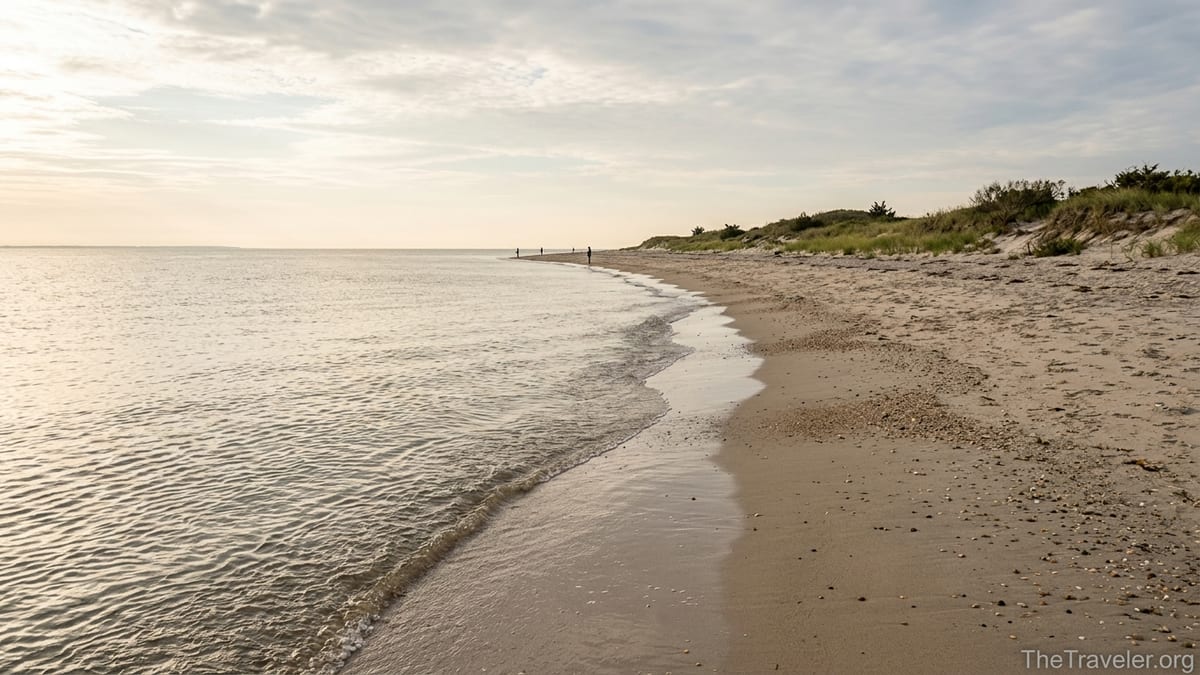
Travelers who punch “Higbee Beach” into a maps app usually imagine a smaller, quieter version of Cape May’s main beachfront: a place for umbrellas, coolers, chairs and kids in the surf. What they actually find is a wild stretch of Delaware Bay shoreline, backed by scrub, dunes and forest, managed by New Jersey Fish & Wildlife as Higbee Beach Wildlife Management Area rather than a municipal bathing beach. The sand is coarse, the water slopes off quickly and there are no lifeguard stands, rental kiosks or snack shacks. On a humid July afternoon, you are more likely to see anglers spaced along the waterline than toddlers building sand castles.
This difference matters in practice. On a summer weekend, a guarded Cape May ocean beach might have roped-off swim zones, color flags indicating conditions, lifeguards blowing whistles and an ice cream cart passing every hour. At Higbee, there are hand-lettered reminders about rules at the trailhead kiosk, then nothing but the sound of wind in the phragmites. Families who arrive towing a beach wagon and a Bluetooth speaker often stay just long enough to realize there are no restrooms, rinse showers or boardwalk, then retreat to the car and head back toward Beach Avenue. Those who stay tend to be birders with binoculars, surfcasters with sand spikes, and couples looking for a quiet walk at the edge of the tide.
For many first-time visitors, the biggest surprise is that the feel of Higbee is closer to rural wildlife preserve than resort town. If you have previously visited national seashore areas like Assateague Island in Maryland or the undeveloped sections of Sandy Hook, you will recognize the vibe: sandy trails, a primitive lot that fills early, and a self-reliant crowd carrying everything they will need in backpacks rather than rolling coolers.
Not a Legal Nude Beach, Despite the Stories
Ask long-time Cape May locals about Higbee Beach and the conversation usually turns, sooner or later, to its history as an unofficial nude beach. Through the 1980s and 1990s, sections of the bayfront near Higbee drew nude sunbathers from around the region, and the area developed a reputation that still lingers. New Jersey’s legislature later changed state law to allow counties and towns to prohibit public nudity on their beaches, and court rulings backed enforcement at Higbee. Today, Gunnison Beach at Sandy Hook, on federal land, is widely considered the only sanctioned clothing-optional beach in the state. Higbee is not one of them.
Visitors who show up expecting a freewheeling social nude scene are often surprised to find a more subdued reality. On a hot weekday in August, you might encounter an occasional discreetly topless sunbather north of the main path or someone tucked into the dunes away from the trail, but the vibe is cautious rather than celebratory. New Jersey Fish & Wildlife regulations make clear that indecent exposure is prohibited in Wildlife Management Areas. Parked state trucks, conservation officers walking the beach and posted rules at the entrance are real, not theoretical. Travelers who misread old online chatter about Higbee as up-to-date guidance can easily find themselves uncomfortable or facing an awkward conversation with an officer.
For travelers specifically seeking a legal clothing-optional experience, the practical takeaway is simple: plan around Gunnison Beach near the New York Harbor entrance and treat Higbee as a conventional, clothed shoreline. For everyone else, understanding this history helps explain the subtle tension you sometimes feel near the tree line on busy summer days: newer visitors treating it as an ordinary bay beach, and a handful of holdouts from an earlier era still testing the boundaries.
Not a Safe Swimming Beach on the Delaware Bay
Another shared misconception among first-timers is that the Delaware Bay is gentler and therefore safer than the open Atlantic, and that Higbee is a good place to wade or let kids splash. From a distance the bay can look deceptively calm, with low chop instead of pounding surf. Regulars know better. Strong tidal currents, abrupt drop-offs and shifting bars characterize this part of the bay, and that combination has led to water rescues and near-misses up and down the bayside, from North Cape May to Higbee. Local fire departments and volunteer rescue squads routinely warn that there are no lifeguards on the bay beaches, and that even confident swimmers can be caught off guard when the tide turns.
In discussions among Cape May County residents, Higbee is often mentioned specifically as a place where people underestimate the water. The deepening channel and heavy tidal flow that make it productive for surf fishing also mean you can go from mid-calf depth to chest deep in a few cautious steps, with a lateral pull you feel the moment you lift your feet. Parents used to the steady, shallow gradient in guarded sections of Wildwood or Ocean City are startled by how quickly the bottom drops away here. On days when strong southwest winds stack water into the bay, that subtle current can turn into a forceful sideways push that has even experienced swimmers choosing to stay on the sand.
Practical planning tip: if your non-negotiable goal is safe ocean swimming with kids, Higbee should not be your primary destination. Instead, reserve it for low-key walks, wildlife watching or casting a line at sunrise. Treat the waterline the way you might at an undeveloped national seashore: ankle-deep wading at most, and only for adults who are watching conditions carefully. Local advice from Cape May lifeguards and first responders is blunt on this point: choose a guarded beach if you intend to go beyond your knees.
Not Fully Open During Ongoing Restoration Work
Another surprise for recent first-time visitors is just how much of Higbee Beach Wildlife Management Area has been affected by a major restoration project. Portions of the area, including trails and interior habitat, were closed beginning in early 2024 as part of the Pond Creek Restoration Project, a multimillion-dollar effort led by New Jersey’s Department of Environmental Protection to restore tidal wetlands, improve wildlife habitat and manage flooding across roughly 400-plus acres. Signage at access points and notices from the state indicate that closures are expected to last into late 2026, with sections reopening in stages as work is completed.
For a traveler who has read older blog posts describing a network of color-coded trails, interior observation points and quiet back bays, the current reality can be jarring. A hike they expected to turn into a loop through fields and woods now ends abruptly at a fence and “Area Closed” placards. Long-planned morning bird walks may need to detour to alternative hotspots like Cape May Point State Park, The Nature Conservancy’s South Cape May Meadows or Cox Hall Creek WMA. In local forums, visitors report arriving early, expecting to explore the entire area, only to find equipment staging zones, temporary barriers and segments of trail that are clearly off-limits.
This does not mean Higbee is entirely closed to the public. The primary beach access via the sandy track from the parking area behind the Sunset Boulevard shops has generally remained available, and surf anglers still regularly share reports from the waterline. But anyone planning a first visit in 2024 through 2026 should build in flexibility. Conditions may change within a season as contractors shift where they are working, and specific side paths you saw in a spring trip report may no longer be accessible by August of the same year. Checking with Cape May tourism staff in town or reading the latest notices from New Jersey Fish & Wildlife shortly before you go will help reset expectations.
Not a Developed, Serviced Park
Because Higbee appears prominently on digital maps and guidebooks, first-timers often assume a baseline level of amenities: permanent restroom buildings, trash cans every few yards, maybe a water fountain or at least a portable toilet in summer. Instead, their introduction is a sandy, often rutted access road, a small unpaved parking area that can hold only a few dozen cars, and a simple signboard listing Wildlife Management Area regulations. On busy summer weekends, that lot can fill by mid-morning, leaving late arrivals to circle in frustration or turn back toward Cape May Point. There are no overflow lots, attendants or shuttles; if every space is taken, your options are to wait patiently for someone to leave or bail out to another beach.
Once past the lot, the experience remains decidedly low-frills. There is no boardwalk or promenade, only sandy paths through low dunes and scrub. You will not find chair and umbrella rentals, cabanas or food concessions. There are no changing rooms, no taps for rinsing sand, and no municipal trash crews making hourly rounds. Regular visitors pack as if they were heading onto a backcountry trail: plenty of water, snacks in sealable containers, a trash bag to pack everything out and sun protection they can carry easily. A visiting couple who stop at a Cape May café for iced coffees before heading over quickly realize that the only “table” for that drink will be a patch of sand near a driftwood log.
This also extends to connectivity and navigation. Cell reception across the Wildlife Management Area can be spotty depending on your carrier, and once you are on the beach it is easy for every stretch of shoreline to look alike. Seasoned birders and local anglers are quick to advise newcomers to drop a pin at the car before walking north along the water so they can reliably find their way back without overshooting the access trail at dusk. If your ideal day by the shore depends on creature comforts, music streaming and quick rideshare pickups, Higbee will feel starkly different from the serviced beaches a few miles away.
Not Just a Beach: A Major Wildlife Hotspot
To birders and naturalists, Higbee Beach is not defined by its sand at all, but by its role as one of the Northeast’s signature migration bottlenecks. The mix of forest, scrub, fields and bayfront makes this Wildlife Management Area a prime staging area for songbirds and raptors funneling along the Atlantic Flyway. During the peak of fall migration in September, guided walks hosted by regional bird observatories have historically brought dozens of people at sunrise to the field edges and hedgerows above the beach. Warblers, flycatchers, tanagers and hawks pour through the area on favorable winds, sometimes concentrating in numbers that draw serious bird photographers from as far as Philadelphia and New York.
First-time visitors who arrive with only a standard notion of “going to the beach” can be surprised to find tripods and telephoto lenses on the trail at dawn, or organized birding groups pausing for long stretches to scan a single treeline. Even outside peak migration, Higbee’s wetlands and thickets are valuable habitat for resident species and for butterflies like monarchs that use the area during their own migrations. You may pass interpretive signs about habitat management, see areas roped off to protect nesting birds or encounter researchers conducting surveys. For families with older kids interested in nature, this unexpected dimension can transform the day into something more like a mini field expedition than a simple sun-and-sand outing.
With the ongoing restoration work at Pond Creek, that ecological role is only likely to grow. The project aims to re-establish more natural tidal flows and enhance marsh habitat for fish, shorebirds and other wildlife. While that may temporarily limit access to some interior routes, it underscores why state agencies manage Higbee primarily as a conservation area rather than a recreational beach. Understanding that priority helps explain the relatively strict regulations, the absence of commercial development and the overall low-key, uncrowded character that regulars prize.
The Takeaway
The pattern that emerges across all these surprises is consistent: Higbee Beach is less of a beach club and more of a coastal wildland that happens to end at the water. It is not a legal nude beach, not a guarded swimming spot, not a fully open network of trails during the current restoration work and not a developed park with restrooms, concessions and staff on hand to solve problems. Those can be deal-breakers if you show up unprepared with small children, large expectations and a beach cart loaded for a full day in the sun.
For travelers who adjust their expectations, however, Higbee offers something increasingly rare on the Mid-Atlantic coast: a relatively undeveloped strand where you can hear waves and bird calls instead of loudspeakers, and where your nearest neighbor might be a fisherman fifty yards down the shore. Treat it as a place for sunrise walks, quiet contemplation, fall migration birding or casting into the bay at high tide, and the very qualities that frustrate some first-timers become the reasons others return year after year. The key to enjoying your first visit is understanding, before you step off the trail and onto the sand, what Higbee Beach is not.
FAQ
Q1. Is Higbee Beach a legal nude or clothing-optional beach?
Higbee Beach is not a legal nude beach. Public nudity is prohibited under state law and Wildlife Management Area regulations, even though it once had a reputation for clothing-optional use.
Q2. Can I swim safely at Higbee Beach on the Delaware Bay?
Swimming is strongly discouraged. There are no lifeguards, the bottom drops off quickly and tidal currents in the bay can be strong and unpredictable.
Q3. Is Higbee Beach currently open to the public during the restoration project?
As of mid 2026, the main beach access has generally remained open, but large inland portions of Higbee Beach Wildlife Management Area are closed for restoration until at least late 2026.
Q4. Are there restrooms, showers or food concessions at Higbee Beach?
No. Higbee has a small unpaved parking area and trailheads but no permanent restrooms, showers, boardwalk, rentals or food stands. Visitors must come self-sufficient and pack out their trash.
Q5. Is Higbee Beach suitable for families with young children?
It can be, but only for short visits focused on walking, shell hunting or nature watching. Because there are no facilities, no lifeguards and limited shade, it is not ideal for a full-day family beach outing.
Q6. Where do I park for Higbee Beach and does it fill up?
Parking is in a small, unpaved lot reached via a sandy access road off Sunset Boulevard. On busy summer mornings it often fills early, and there is no formal overflow lot.
Q7. Can I bring my dog to Higbee Beach?
Rules can change, but dogs are generally allowed only if they are leashed and under control, and some seasonal or area-specific restrictions may apply. Always check the latest Wildlife Management Area regulations before your visit.
Q8. What activities are Higbee Beach best known for today?
Today Higbee is best known for birding during migration seasons, surf fishing along the Delaware Bay and quiet walks on a relatively undeveloped shoreline rather than typical swimming and sunbathing.
Q9. How does Higbee Beach compare with Cape May’s main ocean beaches?
Cape May’s main beaches have lifeguards, restrooms, nearby restaurants, rentals and a boardwalk atmosphere. Higbee is wilder, quieter and largely undeveloped, with no facilities or guards.
Q10. What should I bring for a first visit to Higbee Beach?
Plan to bring plenty of water, sun protection, insect repellent, snacks, a small trash bag and sturdy footwear for sandy and sometimes muddy trails. Think in terms of a simple day hike that happens to end at the water.