


More news on this day
A newly released investigation into a recent passenger train crash concludes the collision could likely have been avoided if the driver had activated the train’s on-board emergency braking system, intensifying scrutiny of how frontline crews are trained to use last-resort safety technology.
Get the latest news straight to your inbox!
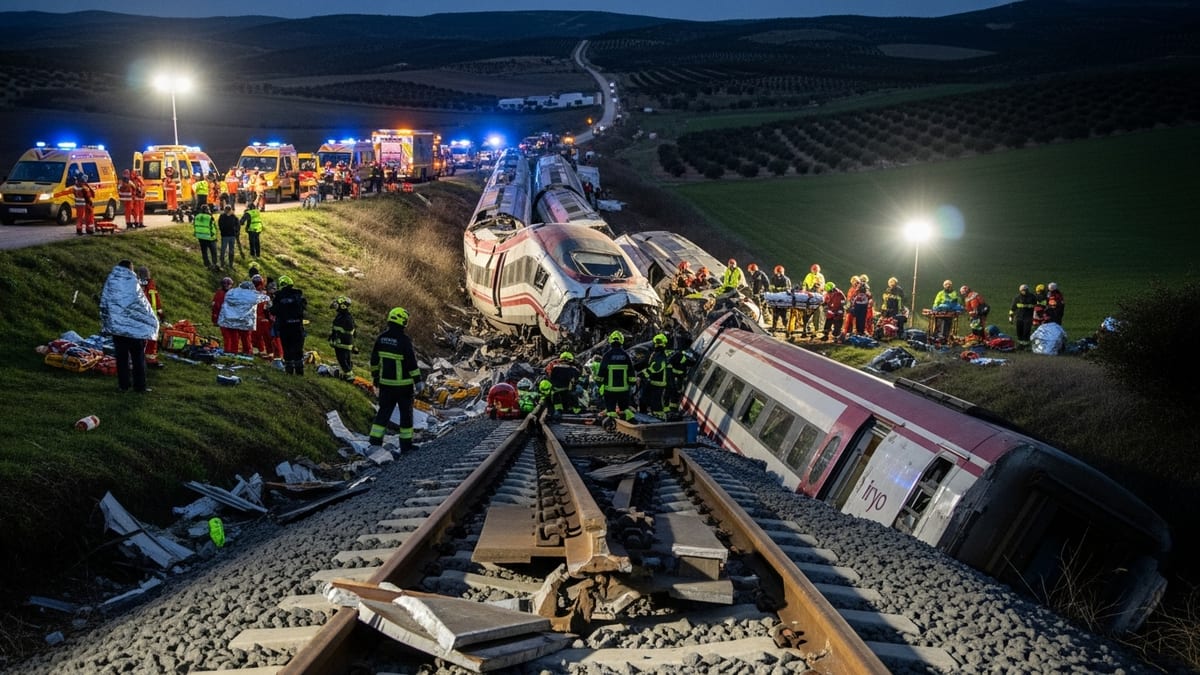
Findings highlight missed use of emergency protection
According to publicly available investigation documents and media coverage, the report reconstructs the final minutes before the crash and finds that the train entered a danger zone at a speed that exceeded what the signaling layout and operating rules allowed. Data recorders and equipment checks reportedly show no significant technical failures with the emergency braking equipment itself.
Instead, the report concludes that the driver did not deploy the dedicated emergency intervention system in time, despite having a brief window in which an emergency application would probably have brought the train to a halt or reduced its speed enough to avoid the collision. Investigators note that standard service braking was applied too late and too lightly to prevent impact.
The analysis portrays the missed use of the system not as an isolated error, but as part of a wider pattern in which train crews may hesitate to trigger emergency functions, concerned about operational disruption or second-guessing signal aspects that appear ambiguous. The report indicates that, in this case, that hesitation proved critical.
How the emergency system is meant to work
The train involved was equipped with an emergency braking function designed as a final barrier when human error or misjudgment puts a service into conflict with other trains or infrastructure limits. When activated by the driver, the system bypasses normal braking logic to deliver the maximum possible deceleration that the track and adhesion conditions safely permit.
In many modern fleets, these emergency functions work alongside automatic protection technologies that can trigger braking if a train passes a stop signal or exceeds a defined speed threshold. The system examined in the report required affirmative action by the driver, giving the human operator the authority to override any concerns about timetable impacts, passenger comfort, or traffic flow.
In the scenario described in the new findings, the driver had sufficient information from lineside signals and in-cab indications to recognize a developing hazard and engage the emergency intervention. The report states that the train’s distance to the conflict point, combined with its recorded speed and the braking performance measured during post-accident tests, would likely have allowed the train to stop short if emergency braking had been used promptly.
Training, culture and human factors under scrutiny
Beyond the technical description of the braking system, the investigation devotes significant attention to human factors, including how drivers are trained to interpret signals and when they are encouraged to treat a situation as an emergency rather than as a recoverable delay. Training materials, simulator scenarios and recurrent assessments are all examined for how clearly they communicate the thresholds for using emergency systems.
Published reporting on the findings indicates that investigators identified a gap between written procedures and day-to-day practice. While manuals emphasize that safety must always take precedence over punctuality, interviews and operational records suggest drivers can feel implicit pressure to avoid abrupt stops or major service interruptions unless a threat is unmistakable.
The report also points to limited practical exposure to emergency braking in routine training. For many drivers, the only time they experience the full performance of an emergency application is in controlled simulations that may not mirror the stress and uncertainty of a real incident. This can make it harder for crews to judge how much distance they truly need, and when a developing risk has crossed the line into an immediate danger.
Implications for rail safety and passenger confidence
The conclusion that the crash could likely have been prevented if the emergency system had been used is expected to feed into a broader debate over how railways balance human decision-making and automated safeguards. In several high-profile rail accidents worldwide in recent years, post-incident reports have reached similar findings that technology capable of stopping or slowing a train was not fully utilized at a decisive moment.
For travelers, the latest report may raise questions about how consistently life-saving systems are being applied across networks. Rail operators routinely promote the presence of advanced train protection and emergency braking capabilities as a reassurance to passengers, but this case highlights that equipment alone is not enough if front-line staff are uncertain about when and how to use it.
Industry analysts expect the findings to prompt a review of operating rules, training syllabuses and the real-world use of emergency functions in the months ahead. Recommendations are likely to focus on embedding clearer guidance for drivers, improving simulator realism, and refining cab interfaces so that emergency actions are intuitive even under extreme time pressure.
Calls for stronger safeguards and automated intervention
In the wake of the report, rail safety specialists are already discussing the potential for stronger automatic intervention systems that can act without human input when thresholds are breached. Technologies such as continuous speed supervision and automatic train protection are designed to remove ambiguity by enforcing limits and triggering brakes whenever a train conflicts with a restrictive signal or exceeds a safe speed profile.
However, many busy passenger corridors and regional lines remain heavily reliant on the skill and judgment of individual drivers, supported by traditional signaling and limited automation. The latest findings add weight to arguments that relying primarily on human performance is no longer sufficient on intensively used routes, especially where trains operate at higher speeds or in complex junction layouts.
For now, the report reinforces a central lesson that has recurred across multiple investigations: when seconds matter, decisive use of emergency systems can make the critical difference between a near miss and a serious crash. Ensuring that rail professionals are fully empowered, trained and equipped to take that action is emerging as one of the most important safety priorities for networks around the world.