


More news on this day
UK rail passengers are being warned to expect prolonged delays and significant disruption after a landslip and subsequent derailment near Lewes in East Sussex severely affected one of the main railway corridors linking London with the south coast.
Get the latest news straight to your inbox!
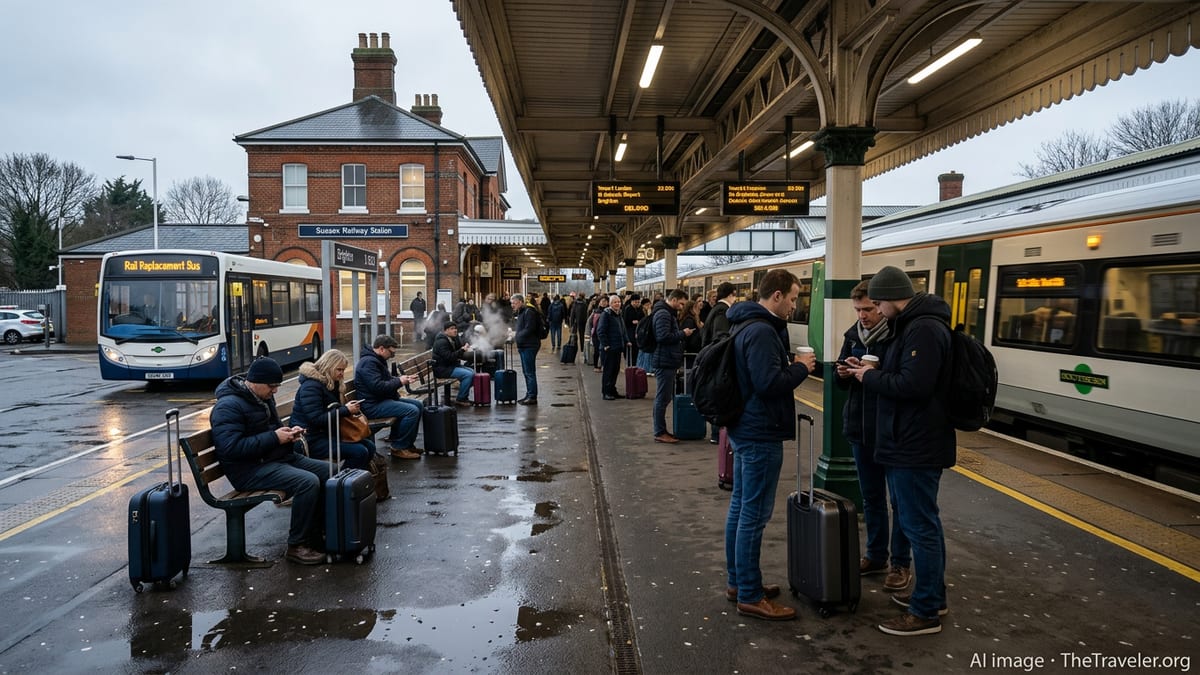
Major route between London, Lewes and Eastbourne hit by landslip
Published reports indicate that the landslip occurred on an embankment close to Lewes station, affecting the busy line that carries Southern services between London Victoria, Lewes and Eastbourne. The incident led to a passenger train derailing on the afternoon of 13 August, with several carriages leaving the tracks and coming to rest at angles beside the line.
Information from national and regional news coverage indicates that around twenty people were treated for injuries, with two reported as seriously hurt, after the London Victoria to Eastbourne service came off the rails near the River Ouse. Emergency responders attended the scene and a major incident was declared, highlighting the seriousness of the disruption to both passengers and local infrastructure.
The line through Lewes is a key part of the rail network in East Sussex, linking London with coastal destinations including Lewes, Eastbourne, Bexhill and Hastings via connecting routes. When this section is blocked, services on multiple corridors are affected, including trains that normally continue onward along the coast or provide cross-country connections.
Publicly available information from rail operators shows that trains in the area are either being cancelled outright or diverted via alternative routes where capacity allows. With limited diversionary paths available in East Sussex, many journeys are being replaced by buses or require complex re-routing through Brighton and other hubs.
Disruption spreads across Southern and Thameslink services
According to live journey planners and operator service updates, the landslip and derailment have forced the closure of at least one of the tracks near Lewes, with engineers assessing the scale of embankment damage, track misalignment and signalling issues. Until the site is stabilised and inspected, significant restrictions remain in place on trains running between London, Lewes and Eastbourne.
Southern-branded services on the London Victoria to Eastbourne and Ore routes are among the worst affected, with many trains terminating short of their normal destination or being removed from timetables. Passengers travelling to the Eastbourne International Airshow and other coastal events are reporting last-minute cancellations, extended waiting times and crowded replacement transport.
Thameslink and other connected routes are experiencing knock-on effects as rolling stock is displaced and staff diagrams are disrupted. Public journey information suggests that services through key hubs such as Brighton and East Croydon are busier than normal as travelers attempt to reroute around the closure in East Sussex.
Network-wide, timetables are being altered at short notice to cope with the blocked section. Passengers are being advised through operator channels and journey planners to check the status of their train on the day of travel and to allow extra time, as revised schedules may not be finalised until shortly before departure.
Investigations focus on extreme weather, ground movement and track stability
Early analysis in published coverage points to a combination of ground movement and track deformation in very hot and dry conditions as a likely factor in the derailment near Lewes. Images from the scene show visible buckling in the rails behind the train, alongside disturbed ballast on the embankment, leading rail commentators to suggest that soil shrinkage and loss of stability may have contributed to the incident.
Specialist commentary cited by national outlets notes that prolonged heat and drought can cause clay and other soils to dry out and contract, undermining railway embankments. At the same time, high rail temperatures can cause steel tracks to expand and lose alignment, particularly on older infrastructure or where historic maintenance constraints exist.
The Rail Accident Investigation Branch is expected to carry out a detailed examination of the derailment site, looking at the condition of the track, sleepers, fastenings and earthworks, as well as monitoring data and speed restrictions in place prior to the event. While the final conclusions will take time, the incident is already feeding into a wider debate about how Britain’s railways need to adapt to more frequent heatwaves and extreme weather periods.
Network Rail has previously acknowledged that hotter, drier summers increase the risk of buckled rails and landslips, and has introduced measures such as more resilient fastenings, targeted speed restrictions and enhanced monitoring of embankments. The scale of the disruption in East Sussex is likely to intensify scrutiny of whether further investment is needed on busy regional corridors connecting London with the south coast.
Replacement buses, diversions and advice for affected travellers
Public information from operators shows that rail replacement buses are running on some sections of the route affected by the East Sussex landslip, particularly between Lewes, Polegate and Eastbourne, although capacity is limited at busy times. Reports from passengers indicate queues forming at key interchange points, with some journeys taking several times longer than usual because of slower road traffic and heat conditions.
Where possible, trains are being diverted via alternative lines, most commonly through Brighton, but the lack of a fully electrified inland relief route in East Sussex limits the options for long-distance diversions. As a result, some coastal communities are experiencing a significantly reduced frequency of services, and off-peak trains are being prioritised or withdrawn depending on rolling stock availability.
Travel advice from journey planners and rail operator bulletins consistently urges passengers heading for Eastbourne, Lewes and surrounding destinations to consider postponing non-essential journeys, or to explore other modes of transport such as regional coach services. Those who must travel by rail are being encouraged to plan additional time, carry water in view of the ongoing heatwave and prepare for the possibility of standing on busy trains and buses.
Compensation rules under the industry’s delay and cancellation schemes remain in force, and passengers whose journeys are severely disrupted can typically claim back part or all of their fare, depending on the length of the delay. Rail users are being reminded to keep tickets, digital receipts or booking confirmations in order to submit claims once their journey is complete.
Broader implications for UK rail resilience
The East Sussex landslip and derailment come at a time of heightened concern about the resilience of the UK’s rail network in extreme weather. Recent days have seen multiple derailments linked in public discussion to the same heatwave, including an incident in Essex, highlighting vulnerabilities on different parts of the network.
Industry commentary suggests that a combination of ageing earthworks, historic underinvestment and increasingly volatile weather patterns is putting pressure on route managers, particularly in regions such as the South East where passenger numbers are high and the scope for diversions is limited. Each major disruption has a ripple effect that can impact commuters, leisure travelers and freight flows far beyond the immediate incident site.
Transport advocacy groups have long argued for stronger investment in embankment stabilisation, drainage improvements and track renewals on secondary main lines like those in East Sussex. The events near Lewes are likely to be cited in forthcoming consultations and strategy documents as evidence that climate resilience and capacity upgrades now overlap, rather than being separate priorities.
For now, the focus remains on restoring safe and reliable services on the affected corridor while investigations continue. However, the scale of the disruption and the number of passengers affected over the peak summer travel period are expected to add urgency to discussions about how quickly the rail industry can adapt its infrastructure and operations to a changing climate.