


In an era when many American cities feel smoothed over by luxury towers, chain stores, and curated “experiences,” Philadelphia still comes across as unapologetically itself. Visitors notice it right away: the dense rowhouse streets, the corner bars buzzing on weeknights, the historic public markets where office workers line up beside construction crews and tourists for the same roast pork sandwich. The city is changing, but somehow it remains stubbornly real. Understanding why Philadelphia feels more authentic than many of its peers is one of the pleasures of getting to know it.
Get the latest updates straight to your inbox!
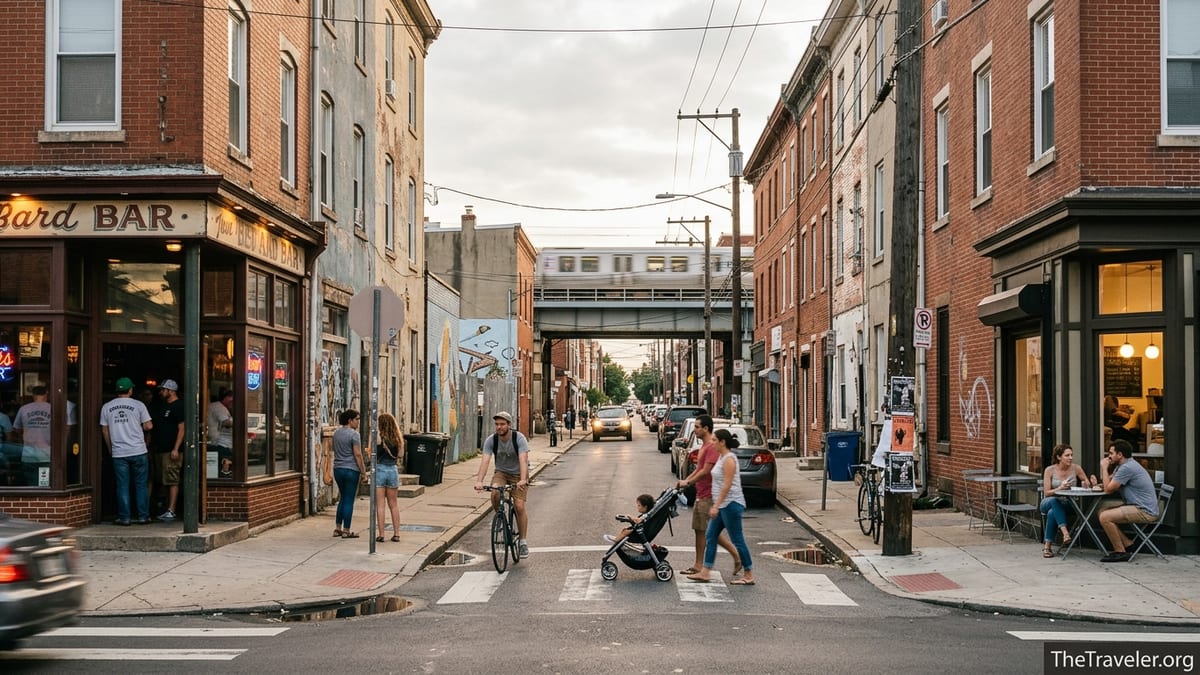
A Big City That Still Lives at Street Level
One of the first things travelers remark on in Philadelphia is how low and intimate the city feels compared with places like New York or Miami. Instead of walls of glass towers, block after block is built from human-scaled rowhouses, many dating back more than a century. Planning documents from the city describe Philadelphia as “largely a rowhouse city,” and walking through neighborhoods like Bella Vista, Point Breeze, or Northern Liberties, you feel that truth in the uniform three-story facades, marble stoops, and narrow alleys where neighbors talk from window to window.
This built form matters for authenticity because it keeps daily life right on the sidewalk. In South Philadelphia you might see someone grilling on a tiny front patio, a grandmother sweeping her stoop, and kids weaving through the narrow streets on bikes, all within a single block. There are few deep front yards or gated condo courtyards to retreat into. The effect is that life in Philadelphia happens in public, where visitors can see and feel it unfiltered.
Compared with downtown cores that transform into business districts by day and quiet canyons by night, Center City Philadelphia still has corner stores, cheap lunch spots, and long-running neighborhood institutions. A block off Broad Street you might find a family-owned hoagie shop with a handwritten cash-only sign sitting next to a new espresso bar. Office workers, students from nearby universities, and longtime residents share the same sidewalks and SEPTA buses. Travelers stepping out of a hotel near City Hall are not walking into a polished entertainment district so much as into a living downtown.
History You Can Actually Bump Into
Almost every major American city advertises its history, but in Philadelphia, it is woven into daily routines rather than isolated behind velvet ropes. Of course, there are headline sites like Independence Hall and the Liberty Bell. Yet the city’s authenticity really shows in the smaller, less choreographed places where history is simply part of the backdrop. Walking through Old City or Society Hill, many residents live in 18th- and 19th-century rowhouses that still line brick alleys originally laid out when Philadelphia was a colonial capital.
Public markets are an example of how that history is still working. Reading Terminal Market, operating since the 1890s inside a former railroad terminal, is a lunchtime staple for office workers and construction crews as much as for visitors. Today more than 100 vendors operate there, from Pennsylvania Dutch bakers turning out sticky buns to family-run produce stands and fishmongers. Local reporting notes that an estimated several million people move through the market each year, and the nonprofit that runs it is currently investing in new seating areas rather than turning the space into something sleeker. When you grab a scrapple-and-egg sandwich, you are not entering a stage set. You are interrupting a 130-year-old routine that the city still genuinely uses.
That pattern repeats in neighborhood-scale landmarks. The former Globe Dye Works textile complex in Northeast Philadelphia, for example, now houses small manufacturers, artists, and craft food producers rather than luxury condos. In South Philadelphia, old corner pharmacies become independent coffee shops, and warehouse buildings convert to breweries or rock-climbing gyms with just enough of the brick and steel left exposed to remind you of what they were. The city’s instinct has often been to reuse rather than erase, and visitors feel those layers of time without needing a plaque to explain them.
Independent Businesses Keep the City’s Voice
Walk along Frankford Avenue in Fishtown, Passyunk Avenue in South Philadelphia, or Baltimore Avenue in West Philadelphia and you will see just how much of the city’s commercial life is still driven by small, local operators. National chains exist, particularly around Center City shopping streets, but they do not dominate entire districts in the way they often do in newer downtowns. Instead, you might find a stretch where an indie record shop, a tattoo studio, a corner bar, and a natural wine shop each occupy a narrow storefront under a painted sign.
Some of these businesses have become institutions. At Reading Terminal Market, Bassett’s Ice Cream has been operating since the market opened in 1893, making it one of the country’s oldest ice cream brands still run by the same family. In Point Breeze, Dock Street Brewing, founded in the 1980s as one of America’s earlier craft breweries, continues to brew beer in a converted industrial space while hosting local concerts and community events. Fishtown’s transformation into a nationally noted dining district has been powered largely by chef-owned restaurants and neighborhood bars rather than by celebrity chains; even as rents rise and menus get pricier, many places remain resolutely local in feel.
For travelers, this independent streak translates into experiences that are difficult to duplicate elsewhere. You can spend a morning in a Latino-owned coffee shop in Kensington, an afternoon browsing Black-owned bookshops or fashion boutiques in neighborhoods highlighted by local tourism groups, and an evening at a community-run arts venue in West Philadelphia, all without stepping into a shopping mall. Prices also tend to be more accessible than in coastal peers: it is still possible to find a satisfying neighborhood bar meal for under 20 dollars, and breakfast sandwiches in corner delis often run in the 5 to 8 dollar range, well below what you might pay for similar items in Manhattan or San Francisco.
Grit, Honesty, and a Very Philly Attitude
What many visitors interpret as authenticity in Philadelphia is also cultural. The city has a reputation for being direct, sometimes to the point of brusqueness, and that bluntness can be disarming if you are used to service-industry polish. A hoagie shop owner may correct the way you order. A sports fan at a bar will freely explain exactly why their team’s last season was a disaster. Yet that candor often comes with a sense of humor and a willingness to engage. Conversations with locals on a SEPTA platform or in line for a cheesesteak can be some of the most memorable parts of a trip.
This attitude is tied to a strong working-class identity that has not been entirely pushed to the margins, even as certain neighborhoods gentrify. Philadelphia remains one of the poorer large cities in the United States, with significant pockets of poverty in North and West Philadelphia. That reality is visible: visitors notice vacant lots, aging infrastructure, and blocks that feel worn around the edges. For some, this roughness is jarring. For others, it reads as a refusal to hide the less glossy parts of urban life. In any case, it means Philadelphia has not been fully sanded down into a lifestyle brand.
Sports culture captures that identity vividly. On game days, you will see Eagles jerseys in supermarket aisles, Sixers gear on the subway, and Phillies caps at almost every bar. Tailgating in the stadium district in South Philadelphia is not a small, VIP-only scene but a vast sea of pickup trucks, grills, and folding tables where families and friends gather for hours before kickoff. Even casual fans end up drawn into conversations about the team’s chances. This loyalty, and the willingness to boo even star players when effort is lacking, reflects a broader local expectation: show up, work hard, and be real about it.
Diverse Neighborhoods That Feel Lived-In, Not Curated
Many big-city visitors today are funneled toward a handful of heavily marketed districts. In Philadelphia, the tourism map is widening as more travelers seek out neighborhoods where people actually live. South Philadelphia offers a vivid example. Along East Passyunk Avenue, a long-standing Italian American corridor now blends new-wave pizzerias and cocktail bars with family-run bakeries and butcher shops. A few blocks away, the Italian Market, with roots going back over a century, sells fresh produce, meats, spices, and imported goods on sidewalks that can feel wonderfully chaotic. Layered into those same blocks are Mexican taquerias, Vietnamese restaurants, and Southeast Asian grocers, reflecting more recent waves of immigration.
In West Philadelphia, particularly around Baltimore Avenue and 52nd Street, visitors can experience a mix of West African restaurants, Caribbean takeout spots, and long-established soul food joints. University City’s student energy spills into these streets, but unlike some college districts, this part of town still revolves around year-round residents. A short trolley ride can take you from a University of Pennsylvania lecture hall to a block of mom-and-pop shops where owners know their customers by name, and where a plate of jollof rice or jerk chicken might cost under 15 dollars.
Even Philadelphia’s emerging “cool” neighborhoods carry traces of their past. Fishtown, once tied to the shad fishing industry, has seen an influx of upscale dining and nightlife, enough that locals sometimes complain about 18 dollar pancakes and brunch crowds. Yet you can still find modest rowhouses on side streets, corner taprooms with simple beer lists, and family-owned seafood spots within walking distance of natural wine bars and boutique hotels. This coexistence of old and new keeps the area from feeling like a theme park.
Culture and Art That Belong to the Streets
Philadelphia’s public art might be the clearest, and most photogenic, expression of its authenticity. The city is often credited with having one of the world’s largest collections of outdoor murals, many created through the Mural Arts Philadelphia program in collaboration with community groups. Unlike the isolated, heavily branded mural districts popping up in some cities, these works are spread across rowhouse corridors, alleys, and underpasses where residents actually live. Travelers wandering through South Philadelphia or West Philly might stumble upon an LED-lit alley mural, a tile mosaic rowhome, or a block-long piece celebrating neighborhood history, all without paying an admission fee.
Street-level creativity extends beyond murals. From DIY music spaces under the El in Kensington to experimental theater in converted churches, much of Philadelphia’s arts scene unfolds in reused buildings with limited budgets and plenty of personality. Tickets to a local band show in a Fishtown bar might run 15 to 25 dollars, while a fringe theater performance in a tiny black-box venue can cost less than a mid-range cocktail in New York. Because rents, while rising, remain lower than in many coastal peers, artists and small organizations still carve out physical space in the city instead of existing only online.
At the same time, Philadelphia’s major cultural institutions remain surprisingly accessible. The Philadelphia Museum of Art, the Barnes Foundation, and the orchestra at the Kimmel Center offer pay-what-you-wish nights or reduced admission programs that make world-class art and music available to residents who are not wealthy collectors or corporate clients. For visitors, that translates into museum galleries filled with a cross-section of local life rather than only tourists and elite patrons, reinforcing the feeling that culture here belongs to the city as a whole.
Affordability and Access Compared With Other Big Cities
Authenticity is not just about look and feel. It is also about who can afford to stay. In city after city, the urban core has become the preserve of the affluent, pushing lower-income residents to the fringe and turning central neighborhoods into playgrounds for visitors and commuters. Philadelphia has not escaped these pressures, but housing and daily costs remain generally lower than in other Northeast corridors like New York, Boston, or Washington, DC. Residents frequently point out that a one-bedroom apartment in many parts of South Philadelphia, Roxborough, or parts of West Philly can rent for hundreds of dollars less per month than a comparable place in Brooklyn or central Boston.
For travelers, this means the ability to experience city life without luxury pricing. Hotel rates in Center City typically undercut those in Manhattan for similar national brands, and a short ride on SEPTA’s subway or trolley network brings you into neighborhoods where you can buy a filling meal for under 15 dollars, or grab a local beer for 5 or 6 dollars at a corner bar. Public transit coverage is far from perfect, but an existing network of subways, trolleys, buses, and regional rail lines does make it feasible to visit without renting a car, particularly if you plan your days neighborhood by neighborhood.
This relative affordability is double-edged. It reflects the city’s ongoing struggles with poverty and disinvestment. Yet it also allows a more diverse population to remain in the urban core, from students and service workers to immigrant families and artists. That mixture, which has drained out of ultra-expensive downtowns elsewhere, keeps Philadelphia’s streets lively beyond the tourist zones and gives visitors a sense of spending time in a real city with a full range of lives going on around them.
The Takeaway
Philadelphia’s authenticity comes from a combination of factors that are increasingly rare in large American cities. Its rowhouse fabric and reused industrial spaces keep everyday life close to the street. Historic markets like Reading Terminal still function as true food halls for locals, not just curated attractions. Independent businesses and corner bars give commercial corridors distinct voices instead of defaulting to the same national retailers. A gritty, straightforward local culture refuses to pretend the city is perfect, while vibrant neighborhood arts and food scenes grow from the bottom up.
Visitors who accept Philadelphia on its own terms, rather than expecting the polished ease of a resort town, often find that this is precisely what makes the city special. You might step around a pothole on your way to see a world-class art collection, or wait in line behind office workers and construction crews for a sandwich that truly earns its reputation. The mix of rough edges and genuine warmth, of deep history and current struggle, creates a sense that what you are seeing is not a performance. It is simply Philadelphia being itself, and that may be the most authentic big-city experience the United States has to offer.
FAQ
Q1. Is Philadelphia safe for visitors compared with other big U.S. cities?
Philadelphia has areas with significant crime, especially in parts of North and West Philadelphia, but the main visitor districts and many residential neighborhoods are routinely explored without incident. As in any large city, staying aware of your surroundings, avoiding clearly distressed blocks at night, and using licensed taxis or rideshares when unsure of an area go a long way toward staying safe.
Q2. Which neighborhoods feel the most “authentically Philly” for a first-time visitor?
For a first visit, spend time in Center City and Old City, then branch into South Philadelphia around East Passyunk Avenue and the Italian Market, plus one emerging area such as Fishtown or Northern Liberties. These districts mix long-term residents with newer arrivals and offer a blend of historic streets, independent shops, and everyday life that captures the city’s character.
Q3. How expensive is Philadelphia compared with New York or Boston?
In general, Philadelphia is noticeably more affordable. Hotel rooms, restaurant meals, and rents in many central neighborhoods tend to cost less than in New York or Boston. You can still find neighborhood bar dinners for under 20 dollars and good coffee under 5 dollars, though prices are higher in fashionable areas and at high-end restaurants.
Q4. Do you need a car to experience the “real” Philadelphia?
You can see a great deal of the city without a car. SEPTA subways, trolleys, and buses, along with regional rail and walkable neighborhoods, make it possible to explore major districts car-free. However, a car can be useful if you want to reach farther-flung areas in the Northeast or Northwest or explore beyond the city limits.
Q5. What local foods best represent Philadelphia’s authentic side?
Beyond the famous cheesesteak, try roast pork sandwiches with sharp provolone, soft pretzels from neighborhood bakeries, Italian Market tacos, Vietnamese hoagies, and Pennsylvania Dutch specialties like scrapple or whoopie pies at Reading Terminal Market. Sampling these in modest neighborhood spots often gives a more “real” taste of the city than only visiting the most famous sandwich shops.
Q6. Where can visitors experience local arts and music without high ticket prices?
Check out small venues along Frankford Avenue in Fishtown, Lancaster Avenue and Baltimore Avenue in West Philadelphia, and independent theaters and galleries in Old City or South Philly. Many shows and exhibitions have tickets in the 10 to 30 dollar range, and the city’s annual fringe and neighborhood festivals often feature free or pay-what-you-wish performances.
Q7. How walkable is Philadelphia for exploring different neighborhoods?
Philadelphia is one of the more walkable large U.S. cities, especially in Center City, Old City, South Philadelphia, and parts of West Philly and Fishtown. Distances between many major sights are short, and the city’s dense grid and small blocks make it easy to wander. Good walking shoes are important because sidewalks can be uneven and some streets are still paved with older materials like brick or cobblestone.
Q8. Are there still truly local markets in Philadelphia, or is everything geared to tourists?
Yes, there are still deeply local markets. Reading Terminal Market attracts many visitors but remains a daily food source for Philadelphians. The Italian Market in South Philadelphia functions as a neighborhood shopping street for produce, meat, and specialty groceries. Smaller farmers’ markets pop up in parks and on neighborhood corners throughout the week, serving residents first and tourists second.
Q9. How many days should I spend in Philadelphia to get beyond the historic core?
With two days, you can see the main historic sights and sample one or two neighborhoods beyond Center City. With three to four days, you can add deeper time in South Philly, West Philly, or Fishtown, visit museums at a relaxed pace, and linger in coffee shops and parks long enough to feel the city’s everyday rhythm.
Q10. What is the best way to meet locals and experience the city’s personality?
Spend time in neighborhood bars and cafes outside the busiest tourist blocks, attend a local sports event or watch a game at a bar, and consider joining a public walking tour run by small operators. Riding SEPTA, shopping at local markets, and simply striking up respectful conversations in line or at the counter will usually be met with Philly’s trademark mix of bluntness, humor, and warmth.