


For travelers chasing the story of the United States, two cities usually rise to the top of the list: Philadelphia and Washington, D.C. Both are dense with monuments, museums and streets where history was made, and both are easy weekend destinations if you are already on the East Coast. Yet they deliver very different experiences. One is the cradle of the nation’s founding, the other the seat of federal power and commemoration. Deciding which historic city delivers more depends on what kind of trip you want.
Get the latest updates straight to your inbox!
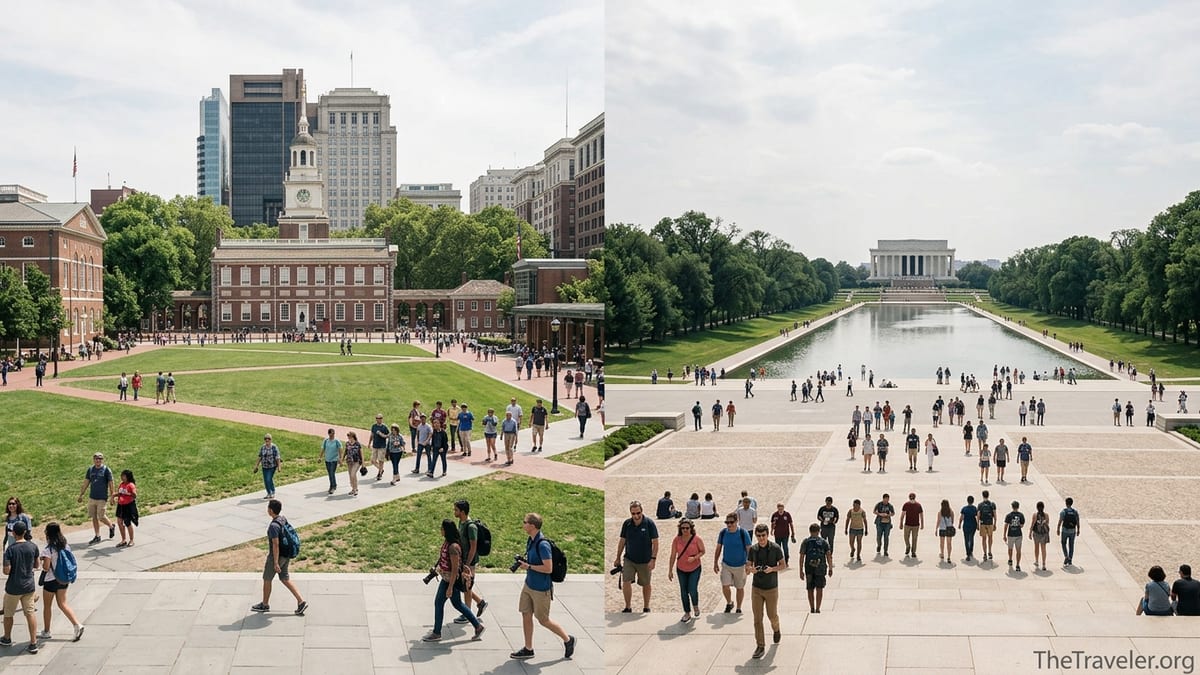
Founding Stories vs Seats of Power
If your priority is the American Revolution and the birth of the republic, Philadelphia has a uniquely concentrated set of sites. Within a few walkable blocks in Independence National Historical Park you can see Independence Hall, where both the Declaration of Independence and the Constitution were debated and adopted, and the Liberty Bell Center, home to the cracked bell that became a global symbol of freedom. These attractions are free to visit, though Independence Hall requires a timed ticket during most of the year, with a small online processing fee for reservations rather than a true admission charge.
Washington, D.C., by contrast, tells the story of what happened after the founding. The National Mall stretches from the Lincoln Memorial to the U.S. Capitol and is lined with memorials to presidents, wars and movements, along with major Smithsonian museums that trace everything from American democracy to spaceflight. Walking from the Lincoln Memorial, where the Gettysburg Address is carved in stone, past the Vietnam Veterans Memorial and the Martin Luther King Jr. Memorial gives a powerful overview of how Americans have remembered and reinterpreted their own history over time.
Travelers who want to stand in the literal rooms where the nation was born usually lean toward Philadelphia. Those who prefer the spectacle of monuments, marble and the machinery of modern government often find D.C. more satisfying. Many visitors ultimately try to pair both on the same itinerary, since the train ride between them is only around 1 hour 20 minutes on Amtrak’s Northeast Corridor and can be reasonably priced if booked in advance.
For a first deep dive into U.S. history, one useful way to think about it is this: Philadelphia is about arguments, ideas and signatures; Washington is about institutions, power and how those ideas played out over the next 250 years.
Signature Landmarks and Museums
In Philadelphia’s Historic District, the landmarks are tightly packed. Independence Hall, Congress Hall and Old City Hall cluster around Independence Square, while the Liberty Bell Center, the National Constitution Center and the Independence Visitor Center line Independence Mall. In practical terms, that means you can see many of the marquee sites on foot in a single day, even if you also step into nearby Christ Church, where many Founders worshiped, or wander to Elfreth’s Alley, often described as one of the oldest continuously inhabited residential streets in the United States.
D.C. offers a different scale entirely. The Smithsonian system alone encompasses more than a dozen major museums in the city, most of them free to enter. On the Mall you can move from the National Museum of American History, with artifacts like the Star-Spangled Banner, to the National Museum of African American History and Culture, to the National Museum of Natural History, which welcomes several million visits per year and regularly ranks among the most-visited museums in the country. The National Gallery of Art, also on the Mall, draws well over three million annual visitors with collections that place American art in a global context.
The variety in Washington means you can tailor each day to a theme. One traveler might focus on American democracy by combining a visit to the U.S. Capitol Visitor Center, the Library of Congress and the National Archives’ Rotunda, where the original Declaration of Independence and Constitution are displayed. Another might spend a full day just in the National Museum of African American History and Culture, whose exhibits on slavery, civil rights and contemporary culture offer a depth that can fundamentally reshape how you understand the country.
In Philadelphia, the core story is more focused. You are retracing a short but intense period in the 1770s and 1780s. Many travelers start at the Independence Visitor Center to pick up timed tickets, then visit the Liberty Bell, tour Independence Hall with a National Park ranger and finish at the National Constitution Center, which uses interactive exhibits and theatrical presentations to trace the life of the Constitution into the present. It is possible to add related sites like the Museum of the American Revolution or the new museums and exhibits planned for the United States’ 250th anniversary, but you will still feel rooted in the founding era.
Atmosphere, Neighborhoods and Day-to-Day Experience
Beyond the must-see landmarks, the feel of each city is strikingly different. Philadelphia’s historic core bleeds naturally into lived-in neighborhoods. Step a couple of blocks from Independence Hall and you are in Old City, where 18th-century brick townhouses now sit above galleries, small boutiques and corner bars. South of there, Society Hill’s cobblestone streets and restored row houses give a sense of what the city looked like in the early republic, even if most interiors now hold modern apartments and upscale dining rooms.
Washington’s central historic zone is more monumental and less residential. The Mall and federal district are composed largely of government buildings, museums and wide ceremonial avenues. To get a sense of older neighborhood fabric, you usually head out to areas such as Georgetown, with its Federal-style townhouses and C&O Canal, or Capitol Hill, where brick row houses and neighborhood markets coexist with views of the dome. The juxtaposition of everyday life with visible power is part of D.C.’s appeal, especially if you explore side streets a block or two off the main routes.
In practical terms, Philadelphia often feels more compact and walkable for a history-focused trip. The densest cluster of Revolutionary sites lies within about a 10 to 15 minute walk end to end. Many travelers stay in Center City or the Historic District and rely on their feet plus the regional rail or subway for longer hops. In D.C., distances can be deceptive. Walking from the Lincoln Memorial to the Capitol can take close to an hour without stopping, and you will likely break up your day with rides on the Metro or buses, especially in hot, humid summer weather.
Both cities offer strong food scenes that tie into their histories. Philadelphia’s immigrant neighborhoods have long shaped its culinary identity, from Italian bakeries in South Philadelphia to Jewish delis and more recent waves of Vietnamese and Mexican eateries. Grabbing a soft pretzel or a roast pork sandwich between museums feels authentic rather than touristy. In D.C., power lunches near K Street and polished restaurants in Penn Quarter or the Wharf sit alongside Ethiopian cafes and family-run spots in neighborhoods like Shaw and Adams Morgan, reflecting the city’s international population and diaspora communities.
Costs, Logistics and Getting Around
From a budget perspective, both cities are manageable, but there are real differences in how costs tend to add up. Washington, D.C. can be surprisingly affordable for culture lovers because so many of its marquee attractions are free: the Smithsonian museums, most monuments and memorials, and the National Gallery of Art. You could easily spend three days visiting top-tier museums without paying any admission fees, other than special exhibits that occasionally require timed-entry tickets.
Philadelphia’s biggest historic sites are also budget-friendly. The Liberty Bell Center is free, and Independence Hall tours are free aside from a small online booking fee during high season. However, many of the city’s excellent private museums, such as the National Constitution Center or the Museum of the American Revolution, charge standard admissions. Families should anticipate paying typical large-museum prices for these, similar to what you would find at major institutions in other U.S. cities.
Accommodation often runs slightly higher on average in central Washington than in central Philadelphia, especially on weekdays when federal business and conventions push up demand. Savvy travelers watch for off-peak dates or stay slightly outside the core in neighborhoods such as Arlington or Alexandria, then ride Metro into the city. In Philadelphia, staying near the Historic District or Center City is usually feasible without paying quite the same premium you might see around the National Mall.
If you are choosing between the two for a long weekend and traveling by train along the Northeast Corridor, it can make sense to look at total trip cost. Amtrak fares between cities such as New York and Washington or New York and Philadelphia fluctuate widely, but booking several weeks in advance often yields base fares in the range of dozens of dollars rather than hundreds, especially on regular Northeast Regional trains. The shorter hop between Philadelphia and D.C. can sometimes be found at attractive prices if you avoid peak business hours and book early, making a two-city itinerary realistic for travelers who are flexible on timing.
Depth of Interpretation and Storytelling
One of the biggest differences between the two cities is how they interpret history for visitors. Philadelphia’s Independence Hall tours, led by National Park Service rangers, focus on the debates and compromises of the Continental Congress and the Constitutional Convention. These tours, typically under an hour, take you into the Assembly Room where the famous documents were debated, with interpreters weaving in anecdotes about figures like George Washington and Benjamin Franklin and explaining how contentious the founding really was. Supplemental exhibits at nearby museums explore topics such as the lives of enslaved people in the city and the broader Revolutionary War.
Washington, D.C., with its huge network of museums, offers more thematic depth across multiple subjects. The National Museum of African American History and Culture traces centuries of Black experience from slavery and Jim Crow to the civil rights movement and contemporary culture, using artifacts, oral histories and immersive exhibits. The National Museum of the American Indian examines Native histories and perspectives, while the United States Holocaust Memorial Museum presents a sobering narrative that many visitors describe as emotionally intense and best planned for with adequate time and mental space.
Even the monuments in D.C. are interpretive spaces. The inscriptions at the Jefferson Memorial, the quotations etched around the Martin Luther King Jr. Memorial and the design of the FDR Memorial all invite visitors to think about leadership, democracy and rights in particular ways. Walking the length of the Vietnam Veterans Memorial, with its black granite wall of names, or standing in the quiet of the Korean War Veterans Memorial at night can be as powerful as any guided museum experience.
Travelers who value long-form, museum-based storytelling may find that Washington delivers more, simply because you can spend entire days in institutions devoted to specific themes, from the history of aviation at the Air and Space Museum to American cultural history at the American History Museum. Philadelphia’s strength lies in the immediacy of place: standing in small rooms, narrow streets and preserved houses where you feel the scale of the 18th-century city and the fragility of the early experiment in self-government.
Time of Year, Crowds and Practical Challenges
Both cities see their peak history traffic from roughly March through early November, with especially heavy crowds around school holidays and summer vacation. In Philadelphia, this can mean lines for the Liberty Bell and limited availability for popular Independence Hall tour times. It is common for travelers who did not reserve ahead to pick up same-day tickets at the Independence Visitor Center early in the morning, then plan the rest of the day around their assigned tour slot.
Washington, D.C. handles even larger visitor volumes on the National Mall, especially around cherry blossom season in late March or early April, and during school-group season in April and May. The most popular Smithsonian museums, such as the National Air and Space Museum and the Museum of Natural History, often experience security lines that stretch outside the buildings at mid-day. Many savvy visitors arrive right at opening, take a midday break when crowds and heat peak, and then return in the late afternoon when lines are shorter.
Weather is a consideration in both places. Summers along the Mid-Atlantic coast are hot and humid, which can make the long walks in D.C. feel strenuous, especially on the largely tree-less stretches of the Mall that have ongoing construction or lawn restoration. Philadelphia’s historic core has more shade and shorter walking distances, and you can easily duck into cafes or indoor attractions between outdoor sites. Winters can be cold and occasionally snowy, but off-season visits often come with lighter crowds and better hotel rates.
Because both cities are adjusting infrastructure and interpretation ahead of the United States’ 250th anniversary in 2026, it is worth checking official tourism and National Park Service sites for any temporary closures or construction around key monuments and museums before you finalize a trip. In practice, travelers rarely find everything closed, but ongoing projects can affect which entrances are open, how you move between sites and what sort of views or photographs are possible.
Who Should Choose Which City?
For travelers trying to decide where to spend precious vacation days, it helps to match each city to traveler types. Families with younger children often gravitate toward Washington, D.C., because the Smithsonian museums combine education with hands-on exhibits and large, climate-controlled spaces that are forgiving when kids get tired. A day that includes dinosaurs at the Natural History Museum, spacecraft at Air and Space and a picnic by the Lincoln Memorial Reflecting Pool can feel like a balanced mix of learning and play.
Adult travelers deeply interested in the Revolutionary era, constitutional history or early American architecture may prefer Philadelphia, where you can move at a slower pace through compact historic streets and spend more time in thoughtful conversation with guides. History buffs often pair the big-name sites with lesser-known gems like local burial grounds, small historic houses or walking tours that explore topics such as the city’s abolitionist movements or its role in early finance and industry.
First-time international visitors to the United States who have only a few days in the Mid-Atlantic region might opt for Washington if they want a single, overwhelmingly iconic picture of “America” to take home, with the Capitol dome, White House views, presidential memorials and the flag-draped galleries of the National Archives. Those who are already familiar with that imagery from film and television and want something grittier and more lived-in may find Philadelphia’s mix of working city and preserved history more compelling.
If you have a week to spare, the ideal solution is often not choosing at all. Spending three days in Washington followed by two in Philadelphia, linked by a short train ride, gives you a fuller sense of the American story than either city alone. You could start with the ideals articulated in the 1770s in Philadelphia, then move to Washington to see how those ideals have been debated, expanded and contested ever since.
The Takeaway
Both Philadelphia and Washington, D.C. are world-class destinations for travelers interested in the United States’ past. Philadelphia delivers an unusually intimate encounter with the founding era, with Independence Hall, the Liberty Bell and surrounding streets offering a compact, walkable immersion in Revolutionary history. Washington provides unmatched breadth, from the lineup of Smithsonian museums to the presidential and war memorials that chronicle two and a half centuries of conflict, compromise and change.
In terms of pure volume of major museums and memorials, Washington arguably delivers more, particularly for travelers who like to spend long days in galleries and interpretive exhibits. In terms of emotional impact tied to a single, formative moment in time, Philadelphia can be hard to beat. Your decision may ultimately hinge on whether you are more drawn to the story of how the nation began or to the evolving narrative of how it has tried to live up to its ideals.
For many, the best answer to the question of which historic city delivers more is “both, in different ways.” With thoughtful planning, it is entirely feasible to design an itinerary that moves from the cobblestone streets where independence was declared to the marble steps and museum halls where its consequences have been argued ever since. However you structure your trip, these two cities together offer one of the richest, most accessible journeys through American history available to travelers today.
FAQ
Q1. If I can only visit one city for history, should I choose Philadelphia or Washington, D.C.?
For a focused experience on the American Revolution and the founding documents, Philadelphia is the better single choice. For a broader sweep of U.S. history, including many free museums and monuments, Washington, D.C. generally offers more variety.
Q2. How many days do I need in each city to see the main historic sites?
Most travelers can see Philadelphia’s core historic district in 1 to 2 full days, though adding more museums can easily fill a third. Washington, D.C. typically benefits from at least 3 days, because the major museums and memorials are more spread out and individually larger.
Q3. Are the main historic attractions in both cities free?
Many are. In Washington, most Smithsonian museums and the major monuments are free. In Philadelphia, the Liberty Bell Center and Independence Hall tours are free aside from small reservation fees in peak season, but several key museums charge regular admission.
Q4. Is it realistic to visit both cities on one trip?
Yes. The train ride between Philadelphia and Washington is usually around 1 hour 20 minutes, and advance-purchase tickets can often be found at reasonable prices. Many visitors split a week between the two, using rail travel to move easily between them.
Q5. Which city is better for families with children?
Washington, D.C. often works especially well for families because of its large, interactive Smithsonian museums and open spaces on the National Mall. Philadelphia can also be family-friendly, but its sites tend to be more focused on guided tours and historic interiors, which some younger children find less engaging.
Q6. How walkable are the historic areas in each city?
Philadelphia’s Historic District is very compact, and most major Revolutionary-era sites are within a short walk of one another. Washington, D.C. is also walkable, but distances on the Mall are longer and many visitors use Metro or buses to avoid long walks in heat or bad weather.
Q7. When is the best time of year to visit for history-focused travel?
Spring and fall are generally the most comfortable in both cities, with milder temperatures and long daylight hours. Summer brings longer opening hours but also higher heat, humidity and crowds, while winter can offer lighter crowds and lower hotel rates along with colder weather.
Q8. Which city offers more variety beyond history, such as dining and nightlife?
Both have strong food and cultural scenes. Washington offers a dense mix of high-end dining and international cuisines near the core visitor areas, while Philadelphia’s neighborhoods combine historic streetscapes with lively local bars, music venues and a growing restaurant scene that many travelers find more budget-friendly.
Q9. Do I need to book tickets in advance for popular sites?
Advance planning helps in both cities. Timed tickets are often recommended or required for specific museums in Washington and for Independence Hall in Philadelphia during busier months. Checking official sites a few weeks before your trip is a good habit.
Q10. Is one city noticeably more expensive than the other?
Day-to-day costs can be similar, but central Washington hotels and dining often run a bit higher, especially on busy weekdays. Philadelphia’s slightly lower lodging costs and compact layout can offset admissions to private museums, so the total cost for a long weekend may come out comparable depending on your choices.