


Philadelphia often sits in the shadow of New York and Washington in East Coast travel plans, which leads to a common question: is it worth dedicating several days to Philadelphia, or is the city better experienced as a quick day trip? The answer depends on what you value most in a trip: historic sites versus food and nightlife, tight budgets versus slower exploration, and whether you are traveling with kids, friends, or solo. This guide compares both approaches in practical terms, using current prices, travel times, and real neighborhood examples so you can decide how much time Philly deserves in your itinerary.
Get the latest updates straight to your inbox!
How Easy Is It to Reach Philadelphia for a Day Trip?
One reason Philadelphia is so often considered for a day trip is how simple it is to reach from nearby hubs. By rail, Amtrak’s Northeast Corridor connects New York’s Penn Station to Philadelphia’s 30th Street Station in roughly 65 to 80 minutes on most trains, depending on whether you take the faster Acela or the slower Northeast Regional. Advance purchase economy tickets on regular Amtrak services can sometimes be found for a few tens of dollars each way if you book off-peak and several weeks in advance, while last minute and peak departures can rise to around or above one hundred dollars one way. That makes a same-day round trip feasible but not always cheap compared with staying overnight.
Travelers on a tighter budget often choose intercity buses such as Megabus or FlixBus from New York, which typically take around 2 to 3 hours each way. In practice, this means leaving Manhattan early in the morning, arriving in Center City Philadelphia late morning, spending six to eight hours exploring, then boarding an evening bus back. Tickets on these services can start around the mid-teens for basic advance fares, although prices vary widely by date and demand. For some visitors, that extra hour each way by bus is a worthwhile trade-off to keep day-trip costs low.
There is also a slower but cheaper train combination using New Jersey Transit and SEPTA local trains via Trenton. This route usually takes about 2.5 hours door to door between New York Penn Station and central Philadelphia plus transfer time, and the combined cost is typically comparable to or lower than many same-day Amtrak fares. This option can make a day trip work for budget-conscious travelers comfortable with transfers, but it does reduce the number of usable sightseeing hours in the city.
From Washington, DC, Amtrak travel times are longer, generally around 1.5 to 2 hours each way under typical conditions, with fares again varying widely based on how far in advance you book and the type of service you choose. A day trip from DC to Philadelphia is still possible, but most travelers from DC will find that at least one night in Philadelphia allows for a far more relaxed visit without spending four or more hours in transit in one day.
What Can You Realistically See on a Philadelphia Day Trip?
On a tight schedule, most day trippers focus on the historic core. Independence National Historical Park concentrates many of Philadelphia’s most famous sites into a compact area, including Independence Hall, where the Declaration of Independence and the US Constitution were both signed, and the Liberty Bell in the nearby pavilion. Timed entry tickets are typically required for Independence Hall during most of the year, usually with a small per-ticket handling fee if reserved online, while the Liberty Bell Center operates on a first-come, first-served basis with airport-style security but no admission charge. With a bit of planning, you can see the Liberty Bell, take a tour of Independence Hall, and walk the surrounding historic square within a few hours.
A classic day-trip route continues on foot along the cobblestone streets of Old City, where you can wander past brick townhouses, small galleries, and cafes along streets like Elfreth’s Alley and Market Street. Many visitors grab a quick lunch at a casual spot nearby, then head to Reading Terminal Market, about a 15-minute walk or short ride away. Inside the market you will find local vendors selling everything from soft pretzels to roast pork sandwiches and Pennsylvania Dutch specialties. A budget-friendly lunch might be a sandwich in the eight to fifteen dollar range, plus a drink and dessert from another stall.
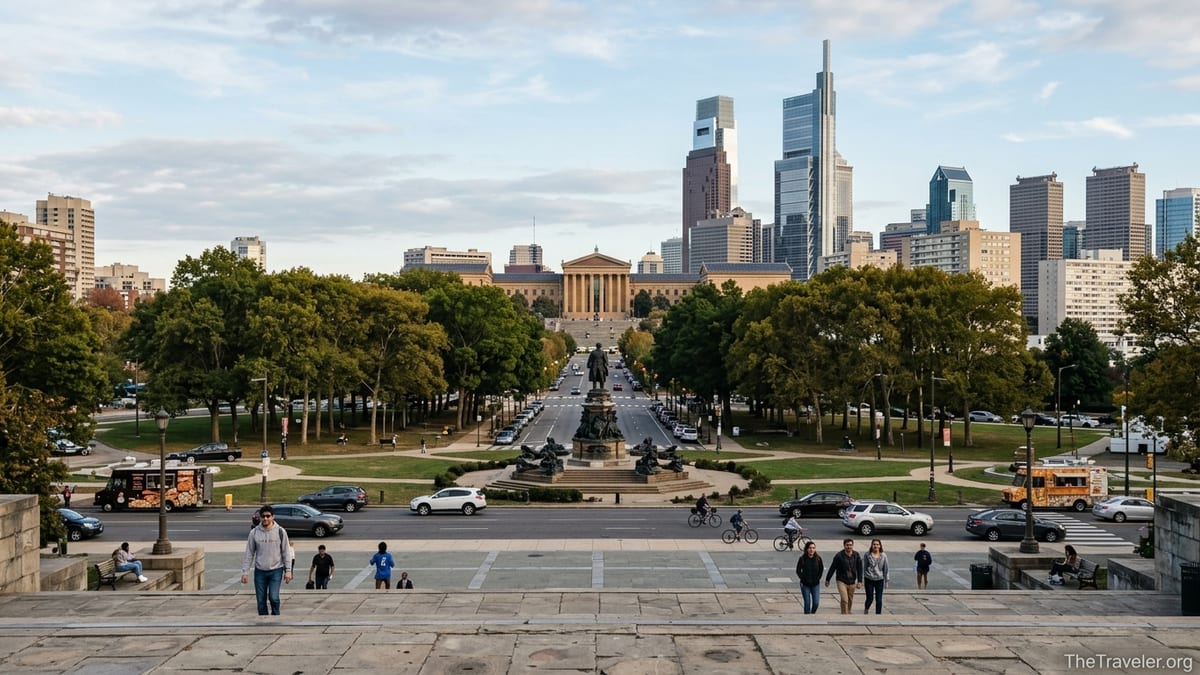
An efficient day trip might then finish with a late afternoon stroll along the Benjamin Franklin Parkway toward the Philadelphia Museum of Art, even if you do not have time to go fully inside. Many travelers prioritize the famous “Rocky Steps” in front of the museum for the skyline view and photo opportunity, then circle back to 30th Street Station for the train or bus home. In a single day you can realistically cover Independence Hall, the Liberty Bell, Old City streets, Reading Terminal Market, and at least the exterior of the art museum, provided you move at a steady pace and do not linger too long in each museum.
What you cannot easily fit into a single day, especially if you are traveling from another city the same morning, is deeper neighborhood exploration. Areas like Fishtown, Northern Liberties, and South Philadelphia’s Italian Market district reward slow wandering, coffees, and dinners that stretch into the evening. If your ideal trip involves discovering bars, music venues, and local bakeries beyond the headline attractions, a single day trip will likely feel rushed and incomplete.
Reasons Philadelphia Is Worth More Than One Day
Philadelphia rewards visitors who give it time. The Philadelphia Museum of Art alone can comfortably fill half a day or more. Current general admission for adults is around thirty dollars, with discounts for seniors and students, and a typical visit spans two to four hours depending on how deeply you explore major collections of European, American, and Asian art. Many tickets also include same-day access to the nearby Rodin Museum, which houses an impressive collection of sculpture in a smaller garden setting, allowing art lovers to turn this corner of the Benjamin Franklin Parkway into a full-day experience.
Families and science enthusiasts will want to add the Franklin Institute, one of the country’s better-known science museums, to their list. Standard daytime hours typically run from late morning to early evening, with separate pricing for general admission and special exhibitions. For kids, highlights include large-scale interactive exhibits, planetarium shows, and spaces where they can touch and experiment rather than simply look. Combining a half day at the Franklin Institute with another half day at the Philadelphia Zoo or Please Touch Museum (aimed at younger children) already pushes a visit beyond what fits comfortably into a single day trip.
Food is another area where extra nights pay off. On a two or three night stay, you can sample competing cheesesteak spots in South Philadelphia, reserve dinner at a more upscale restaurant in Rittenhouse Square, and explore Fishtown for craft beer, natural wine bars, and inventive small-plate menus. For example, one evening might be devoted to a casual meal at a long-running corner bar serving roast pork sandwiches, while another night might involve a reservation at a chef-driven restaurant where entrees hover in the twenty to thirty-five dollar range. A day trip rarely allows for both the lunchtime market experience and a proper sit-down dinner after dark.
Finally, giving Philadelphia more than a day lets you experience its street life and public spaces at different times of day. Early morning jogs or bike rides along the Schuylkill River Trail, quiet late-night walks through the lantern-lit streets of Society Hill, and weekend festivals in neighborhoods like West Philly and East Passyunk rarely line up neatly within a single 8-hour window between trains. If you like to feel the rhythm of a city rather than just ticking off landmarks, at least two nights in Philadelphia will make the city feel far more memorable.
Sample Itineraries: Day Trip vs Weekend vs Three Days
If you are deciding how many days to allocate, it can help to picture concrete itineraries. A realistic New York based day trip might start with an early Amtrak departure around 8 am, arriving at 30th Street Station a bit after 9. You could take a short taxi or trolley into Old City, spend the rest of the morning visiting the Liberty Bell and Independence Hall, and have lunch at Reading Terminal Market around 1 pm. In the afternoon, you might walk up to the Parkway to at least see the Philadelphia Museum of Art and its steps, then head back to 30th Street for a 6 pm train, arriving back in New York around 7:30 pm. That plan gives a satisfying taste of historic Philadelphia but leaves little time to linger or explore neighborhoods off the main tourist spine.
A weekend itinerary over two full days could be more relaxed. On day one, you might focus on the historic district and Old City, adding time at the National Constitution Center or the Museum of the American Revolution if you enjoy detailed exhibits. Dinner could be in Old City at a casual bistro or along South Street, followed by a drink at a small bar or live music venue. Day two could be dedicated to the Benjamin Franklin Parkway, with a morning at the Franklin Institute and an afternoon at the Philadelphia Museum of Art, along with a photo stop on the museum steps. With an extra night, you can enjoy a slow breakfast at a neighborhood cafe before departing instead of rushing straight to the station.
With three full days, Philadelphia opens up even more. One day can be spent in Center City and the historic core, another dedicated to museums on the Parkway, and a third used to explore a neighborhood like Fishtown or Passyunk Avenue in South Philadelphia. For example, you might spend your extra day browsing record shops and boutiques on Frankford Avenue in Fishtown, having coffee at an independent cafe, and staying for dinner at a local restaurant that focuses on seasonal small plates. Alternatively, you could dedicate the extra time to a food-focused tour of the Italian Market area, where you can sample fresh pasta, old-school bakeries, and Mexican taquerias all within a few blocks.
For travelers coming from farther away, such as Boston or the Midwest, folding Philadelphia into a longer East Coast trip can also make sense. Three days in Philadelphia can be combined with three or four days in New York and two in Washington, connected by Amtrak trains. In that scenario, treating Philadelphia as just a day trip risks turning it into little more than a checkmark between two larger cities, whereas dedicating several nights allows you to balance big-city intensity with Philadelphia’s more compact and walkable scale.
Cost Considerations: Day Trip vs Overnight Stay
From a budget perspective, the comparison between a day trip and a longer stay is not always straightforward. On the one hand, you save on accommodation by returning to your base city at night. On the other, round-trip transportation, especially on Amtrak bought close to departure, can easily approach or exceed the cost of a mid-range hotel room in Philadelphia itself. For example, if you pay a higher last-minute rate for same-day Amtrak tickets in and out of the city, that round-trip might cost similar to or more than a centrally located hotel where nightly rates can fluctuate but often fall below those in New York for similar quality.
Within Philadelphia, many of the star attractions have manageable admission fees, so the marginal cost of staying longer is often just extra food and lodging. Independence Hall and the Liberty Bell do not have conventional ticket prices in the way private museums do, though there is generally a small service fee for reserving timed entry tickets to Independence Hall in busy seasons. By contrast, private museums like the Philadelphia Museum of Art, Franklin Institute, and Museum of the American Revolution charge typical big-city rates, often in the twenty to thirty dollar range per adult, with discounts on certain evenings or days such as occasional pay-what-you-wish hours or discounted Friday nights.
Food costs are flexible. You can craft an inexpensive day centered on Reading Terminal Market, food carts, and neighborhood pizzerias, keeping meals in the ten to twenty dollar range for most dishes. For a longer stay, you may naturally gravitate toward a mix of cheaper lunches and sit-down dinners where entrees may cost twenty to thirty-five dollars before drinks. On a multi-day visit, your daily spending can be moderated by staying at a mid-range hotel or short-term rental in neighborhoods slightly outside the highest-demand areas, such as near the Parkway or in parts of South Philadelphia that are still a quick subway ride from downtown.
Transport within the city is another point in Philadelphia’s favor for longer visits. The historic core, Center City, and the Parkway are all walkable for most able-bodied travelers, reducing the need for taxis or rideshares. SEPTA’s subway, regional rail, and buses can take you to more distant neighborhoods or back to 30th Street Station for a few dollars per ride. Spread over several days, the cost of getting around Philadelphia remains modest compared with some other large US cities, making an extended stay relatively good value once you have covered the cost of reaching the city.
Which Travelers Will Be Happy with Just a Day Trip?
Some travelers truly are best served by a day trip, especially those with very specific goals. If your main interest is in checking off major US history landmarks and you are already staying in New York or Washington, a single day dedicated to Philadelphia can be efficient. You will see Independence Hall, the Liberty Bell, and perhaps one additional museum such as the Museum of the American Revolution, then return to your base with a sense of having experienced the birthplace of American independence without uprooting your entire trip.
Time-pressed business travelers may also find a day trip ideal. Someone attending meetings in New York, for instance, might take an early Amtrak train to Philadelphia for the day, schedule a few hours of sightseeing between appointments in the historic district or along the Parkway, then head back in the evening. In this scenario, Philadelphia functions as a quick cultural add-on to an already fixed itinerary, and the convenience of trains dropping you directly at 30th Street Station is a major advantage.
Visitors who are unsure whether they will like Philadelphia’s vibe might also choose to “test” the city with a day trip. Perhaps you are planning a longer East Coast stay in the future and want to see if Philadelphia’s mix of historic sites, rowhouse-lined neighborhoods, and relatively low-key nightlife appeals to you. In that case, a single day of walking the Old City streets, browsing Reading Terminal Market, and seeing the skyline from the art museum steps can provide enough impressions to inform your future plans, even if it does not count as a full exploration.
However, day trippers should recognize what they are trading away. You will almost certainly miss out on neighborhood dinners, local music venues, and the slower pleasures of wandering beyond the guidebook highlights. For travelers who value atmosphere and local culture as much as headline attractions, Philadelphia deserves more.
The Takeaway
Philadelphia works surprisingly well as either a day trip or a standalone destination, but the best choice depends on your priorities. If your main goal is to stand in the rooms where the United States was founded, see the Liberty Bell, and grab a sandwich at Reading Terminal Market, then a day trip from New York or Washington is entirely viable. Fast, frequent trains and walkable streets make it possible to see the top historic sites and get a sense of the city’s core in a single, focused day.
Yet Philadelphia reveals much more of its character to those who linger. With two or three days, you can dive into world-class art and science museums, explore Fishtown’s creative food scene, stroll the Italian Market, and enjoy evenings in Rittenhouse Square or along the riverfront. The city’s relatively moderate costs for food and lodging compared with some neighboring metropolises mean that extending your stay does not necessarily explode your budget, especially if you plan ahead for transportation and choose lodging with care.
In practical terms, travelers who cherish neighborhood exploration, diverse dining, and lingering in museums should treat Philadelphia as a dedicated city break worth at least two nights. Those on tight schedules or laser-focused on US founding history can still have a rewarding, well-structured day trip. Ultimately, Philadelphia is not a city that demands weeks of your time, but it more than earns a long weekend, and for many visitors that extra time is what transforms it from a quick history stop into a place they are eager to return to.
FAQ
Q1. Is Philadelphia worth visiting if I only care about US history?
Yes. If your main interest is US founding history, Philadelphia is one of the most important cities you can visit, with Independence Hall, the Liberty Bell, and several museums dedicated to the Revolutionary era concentrated in a walkable historic district.
Q2. Can I see the main sights in Philadelphia in one day?
You can see many headline sights in a day, such as Independence Hall, the Liberty Bell, Old City streets, and Reading Terminal Market, with time left for a quick visit to one museum or a stroll to the Philadelphia Museum of Art steps if you plan carefully.
Q3. Is a day trip from New York to Philadelphia realistic by train?
Yes. Fast trains typically take a bit over an hour each way between New York and Philadelphia, making a full day in the city feasible, though train tickets can be a significant part of your budget and schedules work best if you depart early and return in the evening.
Q4. How many days do I need in Philadelphia to see more than just the historic core?
Two full days lets you see the major historic sites and at least one or two museums beyond the basics, while three days gives you time to explore neighborhoods like Fishtown or South Philadelphia and try a wider range of restaurants and bars.
Q5. Is Philadelphia cheaper than staying in New York or Washington?
In general, visitors often find hotel and dining prices in Philadelphia somewhat lower than in New York or Washington for similar quality, though exact savings depend on when you travel, which neighborhood you stay in, and how early you book.
Q6. Is Philadelphia walkable for visitors without a car?
Yes. The historic district, Center City, and the Benjamin Franklin Parkway are highly walkable, and public transport or occasional taxis can handle longer trips, so most visitors do not need a car for a short stay focused on central neighborhoods.
Q7. Is Philadelphia safe for tourists staying overnight?
Most visitors who stay in central neighborhoods such as Center City, Old City, and the Parkway area experience no problems, especially if they follow standard big-city precautions like staying aware of their surroundings, avoiding poorly lit areas late at night, and using licensed transport.
Q8. What is the best neighborhood to stay in for a short Philadelphia trip?
For a first visit, many travelers choose Center City or Old City, which offer easy walking access to major historic sites, museums, and restaurants; others prefer staying near the Benjamin Franklin Parkway for quick access to the art and science museums.
Q9. Are Philadelphia’s museums suitable for children?
Yes. The Franklin Institute is especially popular with children thanks to its interactive exhibits, while the Please Touch Museum and Philadelphia Zoo are also strong choices for families, and older kids may enjoy the Museum of the American Revolution and select galleries at the Philadelphia Museum of Art.
Q10. Should I visit Philadelphia before or after New York on an East Coast trip?
The order is flexible, but some travelers prefer to visit Philadelphia after New York so they can move from a very intense, fast-paced city to a slightly more relaxed and compact one, while others break up a longer itinerary by placing Philadelphia between New York and Washington on the train route.