


Few monuments are as instantly recognizable as the Leaning Tower of Pisa. What began as an engineering problem in the marshy soil of medieval Tuscany has become one of the most famous silhouettes in world travel. Today, this slightly off-kilter bell tower continues to fascinate visitors, not only because it leans, but because of the rich mix of history, architecture, science, and playful tourism that surrounds it. For many travelers plotting a first or second trip to Italy, the Leaning Tower remains a must-see stop on the itinerary.
Get the latest updates straight to your inbox!
A Medieval Mistake That Became a Global Icon
The tower that now appears on everything from Italian tourism posters to coffee mugs started as a straightforward project. Construction began in 1173 as the freestanding bell tower for Pisa’s cathedral, in what is now the Piazza dei Miracoli, or Square of Miracles. Within just a few years, builders realized something was badly wrong. By the time they reached the third level in 1178, the soft, waterlogged ground on one side of the foundation had begun to sink, tipping the structure out of vertical. Work stopped for decades as wars and finances intervened, unintentionally giving the soil time to settle.
When construction resumed in the 13th and 14th centuries, successive architects tried to compensate for the lean by building upper floors slightly taller on one side. This correction produced the tower’s subtle banana-like curve that visitors still notice when standing at its base. Historians estimate that by the time the bell chamber was completed in the 14th century, the tilt was already pronounced, though exact measurements came much later. The result was a structure that looked unstable yet somehow refused to fall, a visual paradox that captured imaginations across Europe.
The tower’s story might have ended as a local curiosity if Pisa had remained the dominant maritime power it once was. Instead, as the city’s political influence declined, its leaning campanile became its most enduring claim to fame. Travelers on the Grand Tour in the 18th and 19th centuries stopped to sketch the tower, and guidebooks of the time already treated it as a must-see sight. That centuries-old tradition continues today each time a visitor steps off the train at Pisa Centrale and heads toward the white marble silhouette at the edge of the old town.
Part of the tower’s fame lies in how simple its story is to grasp. You do not need an architecture degree to understand that a 56-meter marble tower leaning nearly 4 degrees off vertical should not still be standing. Yet it is. That immediate sense of “this should not be possible” is often the first thing modern travelers remark on when they emerge into the Piazza dei Miracoli and see the tower in person for the first time.
The Science and Engineering That Keep It Standing
Behind the seemingly precarious tilt is a quiet, ongoing triumph of modern engineering. By the late 20th century, careful measurements showed the tower leaning at about 5.5 degrees, and it was still moving. Concerned that a strong storm or minor earthquake could push it beyond the point of no return, Italian authorities closed the tower to the public in 1990 and launched an ambitious stabilization program. For much of that decade, visitors to Pisa found the monument wrapped in scaffolding, surrounded by temporary counterweights and drilling rigs that looked more like a construction site than a postcard setting.
A multinational team of engineers experimented with ways to reduce the tilt without straightening the tower completely, since its famous lean was now central to its identity. The solution that ultimately worked involved gently removing small amounts of soil from beneath the higher side of the foundation, a process known as soil extraction. This very gradual excavation allowed the tower to settle back a modest amount, easing the lean by roughly 40 to 50 centimeters compared with its most extreme angle, and bringing it to just under 4 degrees according to recent technical assessments. In December 2001 the tower reopened to visitors after roughly 11 years of work, with experts estimating it should remain stable for at least two centuries if carefully monitored.
Today, most travelers will not see any obvious signs of this complex engineering effort beyond discreet monitoring equipment and subtle barriers that guide crowds. Yet the sense of controlled risk still colors the experience. Climbing the 294 worn marble steps, visitors can literally feel the lean as the stairwell alternately tilts underfoot. Many describe the odd sensation of losing balance slightly as they circle the interior, particularly near the midpoint of the climb. At the top, the effect becomes more striking: the low side of the bell chamber feels noticeably closer to the ground than the high side, reinforcing that this is no ordinary tower.
For those with a technical interest, local guides often point out that the Leaning Tower of Pisa has inspired both engineering case studies and rival projects. Modern leaning structures in Abu Dhabi and elsewhere have been deliberately designed to lean by far greater angles, but they rely on sophisticated materials and computer modeling. By contrast, the tower in Pisa is essentially a medieval stone cylinder resting on an imperfect foundation of clay and sand. That mix of centuries-old masonry and late 20th century soil mechanics is a large part of why it continues to be cited in engineering lectures around the world, and why many visitors leave with a new respect for the science keeping it upright.
A Stage-Set Piazza and the Power of First Impressions
The tower is only one part of a larger ensemble, and its setting is a major reason it remains so memorable. The Piazza dei Miracoli is an enclosed green expanse where the cathedral, baptistery, monumental cemetery, and tower all gleam in pale stone against the grass. Recognized as a UNESCO World Heritage Site since the late 1980s, the square is widely considered one of Europe’s finest medieval architectural complexes. For travelers arriving from the more tightly packed streets near Pisa’s Corso Italia shopping district, stepping through the gates into this open rectangle of lawn and marble can feel strikingly theatrical.
The approach itself shapes first impressions. Many visitors arrive on regional trains from Florence, Lucca, or Rome, then either walk 20 to 25 minutes through the compact city or take the local bus to the Piazza dei Miracoli stop. Turning the final corner onto Via Santa Maria, they suddenly see the tower leaning beyond the medieval walls, often framed by souvenir stalls selling postcards and “I love Pisa” magnets. That contrast between tourist bustle and serene white monuments is part of the experience. Travelers frequently comment that the piazza feels smaller and more intimate than they expected from photos, yet also more harmonious in person than any picture suggests.
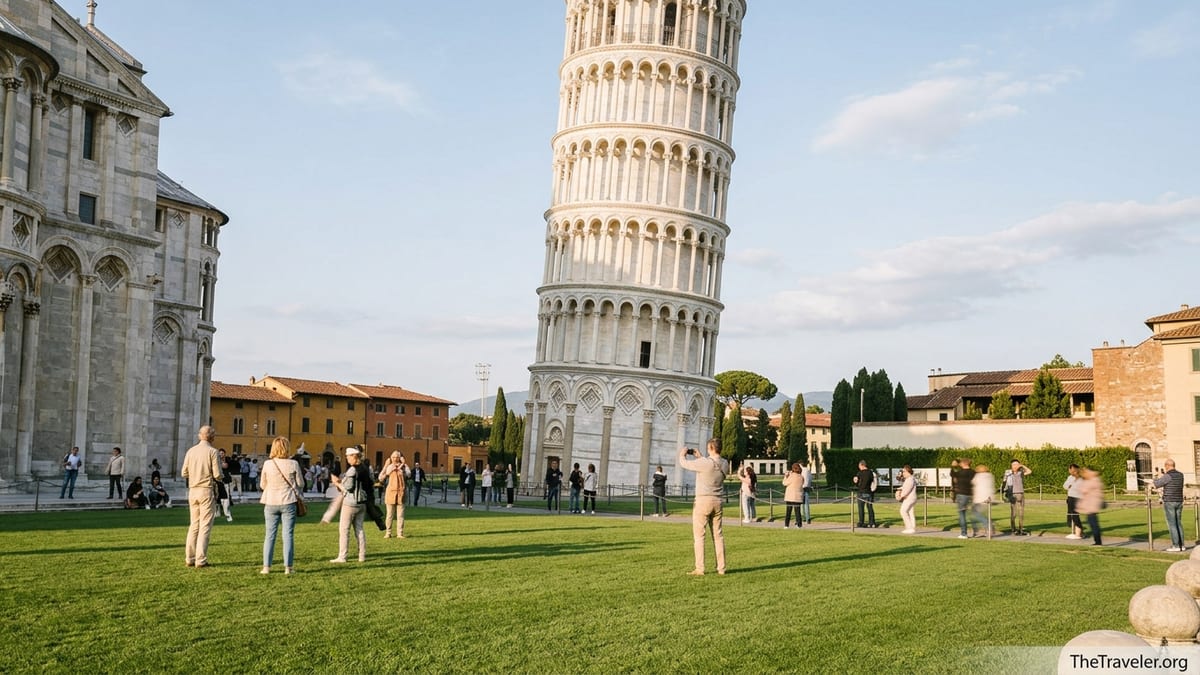
On a typical spring or autumn afternoon, the lawn fills with visitors photographing the tower from every angle. Families spread blankets on the grass, couples lean back against their backpacks to admire the curve of the tower and the cathedral’s facade, and tour groups cluster near licensed guides who raise colored umbrellas above the crowd. Because entry to the cathedral itself is generally free with a timed pass collected at the ticket office, even travelers on very tight budgets can step inside to see the gilded ceiling and marble columns before or after viewing the tower. That accessibility helps keep Pisa on the map for backpackers, interrail travelers, and day-trippers from cruise ships docking in nearby Livorno.
Small practical details reinforce the impression of the piazza as a carefully curated stage. The grass is meticulously maintained, and security staff gently remind people not to walk in restricted areas. The ticket office, museum entrances, and basic facilities, including restrooms and a small information center, are all concentrated toward one side of the square so that the main views remain uncluttered. Even in high season, when timed entry slots to climb the tower routinely sell out, the broad lawns and generous perspectives allow most visitors to find their own angle on the iconic lean.
From Postcards to Social Media: A Visual Icon That Keeps Evolving
Long before Instagram, the Leaning Tower of Pisa was one of the most photographed structures in Italy. Today, its role as a visual icon has only intensified. A quick glance at social media during peak summer months shows thousands of images from travelers posing as if they are “holding up” the tower with their hands or shoulders, carefully aligning limbs with the monument in the background. While some seasoned travelers roll their eyes at the cliché, the sheer number of people trying to get the perfect forced-perspective shot says a lot about the tower’s enduring pull.
For many visitors, especially on quick day trips from Florence or Rome, the experience is as much about capturing a personal version of that classic image as it is about studying the building itself. On the lawn directly opposite the tower, you will see entire families taking turns, with one person running back and forth between the subject and the smartphone to fine-tune the alignment. Amateur photographers bring tripods to get a wide shot that includes the cathedral and baptistery. Others concentrate on details, such as the sculpted capitals or the play of late afternoon light on the marble arcades.
In recent years, improved camera technology on phones has made it easier to photograph the tower in varied conditions. Travelers who visit during winter often capture moody skies over the piazza, while those there in June or September might share high-contrast images with deep blue Tuscan skies and sharp shadows from the tower’s columns. Photography enthusiasts sometimes time their visit to climb just before sunset, hoping to catch a panoramic view over the tiled roofs of Pisa with the Arno River snaking through the city, and then descend to take exterior shots in the soft golden light.
Even official tourism campaigns continue to use the tower’s outline as shorthand for Italy itself, often alongside the Colosseum or the canals of Venice. In airport billboards, magazine spreads, and television commercials, the tilted silhouette in front of green lawn and white stone can instantly signal “Italy” to potential visitors from North America to Asia. The fact that this one flawed structure can stand alongside entire cities and regions as a symbol helps explain why it remains high on so many bucket lists.
An Accessible Stop on Classic Italian Itineraries
Another reason the Leaning Tower of Pisa remains so famous is logistical. It sits almost perfectly on the route of many classic Italian journeys and is surprisingly easy to visit without a car. High frequency regional trains link Pisa to Florence in about an hour, with tickets often priced at a level most travelers consider modest for a day trip. From Pisa Centrale station, taxis queue outside, and local buses run directly toward the tower area, but many visitors simply walk, enjoying a cross-town stroll that passes over the Arno River and through medieval streets lined with cafes and gelato shops.
The concentration of major sights in and around the Piazza dei Miracoli allows travelers to see a lot in a short time. A common pattern for day-trippers is to arrive in late morning, wander the piazza, enter the cathedral and baptistery, climb the tower on a pre-booked timed ticket, have a simple lunch at a nearby trattoria, and still catch an afternoon or early evening train back to Florence or onward to the Cinque Terre. The fact that the core experience can be compressed into half a day makes Pisa an attractive add-on even for those with limited vacation time.
Practical touches matter. Recent visitor guides note that tower entry tickets are sold in specific 30-minute time slots and that capacity is strictly controlled for safety, so booking ahead in busy months is strongly recommended. Travelers who arrive without reservations often find the next available climb is several hours away or sold out altogether, though they can still enjoy the piazza and the exteriors. Budget-conscious visitors often focus on the free or low-cost elements: strolling the grounds, photographing the monuments, and stepping inside the cathedral, then using the money saved for a sit-down meal or a detour to the nearby walled town of Lucca.
Because Pisa airport is a regional hub with flights from various European cities, some travelers structure their trip around it. They might land in Pisa in the morning, leave luggage at a hotel or station locker, and visit the tower before continuing by train to Florence by evening. Others do the reverse on their final day, treating a last visit to the piazza as a farewell to Italy before flying home. That ease of access, combined with the tower’s prestige, helps keep visitor numbers robust year after year.
More Than a Gimmick: History, Art, and Local Life
Although the lean is what draws most people, the tower’s continued fame also rests on the depth of its surroundings. Standing close to its base, visitors can see how finely carved the arcades and columns are, and how the colored stone bands echo the facade of the adjacent cathedral. The tower is not an isolated oddity but an integral part of a carefully planned religious complex that reflects the wealth and maritime reach of medieval Pisa. That context comes alive when travelers take time to step into the cathedral, listen to the extraordinary acoustics of the baptistery, or walk through the cloister-like cemetery with its fresco fragments and tombs.
Local guides often share stories that make the site feel less like a museum and more like a living part of the city’s identity. They talk about how the nickname “Square of Miracles” caught on in the 20th century, or how generations of Pisans grew up watching stabilization works that became a point of local debate. Some mention the pride residents feel that their tower, once perceived as an embarrassing mistake, has been reinterpreted as a symbol of resilience and ingenuity. For many city dwellers, it is a familiar backdrop to daily life: visible from certain apartment windows, glimpsed from commuter trains, or passed during evening walks.
Visitors who linger beyond the most crowded midday hours often glimpse that local rhythm. In the early morning, before tour buses arrive, joggers loop the perimeter of the piazza and workers hose down the paving stones. Late in the evening, after the last timed entry to the tower, small groups of students from the nearby University of Pisa sit along the low walls chatting while the monuments glow under floodlights. These quieter moments reinforce that the Leaning Tower is not just a tourist prop but part of a functioning city with its own pace and personality.
Nearby streets also help anchor the experience in everyday Italian life. Just beyond the piazza walls, family-run cafes serve espresso and pastries to a mix of locals and visitors. Small groceries sell Tuscan olive oil and wine alongside basic household items. For travelers willing to wander a few blocks away from the main souvenir strip, it is easy to find a neighborhood trattoria where the lunch menu features simple pasta dishes and grilled fish at prices that feel reasonable compared with more touristed cities.
The Takeaway
The Leaning Tower of Pisa remains one of Italy’s most famous landmarks because it offers more than a visual oddity. It combines an immediately graspable story of a tower that should have fallen, a dramatic and photogenic setting, and a remarkable example of modern engineering quietly at work beneath centuries-old stone. Its location on major transportation routes makes it an easy stop even on short trips, while its surrounding monuments and lived-in city give depth to what might otherwise be a quick selfie destination.
For travelers, that mix translates into an experience that is flexible and layered. You can approach the tower as a lighthearted photo opportunity, as many day-trippers do, or you can treat it as a gateway into medieval architecture, soil mechanics, and local Tuscan culture. Either way, standing at the base of the tilted campanile, feeling the lean underfoot as you climb, or watching the last rays of sun catch its arcades from the lawn, it is hard not to understand why this once-troubled project still captivates millions of visitors every year.
FAQ
Q1. How much does it cost to visit the Leaning Tower of Pisa? Most recent visitor information indicates that a timed ticket to climb the tower is typically priced in the several tens of euros range for adults, with combined tickets for other monuments in the Piazza dei Miracoli costing a bit less. Entry to the cathedral itself is usually free with a timed pass collected at the ticket office, while simply walking around the piazza and viewing the tower from outside remains free.
Q2. Do I need to book Leaning Tower of Pisa tickets in advance? In busy months from roughly April through October, advance booking is strongly recommended. Timed entry slots often sell out, especially late-morning and mid-afternoon climbs that suit day-trippers from Florence or cruise excursions. Travelers visiting in the quieter winter period sometimes find same-day tickets available, but even then, it is wise to check availability as early as possible.
Q3. How long does it take to climb the tower? The climb itself typically takes about 30 minutes, including time to pause on the way up and enjoy views from the top. Ticketed entry windows are usually structured in half-hour blocks to control numbers inside the tower. Visitors should also allow extra time for security checks, walking from the ticket office, and possibly waiting in line at the base before their allocated slot.
Q4. Is it safe to climb the Leaning Tower of Pisa? After an extensive stabilization project completed in 2001, independent engineering assessments concluded that the tower is stable for many decades, provided it continues to be monitored. Authorities strictly limit the number of people allowed inside at any one time, and access is controlled through timed tickets and security checks. Those with mobility issues, significant vertigo, or certain health conditions may find the climb challenging due to the tilt, narrow spiral stairs, and lack of an elevator.
Q5. How do I get from Pisa Centrale station to the tower? From Pisa Centrale, many visitors choose to walk to the Piazza dei Miracoli, which typically takes 20 to 25 minutes at a relaxed pace and passes through the historic center and over the Arno River. Alternatively, local buses run from near the station toward stops close to the piazza, and taxis are usually available outside the main entrance. Clear signposts and frequent crowds heading in the same direction make the route easy to follow on foot.
Q6. What is the best time of day to visit? Early morning and late afternoon or early evening tend to be the most pleasant times to visit. Midday, especially in summer, can bring intense heat and heavy crowds, as day-trippers and tour groups converge on the piazza. Photographers often favor the first or last climbs of the day, when the light is softer and the views from the top can be particularly atmospheric.
Q7. Can I visit the Piazza dei Miracoli without climbing the tower? Yes. Many travelers, whether for budget, mobility, or timing reasons, choose not to climb the tower but still enjoy the piazza. You can walk the lawns, photograph the tower and other monuments from multiple angles, and visit the cathedral and baptistery without purchasing a tower ticket. For some, this slower exploration of the surroundings becomes the highlight of the trip.
Q8. How long should I plan to spend in Pisa? A focused visit to the Piazza dei Miracoli, including climbing the tower, entering the cathedral, and taking photos around the lawn, typically takes between two and four hours. Travelers with more time often add a stroll through the historic center, a meal at a local trattoria, or a walk along the Arno River. Many people find that a half-day is enough for the main sights, while a full day allows for a more relaxed pace.
Q9. Is Pisa worth visiting if I am already seeing Florence and other Tuscan cities? For many travelers, Pisa offers a complementary experience to cities like Florence and Siena. The Leaning Tower and its surrounding monuments provide a compact, visually striking introduction to Romanesque architecture and medieval Tuscan power. Because the city is easy to reach by train and can be explored quickly, it works well as a day trip and often feels distinct enough to justify the stop.
Q10. Are there other attractions near the Leaning Tower of Pisa? Yes. In addition to the cathedral, baptistery, and monumental cemetery within the Piazza dei Miracoli, nearby streets feature small museums, cafes, and shops. Some travelers combine a visit to Pisa with a short train ride to the walled city of Lucca, known for its Renaissance ramparts and relaxed atmosphere. Others explore more of Pisa itself, including the riverfront and university quarter, before returning to their base elsewhere in Tuscany.