


The first time I saw the Leaning Tower of Pisa in person, it looked almost playful, like a stone prop built to keep smartphone tourists entertained. It was only when I started climbing the tight spiral of marble steps, feeling the tilt in my ankles and watching the curve of the city slide past the windows, that I understood something very different: this is not just a photogenic mistake, but an 850-year negotiation between gravity, bad soil, and human ingenuity. Climbing the tower changed how I saw its engineering, and by the time I stepped back onto the Piazza dei Miracoli, the lean no longer felt like an accident. It felt like a story.
Get the latest updates straight to your inbox!
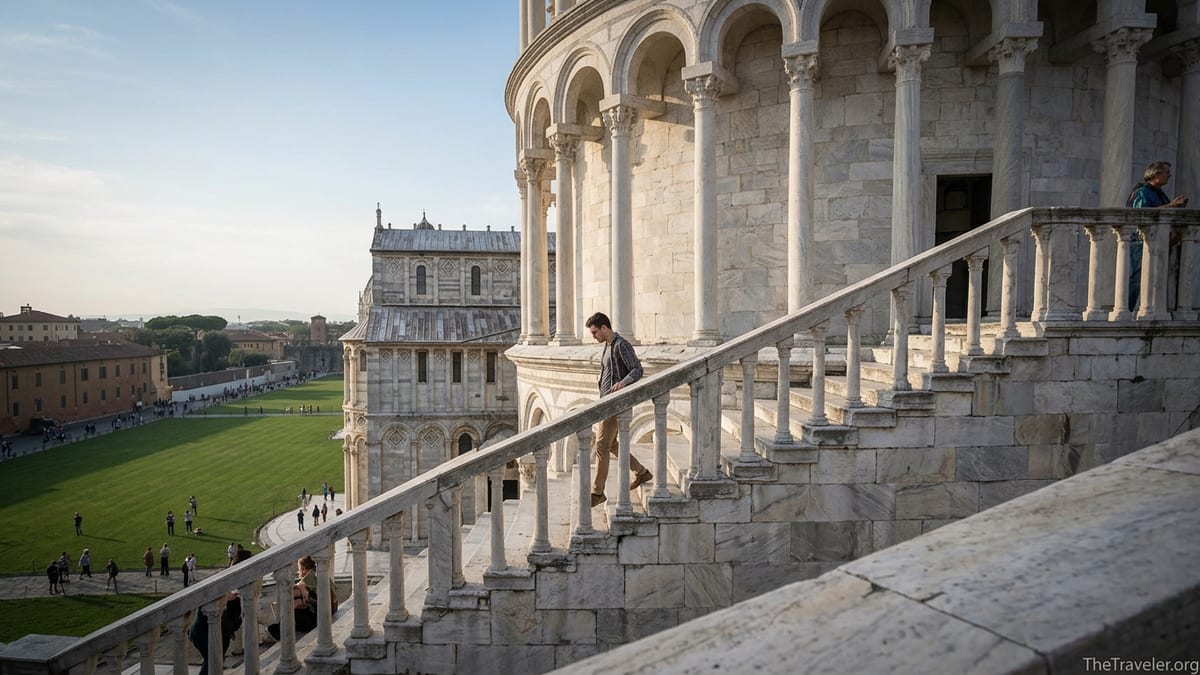
Meeting the Tower: From Meme to Masterpiece
Most travelers arrive in Pisa already knowing the tower as a punchline. On a warm afternoon, the lawn of the Piazza dei Miracoli fills with visitors setting up the famous forced-perspective photo, arms outstretched as if holding up the campanile. The scene feels almost comical until you stand directly under the base and crane your neck upward. The 55-meter marble cylinder really does hang in the air at a visible angle, its top displaced several meters from where you instinctively feel it “should” be.
Walking around the base, the engineering puzzle starts to come into focus. The tower is not a flimsy prop. It is roughly 14,000 to 15,000 tons of stone resting on foundations barely 3 meters deep, set in soft, compressible marine clay. Modern guides in Pisa point out that much of the city leans a little because the ground itself is unreliable. The difference is that this tower became a global icon of that problem.
From the piazza, you can already see traces of the long engineering struggle. Subtle metal bands, carefully restored stone, and a protective ring around the base hint at interventions that most casual visitors never ask about. Before I climbed, I knew the story in broad strokes. After climbing, I started noticing every tiny clue written into the stone.
What surprised me most, standing in that UNESCO-listed square, was how calm the tower felt. This is not a structure in crisis anymore. It is a structure that has been studied, weighed, counterweighted, anchored, and coaxed back toward safety by generations of engineers who refused to let it fall or be “fixed” into something ordinary.
The Strange Sensation of Climbing a Leaning Staircase
It is when you step inside that the abstract idea of “tilt” becomes visceral. Tickets to climb cost about 20 euros in 2026 for a timed 30-minute slot, and the Opera della Primaziale Pisana tightly controls numbers to around a few dozen people per group. Once your slot is called, you file through security, leave bags in a locker, and enter the cool stone cylinder with nothing but your camera and your balance.
The staircase spirals upward in a surprisingly narrow column. There are almost 300 marble steps, their inner edges sharply defined, their outer edges worn into shallow curves by centuries of feet. Engineers, conservators, and even casual Reddit commentators have noted how the treads are more worn on the outer, lower side, concrete evidence of how bodies instinctively shift weight as the lean pulls them sideways.
As you climb, the tilt is not a visual trick; it is something you feel in your joints. On one section of the spiral, you are walking slightly uphill into the lean. A few turns later, you are suddenly pitched downhill with gravity tugging you toward the outer wall. The sensation is disorienting enough that staff quietly watch older or less steady visitors, ready to remind them to use the handrail.
From an engineering perspective, that strange gait is a human-scale demonstration of a key concept: where the line of action of your weight falls. Just as you subconsciously adjust your torso so your center of mass stays over your feet, the tower has had to “adjust” over the centuries so that the line of its weight still falls within its foundation footprint. Every intervention, from medieval stone tweaks to modern soil extraction, has been an attempt to stop that line from crossing the point of no return.
Understanding the Lean: How Bad Soil Made a Perfect Icon
Before climbing the tower, I thought the lean came from some exotic design flaw. In reality, the story is painfully mundane. Construction began in the 12th century, when Pisa was a thriving maritime republic. Builders placed an ambitious, heavy bell tower on a shallow ring foundation, only about three meters deep, sitting on interbedded layers of sand, clay, and waterlogged silt. It was a beautiful design, but the soil had other ideas.
By the time workers reached the third story, the tower had already begun to tilt. One side of the soft clay compressed more than the other, and the structure started to sink unevenly. Medieval masons noticed and tried to compensate in the only way they could: they built upper floors slightly taller on the “low” side, visibly bending the stack of arcades into a banana shape. You can see this from the piazza if you stand at a distance; what appears symmetrical from one angle is clearly warped from another.
That early decision to keep building on bad ground turned the tower into a long-running geotechnical experiment. Over the centuries, the tilt increased, especially in the 19th and 20th centuries, eventually reaching a displacement of more than four meters at the top. By the late 1980s, engineers estimated the factor of safety of the soil at barely above 1, which is a polite way of saying the tower was uncomfortably close to collapse if anything significant changed.
Ironically, the same poor soil that caused the problem helped keep the tower standing. As the structure leaned, part of the foundation pressed harder into the clay, compacting and stiffening it. The tower slowly rotated but did not topple. Modern studies of soil-structure interaction have even suggested that the combination of flexible ground and stiff tower may help it ride out earthquake vibrations rather than amplify them. What once looked like unambiguous failure now reads like an unintended research project in stability.
Saving a Landmark Without Destroying Its Identity
From the mid-20th century onward, the question facing Italy was not just “How do we save the tower?” but also “How do we save its lean?” A perfectly straightened bell tower would survive, but the Leaning Tower of Pisa as the world knows it would essentially disappear. This tension between safety and identity is written into almost every modern engineering decision on the site.
Several early attempts to “fix” the lean reveal how crude interventions can backfire. In the 1930s, for example, concrete was injected under the foundation on the sinking side in an effort ordered at the time by the government. The added weight and disturbance of the soil actually increased the tilt. Decades later, large concrete and steel counterweights were placed on the opposite side of the base to pull the tower back, a temporary measure that helped but could not be permanent.
The real breakthrough came in the 1990s, when a multinational committee of engineers and geotechnical experts led a comprehensive stabilization project. The tower was closed to visitors in 1990 and a massive steel harness and cable system was installed, anchoring the structure while a delicate process of “underexcavation” began. Rather than pushing the tower upright, engineers removed small amounts of soil from beneath the higher side, letting gravity and the tower’s own weight coax it back toward a safer angle.
By the early 2000s, the results were quietly dramatic. The lean was reduced by roughly half a degree, equivalent to rolling back the clock to its 19th-century tilt, and detailed monitoring suggested that motion had slowed enough to declare the tower stable for at least several decades. Crucially, the lean remained obvious to every visitor. Engineers had done something profoundly modern: they solved a life-safety problem without erasing the very quirk that drew travelers here in the first place.
What You Notice at the Top: Subtle Clues of Careful Design
Stepping out onto the top platform after the final tight turns of the staircase is like emerging into a different building. The bells hang overhead, the marble balustrade circles you, and all of Pisa seems to fall away to one side. On a clear day, you can see the red tile roofs sliding down toward the Arno, the green lawns of the piazza below, and distant Tuscan hills in the haze.
From up here, the tower’s engineering reads like a layered palimpsest. The elliptical lip of the platform, slightly higher on one side than the other, reveals how builders tried to correct the lean as they went up. The shallow tilt of the balustrade, which feels higher against your hip on the uphill side, subtly reminds you that nothing about this floor is truly level. Even simple acts, like setting a camera on the stone, reveal the slope as devices slide a fraction of a centimeter toward the low side.
Looking down, you can also see the relationship between the tower and the rest of the cathedral complex. The Baptistery, Cathedral, and Camposanto Monumentale align in a carefully planned composition, and the bell tower was always meant to be part of that greater whole. Its engineering story is not just about one leaning cylinder, but about an entire medieval vision of a sacred precinct adapted, century by century, to realities that its creators never anticipated.
Modern details whisper the presence of 20th and 21st century engineers. Discreet monitoring sensors track micromovements. Restored joints show where stone has been carefully stitched back together. The fact that you, with your timed ticket and smartphone, can wander among the bells and lean over the rail is itself proof that the structure is no longer in immediate danger. Stability here does not look like dramatic steel braces; it looks like ordinary tourism.
Planning Your Own Climb: Practical Lessons From an Engineering Marvel
If climbing the tower is on your itinerary, a little understanding of its engineering can improve both your safety and your appreciation. Timed-entry tickets for 2026 hover around 20 euros for adults for the tower alone, with combination passes around 27 euros including access to the cathedral and other monuments in the square. In peak months, midday slots regularly sell out, and it is common for same-day availability to disappear before the ticket office even opens. Booking online at least a week or two ahead is not just a convenience; it is almost mandatory if you are on a tight schedule.
Visitor rules are shaped around both crowd control and structural concerns. Groups are limited, and each slot gives you roughly 30 minutes for the ascent, time at the top, and descent. Bags are not allowed inside, partly for security and partly to keep weight down and circulation smooth on the narrow staircase. Staff members at the base are unambiguous about health warnings: if you have serious heart, balance, or respiratory issues, this is not the climb to test your limits.
From a traveler’s point of view, one of the best engineering lessons comes from simply watching how people move. You will see visitors subconsciously leaning uphill as they walk, gripping the inner handrail more tightly as the angle steepens, and pausing for breaths at landings where the steps feel particularly skewed. The leaning geometry forces human bodies to negotiate space differently, a live demonstration of how design, gravity, and habit interact.
For those interested in the history of the stabilization works, several local guides and walking tours now weave that story into their commentary, pointing out where counterweights once sat or where soil was removed. While you will not see dramatic machinery anymore, the quiet fact that the tower reopened in 2001 after more than a decade of technical debate and intervention underpins every smooth, well-managed visit today.
How the Tower Changed My Understanding of Failure
Climbing the Leaning Tower of Pisa changed the way I think about engineering success and failure. On paper, this project was a miscalculation: inadequate foundations, underestimated soil behavior, and a visibly deformed structure even before it was completed. Yet standing on those worn marble steps, it is difficult to call the tower a failure in any simple sense.
The more you learn, the more the tower begins to resemble a case study in adaptive problem solving. Medieval builders recognized the lean and altered the upper floors rather than tearing everything down. Nineteenth-century scholars measured and documented the tilt with increasing precision. Twentieth-century and contemporary engineers tried, failed, refined, and eventually found a solution that balanced safety with cultural meaning. Each generation inherited a problem it could not ignore but could not “solve” in the traditional sense.
There is also a humbling lesson in the relationship between the tower and its ground. Travelers often comment on how many other buildings in Pisa lean slightly. The tower is just the most extreme and visible expression of a city built on soft soils. In that sense, it is less an exception than a magnifying glass for a larger urban condition. It reminded me that many of the world’s most beloved landmarks stand on compromises with geology, climate, and time.
As an engineering story, the Leaning Tower of Pisa is now less about a single mistake and more about a conversation across centuries: between marble and clay, between weight and support, between human ambition and the persistent pull of gravity. You feel that conversation in your calves as you climb, and you see it in the subtle asymmetries of the arcades and the cautious confidence of the tourists around you.
The Takeaway
By the time I stepped back onto the grass of the Piazza dei Miracoli, the tower no longer looked like a quirky accident frozen in stone. It looked like a living system, constantly monitored, interpreted, and cared for. Its tilt is not only a reminder of what its builders misjudged, but also of what later generations managed to preserve.
For travelers, climbing the Leaning Tower of Pisa offers more than a view and a photograph. It invites you to inhabit a structure that has been very close to failure, that has been pulled back from the brink with patience and ingenuity, and that now survives as much because of modern soil mechanics and risk management as because of medieval craftsmanship. The next time you see someone posing with an outstretched arm on the piazza, remember that behind that lighthearted image lies one of the most complex, careful, and creative engineering stories in Europe.
If you go, give yourself time not just to climb, but to look: at the curvature of the stair treads, at the slight warp of the arcades, at the way the tower relates to the cathedral and baptistery around it. Those are the places where its story is written. Reading that story, step by step, is what truly changes how you understand this iconic lean.
FAQ
Q1. Can you still climb the Leaning Tower of Pisa safely?
Yes. After major stabilization works completed around 2001, engineers consider the tower safe for controlled tourism, and it is carefully monitored for any movement.
Q2. How much does it cost to climb the tower in 2026?
Standard adult tickets to climb the tower cost around 20 euros in 2026, with optional combination passes costing slightly more if you include other monuments.
Q3. How many steps are there to the top?
There are just under 300 marble steps in the spiral staircase. They are worn and uneven in places, so you should be prepared for a moderate but steady climb.
Q4. Do you need to book Leaning Tower tickets in advance?
In most seasons, yes. Timed-entry slots often sell out, especially in the middle of the day and during summer, so advance online booking is strongly recommended.
Q5. Why is the Leaning Tower of Pisa tilted?
The lean is caused by shallow foundations built on soft, uneven clay and silt. One side of the ground compressed more than the other, causing the tower to sink and tilt.
Q6. Did engineers ever try to straighten the tower completely?
Several attempts were made to reduce the tilt, but modern engineers deliberately chose not to straighten it fully, aiming instead for a safe but still clearly leaning tower.
Q7. Is the tower at risk of collapsing in an earthquake?
Current research suggests that the combination of the tower’s stiffness and the soft soil may actually reduce resonance during typical earthquakes, and continuous monitoring helps manage the remaining risk.
Q8. How long is a typical visit inside the tower?
Timed tickets usually allow about 30 minutes, including climbing up, spending a short time at the top to enjoy the views, and descending the staircase.
Q9. Are there age or health restrictions for climbing?
Children under a certain age are not allowed to climb, and people with serious heart, mobility, or balance issues are advised against it because of the steep, leaning stairs.
Q10. What else should I see in the Piazza dei Miracoli?
Beyond the tower, the cathedral, the circular baptistery, and the monumental cemetery are all significant architectural and historical sites that reward an unhurried visit.