


The Leaning Tower of Pisa is one of those rare places that almost every traveler recognizes long before they ever set foot in Italy. Yet what surprises many visitors is not just that the tower still stands, but how compelling it is in person. Year after year, millions of travelers continue to detour to this small Tuscan city for a fresh look at a familiar icon, often discovering that Pisa offers much more than a funny photo of a crooked bell tower.
Get the latest updates straight to your inbox!
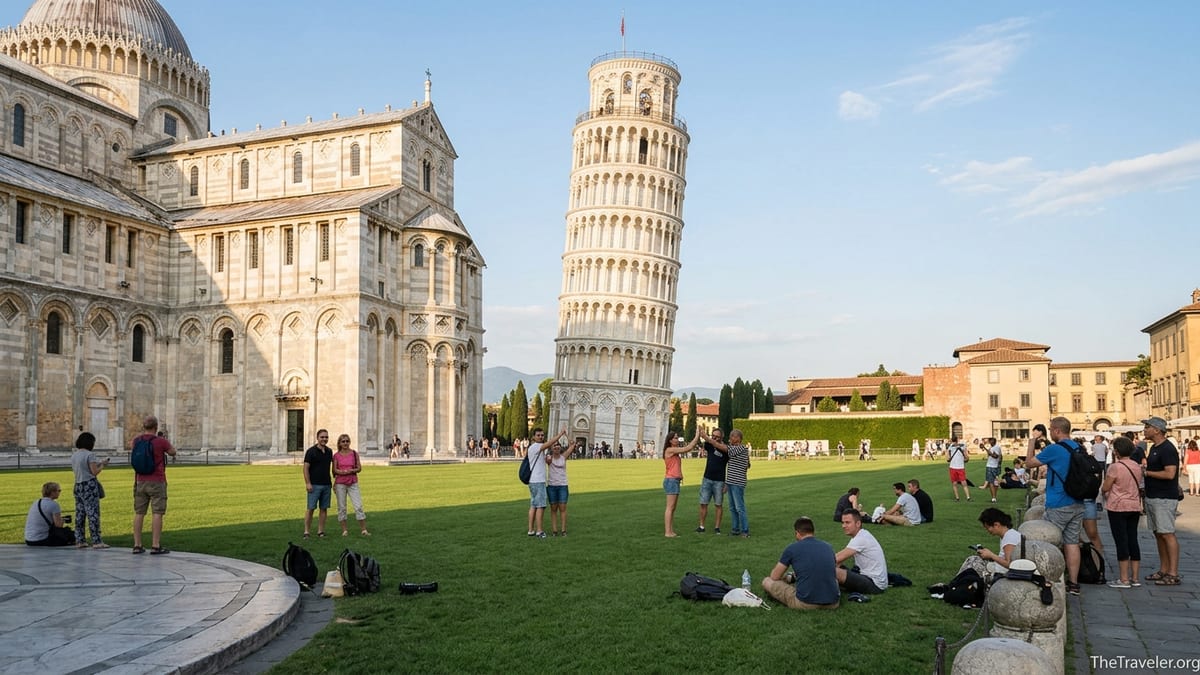
An Icon That Looks Even More Impossible in Real Life
Most travelers arrive in Pisa with the tower already etched in their minds from guidebooks and social media. Even so, the first glimpse of the real thing can be startling. The campanile of Pisa’s cathedral leans at roughly 4 degrees off vertical today, the legacy of unstable clay soil beneath its 12th‑century foundations. From a distance it appears almost like a digital illusion pasted against the skyline; up close, the white marble drum physically seems to be sliding away from the cathedral it was designed to serve.
Standing on the Piazza dei Miracoli lawn, visitors quickly see why photos never quite capture the experience. The tower rises more than 55 meters, but because of the tilt the eye reads it as both tall and precariously off‑balance. Many travelers describe an odd sensation of vertigo even with two feet planted firmly on the grass, especially when they compare it to the dead‑straight lines of the cathedral and baptistery beside it. What looked cute online suddenly feels like a genuine feat of survival.
Modern monitoring, carried out after extensive stabilization work in the 1990s, has reassured engineers that the tower is stable for at least the next couple of centuries. That combination of perceived fragility and scientific security is part of the draw. Visitors can lean back, enjoy the spectacle and take their time walking around the base to see how the tilt changes from each angle, without the genuine fear that it might finally topple.
Because the tower is one of Italy’s best‑known symbols, finally seeing it in person also satisfies a long‑held curiosity. Many travelers fold a couple of hours in Pisa into a longer Tuscan itinerary, ticking off a world‑famous landmark between wine tasting in Chianti and museum visits in Florence. For repeat visitors to Italy, returning to Pisa becomes a way to introduce friends or children to the country using a monument they immediately recognize.
The Thrill and Weird Sensation of Climbing the Tower
One of the main reasons travelers come back is the chance to climb the 294 narrow steps to the top platform. Access is controlled through timed tickets, usually in 30‑minute slots. As of 2026, a standard adult ticket to climb the Leaning Tower costs around 20 euros from the official operator, with numbers capped at roughly 1,600 climbers per day, so the interior never feels overly crowded.
The climb itself is an experience unlike other famous towers. Inside, the staircase wraps around the hollow core of the campanile. Because of the tilt, the marble treads are noticeably lower on one side of the spiral and higher on the other. Travelers often remark that in some sections they feel as if they are walking slightly downhill, only to feel the staircase steepen abruptly a few turns later. It is a subtle reminder, step after step, that the entire structure really is leaning underneath you.
At the top, visitors emerge onto an open viewing gallery ringed by stone balustrades and the tower’s bells. On the leaning side, many people instinctively move toward the inner wall, especially those with a fear of heights, because they genuinely feel pulled toward the lower edge. The views reward the effort: the whole Piazza dei Miracoli complex spreads out in perfect miniature below, while the red tile roofs of Pisa stretch toward the Arno River and, on clear days, the Apuan Alps rise faintly in the distance.
Because tickets are timed and in high demand, travelers often return to Pisa in different seasons to experience the climb again. Someone who last visited on a hazy August afternoon might come back on a crisp October morning and finally see the snowy ridges beyond the city. Others plan a repeat trip to allow a partner or teenage children, now old enough to climb, to share the same dizzying walk their parents remember.
A UNESCO‑Listed Square of Miracles, Not Just a Single Tower
Another reason people keep revisiting is that the Leaning Tower is only one part of a remarkably intact medieval religious complex. The Piazza dei Miracoli, formally known as Piazza del Duomo, has been recognized as a UNESCO World Heritage site since 1987 and includes the cathedral, baptistery, monumental cemetery and associated museums. Many first‑time visitors underestimate how long they will want to stay, then return on a later trip specifically to explore the entire ensemble in more depth.
The cathedral interior, with its striped marble columns and glittering apse mosaic, offers a powerful contrast to the playful atmosphere on the lawn outside. Independent travelers often choose a combined ticket that adds cathedral and baptistery access to their tower climb for only a modest supplement over the basic tower ticket. Once inside, they discover art and architecture that would be headline attractions in almost any other Italian city: pulpits by Giovanni Pisano, delicate bronze doors and soaring Romanesque naves.
The baptistery, a separate circular building, surprises many with its acoustics. At set times during the day, an attendant demonstrates how a single voice can create layered chords that echo around the domed interior. Travelers who have already done the tower on a previous visit sometimes skip the climb in favor of lingering here, catching one of the impromptu singing demonstrations, then moving on to the Camposanto Monumentale to see medieval fresco fragments and quiet cloisters away from the tour groups.
Because access combinations and museum arrangements are occasionally updated, repeat visitors often find new reasons to explore. One trip might focus on the monuments themselves; a subsequent one might be built around a guided art history tour, a photography walk at blue hour or a visit timed to a temporary exhibition in the cathedral museum. The tower is still the anchor, but the square around it offers enough layers to justify multiple returns.
Easy Day‑Trips and Short Stops on Bigger Itineraries
Pisa’s location keeps it firmly on the return‑visit circuit. The city sits on a major rail line and is just under an hour by regional train from Florence, with frequent departures throughout the day. Low‑cost airlines and European carriers also operate flights into Pisa International Airport, which lies only a few minutes by shuttle from the city center. That convenience makes the Leaning Tower an effortless stop on trips focused on Florence, the Cinque Terre or the broader Tuscan coast.
Many travelers first encounter the tower as part of a guided day tour from Florence that bundles transport, a tower ticket and a short city walk into a single price. These tours are popular with first‑time visitors and cruise passengers but often leave only an hour or two on the square. After getting a taste of the site, visitors frequently return on a later holiday with more time, booking their own tickets and exploring independently. Having already done the logistics once, they find it easy to replicate the trip with different companions or at a slower pace.
Others pass through Pisa almost accidentally. Intercity trains between Rome and the Ligurian coast sometimes involve a change here, and travelers discover that a three‑hour layover is more than enough to store luggage at the station, hop on a city bus or taxi to the Piazza dei Miracoli, walk around the tower and be back in time for their next train. After discovering how simple that detour can be, some deliberately schedule future journeys to include another quick stop, turning Pisa into a recurring travel ritual.
Because a basic tower climb ticket is relatively affordable compared with major attractions in larger cities, many repeat visitors treat it as a justifiable indulgence each time they pass through Tuscany. Travelers who paid for a ticket in euros a decade ago often comment that, given how prices for long‑haul flights and hotels have risen, returning to the tower is still good value for a world‑class experience.
Playful Photo Traditions and the Social Media Factor
If there is one ritual that never seems to fade, it is the playful photo session in front of the Leaning Tower. The classic pose, where travelers stand at a distance and pretend to hold up or push over the tower with their hands, is visible in every direction on busy days. What might look clichéd from afar proves unexpectedly fun for families and groups of friends organizing each other by shouting instructions across the lawn until the angles line up.
Social media has amplified this tradition rather than replacing it. Travelers now arrive with ideas saved from Instagram or TikTok: someone pretending to lick an ice cream cone positioned so the tower appears as the scoop, a couple “pinching” the top between their fingers, a group of friends doing synchronized handstands. Because the tower’s outline is so instantly recognizable, even a small slice of it in the background of a selfie is enough to signal where the photo was taken.
Repeat visitors often use these photos to mark the passage of time. Parents return when their children are taller, recreating the same pose from a trip years earlier. Couples on a first holiday together might come back later for an anniversary and take a new version of their original picture, now with wedding rings or a stroller in the frame. The tower becomes less a one‑time sightseeing object and more a backdrop for personal milestones.
Practical photography also draws visitors back. Serious hobbyists know that the Piazza dei Miracoli looks completely different at sunrise, when the marble glows pink and the lawn is almost empty, compared with midday in high summer. Some travelers plan early‑morning or winter return trips specifically for clean, crowd‑free tripod shots that are impossible to capture during a hurried summer bus tour.
Engineering Feat and Ongoing Story of Survival
Beyond the postcard images, the Leaning Tower is a living case study in geotechnical engineering and conservation. Construction began in 1173, but the tower started to tilt just a few years later as the heavy stone structure settled unevenly into soft clay and sand. Work stopped and started over nearly two centuries as builders tried to correct the lean by adjusting upper floors. The visible curve in its profile tells that story to anyone who looks closely.
By the late 20th century the tilt had increased to around 5.5 degrees, and in 1990 Italian authorities closed the tower to the public over safety concerns. A multinational committee of engineers and historians embarked on a decade‑long stabilization project. Their key move was to carefully remove soil from beneath the higher side of the foundation, allowing the tower to settle back slightly toward vertical. After years of slow, monitored adjustments, the lean was reduced by roughly half a degree and sensors confirmed that the motion had essentially stopped.
The tower reopened to visitors in 2001 and has remained a rare example of successful large‑scale monument stabilization. Travelers fascinated by architecture or engineering often return to Pisa to see how the structure has fared over the years. Some join specialized tours that explain the monitoring systems, the underground counterweights and the logic behind preserving, rather than eliminating, the tilt that made Pisa famous in the first place.
The narrative continues to evolve. Research groups periodically publish new studies on how the tower behaves during windstorms or subtle shifts in the water table. Travelers who follow cultural heritage news sometimes plan repeat visits after reading about fresh findings or anniversaries related to the stabilization work. For them, standing beneath the tower is less about checking off a bucket‑list item and more about witnessing a long‑running scientific experiment succeed in real time.
Atmosphere, Cafes and the Simple Pleasure of Being There
While the monuments dominate the skyline, what keeps many people coming back to Pisa is the atmosphere that builds up around them. Outside the walled Piazza dei Miracoli, narrow streets lined with gelato parlors, panini counters and souvenir stalls give travelers an immediate taste of everyday Tuscany. It is easy to grab a cone from a family‑run gelateria or a quick espresso at a bar where locals chat over the sports pages before or after a visit.
Independent travelers often remember details that have nothing to do with the tower itself: a waiter recommending a Tuscan soup at a trattoria just off Via Santa Maria, a street musician playing under the city walls at sunset, a quiet corner table where they watched student life drift by in this university town. Those small, personal moments are what tempt many to schedule a second overnight in Pisa rather than simply passing through for an hour.
The grassy expanse of the Piazza dei Miracoli also invites lingering. On cooler days, travelers stretch out on the lawn, use their day packs as pillows and watch the steady choreography of tours come and go. Because the square is largely vehicle‑free and enclosed by medieval walls, it feels sheltered from city traffic. Parents often comment that it is one of the easier major sights in Italy to visit with children, who can run around between the monuments without the constant worry of nearby cars.
With each return, visitors tend to move a little further from the tower in search of new vantage points and quieter corners: a late‑afternoon stroll along the Arno, a walk to Pisa’s lesser‑known leaning churches, or a stop in a neighborhood bakery to pick up cantucci biscuits for the train. The tower remains the magnet, but the city around it steadily fills in with memories.
The Takeaway
Travelers keep visiting the Leaning Tower of Pisa year after year because it offers a rare combination of visual shock, physical experience and broader cultural context. The tilt feels more dramatic in person than any photograph suggests, the climb delivers a genuinely unusual bodily sensation and the surrounding Piazza dei Miracoli rewards slow exploration beyond a single snapshot.
Its practical advantages also matter. Easy train connections, relatively straightforward ticketing and proximity to Tuscan hot spots make it one of the simplest world‑class monuments to revisit. Layer on centuries of history, cutting‑edge engineering and the playful tradition of posing for “holding up the tower” photos, and it becomes clear why so many travelers choose to come back, often bringing new companions with them.
Whether it is your first time in Italy or your fifth trip through Tuscany, the Leaning Tower of Pisa offers more than a quick detour. Treated as a place to linger rather than just a stop for a snapshot, it can become a recurring highlight of your travels, revealing something new each time you walk across the grass and look up at that improbable, enduring tilt.
FAQ
Q1. Do I need to book Leaning Tower of Pisa tickets in advance?
Booking in advance is strongly recommended, especially from spring through early autumn. Daily climber numbers are capped and same‑day slots often sell out by late morning.
Q2. How much does it cost to climb the Leaning Tower of Pisa?
As of 2026, the official adult ticket to climb the tower is around 20 euros. Third‑party platforms and guided tours may charge more but often include skip‑the‑line access or transportation.
Q3. How long does a visit to the Leaning Tower and Piazza dei Miracoli take?
The tower climb itself takes about 30 minutes, but most travelers spend 2 to 3 hours exploring the entire square, including the cathedral, baptistery and cemetery.
Q4. Is it safe to climb the Leaning Tower of Pisa?
The tower underwent extensive stabilization works completed in 2001 and is constantly monitored. Visitor numbers are limited and access rules are designed to keep the experience safe.
Q5. Can children climb the Leaning Tower?
Children are welcome, but there is usually a minimum age requirement of around 8 years and height restrictions may apply. Young visitors must be accompanied by an adult and should be comfortable with narrow stairs and heights.
Q6. What is the best time of day to visit the Leaning Tower?
Early morning and late afternoon typically offer fewer crowds and softer light for photos. Midday visits in high summer can be very busy and hot on the exposed square.
Q7. What should I wear to climb the tower?
Comfortable, flat shoes with good grip are important because the steps are worn and uneven. In warm weather, light clothing and a hat help with the sun, as the top platform is fully exposed.
Q8. Can I store luggage or backpacks while I climb?
Large bags are not allowed on the tower for safety reasons. A staffed cloakroom or locker area near the ticket office is typically available so you can leave backpacks before your time slot.
Q9. Is Pisa worth visiting if I have already seen the tower?
Yes. Many travelers return to explore the cathedral interiors, baptistery acoustics, riverside walks and local food scene, using the tower as a familiar starting point.
Q10. How do I get to the Leaning Tower from Pisa train station or airport?
From Pisa Centrale station, you can reach the Piazza dei Miracoli by local bus, taxi or a 20‑ to 25‑minute walk. From the airport, a short shuttle or taxi ride connects easily with the city center and onward buses to the square.