


Few landmarks divide travelers quite like the Leaning Tower of Pisa. For some, it is a thrilling, once-in-a-lifetime encounter with a world icon. For others, it is a cramped staircase, overcrowded square, and a long journey for a 20-minute photo stop. If you are planning an Italy trip in 2026, you may be wondering whether the Leaning Tower is genuinely worth visiting or just too touristy to enjoy. The honest answer depends on your expectations, timing, and how you structure your visit.
Get the latest updates straight to your inbox!
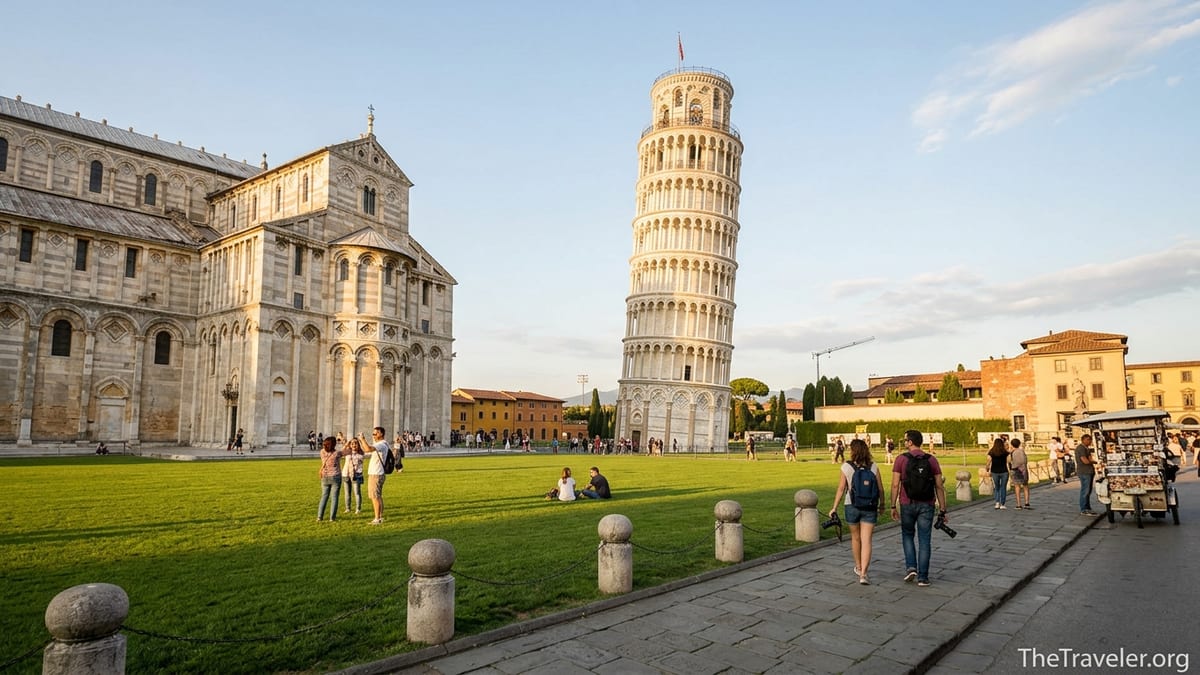
The Reality of Visiting the Leaning Tower Today
Arriving at Piazza dei Miracoli for the first time can be a shock. The white marble of the Leaning Tower, cathedral, and baptistery glows against the grass, and the famous tilt of the tower is more dramatic in person than in photos. At the same time, this beauty comes with significant crowds. In peak season from late spring through early autumn, you can expect long lines at security checkpoints, clusters of tour groups, and the classic “holding up the tower” photo poses filling the lawn almost all day.
Tickets to climb the tower are strictly timed, and visitor numbers per time slot are limited for safety, so the experience itself is fairly controlled even when the piazza feels busy. Most travelers receive around 30 minutes for the climb and views, and staff keep groups moving without making you feel rushed. The staircase is narrow and slightly dizzying because of the tilt, so it will not feel like a relaxed stroll, but most visitors describe it as memorable and even surreal rather than miserable.
In 2026, standard tower tickets are typically in the high 20 euro range for adults for the climb alone, while combo passes that include the cathedral, baptistery, cemetery, and museums usually cost a bit more. These prices make the tower one of the more expensive single monuments in Italy relative to time spent, especially if you only come for a quick visit. However, when you also explore the rest of the complex, the value improves significantly.
Outside the monuments, the immediate streets between Pisa Centrale station and the piazza have the usual tourist economy: souvenir stands stacked with leaning-tower keychains, inexpensive pizza-and-gelato counters, and vendors offering tripod photos or phone trinkets. Many travelers find this strip underwhelming, but the historic core of Pisa just a few streets away offers quieter cafes, local bakeries, and more authentic corners of the city that most quick day-trippers never see.
Crowds, Seasonality, and the Best Times to Go
Whether the Leaning Tower feels “too touristy” often comes down to timing. Between roughly late May and early October, as well as Easter week, the piazza stays busy from mid-morning until late afternoon. Tour buses from Florence and cruise excursions from Livorno typically arrive between about 10:00 and 15:00, which is when you are most likely to encounter lines at security and crowds jostling for photos in front of the tower.
If you visit during the shoulder seasons, such as March and early April or late October and November, the experience can be much calmer. The weather is cooler and less predictable, but the tower and piazza feel less like a theme park. You may still want to reserve a timed ticket in advance, especially for weekends, but you are less likely to find fully booked time slots. In winter, apart from the Christmas and New Year period, you can often book same-day tickets and move through the square with plenty of space between groups.
Time of day matters just as much. Travelers who arrive with the first entry times of the morning or in the last slots before closing frequently report a more enjoyable experience. In the early morning, the light on the marble facades is soft, and you often see local residents cycling to work just beyond the piazza. In the late afternoon or early evening, day tour buses start to leave, and the mood becomes more relaxed; the tower takes on warm golden tones as the sun sinks, and the lawns feel less chaotic.
For example, a traveler staying in Florence might take an early regional train, reaching Pisa Centrale around 8:00. After a 20 to 25 minute walk across the historic center, they could arrive at the piazza before most tours, climb the tower with fewer people inside, photograph the empty lawns, then have a late-morning espresso at a quieter bar off the main square before heading back. In contrast, someone arriving on a noon bus tour in July will likely encounter intense mid-day heat, heavily booked time slots, and shoulder-to-shoulder crowds throughout the complex.
The Experience of Climbing the Tower
Climbing the Leaning Tower is the highlight for many visitors and one of the main reasons to come at all. The tower is about 56 meters high, with close to 300 steps in a spiral staircase that gets noticeably steeper and more tilted as you rise. The lean is immediately perceptible inside; as you walk, you may feel pulled toward the lower side of the staircase, and the angle changes as you circle upward. People in average shape usually manage the climb without trouble, but it can be challenging if you have knee problems, vertigo, or issues with confined spaces.
At the top, a narrow walkway wraps around the belfry, giving you views over the cathedral, baptistery, red-tiled rooftops of Pisa, and the green countryside beyond. On clear days you can see toward the Apuan Alps in the distance. Because entries are timed and staff monitor capacity, the top never becomes dangerously crowded, but it can feel snug during popular time slots. Most people spend about 10 to 15 minutes on the summit before beginning the descent.
The climb is not accessible to visitors with significant mobility issues or those using wheelchairs, which is an important consideration if you are traveling with older family members or anyone with limited mobility. In these cases, it may be better to skip the climb and instead focus on the accessible portions of the piazza, the cathedral interior, and the museums, which still offer excellent views of the architecture and detailed exhibits about the history of the complex.
Because the climb is such a short but intense experience, some travelers question whether the cost is justified. If you enjoy unusual vantage points, architecture, and the physical feeling of the tilt, the answer is usually yes. If you dislike heights, crowded staircases, or are budget-sensitive, you may be just as happy admiring the tower from below and investing your time and money elsewhere in Tuscany.
Beyond the Selfies: What Else Is in Piazza dei Miracoli
Many quick tours treat Pisa as a one-photo stop, but Piazza dei Miracoli actually holds several important monuments that can turn a rushed visit into a rich half-day. The cathedral is a masterpiece of Pisan Romanesque architecture, with striped marble columns, detailed bronze doors, and artworks that rival better-known churches in Florence and Siena. Entry to the cathedral itself is often free with any paid monument ticket, though you still need a timed entrance slot.
The baptistery, a large circular building in front of the cathedral, is another highlight. Inside, its acoustics are so remarkable that staff periodically demonstrate a simple chant, allowing the sound to echo and layer in the vast dome. Listening to this brief demonstration, often with visitors silently looking upward, can be one of the most memorable parts of a visit. From the upper gallery, you also get atmospheric views into the baptistery and across to the cathedral facade and tower.
On the far side of the square lies the Camposanto Monumentale, a monumental cemetery with cloistered walkways, fresco fragments, and a quieter, contemplative atmosphere. While the tower and baptistery attract the biggest crowds, Camposanto remains comparatively peaceful even in busy months, making it a favorite among travelers who value art and history over quick photos. Nearby museums, such as the Sinopie Museum and the Opera del Duomo Museum, display original sculptures, fresco drawings, and artifacts removed from the monuments for conservation.
If you purchase a combo ticket that includes several of these sites, you can easily spend three or four hours exploring the piazza without feeling rushed. In practice, this transforms Pisa from a crowded 20-minute tower stop into a balanced cultural visit, which many travelers find more satisfying and more worth the trip.
Costs, Logistics, and Day-Trip Practicalities
Pisa is one of the easiest major day trips in central Italy, which is part of why it feels so busy. From Florence, frequent regional trains connect Santa Maria Novella station to Pisa Centrale in about one hour on average, with faster options that can be just under an hour. As of early 2026, one-way second-class regional fares are often in the range of 10 to 15 euros per adult if bought directly from Trenitalia or similar services. Trains typically depart every 20 to 30 minutes throughout the day, making it simple to choose early or late slots to avoid mid-day crowds.
From Pisa Centrale, you can walk through the historic center to the tower in about 20 to 25 minutes, passing the Arno River and local shops along the way. Taxis and local buses are also available if you are traveling with luggage or want to save energy. Cruise passengers docking in Livorno often join organized half-day excursions, which include bus transfers and pre-booked tower tickets. These tours are convenient but usually timed for mid-day, which is precisely when the piazza is busiest.
Once you factor in transport and tickets, a typical day trip from Florence for two people might include roughly 40 to 60 euros for round-trip train fares combined, plus 50 to 70 euros or more for tower and monument tickets, and additional spending on food and incidental purchases. Families and groups will need to multiply these costs accordingly. Compared with a day spent in Florence’s free piazzas and outdoor viewpoints, Pisa is a relatively expensive excursion. However, for travelers who care about seeing world-famous landmarks, many feel the price is comparable to visiting places like the Colosseum or Vatican Museums in Rome.
To reduce stress and avoid wasted time, it is wise to reserve tower tickets online for a specific time window, especially if you have same-day train connections. Many travelers choose a mid-morning or mid-afternoon tower slot, allowing time before or after for the other monuments and a leisurely walk through the city. If you are staying overnight in Pisa, you can choose quieter times like early morning on your second day, enjoying both a calmer climb and a more relaxed schedule.
Who Will Love Pisa, and Who Might Skip It
The Leaning Tower is most rewarding for travelers who genuinely enjoy famous landmarks and do not mind a certain level of commercialism and crowds in exchange for that iconic view. First-time visitors to Italy, families with older children, and photography enthusiasts often rank Pisa highly because it delivers exactly what they expect: a surreal tilted tower, a beautiful square, and a story they know before they arrive. For many, simply standing at the base of the tower and seeing it tilt so dramatically in real life feels like checking off a lifelong wish.
It is also a strong fit for travelers who are already passing through Pisa for practical reasons. If you fly into or out of Pisa airport, or need to change trains there on your way along the Tuscan coast, adding a few hours for the tower and piazza makes sense. In that context, even a short visit that only includes exterior views and a stroll around the square can feel worthwhile without requiring a full dedicated day trip.
On the other hand, some travelers may prefer to skip Pisa. If you strongly dislike crowded, heavily photographed sites and already feel that Rome and Florence will stretch your tolerance for busy attractions, the Leaning Tower will probably not change your mind. Slow travelers who want deep immersion in Tuscan countryside, food, and small towns may find more joy in places like Lucca, Montepulciano, or smaller hilltop villages, where time moves more slowly and interactions with locals feel more organic.
Budget-conscious visitors with only a few days in Florence may also decide that the combination of train fares, ticket costs, and several hours of travel is not the best use of limited time. For example, a three-night Florence stay already offers world-class sights like the Duomo, Uffizi, and Piazzale Michelangelo views with no additional train journeys. In such cases, Pisa is better saved for a future trip when you have more time for central and northern Tuscany.
How to Make a “Touristy” Site Feel More Authentic
Even the most popular attractions can feel enjoyable and personal with a bit of planning. One simple strategy in Pisa is to spend at least part of your time away from the lawns where everyone takes the same perspective photo. Walk behind the cathedral and baptistery, where there is often more space and fewer people, and take time to look at the stone carvings and weathered details rather than just the outline of the tower. Inside Camposanto or the museums, slow down and read a few of the interpretive panels to connect the place to real historical events, such as the damage during the Second World War and later restoration efforts.
Choosing where you eat and drink also affects how touristy a visit feels. Instead of grabbing a quick slice of pizza directly next to the piazza, consider walking ten minutes toward the river and finding a cafe or trattoria filled mainly with Italian conversations. A morning cappuccino at a small bar near Borgo Stretto, followed by a leisurely walk to the tower, can anchor your day in a more local rhythm. In the evening, if you stay overnight, the student presence from the University of Pisa adds a lively yet more authentic feel to the city’s streets and squares away from the main attraction.
Guided tours can also shift the experience from superficial to meaningful. A small-group or private guide can explain how engineers stabilized the tower in the late twentieth century, walk you through the symbolism of the cathedral’s facade, and point out details that casual visitors miss. While these tours are an extra cost, they may help you feel that you gained deeper insight rather than just a set of photos.
Finally, set expectations clearly within your travel group. Make it explicit that Pisa is likely to feel busy and tourist-focused in parts, but that you are choosing to visit because the tower is genuinely unique. When everyone understands this trade-off, minor frustrations such as souvenir hawkers or brief queues are less likely to overshadow the highlights of the day.
The Takeaway
So, is the Leaning Tower of Pisa worth visiting or too touristy to enjoy? In reality, it can be either, depending on how you approach it. If you arrive at mid-day in high season on a quick tour, rush straight to the classic photo spot, and leave after 30 minutes, you may come away feeling that the attraction is little more than a crowded backdrop. Yet with off-peak timing, a bit of exploration beyond the lawns, and an interest in the wider piazza and city, the experience can easily justify a day trip or a one-night stay.
The tower itself is undeniably impressive. The visible tilt, the sensation of climbing inside a leaning structure, and the views over Pisa are unlike anything else in Italy. When combined with the cathedral, baptistery, Camposanto, and museums, it becomes part of a much larger story about medieval maritime power, religious art, and modern engineering. For most first-time visitors to Italy, especially those already passing through Tuscany, that combination still makes Pisa a worthwhile stop in 2026.
If your time is extremely limited, your budget tight, or your patience for tourist crowds already stretched thin, you can confidently prioritize other Tuscan towns and cities, knowing that you are not missing an essential ingredient of Italian culture. But if you have room in your schedule and accept that a famous landmark will attract the world, the Leaning Tower can be both touristy and deeply enjoyable, provided you give it more than a single snapshot.
FAQ
Q1. Is the Leaning Tower of Pisa worth a day trip from Florence?
Yes, for many travelers it is worth a day trip, especially if you have at least three full days in Florence. The train ride is about an hour each way, and with a timed tower ticket plus visits to the cathedral and baptistery, you can have a rich half-day in Pisa and still return to Florence by evening.
Q2. How much time do I need in Pisa to see the tower properly?
If you are climbing the tower and visiting at least one or two other monuments in Piazza dei Miracoli, plan for three to four hours on-site. This allows time for security checks, the climb, photos, and a relaxed look at the cathedral or baptistery rather than rushing from one entrance to the next.
Q3. Do I really need to buy Leaning Tower of Pisa tickets in advance?
In busy months and on weekends, advance purchase is strongly recommended because time slots for climbing can sell out, especially in the late morning and mid-afternoon. In quieter seasons or on weekday mornings, you may find same-day availability, but advance booking still gives you more control over your schedule.
Q4. Is it safe and physically difficult to climb the Leaning Tower?
The tower is considered structurally safe after major stabilization work, but the climb involves nearly 300 steps on a narrow spiral staircase, and the tilt is clearly felt. Most reasonably fit adults manage it without issues, but it can be challenging for people with heart or mobility problems, fear of heights, or sensitivity to confined spaces.
Q5. Can children and older travelers climb the tower?
There are age limits and safety rules, and very young children are not allowed to climb. Older travelers in good health often complete the climb successfully, but anyone with serious mobility, balance, or heart issues should avoid it. For mixed-age groups, it can work well to let some members climb while others explore the cathedral or Camposanto below.
Q6. Is Pisa just the tower, or is there more to see?
Pisa is much more than the tower. Piazza dei Miracoli includes the cathedral, baptistery, Camposanto cemetery, and museums that together form a significant historical and artistic complex. Beyond the piazza, the city has pleasant streets, university life, and riverside walks that reward travelers who stay longer than a quick photo stop.
Q7. How crowded does the Leaning Tower get in summer?
In summer, the piazza is very busy from mid-morning to late afternoon, with tour groups, cruise excursions, and independent travelers all arriving at similar times. Expect packed lawns and lines at security. Visiting early in the morning or toward closing time, or coming in spring or autumn instead, can significantly reduce the sense of crowding.
Q8. Is it possible to enjoy Pisa on a tight budget?
Yes, though you may need to skip the tower climb. You can freely admire the tower and other buildings from outside, walk through the historic center, and enjoy the atmosphere without paying for multiple tickets. Buying snacks and coffee a bit away from the piazza and using regional trains instead of organized tours also helps keep costs down.
Q9. Is Pisa a good overnight stop or only a day trip destination?
Pisa works well as both. An overnight stay lets you see the tower early or late in the day when tour buses have left, and it gives you time to explore local neighborhoods, the riverfront, and student areas. Many travelers combine an overnight in Pisa with onward journeys to the coast, Cinque Terre, or other Tuscan towns.
Q10. If I have to choose between Pisa and another Tuscan town, which should I pick?
It depends on your priorities. Choose Pisa if seeing the Leaning Tower is a personal must and you enjoy iconic landmarks. Choose places like Lucca, Siena, or smaller hill towns if you prefer medieval streets, local food, and a slower pace with fewer large tour groups. Neither choice is wrong; they simply offer different kinds of experiences.