


Few travel dilemmas in Tuscany are as classic as choosing between the Leaning Tower of Pisa and Florence’s Duomo. Both are global icons, both are easy day trips on most Italy itineraries, and both promise sweeping views and goosebump-inducing moments of history. Yet they deliver very different kinds of experiences. Understanding those differences, down to how many steps you will climb and what you actually see at the top, can help you decide which landmark will leave the bigger impression on your own trip.
Get the latest updates straight to your inbox!
The Icons in Brief: Two Very Different Tuscan Statements
The Leaning Tower of Pisa is instantly recognizable for its 3.9–4 degree tilt, rising roughly 56 meters above the green lawns of Piazza dei Miracoli. You see it long before you reach it, a slender white cylinder of Romanesque arcades that looks as if it should have toppled centuries ago. The main experience here is the visual shock of that lean, the playful atmosphere of the square, and, if you buy a ticket, the physical sensation of climbing a staircase that is itself off-kilter.
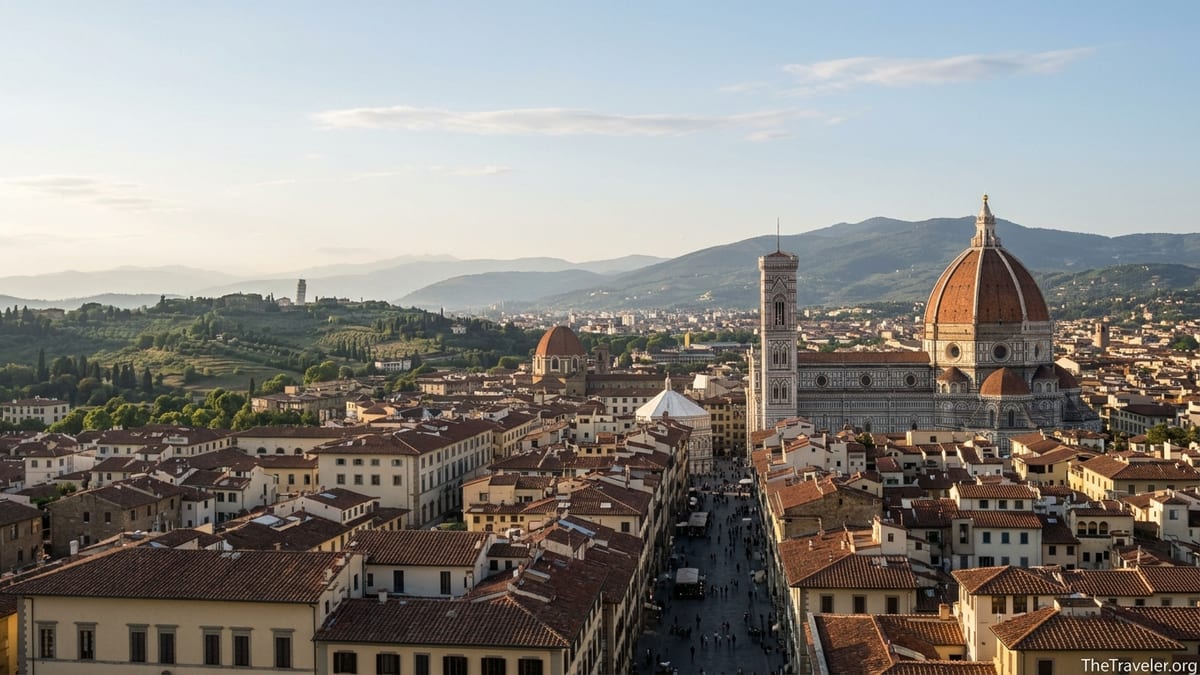
Florence’s Duomo, formally the Cathedral of Santa Maria del Fiore, makes a very different impression. Its terracotta dome designed by Filippo Brunelleschi dominates the city skyline, while the polychrome marble facade, Giotto’s Bell Tower and the Baptistery crowd together in the compact Piazza del Duomo. Here, the drama is about scale, artistic detail and engineering genius. Instead of a single tilted tower, you are standing inside a complete Gothic and Renaissance cityscape, layered with sculpture, frescoes and centuries of Florentine ambition.
For many travelers, Pisa delivers the “I can’t believe it really leans that much” moment, while Florence delivers the “I had no idea it was this huge and intricate” reaction. Which of those emotional beats matters more to you is a good starting point in deciding where to focus your time.
In practice, you do not have to choose only one, but time, budgets and energy levels are limited. Comparing what you actually do, see and feel at each site can help you prioritize, especially on tighter itineraries where adding one more stop might mean cutting into valuable hours elsewhere in Tuscany.
What the Experience Feels Like on the Ground
Arriving at the Leaning Tower of Pisa, the first impression is how compact and legible the site is. Piazza dei Miracoli is essentially a large grassy rectangle ringed by the Tower, the Cathedral, the Baptistery and the Camposanto cemetery. You can walk from one monument to another in a couple of minutes, and there are clear sightlines from almost everywhere. This makes it easy to capture the classic postcard photos from multiple angles in a short amount of time, even if you never climb the tower itself.
Climbing the tower is a sensory experience unlike most other bell towers in Europe. The spiral staircase has 294 steps and you feel the tilt in your body as you ascend, with your weight subtly shifting to one side on certain sections. Many visitors report a slight sense of disorientation as their inner balance adjusts. At the top, the viewing platform gives a 360-degree view over the rooftops of Pisa and the patchwork of fields beyond; the panorama is pleasant rather than dramatic, but the memory most people carry away is the feeling of having walked inside the famously leaning structure.
Florence’s Duomo complex, by contrast, can feel overwhelming on first arrival. Piazza del Duomo is typically crowded from early morning until late evening, and the buildings rise very close to one another. If you choose to climb Brunelleschi’s Dome, you will tackle 463 narrow steps within the double-shell structure of the cupola. Tickets are timed, and the climb includes walkways that bring you close to the vast Last Judgment frescoes painted on the interior of the dome. You can look down into the nave far below before continuing up to the lantern terrace for one of the most celebrated views in Italy.
That view from the top of the dome, with the red roofs of Florence spreading to the surrounding hills and Giotto’s Bell Tower almost at eye level, often feels more immersive than Pisa’s panorama. Where Pisa’s tower gives you the thrill of defying gravity, Florence’s dome climb gives you the sense of standing at the heart of Renaissance Europe, surrounded by the city that financed and inspired masters like Michelangelo and Leonardo.
History and Architecture: Simple Wonder vs Layered Story
The Leaning Tower of Pisa began to tilt soon after construction started in the 12th century because of soft, unstable soil beneath its foundations. Over the centuries, engineers tried to correct or stabilize the lean, and in the late 20th century major stabilization works reduced the tilt slightly to keep the tower safe for visitors. The result is a structure that is historically interesting but architecturally straightforward: an elegant Romanesque campanile whose fame rests largely on physics gone wrong.
For travelers who enjoy a clear, easy-to-grasp narrative, this simplicity is powerful. Guides often explain how the tower continued to sink as additional floors were added, and how the builders subtly adjusted the upper levels in an attempt to compensate, giving the tower a slight curve. Standing at its base, you can see with your own eyes how small engineering decisions and soil conditions created a global icon. It is a story you can retell at dinner in a couple of sentences, which is part of its popular appeal.
Florence’s Duomo offers a more layered and demanding story. The cathedral itself was begun in the late 13th century, but the enormous octagonal dome was left unresolved for decades because no one could figure out how to build it without traditional wooden centering. Brunelleschi’s solution, developed in the early 15th century, involved a double-shell dome with herringbone brickwork and an ingenious internal support system. When you climb the dome today, you are literally inside that engineering experiment, walking between its shells and seeing details of the structure at close range.
This complexity tends to resonate deeply with travelers who are interested in art, architecture or history beyond the surface. Many visitors combine the dome climb with time in the Opera del Duomo Museum, where they can see the original facade sculptures, Ghiberti’s Baptistery doors and models of the dome. The impact here is cumulative: it is not one simple story but an accumulation of artistic and technical breakthroughs that define Florence’s role in the Renaissance.
Time, Tickets and Practical Logistics
From a logistics perspective, the Leaning Tower of Pisa is the more contained commitment. Standard tickets to climb the tower itself typically cost around 20 euros in 2026, with a broader Piazza dei Miracoli combination ticket around the mid-20 euro range that includes the Cathedral, Baptistery and Camposanto. Time slots for the tower are tightly controlled, and the climb usually takes about 30 minutes, leaving you another hour or so to explore the rest of the complex at a relaxed pace.
Many travelers fold Pisa into a half-day trip. For example, if you are staying in Florence, regional trains from Firenze S. M. Novella to Pisa Centrale can cost in the range of 10 to 15 US dollars one way, with journey times of about one hour. From Pisa Centrale, it is a 20 to 25 minute walk or a short local bus ride to Piazza dei Miracoli. This makes it feasible to leave Florence mid-morning, visit the tower and surrounding monuments, and be back in Florence by late afternoon for dinner.
Florence’s Duomo complex requires more planning. In 2026, the main ticket products managed by the Opera di Santa Maria del Fiore include timed entry to Brunelleschi’s Dome bundled with multi-day passes to the Baptistery, Giotto’s Bell Tower, cathedral crypt and the Opera del Duomo Museum. Official dome climb tickets are commonly priced around 30 euros, while more comprehensive passes that add other monuments can cost noticeably more, especially through third-party vendors that include guided tours and priority entry.
Because dome tickets often sell out days in advance during peak months, travelers who decide at the last minute may find only higher-priced guided tour options left. A typical small-group tour that includes the dome climb and a cathedral visit, as of mid-2026, might range from 40 to 70 euros per person, depending on group size and inclusions. The full experience, from meeting your guide to stepping back into the piazza after the climb, can easily take two to three hours, and that is without adding time for the museum or bell tower.
Crowds, Atmosphere and Stress Levels
Both sites draw heavy crowds, but the way those crowds feel is quite different. Pisa’s Piazza dei Miracoli has ample open space, so even when thousands of people are on the lawns posing for the classic “holding up the tower” photos, you can usually find a quiet corner near the Camposanto walls or behind the Baptistery to rest. The vibe is light and playful, with street vendors selling souvenirs and plenty of families taking turns with the camera.
The most stressful part of Pisa is often the ticketing and time slot management rather than the crowds themselves. On busy days, same-day tickets to climb the tower can sell out, and queues can form at security checkpoints. Travelers who pre-book a specific slot and arrive 20 to 30 minutes early usually find the experience manageable, with the main intensity coming from the stairs and the slight vertigo of the lean rather than from crush-level crowds.
Florence’s Duomo area, on the other hand, can feel crowded from early morning until late night, especially in high season. The narrow streets that feed into Piazza del Duomo funnel tour groups, independent travelers and local foot traffic into a relatively small space. Even if you are only trying to take photos of the facade, it can take time to navigate through the flow of people. Inside the cathedral, lines for free entry can reach an hour or more on certain afternoons, and security procedures add to the wait.
Timed dome tickets help regulate the numbers on the stairs and at the summit, but the climb is still intense: narrow passages, two-way traffic on certain stretches and the need for steady footing on worn stone steps. Travelers prone to claustrophobia or discomfort in tight spaces sometimes find this aspect challenging. When it all comes together, however, the sense of emerging out onto the viewing platform above Florence after the confined climb can feel cathartic, in a way that many visitors describe as one of the standout memories of their trip.
Which Landmark Works Best for Different Kinds of Travelers
If you are traveling with children or family members who are less interested in detailed art history, Pisa often delivers faster gratification. Kids quickly understand what makes the tower special, and the grassy fields are an easy place for them to move around safely while adults take photos. A family of four might choose to buy tower tickets for only the older children and one parent, for example, while the other adult relaxes on the lawn with younger siblings and explores the Cathedral interior when energy allows.
Florence’s Duomo complex tends to reward travelers who enjoy deeper cultural immersion. Visiting the museum to see the original sculptures from the facade, listening to a guide explain the dome’s construction, then climbing up to look across the city that funded the Renaissance creates a narrative that can shape your entire understanding of Tuscany. Solo travelers, couples and small groups with a strong interest in art and architecture often describe the Duomo as the emotional and intellectual highlight of their time in Florence.
For photographers, both landmarks offer rich possibilities but in different ways. The Leaning Tower is an exercise in playful composition: finding angles that emphasize the tilt, pairing the tower with the Baptistery or Cathedral in the frame, or capturing the sea of visitors striking comic poses. Florence’s Duomo rewards patience and attention to detail: close-ups of marble inlays, the geometry of the dome’s ribs against an evening sky, or sunrise views from a nearby terrace where the cathedral becomes the center of a broader cityscape.
Travelers on compressed itineraries might realistically have to choose. Someone with only one full day in Florence, for example, could easily spend a morning inside the Duomo complex, climb either the dome or Giotto’s Bell Tower, and still have time for the Uffizi or the Accademia. Adding a separate half-day trip to Pisa on that same day would risk turning a potentially rich experience into a rushed checklist. In those cases, the more layered and central role of the Duomo in Florence’s story often tips the balance in its favor.
Costs, Value and Long-Term Memories
Purely in terms of ticket prices, the Leaning Tower of Pisa and Florence’s dome climb are in a similar bracket, though Florence’s more comprehensive passes and guided experiences can quickly push costs higher. A traveler who pre-books a straightforward Pisa tower ticket with a basic combination pass might spend around 25 to 30 euros to see the main monuments in the square. By contrast, someone purchasing a dome climb plus broader Duomo complex access and a guided tour in Florence could easily spend the equivalent of 50 to 80 euros or more, especially via private operators.
When travelers look back on their trips, however, value is usually measured less in euros and more in emotional resonance. Many people remember Pisa as a fun, slightly surreal episode: the tilted staircase, the obligatory perspective photos, the bright white marble glowing against the deep green grass. It is often the site they mention when showing quick snapshots to friends: an unmistakable icon that needs no explanation.
Memories of Florence’s Duomo tend to be deeper and more varied. Some remember the feeling of craning their necks inside the nave to take in the frescoed dome, others recall the moment the city opened up beneath them at the top of the climb, and still others talk about details from the museum or the Baptistery mosaics that unexpectedly moved them. The Duomo is interwoven with everything else in Florence: you see it from rooftop bars, from the far side of the Arno and from hilltop viewpoints like Piazzale Michelangelo. That constant presence often turns it into a recurring character in the story of the trip, rather than a single episode.
For that reason, travelers who are choosing where to invest more money in premium experiences, such as small-group guided tours or skip-the-line passes, often find that doing so around the Florence Duomo complex yields more layered benefits. A well-timed dome climb at golden hour, combined with context from a knowledgeable guide, can color your perception of the entire city. Pisa, with its more self-contained and quickly grasped narrative, may not always need the same level of investment to feel complete.
The Takeaway
So which Tuscany landmark leaves a bigger impression: the Leaning Tower of Pisa or Florence’s Duomo? In broad strokes, Pisa offers a concentrated burst of delight and curiosity, while Florence’s Duomo offers a slower-burning but ultimately deeper sense of awe. The tower’s tilted silhouette is unforgettable, but the Duomo’s dome, facade and surrounding monuments have a way of weaving themselves into every day you spend in Florence.
If your itinerary and budget allow, seeing both is ideal. You could spend a relaxed half-day in Pisa, enjoying the novelty and elegance of the tower and its square, then devote a more substantial block of time in Florence to the Duomo complex, climbing either the dome or Giotto’s Bell Tower and exploring the museum. If you must choose only one, travelers seeking a quick, accessible thrill and straightforward bragging rights might lean toward Pisa, while those hungry for richer historical context, transformative city views and a landmark that shapes the entire urban experience are likely to find that Florence’s Duomo leaves the more enduring mark.
In the end, the bigger impression often comes from how you connect the place to your own interests. A structural engineer might never forget the feel of Pisa’s leaning staircase underfoot. A painter or architect may be haunted for years by the geometry and color of Brunelleschi’s dome at sunset. Tuscany offers both stories within an easy train ride of each other, inviting you to decide which one will anchor your own memory of the region.
FAQ
Q1. If I only have one day in Tuscany, should I prioritize the Leaning Tower of Pisa or Florence’s Duomo?
If you have just one day, Florence’s Duomo usually offers a richer overall experience, as it is embedded in a city full of museums, markets, churches and viewpoints that can fill the rest of your time.
Q2. Which climb is more challenging, the Leaning Tower of Pisa or Brunelleschi’s Dome?
Brunelleschi’s Dome is generally more demanding, with about 463 narrow steps and some tight sections, while the Leaning Tower has fewer steps and a shorter climb, though the tilt can feel disorienting.
Q3. Can I easily visit both the Leaning Tower of Pisa and Florence’s Duomo on the same day?
It is possible but can feel rushed. You could visit Pisa in the morning and return to Florence for a late-afternoon Duomo visit, but you would need careful timing and advance reservations for any climbs.
Q4. Which site is better for travelers with limited mobility?
Neither tower nor dome climb is ideal for limited mobility, but Pisa’s Piazza dei Miracoli offers more level outdoor space and good exterior views, while Florence’s Duomo interior can be appreciated without climbing.
Q5. Are tickets more expensive for the Leaning Tower of Pisa or Florence’s Duomo?
Basic tower tickets and dome climb tickets are broadly comparable in price, but Florence’s multi-monument passes and guided tours can cost significantly more than a simple Pisa visit.
Q6. Where will I get better panoramic city views?
Florence’s dome offers more dramatic city views, with terracotta roofs and surrounding hills, while Pisa’s tower looks out over a smaller, flatter city and nearby countryside.
Q7. Is Pisa worth visiting if I do not climb the Leaning Tower?
Yes. You can still enjoy the visual impact of the tower, photograph it from multiple angles and explore the Cathedral, Baptistery and Camposanto even without climbing.
Q8. Do I need to book tickets in advance for both landmarks?
Advance booking is strongly recommended for both the Leaning Tower and Brunelleschi’s Dome, especially from spring through autumn, as same-day time slots can sell out.
Q9. Which landmark is better for children and families?
Pisa is often easier with children due to its open lawns, simple story and more compact visit, while Florence’s Duomo can be more rewarding for older kids and teens interested in history and art.
Q10. If I am mainly interested in Renaissance art and architecture, which should I choose?
Florence’s Duomo is the stronger choice for Renaissance enthusiasts, especially when combined with the Opera del Duomo Museum, nearby churches and the city’s major galleries.