


The Leaning Tower of Pisa is one of Europe’s most recognisable landmarks, yet many travellers reach Piazza dei Miracoli only to be swallowed by queues, confused ticket rules, and tight time slots. With timed-entry climbs, crowd surges from tour buses, and strict security checks, a little planning makes the difference between an hour stuck in line and a relaxed visit with space to enjoy the view. Here is how to get the best experience at the Leaning Tower of Pisa without long waits, using up-to-date, real-world advice.
Get the latest updates straight to your inbox!
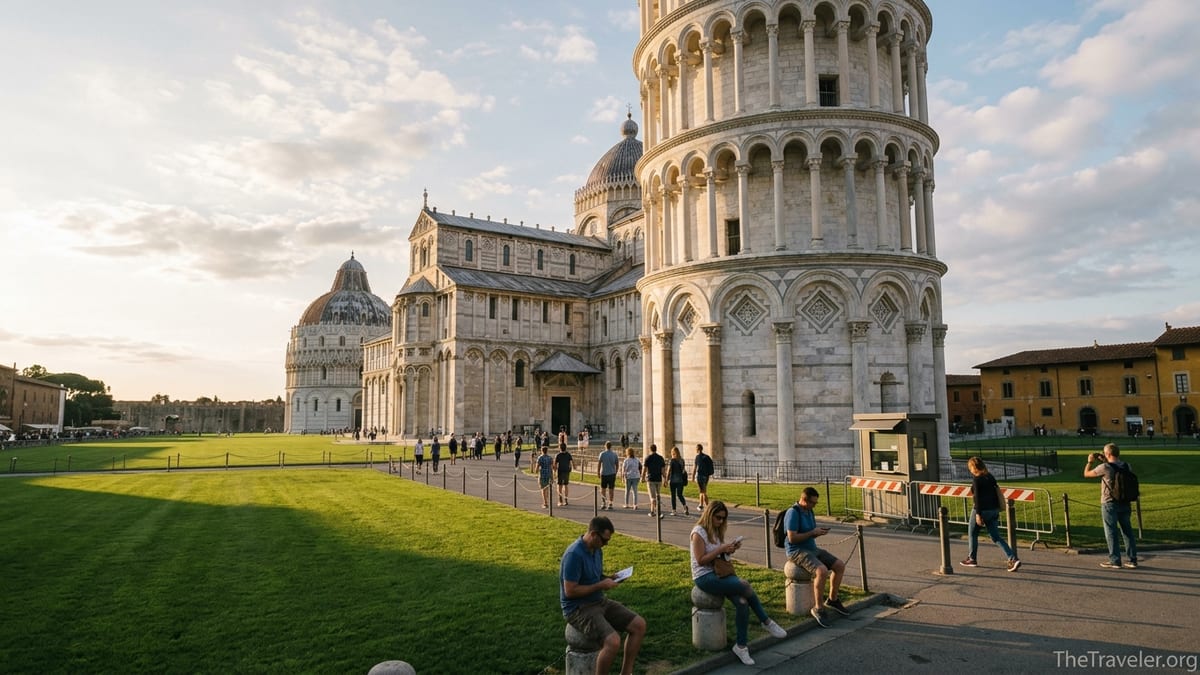
Know How the Tower Visit Actually Works
The Leaning Tower is not a casual walk-up attraction. Visitor numbers are tightly controlled both for safety and preservation. Only a limited group is allowed inside at any one time, and each group is given about 30 minutes to climb the 251 steps, explore the viewing platform and descend. Security staff run the visit like an airport checkpoint: backpacks and larger bags must be left in free lockers near the ticket office, and only cameras, phones and small items that fit your pockets can go up with you. This entire process creates bottlenecks if you arrive at a popular hour without a ticket.
Entry to the tower is always by timed ticket. Your ticket shows a specific start time, and you are expected to be at the base of the tower at least 10 to 15 minutes before that to clear security. If you arrive late, staff may move you to a later slot if there is room, but in peak months that often means losing your original time and waiting again. Understanding this system is key to avoiding frustration: you do not beat the crowds by rushing the entrance, but by choosing the right time and having a confirmed slot in hand.
Most visitors also underestimate how compact Piazza dei Miracoli is. The Cathedral, Baptistery, Camposanto cemetery and tower all sit within the same walled complex, and tour groups move through in waves. A morning that looks quiet at 8:30 can feel packed by 10:30 when multiple coaches arrive from Florence and the Tuscan coast. Planning your tower climb to fall just before or just after these waves will dramatically cut waiting time, both at security and on the stairs themselves.
Because the tower is part of a working religious complex, hours can change for special services or ceremonies. In practice, that means some dates see slightly shorter opening hours, or temporary closures of nearby monuments. Schedules are generally announced in advance, but staff on the ground always have the final word. Build a little flexibility into your plan, especially if you are visiting around major Catholic holidays in December or Easter week.
Choose the Right Time of Day and Year
The biggest crowd-control decision you make is when to visit. In 2026, regular opening hours for the Leaning Tower typically run from 9:00 in the morning to 8:00 in the evening, with extended hours to around 10:00 on busy summer weekends. Early morning and late evening are consistently the quietest times, especially on weekdays from Tuesday to Thursday. If you book a climb between 9:00 and 9:30, you will often share the stairs with a relatively small, relaxed group, while the grass and surrounding square are still fairly empty.
By contrast, the most crowded hours tend to be late morning to mid-afternoon, roughly 10:30 to 15:30. This is when bus tours from Florence and Rome, cruise excursions from Livorno and La Spezia, and independent day trippers all converge. On a sunny Saturday in June or July, it is normal to see long lines stretching from the ticket offices and a constant flow of people posing with the tower. If you can only visit during these peak hours, having a pre-booked timed ticket is almost essential to avoid an hour or more of waiting for the next available slot.
Season also matters. July and August bring the highest visitor numbers. The combination of heat radiating off the white marble and crowds clustered on the stairs can make a climb in mid-afternoon feel exhausting. Late spring (May to early June) and early autumn (September and early October) are more comfortable, and weekdays outside school holidays are noticeably calmer. Winter has shorter daylight hours and some days with reduced opening hours, but crowds thin out significantly. Travellers in January or February often report being able to book same-day tower entries and enjoying almost empty lawns.
A strong strategy is to combine timing with the rest of your itinerary. If you are staying overnight in Pisa, aim for the first climb of the day, then explore the Cathedral and Baptistery before day-trip crowds arrive. If you are coming as a side trip from Florence, consider a late-afternoon or evening climb, such as a 18:30 or 19:00 slot in summer, when many tour groups have already left. The marble still glows in soft light, and lines at the ticket office tend to be shorter.
Book Smart: Tickets, Bundles and What to Skip
To avoid long waits entirely, book your Leaning Tower ticket in advance through the official booking channels or a reputable ticketing partner that issues timed-entry vouchers. As of 2026, a standard adult ticket to climb the tower is typically in the range of a few dozen euros, more expensive than the other monuments in the square. Combined tickets that include the Cathedral, Baptistery and Camposanto add good value if you plan to spend several hours on-site. Families often choose a tower-plus-monuments bundle for convenience rather than buying each ticket separately at the last minute.
When booking, pay close attention to what is and is not included. A common real-world scenario is a traveller who buys a general “Pisa monuments” ticket from a reseller, assuming it covers the tower, only to arrive and discover the climb is extra and already sold out for the time they need. For a Florence-based day trip where your train back is fixed, you should secure a dedicated tower climb time first, then build other visits around it. If budget is tight or you are wary of heights, you can skip the tower climb altogether and still have a rich experience with a ticket that covers only the Cathedral, Baptistery and Camposanto, all of which usually have more flexible entry.
Third-party “skip the line” offers can be helpful, but they do not mean you bypass security or the timed-ticket system. In practice, you are paying someone else to handle the booking for a fixed slot, often bundled with a guide or transport from another city. For example, a half-day tour from Florence might include round-trip bus travel, a 30- to 45-minute guided walk through the square and a pre-reserved tower climb, allowing you to go straight to security instead of queuing at the ticket office. If you are short on time or nervous about navigating Italian rail and schedules, this arrangement can be worth the extra cost.
Travellers who prefer flexibility may choose to buy tickets on arrival. In shoulder seasons or on quiet weekdays, this can work, but you should still visit the ticket office as soon as you reach Piazza dei Miracoli to secure the next available tower slot. Staff will assign you a time, which might be 30 to 90 minutes later. Use that window to explore the Cathedral or Camposanto instead of waiting idly. This simple adjustment often turns what could feel like a delay into a structured, efficient visit.
Beat the Crowds in the Square, Not Just on the Stairs
A good Leaning Tower experience is about more than climbing the tower itself. Piazza dei Miracoli is a UNESCO World Heritage Site that concentrates some of medieval Italy’s finest architecture in one walled area. Yet many visitors rush in, queue for the tower, snap their obligatory “holding it up” photo and leave, never seeing the Baptistery’s acoustics or the Camposanto’s fresco fragments. You can turn crowd management into a richer visit by thinking of the square as a circuit and timing each stop to avoid bottlenecks.
One practical sequence that works well on a busy summer day is to enter the square as early as possible, walk straight past the souvenir stalls and photographers, and head to the ticket offices near the Cathedral. Secure your tower climb time first. If your slot is more than an hour away, visit the Baptistery next, ideally timing your visit for one of the short acoustic demonstrations that staff sometimes give, when a single voice fills the circular space. After that, step into the Cathedral, where queues move quickly, and leave Camposanto for last, when heat and crowds outside are at their worst but the cloistered walkways remain cool and quiet.
The grassy areas around the monuments are iconic in photographs, but local rules on using the lawns vary and can change. In recent years, visitors have been directed to stay off some sections of grass to protect the site, especially when it is wet. Obey the posted signs and instructions from wardens, and resist the temptation to follow others if they wander into closed-off zones for photos. Fines are possible, and in peak hours staff are quick to intervene. To get an uncluttered view without trespassing, walk to the far end of the square near Camposanto and look back toward the tower and Cathedral; this angle is often less crowded.
Food and drink choices can also affect your experience. The streets just outside the square’s walls are lined with quick-service pizzerias and souvenir stands offering fast, inexpensive meals, but they are designed to turn over coach groups, not to provide a slow, comfortable break. If you have more time, consider walking 10 to 15 minutes into the historic center toward the Arno River, where local cafés and trattorias usually have a calmer atmosphere and more authentic menus. You can then return to the square for an evening stroll and photographs once the daytime crush has thinned.
Navigate Security, Health Limits and Practical Details
Once your time slot arrives, your speed through security determines how much of your 30-minute window you actually spend on the tower. Before getting in line, stop at the bag check near the ticket office and place backpacks, shoulder bags and larger camera packs in the free lockers. Keeping only your ticket, phone and a small camera avoids backtracking at the entrance. Many travellers lose 10 minutes, and sometimes their entire slot, by reaching the tower door with a bag and being turned back to the lockers when the group is already being admitted.
Climbing the tower is moderately demanding. The 251 stone steps are worn smooth by centuries of use and can feel slippery, particularly on wet days. The tilt of the tower means that on some parts of the spiral staircase you lean noticeably to one side, which can feel disorienting. Anyone with serious mobility issues, vertigo, heart problems or respiratory conditions should think carefully before booking. Entry rules typically restrict very young children, and under-18s must be accompanied by an adult. If you are travelling with a baby or toddler, plan for one adult to remain in the square while the other climbs, then switch.
At the top, the viewing platform is ringed by a stone balustrade. The height is roughly equivalent to a six-story building, and the lean is still very apparent. On windy days, sensitive visitors sometimes feel uneasy. To minimise crowding on the platform, staff control how long each group stays at the top, but there is usually time for a full circuit of photos and a pause to look out over Pisa’s red rooftops and surrounding countryside. To avoid jostling at the best viewpoints, let the first rush of your group move ahead and take a few moments to acclimatise near the stairs before circling.
Comfortable, closed-toe shoes with good grip are strongly recommended. This is not the place for smooth-soled sandals or high heels. In summer, bring a hat and water bottle for the wait outside, remembering that you will not carry large bottles up the tower itself. In shoulder seasons, a light jacket is useful, as the stone interior can feel cool even when the sun is warm. Weather rarely stops climbs entirely, but heavy rain can make the staircase treacherous, so check conditions on the day and be prepared for minor delays if staff slow the flow of visitors for safety.
Plan Your Transport and Time in Pisa
Many visitors experience Pisa as a quick detour, but your transport choices can either compress you into the worst crowds or let you sidestep them. Pisa Centrale railway station has frequent fast connections to Florence, Lucca and the Tuscan coast, making a self-planned train trip straightforward. From Pisa Centrale, you can walk to the tower in around 25 to 30 minutes through the historic center, or take a local bus or taxi. The walk is pleasant and offers a real sense of the city beyond the square. Travellers with luggage or limited time often opt for a taxi, which drops you near the northern entrance to Piazza dei Miracoli.
Pisa’s small international airport sits just south of the city and connects to Pisa Centrale by a short monorail or taxi ride. Some travellers arrive in the morning on a low-cost flight, leave their bags in station luggage storage, and spend half a day at the tower before moving on to Florence or the Cinque Terre. If you have a layover of six to eight hours, it is entirely feasible to visit the square without rushing, provided you pre-book a mid-morning or early-afternoon tower climb and allow generous time for airport security on your return.
Cruise passengers docking at Livorno or La Spezia typically reach Pisa on organised shore excursions. These buses often deliver large groups to the square between late morning and early afternoon, which is exactly when queues lengthen. If your ship’s schedule allows and you are comfortable arranging your own transport, consider taking a regional train instead and targeting an earlier arrival. Even arriving at 9:30 instead of 11:00 can mean the difference between walking straight into your time slot and waiting for the next available one.
If you decide to spend a night in Pisa, you gain access to the square at its quietest. After dinner, locals and a handful of visitors wander through Piazza dei Miracoli to admire the tower and Cathedral under floodlights. While the tower itself will be closed, there are virtually no lines, and you can take photographs from multiple angles without other travellers in every frame. Early risers can repeat the experience at sunrise, when the white marble slowly picks up color and the only people around are joggers and workers preparing for the day’s opening.
The Takeaway
Visiting the Leaning Tower of Pisa without long waits is less about secret shortcuts and more about informed choices. By understanding how the timed-entry system works, choosing early morning or late-evening slots, and securing your ticket before you arrive, you can move smoothly through security and spend your energy on the climb and the view instead of on queues. Aligning your tower visit with a thoughtful circuit of the Cathedral, Baptistery and Camposanto turns what might be a rushed photo stop into a meaningful half-day exploration of one of Europe’s great medieval ensembles.
Just as important is how you integrate Pisa into your wider trip. A little extra time in the city, a willingness to walk beyond the souvenir stalls, and realistic expectations about crowds all pay off. Whether you come for a layover, a day trip or an overnight stay, these practical strategies allow you to experience the Leaning Tower of Pisa at its best: not as a stressful box to tick, but as a remarkable piece of living history that you can appreciate without feeling hurried.
FAQ
Q1. Do I really need to book Leaning Tower of Pisa tickets in advance?
Booking in advance is strongly recommended, especially from late spring through early autumn and on weekends. Same-day tickets are sometimes available in low season or on quiet weekdays, but popular time slots in mid-morning and mid-afternoon often sell out. Having a timed ticket before you arrive lets you skip the ticket-office queue and go straight to security at your chosen time.
Q2. What is the best time of day to climb the Leaning Tower to avoid crowds?
The quietest times are usually early in the morning, around the first entries after opening, and late in the afternoon or early evening on days with extended hours. Mid-morning to mid-afternoon sees the heaviest crowds from tour buses and day trips. If you can choose freely, aim for a 9:00 to 10:00 slot or a climb after about 17:00 in summer.
Q3. How long does a visit to the Leaning Tower of Pisa take?
You should plan around 30 minutes for the tower itself, from the moment your group is admitted until you return to ground level. Add extra time for security checks and for storing and retrieving bags in the lockers. If you include the Cathedral, Baptistery and Camposanto, a relaxed visit to Piazza dei Miracoli easily fills two to three hours.
Q4. Can children climb the Leaning Tower, and are there age restrictions?
There are age and safety rules that restrict very young children from climbing the tower, and all minors must be accompanied by an adult. If you are travelling with a baby or toddler, expect that they will not be allowed on the stairs. Many families take turns, with one adult staying in the square with younger children while the other climbs with older ones.
Q5. What should I wear and bring for the climb?
Wear comfortable, closed-toe shoes with good grip, as the marble steps are worn and can be slippery. In summer, light clothing, sunscreen and a hat help with the heat while waiting outside. Bring only small items that fit in your pockets, such as a phone and compact camera, because backpacks and larger bags must be left in the free lockers before entering.
Q6. Is the Leaning Tower climb suitable for people with vertigo or mobility issues?
The climb involves a narrow spiral staircase, uneven steps and a noticeable sideways tilt, which can be challenging for anyone with vertigo, balance problems or limited mobility. There are no lifts, and resting spots are limited. If you have significant health concerns, you may prefer to enjoy the tower from the ground and focus on the Cathedral, Baptistery and Camposanto instead.
Q7. Can I visit the Cathedral and Baptistery without climbing the tower?
Yes. You can buy tickets that cover the Cathedral, Baptistery and Camposanto without including the tower climb. This option is less expensive and usually more flexible in terms of entry times. Many visitors who dislike heights, or are travelling with small children, choose to skip the tower and still find plenty to enjoy in the rest of Piazza dei Miracoli.
Q8. How far is the Leaning Tower from Pisa Centrale train station?
The walk from Pisa Centrale station to the Leaning Tower takes about 25 to 30 minutes at a moderate pace, passing through the historic center and across the Arno River. Alternatively, you can take a local bus or a taxi for a faster trip. If you are carrying luggage or have limited time, a taxi is the most convenient option.
Q9. Are there good places to eat near Piazza dei Miracoli?
There are many cafés and snack bars just outside the square, offering quick meals aimed at tour groups. For a more relaxed and local experience, walk 10 to 15 minutes toward the city center and the Arno, where you will find a wider choice of trattorias, wine bars and gelaterias. Planning a proper meal away from the square can make your day in Pisa feel less rushed.
Q10. Is it worth staying overnight in Pisa instead of visiting on a day trip?
Staying overnight changes the experience significantly. In the evening and early morning, the square is far quieter, allowing you to enjoy the tower and Cathedral with minimal crowds and softer light for photography. If your itinerary allows, one night in Pisa lets you combine a relaxed tower visit with a stroll through the historic center, rather than squeezing everything into a rushed day trip.