


I almost skipped Paraga Beach. On paper it sounded like a louder, pricier version of what I had already planned in Mykonos: a small cove squeezed between famous party spots, crowded with beach clubs and thumping music. I had penciled in Ornos and Elia instead and told myself I was not the “Mykonos beach club” type. But travel has a way of rewarding small detours. The day I finally gave Paraga a chance, it quietly became the beach I kept measuring all the others against.
Get the latest updates straight to your inbox!
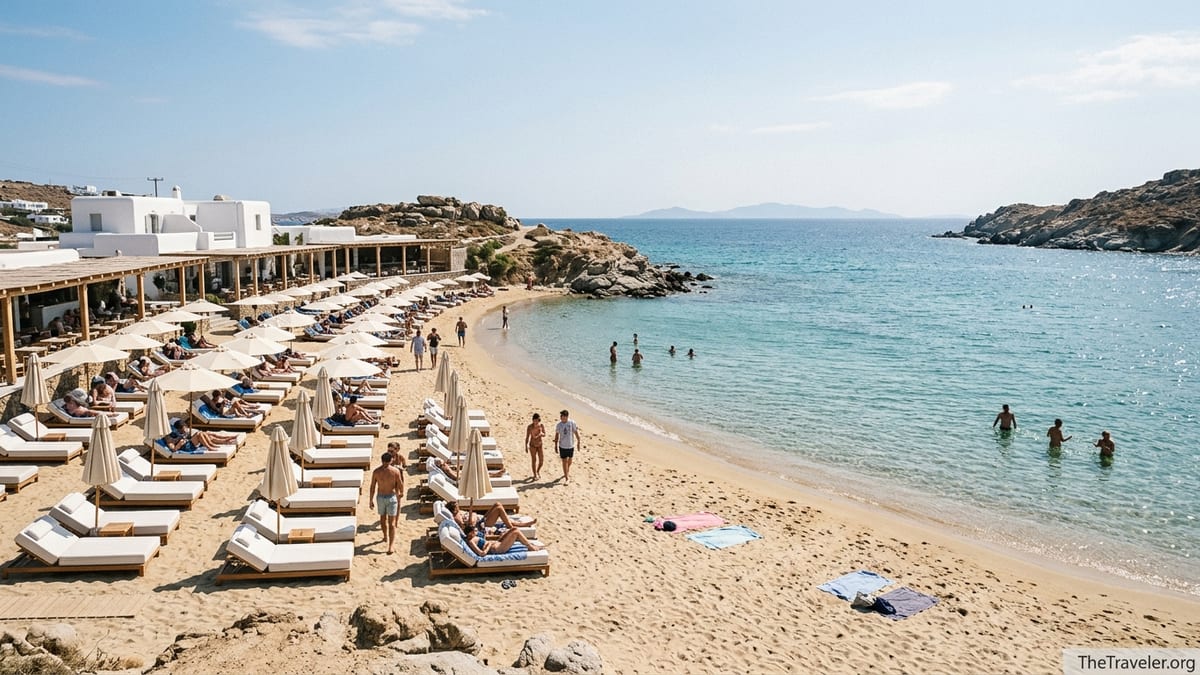
First Impressions: More Than “Just Another Party Beach”
Paraga sits on the south coast of Mykonos, roughly 6 kilometers from Mykonos Town, in the middle of a stretch of golden sand that links Platis Gialos and Paradise Beach. On maps, it is often lumped in with Paradise’s party reputation, which is exactly why so many travelers, myself included, initially overlook it. Yet the moment you step off the bus at the little mini market above the sand, you feel that Paraga has a split personality in the best possible way: half easygoing cove, half high-energy beach club scene.
From the bus stop, a short sandy path leads down between low shrubs onto a crescent of beach where water shifts from pale turquoise at the shore to a deeper cobalt further out. Rocky headlands frame both ends, and on a clear day you can see the outline of Delos on the horizon. In early season, say late May or early June, the first thing you notice is not the music but the silence between tracks, the clink of glasses, and the soft slap of waves on the sand. It feels more like a sophisticated seaside village than the all-day party some online comments might make you fear.
Trip-planning sites often describe Paraga as “small and overcommercialized,” and it is true that much of the sand is lined with neat rows of sunbeds. At high summer, those beds fill up by late morning. But what those quick takes often miss is the way the beach is laid out: one side closer to the big-name clubs and one side that feels more like classic Greece, where a few rows of sunbeds share space with people who simply drop a towel on the sand. If you only skim a map, you miss that nuance. On the ground, it is the difference between writing Paraga off entirely and realizing you can tune the experience to exactly how social, quiet, or indulgent you want your day to be.
Finding Your Corner: Quiet Sand or Beach Club Energy
Paraga is effectively two coves in one. On the left as you face the sea, sunbeds from spots like SantAnna and Kalua stretch across much of the sand. Here, the soundtrack is upbeat house music, and servers weave between loungers delivering Aperol spritzes, iced coffees, and plates of grilled octopus. On peak-season afternoons, especially in July and August, the volume rises as people gather around the beach bars and the mood shifts toward an informal party that can roll into sunset.
Walk to the other side of the bay and the tone changes. The music fades and you are more likely to hear Greek spoken at simple tavernas and see families paddling in shallow water. In recent years, classic places such as Tasos Taverna, just off the sand, have become favorites precisely because they feel like the Greece many visitors are hoping still exists: wooden chairs, paper tablecloths, carafes of local wine, and grilled fish priced by the kilo rather than by the mood of the DJ. This pocket of Paraga feels worlds apart from Paradise Beach next door, even though you can reach Paradise on foot along the rocky path in about 10 minutes.
Having both personalities in one compact beach is what makes Paraga such a smart base for a Mykonos day. You might start with a simple morning swim and a coffee at a quieter café, migrate to hired loungers when the sun is high, and then decide on a whim to check out the late-afternoon energy at a beach club. Or you might do the reverse: settle into the club scene for the bulk of the day, then escape to a low-key taverna for dinner when the music at Paradise or Super Paradise kicks into an altogether louder gear.
What a Day at Paraga Actually Costs
Paraga is not a budget beach, but it can be more manageable than some Mykonos hotspots if you know what to expect. Recent traveler reports in 2025 and early 2026 suggest that basic pairs of sunbeds with an umbrella on the quieter side of the beach often run in the region of 40 to 60 euros for two people in high season, sometimes less in May or late September. At the more upscale clubs, front-row loungers and “premium” spots can easily climb above 100 euros per pair, with minimum spend requirements attached for food and drinks.
Sticker shock is real in Mykonos, so it helps to think in terms of half-day and full-day choices. For example, you might reserve standard loungers at SantAnna or Kalua and treat it as your “splurge day,” knowing your bill for two loungers, lunch, and a few drinks might comfortably land north of 150 euros for two. On another day, you could simply bring towels, claim a free patch of sand near the rocks, and treat the beach clubs as occasional service stations where you step up to the bar for a single cold beer or iced coffee rather than occupying a bed.
Food ranges widely in price. A simple Greek salad and a plate of grilled sardines at a taverna behind the beach might come in somewhere around 18 to 25 euros per person without drinks, while a sushi platter or seafood tower at a high-end restaurant attached to a club may be several times that. Many visitors mix the two: an indulgent lunch with a view one day, then gyros from a snack bar or an early dinner back in Mykonos Town the next to balance their budget.
Transportation also adds up if you are not paying attention. Public buses from the Fabrika terminal in Mykonos Town run frequently in season and typically cost only a few euros each way. Taxis, on the other hand, can be surprisingly expensive on the island, especially at night or if ordered via a private transfer service. Some beach clubs offer complimentary or fixed-price shuttle services from town when you reserve sunbeds, which can represent better value than a metered cab. Parking in the area has also crept upward, with recent visitors noting fees of around 5 to 15 euros for all-day parking in private lots near the sand.
Getting There: Buses, Boats, Walks and What Actually Works
On a map, Paraga’s location makes it one of the most accessible beaches on Mykonos without a car. In practice, your best option depends on your timing and tolerance for crowds. During the main season, buses from Mykonos Town’s Fabrika Square run roughly every 30 minutes during the day to the Paraga area, reaching the beach in about 15 minutes. In busier months, queues can be long around midday, so arriving earlier in the morning or later in the afternoon can make the journey smoother.
If you are staying in Platis Gialos or Ornos, the small water-taxi boats that hop between beaches along the south coast are not only scenic but also efficient. For a fixed per-person price, often around 20 euros for a hop-on, hop-off day ticket, you can move between Ornos, Platis Gialos, Paraga, Paradise, Super Paradise, Agrari, and Elia. That means you can start your day on a quieter stretch of sand and glide over to Paraga for lunch and an afternoon swim, then continue onward to Paradise if you decide you do want a louder party later.
For walkers, Paraga links beautifully with neighboring beaches via coastal paths. One of the most rewarding short walks on the island traces the shoreline between Paraga and Platis Gialos, passing Agia Anna and a sequence of rocky outcrops and tiny coves. Another popular mini-hike is the 10-minute path from Paraga to Paradise Beach, where the terrain is rocky but manageable in sandals with good grip. If you attempt either route in peak summer heat, start early, carry water, and treat them as leisurely strolls rather than speed walks.
Driving is possible but comes with caveats. The road that drops down to the beach is narrow, and parking, while available, fills quickly when the clubs are busy. Some lots are free for customers of particular tavernas or clubs, while others charge a daily flat fee. For many visitors staying in or near Mykonos Town, the bus-and-boat combination ends up being easier and no slower once you account for time spent searching for a parking spot and navigating the tight coastal roads.
The Beach Clubs: How They Actually Work
Much of Paraga’s reputation, good and bad, revolves around its beach clubs. Names like SantAnna, Kalua, and Scorpios appear often in travel magazines and social media posts, which can give the impression that the entire beach is one giant roped-off VIP zone. The reality is more nuanced. These clubs occupy prime frontage along parts of the sand and offer comfortable loungers, attentive service, pools, and often live DJs, but they coexist with open public sections of beach where you are free to swim and lay a towel without paying a cover charge.
At most clubs, you reserve sunbeds either online or by calling ahead, particularly in July and August or on weekends. Prices vary by row and by date, with front-row loungers near the water commanding the highest minimum spend. You typically pay for the bed rental itself or commit to a set minimum consumption amount per person that covers food and drinks. If you arrive without a reservation on a busy day, expect to be offered only back-row options or told there is no availability, especially at the most in-demand places.
One helpful detail for travelers unsure about the commitment: in many cases you can still enjoy the atmosphere of a club without paying for a lounger. You might, for example, visit the restaurant area of a place like SantAnna for lunch at a regular table, or step up to the bar for a drink while keeping your main base on the public part of the sand. For sunset at Scorpios, the sought-after loungers and tables often require bookings, but you can sometimes still access standing areas or less formal seating if you arrive early in the afternoon on a shoulder season day.
Clubs in Mykonos generally wrap up their daytime operations between around 10 p.m. and 1 a.m., depending on the venue and season. The busiest time at Paraga tends to be late afternoon into early evening when DJ sets pick up and people migrate from the water’s edge toward the bars. If that atmosphere does not appeal, planning your Paraga day from early morning until mid-afternoon lets you enjoy the clear water and calmer soundscape before the volume rises.
Beyond the Loungers: Swimming, Walks and Nearby Coves
While it is easy to focus on loungers and cocktails, Paraga rewards those who treat it like a beach first and a social scene second. The water here is typically calm and clear, sheltered by the headland that separates it from Paradise Beach. Entering the sea, you may find some rocks underfoot near the shoreline, so water shoes can be helpful if you have sensitive feet. Once you step past the first few meters, the seafloor becomes mostly sandy, offering good conditions for comfortable swimming.
Families often gravitate to the side of the beach where the shallows extend farther, creating a kind of informal paddling pool for children with supervision. Those looking for more space sometimes continue on to Agia Anna, a small adjacent cove that feels quieter even in high season. You can reach Agia Anna by walking over the rocks or following the path that traces the coastline, passing a cluster of seafood restaurants perched just above the water.
For a low-key afternoon, you might combine Paraga with a mini coastal hike. One popular route starts at Paraga, loops through Agia Anna, continues on to Platis Gialos, and then back along the same path, with swim stops at each beach. Along the way you pass small chapels, whitewashed buildings, and classic Cycladic terraces with bougainvillea spilling over stone walls. It is not a wilderness trek, but it is a reminder that even on one of Greece’s most glamorous islands, simple moments like watching fishing boats bob offshore still exist between the designer-label storefronts.
As day slides toward evening, Paraga’s rock formations also create natural viewing points. Scramble a short way onto the low promontories at either end of the bay and you get a wider perspective on the south coast of Mykonos, with the outlines of other beaches tracing the shoreline. Many travelers walk over toward Scorpios or similar venues for curated sunset experiences, but you can also simply sit on the rocks with a takeaway coffee or bottle of water and watch the sky soften to orange on your own terms.
When to Go: Timing Your Visit to Fit Your Style
Choosing the right time to experience Paraga can make the difference between falling in love with it and vowing never to return. In shoulder months like late May, early June, and late September, the beach strikes a sweet balance: most venues are open, buses and water taxis operate reliably, but crowds are still manageable and sunbeds are easier to book last-minute. Water temperatures in these months are generally pleasant for swimming, especially by afternoon, and the midday sun feels strong without being stifling.
July and August bring a different rhythm. On clear, windy days the Aegean light over Paraga is electric, but so too are the crowds. Expect loungers to book out in advance at popular clubs, bus queues to snake down the street in Mykonos Town around late morning, and parking lots to fill quickly. If your idea of a perfect beach day involves a buzzing social scene, DJ sets, and possibly spotting a few familiar faces from social media, this is the season when Paraga is most in its element. If you prefer to hear the waves, aim for earlier or later in the year, or visit in high season but plan for early-morning swims before the music turns up.
Time of day matters as much as time of year. Early mornings at Paraga can be surprisingly tranquil, with staff setting up loungers, a few dedicated swimmers in the water, and the first coffee orders drifting out of beach cafés. By midday, the sun is high, and people settle into long lunches and naps on loungers. Late afternoon tends to be the tipping point, when beats grow stronger, groups arrive in a celebratory mood, and cocktails replace iced coffees. Sunset is a highlight whether you choose a curated setting at a club terrace or the simple pleasure of watching the last light flare behind silhouetted hills.
Weather is another factor. The Meltemi winds that sweep the Aegean in summer can make some north-facing beaches feel choppy and exposed. Paraga, tucked on the south coast, often stays more sheltered in windy spells, which is one reason locals and frequent visitors rank it among their go-to beaches when conditions elsewhere feel rough. It is never guaranteed, of course, but if you wake to whitecaps in Mykonos Town, checking the south-coast forecast and heading to Paraga can be a smart move.
The Takeaway
Paraga Beach rewards curiosity. It is easy to stereotype it as a place only for people chasing the next big party, or to dismiss it when you see photos of tightly packed loungers and hear about high-end clubs. I nearly did both. Instead, taking the bus down for “just an hour to see it” turned into one of those long, unplanned days that anchor a trip in your memory: a quiet swim before the music rose, lunch under a vine-covered pergola, a nap on rented loungers, and a slow walk toward the next cove as the sun tilted lower.
What makes Paraga worth your time is the mix. Few beaches on Mykonos combine easy access from town, clear water, nearby walking routes, simple tavernas, and headline-grabbing clubs in such a compact space. You can experience only the parts that appeal to you and ignore the rest. If you like your Greek-island days gentle and low-key, stay toward the quieter end of the sand, stick to local tavernas, and head back to town by late afternoon. If you want a taste of the high-gloss Mykonos scene, book loungers at a club, arrive ready to linger, and lean into the soundtrack.
The mistake is not deciding which version of Paraga is right for you. The mistake is writing it off entirely because of a reputation that only tells half the story. For many travelers, one unhurried day here ends up being the bridge between the postcard Mykonos they imagined and the more layered, lived-in island they actually discover.
FAQ
Q1. Is Paraga Beach suitable if I am not into partying?
Yes. While part of Paraga is lined with lively beach clubs, the opposite side of the bay and nearby Agia Anna offer a much quieter atmosphere, with traditional tavernas and more relaxed sunbed areas where music is softer and families and couples mix comfortably.
Q2. How do I get to Paraga Beach from Mykonos Town without a car?
The easiest option is the public bus from the Fabrika terminal in Mykonos Town, which takes about 15 minutes in normal traffic. In season, you can also use the small water-taxi boats that link Ornos and Platis Gialos with Paraga and other south-coast beaches.
Q3. Do I have to pay to enter the beach clubs at Paraga?
In most cases there is no separate entry fee, but you pay for sunbeds or commit to a minimum spend if you reserve loungers. You can usually still visit the restaurant or bar areas as a walk-in guest, ordering food or drinks without renting a bed, as long as there is available seating.
Q4. Can I use Paraga Beach without renting a sunbed?
Yes. There are still portions of sand where you can spread your towel and swim for free, although these areas are more limited than they once were. Many budget-conscious visitors do this and simply buy occasional drinks or snacks from nearby cafés or kiosks.
Q5. Is Paraga Beach family-friendly?
It can be, particularly earlier in the day and outside peak party weeks. The water is generally calm and shallow close to shore on one side of the bay, which suits supervised children, though parents should be aware of occasional rocks underfoot and that music can become louder later in the afternoon.
Q6. Do I need to book sunbeds in advance at Paraga?
If you are visiting in July or August, on weekends, or want specific front-row loungers at popular clubs, advance reservations are strongly recommended. In shoulder seasons or if you are flexible about location and time, you may be able to find walk-in availability, especially earlier in the day.
Q7. What should I expect to pay for a day at a Paraga Beach club?
Prices vary by venue and season, but for two people in high season it is common to spend somewhere around 100 to 200 euros in total once you factor in a pair of loungers, shared dishes or mains for lunch, and a few drinks. Choosing simpler tavernas or free-sand areas can reduce that significantly.
Q8. Are there good food options near Paraga if I want something simple?
Yes. Behind the beach and in the neighboring cove of Agia Anna you will find traditional tavernas serving dishes such as Greek salads, grilled fish, souvlaki, and local meze at more moderate prices than some high-end club restaurants. Many visitors eat lunch here even if they spend the rest of the day on loungers.
Q9. Is Paraga Beach accessible for people with limited mobility?
Access from the road to the main part of the beach is relatively flat compared with some other Mykonos coves, and the sand is firm near the entrance. However, moving across soft sand and entering the water can still be challenging without assistance, and not all venues are equally equipped with ramps or accessible restrooms.
Q10. When is the best time of year to visit Paraga Beach?
For a balance of atmosphere and manageable crowds, late May, June, and late September are attractive options. July and August offer the liveliest beach-club scene and warmest water but also the highest prices and densest crowds, so they suit travelers who enjoy a busy, social environment.