


On an island where legendary nightlife often steals the spotlight, Paraga Beach quietly delivers what many travelers secretly want from Mykonos: a place where you can wake to calm turquoise water, spend the day drifting between simple tavern tables and design-forward beach clubs, and still be close enough to the island’s buzz when you feel like turning things up. Set on the south coast, sheltered from prevailing winds and ringed by low rocky headlands, Paraga has become one of Mykonos’s most appealing beach escapes precisely because it offers both: barefoot simplicity and full-scale scene, all on one compact bay.
Get the latest updates straight to your inbox!
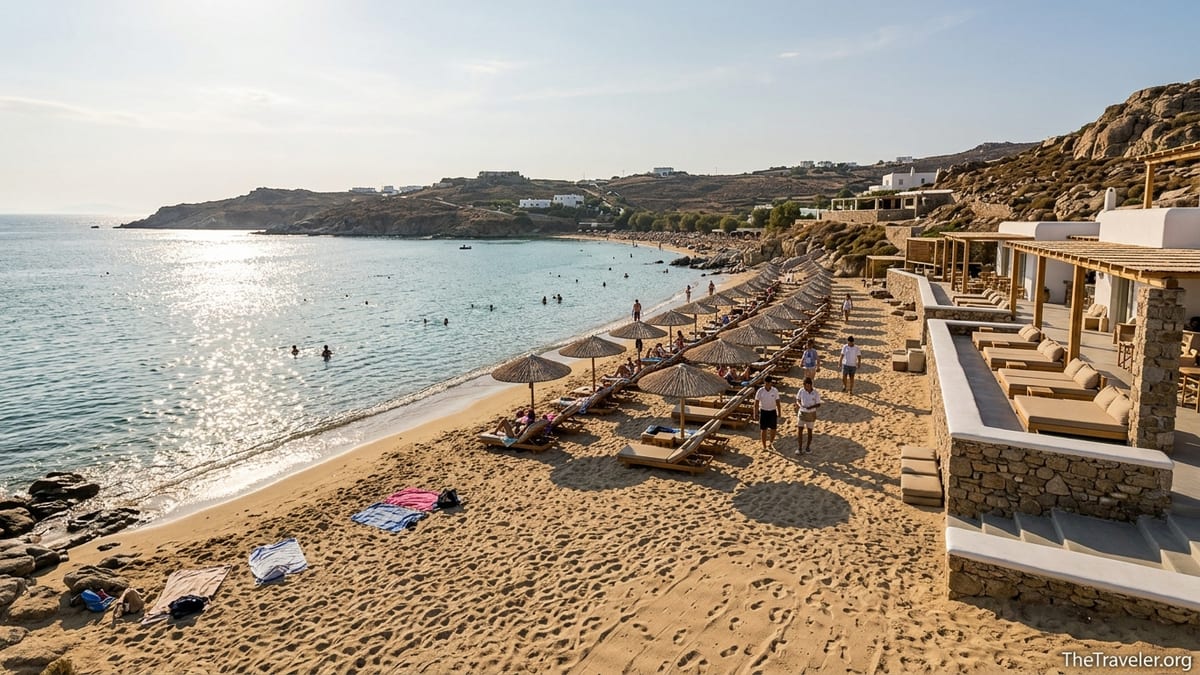
A Calm, Sheltered Bay With Classic Cycladic Beauty
Paraga Beach curves around a small, protected bay on the south side of Mykonos, which means the water here is often calmer than on the north-facing shores that take the brunt of the Aegean winds. Even in peak season, you are likely to find the sea here glassy in the early morning, with gentle ripples instead of surf. The sand is a mix of golden grains and small pebbles, which helps keep the water remarkably clear. Many first-time visitors comment that they can still see their toes while standing chest-deep offshore, something that immediately sets the tone for slow, easy swimming.
The landscape around Paraga is distinctly Cycladic: low, scrubby hills broken by whitewashed villas and stone walls, with the occasional blue-domed chapel perched above the bay. Unlike some more heavily developed beaches, Paraga’s buildings tend to sit slightly back or on the slopes above the shore, so when you face the water you mostly see open sea and the island of Naxos faint on the horizon on clear days. It feels like a place where the Mykonos of postcards and the Mykonos of modern beach clubs coexist without clashing.
Because the cove is compact, you can walk its whole length slowly in under 10 minutes, passing from quiet corners where couples spread towels on the sand to full-service zones of sunbeds, bars, and restaurant terraces. This walkable scale is one reason many repeat visitors base themselves here for several days. You can step out of a small guesthouse, grab a coffee from a simple café on the hill, and be in the water within minutes, without needing a car or ATV.
Paraga also benefits from its southern exposure when it comes to weather. During meltemi season, when strong northerly winds can make beaches like Ftelia or Agios Sostis choppy and uncomfortable, Paraga is often noticeably more sheltered. Travelers who arrive in July or August frequently shift their plans after discovering that, on windy days, Paraga remains swimmable and pleasant while other beaches feel like being in a sandblaster.
Easy Access From Town Without Losing the Escape
One of Paraga’s greatest advantages over more remote coves is how straightforward it is to reach from Mykonos Town, especially if you do not want to rent a vehicle. In summer, local buses typically run from the main Fabrika bus station in Mykonos Town to nearby hubs such as Platis Gialos and Paradise. From there, Paraga is either a short onward walk or a quick ride on the beach boat service that shuttles between Ornos, Platis Gialos, Paraga, Paradise, Super Paradise, Agrari, and Elia. Regular travelers note that the boat ticket for this hop-on, hop-off service is often in the region of 15 to 20 euros for the day, which can be good value if you plan to explore multiple beaches.
Those arriving by bus usually pay what is, by Mykonos standards, an affordable fare for the 15 to 20 minute ride from town, then either walk down a signposted path to the beach or transfer to the coastal boat. Many visitors who want to minimize costs will ride the morning bus, bring snacks and water from a supermarket in town, and base themselves on the quieter, less commercial side of the bay where towel space is still available among the rocks. Others pre-book sunbeds at one of the organized sections, where the price includes service and convenience.
If you prefer the flexibility of your own transport, the drive from Mykonos Town to Paraga typically takes around 10 to 15 minutes in light traffic. There are small parking areas near the beach and at the larger clubs. In peak months such as late July and August, these lots can fill by late morning, especially on days when well-known DJs are playing at SantAnna or Scorpios, so arriving early is sensible. Many travelers choose a compromise: rent a scooter or ATV for one or two days of their trip to explore the south coast beaches, then rely on buses and boats the rest of the time.
Crucially, despite this relatively easy access, Paraga still feels more like a self-contained cove than an extension of town. Once you are down at sea level, the sounds that dominate are waves, lounge music from the beach clubs, and the low hum of conversation. There are no large roads right on the sand, and traffic remains mostly out of sight on the hills above. It is exactly the sort of place where you can head out from a Chora boutique hotel just after breakfast and still feel that you have “escaped” for the day.
A Rare Blend of Laid-Back Corners and High-Energy Beach Clubs
Paraga’s reputation has grown in recent years because it manages a balance that is surprisingly hard to find on Mykonos: you can spend a day here reading in the shade, or you can lean fully into the island’s big-name beach club culture, without changing beaches. On one end of the bay you still find simpler set-ups, with more modest rows of sunbeds and a quieter soundtrack. Some visitors skip the organized section entirely and lay towels on the sand or among the rocks at the far sides of the cove, using the sea as their main entertainment.
At the same time, Paraga has become one of the island’s key addresses for all-day venues. Kalua Beach Bar, for example, occupies a prime spot with tightly packed rows of loungers, a central bar, and restaurant service that shifts gears as the day goes on. By mid-afternoon in high season, the volume typically rises, champagne buckets start to appear, and staff may be encouraging people to dance on the sand. Travelers in their late twenties and thirties often describe Kalua’s vibe as lively but less intense than the full-on club atmosphere of Paradise Beach next door.
Walk a few minutes around the curve and you reach SantAnna, which has evolved into one of the most elaborate beach clubs on Mykonos. It combines a beachfront zone of sunbeds with a vast free-form seawater pool, cabanas, multiple bars, and a full restaurant complex. SantAnna often hosts big-name DJs and series such as Black Coffee’s summer residency, where a Monday sunset set can draw a crowd all on its own. Yet during the first half of the day, the mood around the pool and on the beach is often much more relaxed, with families and groups of friends sharing large daybeds and ordering sushi or Greek plates between swims.
Because the sandy strip is relatively short, you can drift between these moods in the space of a few minutes. A couple might spend a quiet early morning at the far end of the beach, then move to pre-booked loungers at Kalua or SantAnna for lunch and afternoon people-watching, before walking up the rocky path to Scorpios at golden hour. Few other Mykonos beaches give you this range without needing a car or boat ride in between.
Culinary Highlights: From Simple Taverna Tables to Global Names
For many visitors, Paraga’s food scene is as much of a draw as the swimming. On the simplest level, you can still find café-tavernas set just back from the sand that serve Greek salads, grilled souvlaki, and ice-cold beer at relatively moderate prices compared with the island’s most prestigious venues. These spots are particularly popular with younger travelers and backpackers staying at nearby campgrounds or budget-friendly rooms, who might share a few plates at lunch before heading back to free towel space on the sand.
At the higher end, Paraga has become a base for some seriously ambitious kitchens. SantAnna runs multiple food outlets, including a Greek taverna and a sushi bar, where it is not unusual to see tables sharing platters of sashimi and local seafood pasta while sitting only a few steps from the water’s edge. Prices reflect both the setting and the broader cost structure of Mykonos, so a couple can easily spend a three-figure sum on appetizers, mains, and cocktails over the course of a long lunch and afternoon at a reserved bed.
Nearby, Kalua serves a menu with Mediterranean staples, seafood, and crowd-pleasing dishes such as lobster pasta or tuna tartare. Portions tend to be generous, designed for sharing among groups who may be spending most of the day on-site. It is the sort of place where ordering a magnum of rosé or a round of tequila shots for the table feels entirely in keeping with the surroundings once the music climbs past mid-afternoon levels.
Most recently, Paraga has attracted global restaurant brands. ROKA Mykonos, set on the shores of the bay, offers a full Japanese robatayaki experience alongside beach and pool areas. Here, travelers might move from sunbeds to a table overlooking the sea for dishes built around charcoal-grilled fish, sushi, and vegetable plates, then linger over cocktails as the sky turns pink. The arrival of names like ROKA speaks to how Paraga has shifted from a simple cove to a full-fledged dining destination where you can structure an entire day around the next meal.
Beach Day Practicalities: Sunbeds, Prices, and What to Expect
Because Paraga sits at the intersection of relaxed cove and upmarket scene, prices on the beach vary widely. In the quieter, less organized zones, you still see people spreading their own towels for free, especially towards the edges of the bay and among the rocks that separate Paraga from neighboring coves. Here, your main expense might be a coffee, a soft drink, or a simple plate of fries and tzatziki from a nearby snack bar.
In front of the organized sections, expect to pay for sunbed packages that often include two loungers and an umbrella, with service from the bar or restaurant. At more modest operations, the charge for a pair of beds and shade might be in the region of a few dozen euros for the day, especially if you arrive early and do not insist on the very front row. At the prestige venues, particularly during July and August and in the first rows by the water or pool, minimum spends and bed fees can run much higher. Travelers regularly report that at headline clubs such as SantAnna or Scorpios’ beach area, spending comfortably into three figures over the course of the day is easy once you add lunch, cocktails, and bottles of wine.
The key is to decide in advance how you want your day to look. If you are on a tighter budget but still want a taste of the scene, consider booking a mid-row set of beds at a club for one special day, then spending other beach days on the simpler side of Paraga or using your own towels and occasionally ordering drinks. Many visitors also find that arriving early, before 11 am, can sometimes give them more choice of seating and better value. By contrast, if you are planning to celebrate a birthday or special occasion and want a front-row bed, pool island, or cabana at a place like SantAnna in late July, reserving weeks ahead is prudent.
Paraga’s compact size also influences sound levels. As the afternoon progresses in high season, music from the bigger clubs often becomes the soundtrack for most of the bay, even if you are sitting in a quieter section. For some travelers this is part of the appeal; for others, especially those with young children or those seeking pure tranquility, it may be a cue to swim and relax earlier in the day and retreat to a more low-key beach like Agios Ioannis or Agios Sostis later in the trip.
Sunsets, Scorpios, and the After-Hours Glow
One reason Paraga has become such a central part of the Mykonos experience is what happens as the day slides into evening. The bay faces southwest, so sunsets here are reliably dramatic, with the sun dropping toward the open water and painting the cliffs and stone walls in amber light. Even if you never set foot in a club, simply watching this show from the sand or a simple taverna table can become one of your dominant memories of the island.
For those who do want to lean into Mykonos’s celebrated sunset rituals, Paraga is home to Scorpios, perhaps the island’s best-known beach club. Positioned on a peninsula between Paraga and Kavos, Scorpios has built a global reputation for its bohemian-chic aesthetic, vegetarian-leaning menus, and music programs that blend DJs with live performers. On peak summer evenings, its sunset gatherings can feel like a small festival, with guests spread across tiered terraces, sandy dance floors, and tented lounge areas, all oriented toward the horizon as the music builds with the fading light.
Reservations at Scorpios are strongly recommended in high season, whether for lunch, a sunset table, or access to specific lounge areas. Many travelers structure an entire day around a sunset session here: they might spend the morning at the quieter end of Paraga or at SantAnna’s pool, then walk the well-trodden coastal path up to Scorpios mid-afternoon, in time to settle into a cabana or table for the evening. Others arrive by taxi directly from town, treat the visit as their big splurge night, and then head on to a late club such as Cavo Paradiso at nearby Paradise Beach once the Scorpios program ends.
Even if you prefer not to commit to a full evening reservation, simply approaching the headland around golden hour gives you an idea of the atmosphere that has made Paraga famous worldwide. You see guests wrapped in light linens and straw hats, candles beginning to flicker on low tables, and the whole bay shifting from blue to orange to deep cobalt. It is this blend of natural drama and carefully curated hospitality that has turned the broader Paraga area into a shorthand for “the Mykonos experience” among many travelers.
Who Paraga Beach Is Best For
Despite its growing fame, Paraga remains surprisingly versatile in terms of who will enjoy it most. Couples often choose it as a base because it allows for slow, romantic mornings by the sea, mid-range or upscale dining at lunch, and the option of a big night out without needing to cross the island. A typical day for a couple might involve coffee at a simple café on the hill, a few hours on a quieter patch of sand, a shared seafood lunch at a beach taverna, and then a sunset reservation at Scorpios or a cocktail at SantAnna’s bar.
Groups of friends, especially those in their twenties and thirties, are drawn by the ability to combine a relaxed beach day with a guaranteed scene. They might reserve a cluster of sunbeds or a cabana at Kalua or SantAnna, budget for a minimum spend that covers food and drinks, and then decide late in the afternoon whether to continue the night at Scorpios, head to Paradise Beach, or return to Mykonos Town for bars and clubs there. For such travelers, Paraga functions as an efficient “one-stop” hub: sea, food, music, and nightlife logistics all aligned along a single strip of sand.
Families can also enjoy Paraga, particularly earlier in the day and toward the quieter ends of the bay. The relatively calm water and gentle gradient into the sea make paddling and short swims less intimidating for children, though parents should keep in mind that by mid to late afternoon in peak season, the soundtrack shifts decidedly toward adult-oriented music and partying. Many family travelers report that arriving around 9 or 10 in the morning, securing a spot in a calmer section, and leaving by mid-afternoon gives them the best of Paraga without the late-day intensity.
Finally, solo travelers often appreciate Paraga as a place where it is easy to meet others. Sharing a table at a taverna, chatting with neighbors on adjacent sunbeds, or joining a small group heading up to a sunset event is common. The presence of large, international beach clubs means you hear a mix of languages and accents around you, from European weekenders to travelers from North America, the Middle East, and beyond, all converging on the same curve of sand.
The Takeaway
Paraga Beach has risen to prominence on Mykonos not because it is the quietest cove or the wildest party beach, but because it manages to be both escape and epicenter at once. Here, clear water and classic Cycladic scenery form the backdrop to some of the island’s most ambitious beach clubs and restaurants, yet you can still find spaces that feel casual and unpretentious. You can arrive by public bus and beach boat with a daypack and a towel, or step into a private cabana with butler service and a sushi platter, all within a few hundred meters of each other.
For travelers planning a Mykonos itinerary, Paraga rewards those who give it more than a quick look. Spend a full day or two here and you start to understand its rhythm: the calm of early swims, the gradual rise of music and chatter, the late-afternoon glow, and the sense, after sunset, that you are exactly where the island’s energy is naturally flowing. Whether you are coming for the scene, the sea, or a bit of both, Paraga Beach is one of Mykonos’s most compelling answers to the question of where to escape without ever really being far from the action.
FAQ
Q1. How do I get to Paraga Beach from Mykonos Town without a car? You can usually reach Paraga by local bus from Mykonos Town to nearby stops such as Platis Gialos or Paradise and then walk or take the coastal beach boat, which runs between several south-coast beaches in summer. Taxis and hotel transfers are another option, but many visitors find the bus and boat combination the most economical.
Q2. Is Paraga Beach suitable for families with children? In the mornings and early afternoons, Paraga can be very pleasant for families thanks to its relatively calm water and gentle entry into the sea. However, by mid to late afternoon in high season, music and crowds from the bigger beach clubs can make the atmosphere louder and more adult, so many families choose to visit earlier in the day and sit toward the quieter ends of the bay.
Q3. Do I need to reserve sunbeds at Paraga Beach in advance? For the larger and more popular beach clubs such as SantAnna or Kalua, reserving sunbeds or cabanas in advance is strongly recommended in July and August, especially if you want front-row spots or are visiting on days with big-name DJs. For the simpler sections of the beach, you can often just arrive in the morning and find space for towels or rent basic loungers on the spot.
Q4. How expensive are beach clubs at Paraga compared with the rest of Mykonos? Prices at Paraga vary widely. Simple tavern-backed sunbeds and snacks can be relatively moderate by Mykonos standards, while headline venues with pools, cabanas, and DJ programs often come with higher minimum spends and premium pricing for food and drinks. Many travelers plan one “big” club day at SantAnna or Scorpios and spend the rest of their beach time in more casual, budget-friendly parts of the bay.
Q5. Can I visit Paraga Beach on a budget? Yes, it is possible to enjoy Paraga on a budget if you are flexible. You can arrive by bus, bring your own towel, and use the free sections of sand instead of renting loungers, then limit your spending to an occasional coffee, drink, or shared plate from a café or taverna. Avoiding peak afternoon hours at the most upscale clubs and eating main meals away from the beach can also keep costs lower.
Q6. What is the atmosphere like at Paraga Beach in the evening? Evenings at Paraga are shaped by its sunset views and nearby venues. As the sun goes down, the bay takes on a golden glow, and many people gather at beach clubs and on the headland, especially at Scorpios, to watch sunset with music and drinks. Later in the night, some guests continue to nearby clubs or return to Mykonos Town, while others simply enjoy a quieter dinner at a beachfront restaurant.
Q7. Are there quieter spots on Paraga Beach if I want to avoid loud music? Quieter spots tend to be found toward the edges of the bay and among the rocks where there are fewer organized sunbeds. Visiting earlier in the day also helps, as the music and party atmosphere usually build in the afternoon. That said, in peak season you will still hear some background music from the larger venues across much of the beach.
Q8. When is the best time of year to visit Paraga Beach? June, early July, and September often offer a good balance of warm weather, open venues, and slightly thinner crowds than the absolute peak of late July and August. In these shoulder periods, you are more likely to find available sunbeds without extreme minimum spends, while still enjoying the full beach club and restaurant offerings that make Paraga famous.
Q9. Can I walk from Paraga Beach to other beaches nearby? Yes, you can walk along the coastal paths between Paraga and neighboring beaches such as Paradise and Platis Gialos, though the exact route involves some rocky sections and stairs. Many travelers combine Paraga with a quick visit to these nearby beaches in a single day, either on foot or using the small beach boat that connects the main south-coast bays.
Q10. Is Paraga Beach windy compared with other parts of Mykonos? Paraga is on the more sheltered south coast of Mykonos, so it is often less affected by the strong northerly meltemi winds than some of the island’s north-facing beaches. While no beach is completely immune to wind, many visitors find that on blustery days, Paraga remains swimmable and comfortable when other areas feel too exposed.