


More news on this day
The United States is preparing to test a controversial new $750 premium service that promises B1/B2 visitor visa interview appointments within 10 business days, raising the stakes for travelers from countries facing record wait times and prompting debate over whether fast-track access to America is becoming a perk only the well-off can afford.
Get the latest news straight to your inbox!
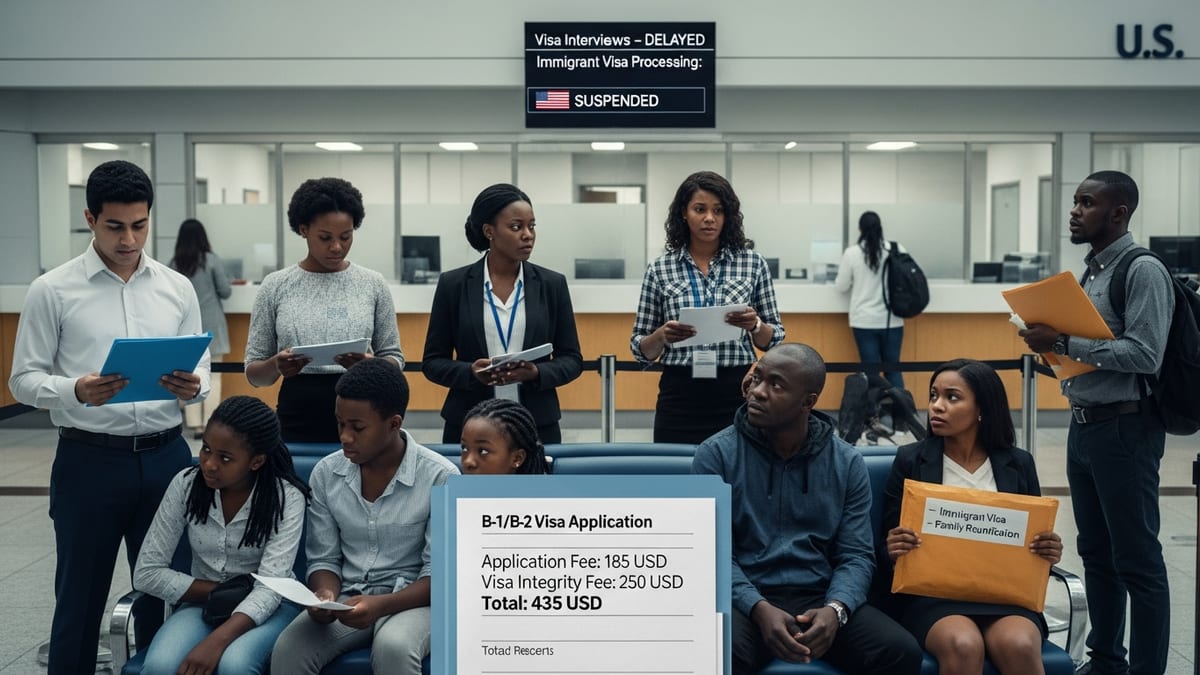
How the New $750 Premium Interview Service Works
According to published regulatory notices and legal briefings, the US Department of State will launch a six-month pilot on July 1, 2026, introducing a $750 optional add-on fee for certain B1/B2 business and tourist visa applicants. The premium payment sits on top of the existing 185 dollar nonimmigrant visa application fee, bringing the total government cost for those who use it to 935 dollars per person.
The new product does not create a different visa category. Instead, it allows eligible applicants to purchase an interview appointment at select embassies and consulates within 10 business days of payment, provided that slots and staffing are available. Once at the window, cases follow the same scrutiny, documentation checks, and security vetting that apply to all visitor visas.
Public guidance from immigration law firms and policy analysts emphasizes that the $750 fee buys only earlier access to an appointment. It does not guarantee that a visa will be issued, does not waive standard eligibility rules, and does not speed up post-interview administrative processing, which can still delay travel if further checks are required.
The premium option will initially run from July 1 through December 31, 2026. Authorities intend to study demand, operational impact, and revenue over that period before deciding whether to keep, modify, or cancel the service.
Targeting Massive Backlogs in India, Brazil, Mexico and Beyond
The pilot appears tailored to the countries that have struggled most with US visitor visa queues in recent years. Wait times for first-time B1/B2 interviews in India, Brazil, Mexico, Nigeria, the Philippines and parts of Africa and Latin America have frequently stretched from several months to over a year, as consulates grapple with post-pandemic backlogs and rising demand for travel, study and business.
Publicly available appointment data and media reports have documented some of the longest delays in major markets such as India’s tech hubs, Mexico’s large border and tourism posts, and Brazil’s biggest cities. Travelers from China, Indonesia, South Africa and other populous nations have also reported difficulty securing timely interview dates, especially around peak travel seasons.
By offering a paid fast lane, the State Department is effectively testing whether a subset of applicants in these high-demand countries is willing to absorb a near 1,000 dollar total fee in exchange for predictability. For business travelers facing contract deadlines, international conferences or investor meetings, the cost may be viewed as a necessary price of doing business with the United States. For families planning once-in-a-lifetime holidays or visiting relatives, it may be a far more painful calculation.
The timing is not accidental. The pilot coincides with preparations for the 2026 FIFA World Cup, co-hosted by the United States, Canada and Mexico, and precedes the 2028 Olympic and Paralympic Games in Los Angeles, both of which are expected to generate surging demand from international fans, sponsors and corporate delegations.
What Travelers Actually Get For Nearly $1,000
Despite headlines about a “10-day visa,” the new program does not promise a final decision within that period. What it guarantees, subject to capacity, is an interview appointment scheduled within 10 business days of paying the premium fee at a participating consulate. The interview itself, questions asked, evidence requirements and subsequent processing remain unchanged.
Analyses of the rule by immigration-focused law firms note that consular posts will retain flexibility to open or close premium slots depending on staffing and workload. If local posts cannot support the extra demand, they will not be required to offer the service. Applicants are being advised to confirm that their chosen embassy or consulate is part of the pilot before paying the surcharge.
For some, the main value will be certainty. Travelers who today see appointment calendars pushed many months out may be able to anchor trip plans, conference registrations and nonrefundable bookings around a much shorter window. Travel planners suggest that this predictability could reduce losses from canceled flights and hotel reservations when interviews are delayed.
However, risk remains. An applicant who pays the premium fee and secures a quick interview can still face refusal, or be placed into extended administrative processing that lasts weeks or months. In such cases, the 750 dollar payment will have yielded speed only up to the moment of the interview itself, not beyond.
Equity Concerns and the Two-Speed Visa System Debate
The decision to charge a high additional fee for faster access is already feeding a broader debate over equity in global mobility. Advocacy groups, commentators and immigration practitioners have long warned that lengthy US visa queues disproportionately affect travelers from emerging economies such as India, Brazil, Nigeria, the Philippines, Indonesia and South Africa, where incomes are typically lower than in long-standing US Visa Waiver Program countries.
By layering a steep premium on top of the standard fee, critics argue, the pilot risks entrenching a two-speed system in which higher earners can pay their way out of delays while students, lower-income workers and family visitors wait in the slow lane. Some point out that the 935 dollar combined cost can exceed the monthly salary of many applicants in the very markets the program is most likely to attract.
Supporters of the experiment counter that consular resources are finite and that charging for expedited appointments can channel demand toward those who most urgently need rapid travel. They also note that the revenue could, in theory, fund additional staffing or infrastructure that benefits the wider applicant pool over time, though such reinvestment has not been formally detailed in public materials describing the pilot.
Travel industry observers are watching closely to see whether the new model meaningfully alleviates headline-making delays or merely redistributes scarce appointment slots to those able to pay more. The response in major outbound markets like India, China, Brazil, Mexico, Nigeria and the Philippines may determine whether the United States ultimately extends or reshapes the program.
What Comes Next for US Visa Policy and Global Travel
For now, the expedited B1/B2 service remains limited in scope. Only a subset of embassies and consulates will participate at the outset, and the program is explicitly described as a temporary test. Applicants are being encouraged through public-facing advisories to monitor official consular information channels for lists of participating posts and updates on availability.
The broader context is a US visa system still adjusting after years of pandemic-era disruptions, changing security rules and surging demand from middle-class travelers in countries like India, Brazil, Mexico, Nigeria, the Philippines, Indonesia and South Africa. Airlines, hotels and destination marketers have repeatedly highlighted US visitor visa delays as a drag on tourism recovery and business travel, especially when competing destinations offer smoother entry.
Whether enough travelers are willing to pay nearly 1,000 dollars for a faster shot at visiting the United States will become clearer as the pilot unfolds in the second half of 2026. If uptake is strong, the premium model could spread to more consulates or even to additional visa categories. If demand is weak or controversy intense, the experiment may prove short-lived.
Either way, the new service underscores a growing reality in international travel: at a time of strained consular capacity and volatile global events, speed and certainty in securing a US visa are becoming commodities with a significant price tag, especially for applicants from the world’s most populous and visa-dependent nations.