


More news on this day
A freight train derailment involving 45 cars in the Le Gardeur sector of Repentigny, northeast of Montreal, sent railcars tumbling beside backyards and power lines on Sunday, leaving residents describing moments of panic and fear even as early reports indicated no injuries or hazardous leaks.
Get the latest news straight to your inbox!
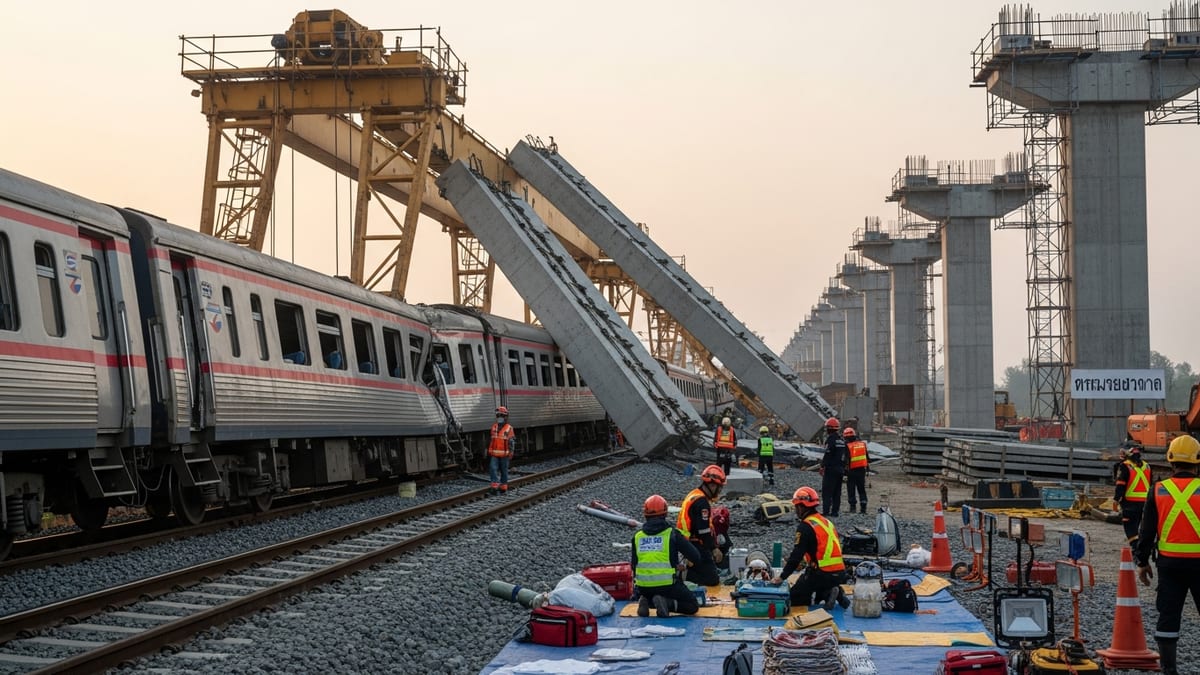
Derailment beside homes shocks north-shore community
Reports indicate the derailment occurred on Sunday, July 5, 2026, in the late afternoon in Repentigny’s Le Gardeur sector, a residential area on the north shore of the St. Lawrence River. A Canadian National Railway freight train left the tracks near a corridor lined with single-family homes, low-rise buildings and local streets that run close to the rail line.
Information published by multiple Canadian outlets indicates that 45 railcars derailed in the incident, some ending up at sharp angles and partially overturned along the right-of-way. Photos from the scene show crumpled freight cars resting just meters from backyard fences and tree lines, underscoring how narrowly the neighborhood avoided a more serious impact.
Local coverage describes residents rushing outside after hearing a series of loud bangs and metallic crashes, followed by alarms from emergency vehicles converging on the site. One witness quoted in Quebec media said they feared for their life as the train cars began to leave the tracks, a sentiment echoed by others who watched the derailment unfold from their homes or nearby streets.
Publicly available information shows that police and fire crews established a perimeter and asked people to avoid the area while they assessed risks from the derailed cars and overhead power infrastructure. The incident also led to temporary disruptions to electricity service in parts of the community after power lines were affected.
No injuries or hazardous leaks reported, but anxiety runs high
According to published coverage from national and local news organizations, early assessments found no injuries among train crew or residents. A railway spokesperson cited in those reports indicated that three of the derailed cars had previously carried diesel but were not loaded at the time, reducing the immediate risk of a fuel spill.
Reports further indicate that specialists monitored the site for any sign of leaks or contamination, while firefighters remained on scene as a precaution. Information released through public channels on Monday suggested that no hazardous materials had been released and that the environmental risk from the incident appeared limited.
Despite the relatively fortunate outcome, local reporting highlights widespread anxiety in Repentigny. Residents described feeling vulnerable as they looked out on a line of twisted railcars pressed up against their neighborhood. For many, the sight revived long-standing worries about freight trains moving through densely populated corridors and the potential consequences if a train carrying flammable or toxic cargo were to derail.
Municipal leaders used social media to call the derailment unsettling and to thank citizens for their patience as responders secured the zone and rail crews began the painstaking work of clearing cars from the tracks. Public messages also encouraged people to stay informed through official channels while avoiding speculation about the cause.
Investigators deployed as cause remains under review
The Transportation Safety Board of Canada announced through a public deployment notice that it has sent investigators to Repentigny to gather information and assess what led to the derailment. The independent agency routinely examines major rail incidents across the country, focusing on safety lessons rather than fault or liability.
Reports indicate that at least two investigators reached the scene shortly after the crash and began documenting the position of the derailed cars, track conditions, and the condition of rail infrastructure in the area. The process typically includes examining mechanical components, train handling data and inspection records, as well as interviewing crew members and other witnesses.
Past TSB rail investigations in Quebec have pointed to a range of factors in other derailments, including broken components, track defects, operating practices and train securement issues. While there is no early indication that any of those scenarios apply in Repentigny, transportation specialists note that such history shapes the questions investigators will ask as they reconstruct the sequence of events.
The rail line involved is a key artery in and out of the Montreal region, used primarily for freight traffic. The derailment has forced changes to train movements while crews remove damaged equipment and repair track, a process that can take days depending on the complexity of the damage and the need for engineering assessments.
Travel disruptions and wider rail network impacts
Although the incident occurred on a freight corridor, its effects have rippled beyond Repentigny. Publicly available information shows that the damaged section of track has caused temporary disruptions for freight operations serving the Montreal area, prompting rerouting and delays on a network that links Quebec to the rest of Canada and the United States.
For travelers and commuters, the immediate impact appears limited, as the derailed train was not carrying passengers. However, rail analysts quoted in Canadian media point out that significant freight delays can have downstream effects on supply chains, including intermodal connections that feed ports, trucking routes and, in some cases, passenger services sharing nearby infrastructure.
In the short term, residents near the site are contending with heavy machinery, floodlights and around-the-clock cleanup. Rail cranes, excavators and specialized trucks are being used to lift cars back onto the rails or onto flatbeds for removal, an operation that can generate noise and dust even as crews work to minimize the disturbance.
For visitors to the Montreal region, the derailment serves as a reminder that industrial and residential spaces coexist closely along the north shore. Travel planners and tourism operators monitoring the situation are watching for any extended rail congestion that might affect cargo-dependent sectors, though at present public reports emphasize safety and infrastructure recovery rather than long-term economic damage.
Memories of Lac-Mégantic shape public reaction
The Repentigny derailment occurred on the thirteenth anniversary of the Lac-Mégantic rail disaster of July 6, 2013, a coincidence widely noted in Quebec media coverage. In that earlier tragedy, a runaway oil train derailed and exploded in the town’s center, killing dozens of people and destroying much of the downtown.
Those events remain a defining reference point in Quebec’s collective memory when it comes to rail safety. Analysts and commentators observing the Repentigny incident have suggested that this history may amplify residents’ fears, even in an event where no fire, explosion or hazardous leak has been reported.
Publicly available reports indicate that, since Lac-Mégantic, rail operators and regulators have introduced a series of safety measures, from train securement rules to tank car standards and route risk assessments. Nonetheless, each new derailment, especially in a residential setting, tends to reignite debate about whether current safeguards are sufficient.
In Repentigny, images of toppled cars near family homes are feeding those questions once again. Commentaries in Canadian outlets note that many Quebec communities lie close to active freight corridors, raising ongoing discussions about land-use planning, emergency preparedness and the balance between national rail operations and local safety concerns.