


More news on this day
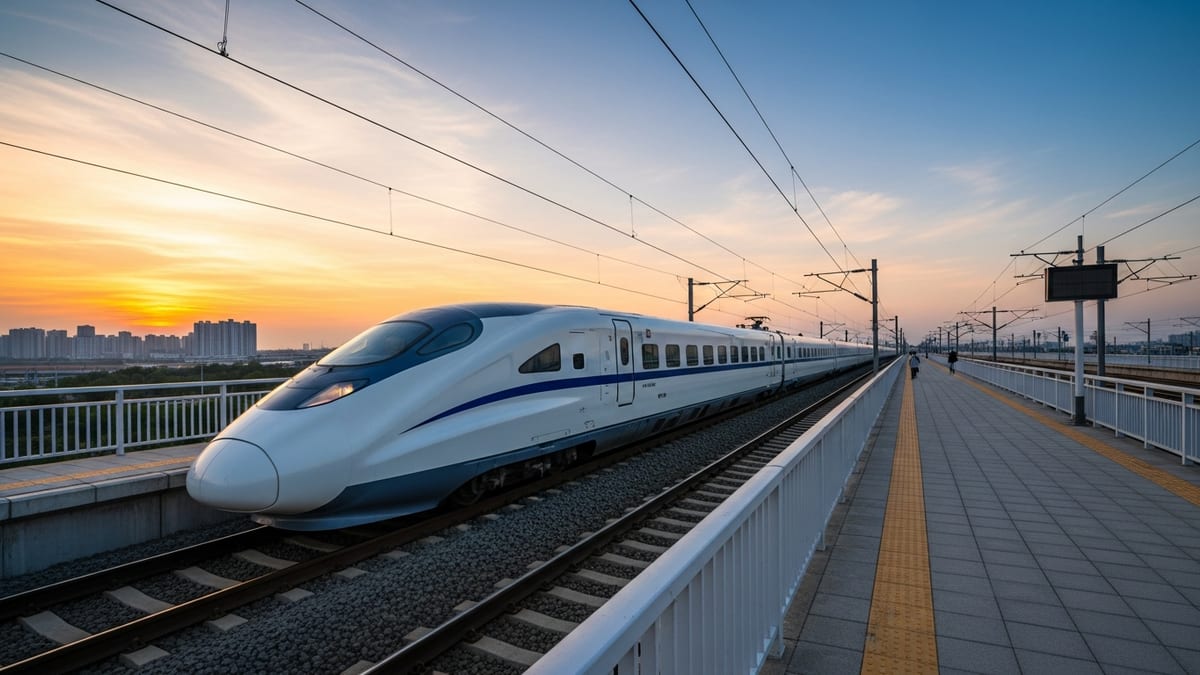
China has retained its status as the world’s high speed rail frontrunner in the latest World Speed Survey for 2025, while Indonesia’s Jakarta–Bandung Whoosh service makes its first appearance among an expanded group of countries running commercial passenger trains at more than 300 km/h.
Get the latest news straight to your inbox!
China Extends Its Lead In The Global Speed Stakes
The 2025 edition of the World Speed Survey, compiled by Railway Gazette International, highlights how comprehensively China dominates commercial high speed operations. The country now combines the fastest regularly scheduled services with by far the largest network length, giving it a commanding position in both speed and scale.
Publicly available data on scheduled timetables shows that selected Chinese services continue to operate at peak speeds of 350 km/h, while maintaining very high average speeds over long distances. Flagship routes, including key sections of the Beijing–Shanghai corridor, post average timings that remain the benchmark for end to end performance in commercial operation.
Alongside current services, China is pushing ahead with next generation rolling stock. Recent test campaigns of the CR450 trainsets have reported trial speeds above 450 km/h, underlining the country’s intention to keep raising the technical ceiling even as day to day commercial running speeds stay within established limits for efficiency and safety.
The survey period also coincides with continued expansion of China’s high speed network. By late 2025, published network statistics indicate more than 50,000 km of high speed lines in service, accounting for the majority of global high speed track and enabling dense, frequent long distance operations that no other country yet matches.
Seven Countries Now Run Above 300 km/h
One of the most notable findings in the 2025 World Speed Survey is that seven countries now field commercial passenger services exceeding 300 km/h. This reflects not only technological progress but also a growing political and economic commitment to high speed rail as a mainstream mode of intercity transport.
Beyond China, established high speed markets in Japan, France, Spain, Germany and Italy continue to refine operations and incrementally improve average speeds on their fastest services. Network managers have focused in recent years on timetable optimisation, infrastructure upgrades and targeted rolling stock renewals to squeeze more performance from existing corridors.
The survey methodology emphasises sustained commercial speeds rather than record-breaking test runs. This approach highlights the systems that can maintain high velocities over long distances, through real-world operating conditions that include intermediate stops, congestion and mixed-traffic interfaces.
The broadening of the 300 km/h club is seen by many analysts as a sign that high speed rail is moving from a showcase technology into a more widely adopted backbone for national and regional mobility. It also serves to sharpen competitive pressures among suppliers and operators, who look to differentiate through faster journeys, higher reliability and improved passenger experience.
Indonesia’s Whoosh Enters The High Speed Premier League
The 2025 survey marks a milestone for Southeast Asia, with Indonesia’s Whoosh service joining the global roster of high speed operators achieving 300 km/h operations. The Jakarta–Bandung line, which opened commercially in late 2023, uses Chinese-derived technology and is designed for an operating speed of 350 km/h.
According to published operating data and independent speed rankings, the 142 km corridor has rapidly established itself as one of the fastest new routes outside East Asia and Europe. Timetabled journey times of under one hour between the Jakarta area and Bandung position the service firmly within the high speed category used in the World Speed Survey.
Ridership figures released over the past two years indicate strong passenger uptake, with tens of thousands of daily users on peak days and cumulative totals running into the millions. This performance has strengthened Indonesia’s case that high speed rail can relieve highway congestion, support regional development and provide a modern alternative to short-haul air travel on key domestic corridors.
Industry commentary suggests that Whoosh’s inclusion in the 2025 survey will be closely watched by policymakers across the Global South. The project showcases a model in which imported technology, joint-venture operations and phased expansion are combined to deliver a first high speed link in an emerging market context.
Technology Transfer And The China–Indonesia Connection
Behind the headline speeds lies a broader story of technology transfer and industrial cooperation. Publicly available technical documentation on the Jakarta–Bandung project notes that its track systems, rolling stock and signalling architectures are largely derived from proven Chinese high speed designs, adapted to Indonesian conditions.
The joint venture structure between Indonesian stakeholders and Chinese railway companies has facilitated local skills development and training, particularly in operations, maintenance and safety management. Reports from sector conferences describe Indonesian managers presenting operational experience to an international audience, highlighting how the line has been integrated with wider transport planning objectives.
For China, the success of Whoosh strengthens its credentials as an exporter of complete high speed rail systems, from civil works and electrification to rolling stock and control systems. The project has been widely cited in industry analysis as a reference case for future high speed ventures in Asia, the Middle East, Africa and Latin America.
For Indonesia, the corridor serves as both a transport artery and a testbed. Government and operator statements point to potential extensions towards key cities on Java, which would transform the single line into the backbone of a wider intercity rail network built to high speed standards.
What The 2025 Rankings Signal For Future Projects
The World Speed Survey for 2025 arrives at a time when many countries are reassessing the role of rail in national climate and infrastructure strategies. The dominance of China, coupled with the entry of new players such as Indonesia into the top speed tier, signals that the centre of gravity for high speed rail is shifting further toward Asia.
In Europe and Japan, where networks are mature, the survey results are likely to reinforce a focus on raising average speeds through incremental upgrades rather than dramatic new-build projects. By contrast, in emerging markets, the visibility gained by Whoosh and other new lines may encourage governments to move from pilot corridors to more extensive high speed plans.
Analysts also point to the survey’s emphasis on real-world operating speeds as a corrective to discussion focused solely on headline maximums. With next-generation trains demonstrating test speeds well over 400 km/h, the challenge for policymakers and engineers is to translate those capabilities into commercially viable, energy-efficient timetables on complex networks.
As the 300 km/h club expands, the competitive landscape for suppliers, constructors and operators is expected to intensify. The 2025 findings suggest that future high speed projects will be judged less on isolated record runs and more on how reliably they can deliver true high speed performance over entire routes for growing numbers of passengers.