


More news on this day
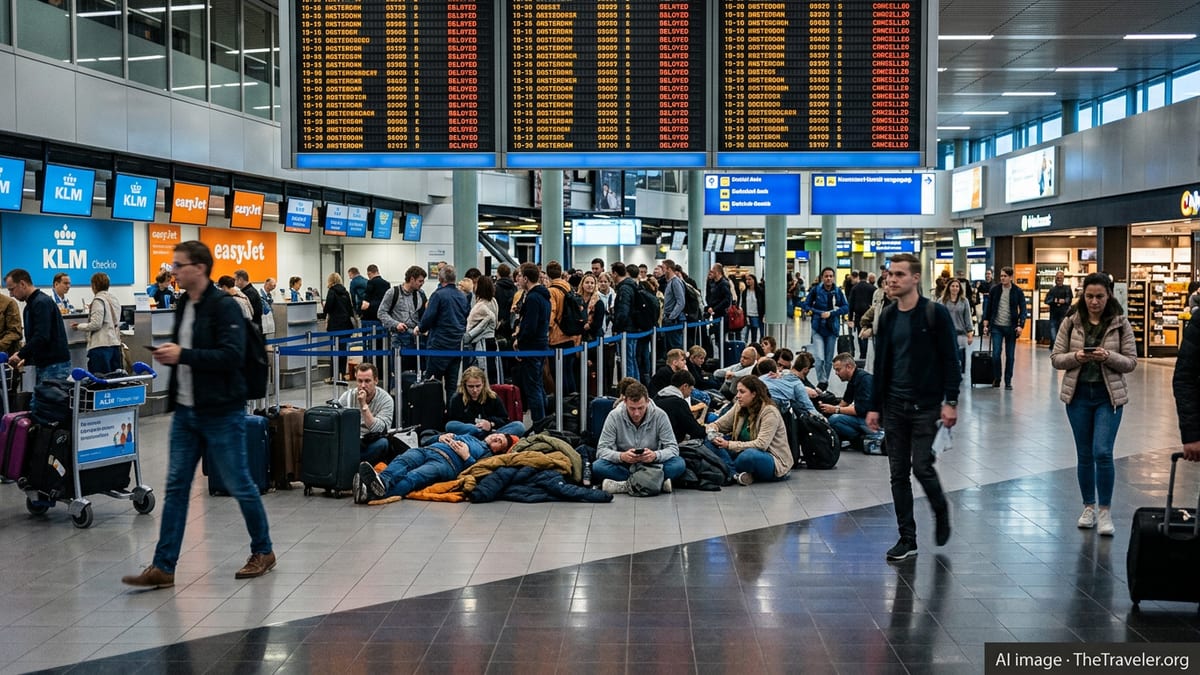
Early summer holiday plans across Europe have been thrown into disarray as 1,225 flight delays ripple through London, Amsterdam and Paris, overwhelming airport terminals and stranding thousands of passengers at three of the continent’s busiest hubs.
Get the latest news straight to your inbox!
Europe’s Busiest Gateways Buckle Under Peak Demand
The latest wave of disruption is hitting just as Europe’s peak travel season accelerates, with London Heathrow, Amsterdam Schiphol and Paris Charles de Gaulle already operating near capacity. Publicly available aviation data shows that these hubs consistently rank among the continent’s busiest airports, handling hundreds of thousands of passengers per day and serving as critical transfer points for global traffic.
Against that backdrop, the reported total of 1,225 delays concentrated across the three cities has amplified normal congestion into widespread operational strain. Airlines and airports are juggling saturated runways, slot restrictions and heavy connecting traffic, leaving little margin when schedules begin to slip. Once early morning departures fall behind, knock-on delays spread through the afternoon and evening waves, hitting both European short-haul and long-haul routes to North America, Africa and Asia.
Travel industry monitoring also indicates that average delay times across Europe have been creeping upward in recent months, as air traffic rebounds toward or beyond pre-pandemic levels. Even modest increases in delay minutes per flight, when multiplied across hundreds of departures and arrivals in London, Amsterdam and Paris, translate into extensive queues, ground holds and missed onward connections.
Weather, Staffing and System Strains Combine
The 1,225 delays are not tied to a single cause but reflect a mix of short-term shocks and longer-running structural weaknesses. Periodic thunderstorms and low-visibility conditions have triggered temporary ground stops and reduced runway capacity around major North Sea and Channel hubs, forcing aircraft to circle or divert and compressing tight departure windows.
At the same time, air traffic management and ground-handling resources remain under pressure. European aviation analysis for 2026 highlights air traffic control capacity and staffing constraints as a leading source of en-route and airport delays, particularly in busy airspace over France and in gateway hubs that rely on precise sequencing of arrivals and departures. When combined with packed schedules at Heathrow, Schiphol and Charles de Gaulle, even a brief staffing gap or equipment issue in one control sector can cause minutes of delay that quickly accumulate.
Infrastructure dependencies beyond the terminal are also playing a role. Recent disruption to rail services linking Amsterdam with Schiphol Airport demonstrated how quickly passengers can be delayed reaching the airport itself, putting extra stress on check-in and security at peak times. Similar vulnerabilities exist around London and Paris, where dense urban rail and road networks feed enormous volumes of travelers into constrained airport footprints.
Knock-On Chaos for Connections and Baggage
For many travelers, the immediate impact of the 1,225 delays is being felt not just at departure gates but across entire itineraries. The three affected cities function as core connecting nodes for flights between North America and Europe, intra-European routes, and onward services to Africa and the Middle East. When early transatlantic or morning European feeder flights arrive late into London, Amsterdam or Paris, connecting passengers face a shrinking window to clear passport control, navigate large terminals and board onward aircraft.
Published coverage of recent European disruptions shows that missed connections can quickly cascade into overnight airport stays, particularly when later flights on popular leisure routes are already fully booked. Families bound for Mediterranean holiday destinations or long-haul travelers heading to Asia may find themselves rebooked via alternative hubs in Germany or Southern Europe, adding hours or a full day to journeys originally planned with tight, same-day transfers.
Baggage systems are also under strain. When flights are retimed at short notice, luggage that has already entered automated handling systems may not be rerouted or offloaded quickly enough to make new connections. This raises the likelihood of bags arriving a day or more after passengers, a recurring complaint during previous summers of disruption at these same airports.
Passenger Rights and Compensation Under EU Rules
For affected travelers, Europe’s consumer protection regime offers some recourse. Public information on the EU’s air passenger regulations indicates that travelers departing from European airports, or flying into the region on EU-based carriers, may be eligible for compensation when delays or cancellations meet certain thresholds and are not caused by extraordinary circumstances such as severe weather or airspace closures.
Under these rules, significant delays can trigger entitlement to meals, refreshments, hotel accommodation and, in some cases, fixed financial compensation. Recent travel reporting has underlined that eligibility depends on factors including flight distance, length of delay on arrival, and whether the cause is considered within the airline’s control. As the 1,225 delays are examined case by case, outcomes are likely to vary between weather-related disruption, air traffic management restrictions and operational or scheduling issues attributed to carriers.
Consumer advocates often encourage passengers to document boarding passes, delay notifications and actual arrival times, then file claims directly with airlines or, if necessary, with national enforcement bodies in the country where the disruption occurred. Given the concentration of delays in London, Amsterdam and Paris, enforcement authorities in the United Kingdom, the Netherlands and France can expect a rise in queries during the early summer period.
What Travelers Can Do Now
While the current disruption underscores persistent fragility in Europe’s air travel system, there are steps passengers can take to reduce their exposure as the summer peak intensifies. Travel experts frequently recommend building longer layovers when itineraries route through major hubs such as Heathrow, Schiphol and Charles de Gaulle, particularly on journeys that involve separate tickets or tight evening connections to leisure destinations.
Checking flight status repeatedly in the 24 hours before departure, monitoring terminal and gate changes, and registering for airline and airport alerts can help travelers react more quickly when schedules start to slip. During periods of known strain, some passengers are also opting for earlier departures in the day, when aircraft and crews are less affected by accumulated delays from earlier rotations.
For those yet to book, routing through less congested secondary airports or alternative hubs may offer a trade-off between convenience and resilience. However, with demand surging into school holidays and major events across Europe, analysts expect continued pressure on the entire network. With 1,225 delays already recorded across London, Amsterdam and Paris, early indicators suggest that Europe’s 2026 summer travel season is shaping up to be another arduous test of patience for passengers and operators alike.