


More news on this day
Missile strikes, rolling airspace closures and prolonged flight suspensions across the Gulf and Levant are prompting a marked pullback by European travelers, with Germany joining the UK, France, Spain, Italy and the Netherlands in steering tourists away from Middle East hubs such as Dubai, Abu Dhabi, Riyadh, Tel Aviv and Doha in June 2026.
Get the latest news straight to your inbox!
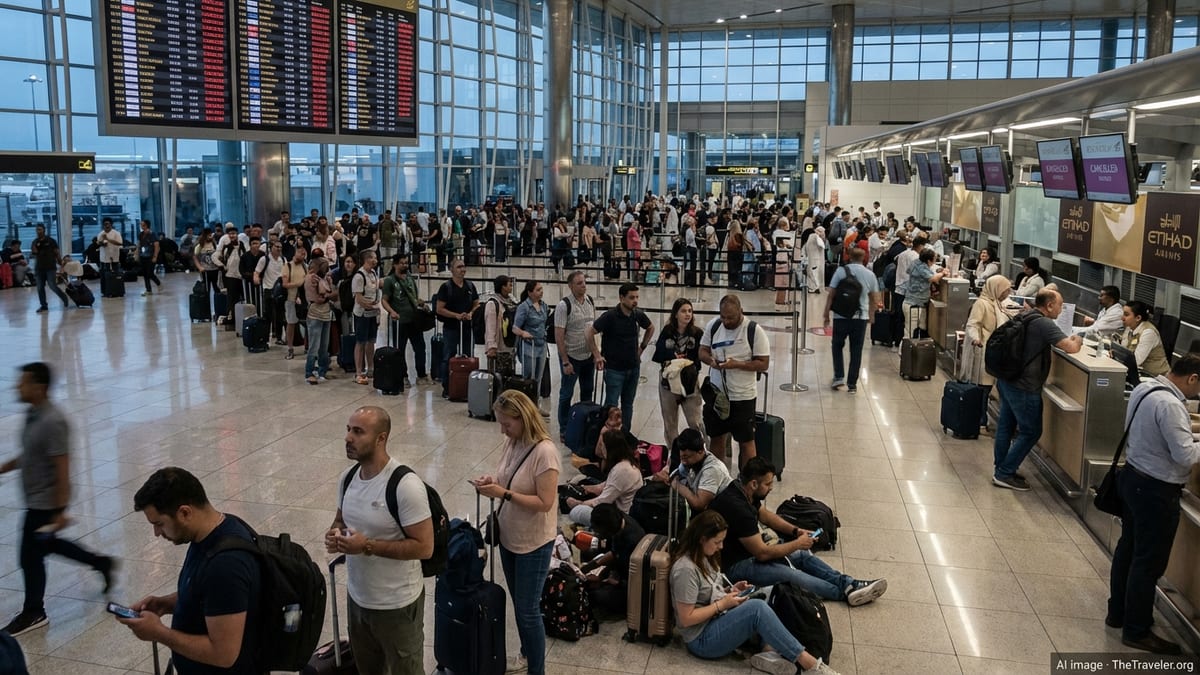
Missile Strikes Turn Travel Hubs Into Risk Corridors
Middle Eastern gateways that once marketed themselves as safe, ultra-connected transit points are now at the center of an expanding conflict zone. A wave of Iranian missile and drone strikes since late February has hit infrastructure in the United Arab Emirates and Israel, triggering temporary shutdowns and damage at airports in Dubai and Abu Dhabi and forcing carriers to divert or cancel thousands of flights across the region.
The escalation has been compounded by repeated long-range launches toward Israel and missile alerts across Saudi Arabia, including Riyadh and the Eastern Province, which have underscored the vulnerability of key aviation corridors. Publicly available incident reports describe interceptions over several Gulf states and spillover risks to neighboring airspace, feeding a perception among leisure travelers that the wider region is unpredictable for nonessential trips.
These security events are being closely tracked by airlines and regulators, which are required to conduct route-by-route risk assessments. For travelers, however, the practical effect is straightforward: more last-minute cancellations, complex rerouting and longer flight times on journeys that would once have relied on smooth connections through Dubai, Doha, Abu Dhabi or Riyadh.
Airspace Closures and EASA Bulletins Reshape European Routing
European aviation oversight has intensified in parallel with the conflict. The European Union Aviation Safety Agency has extended and repeatedly updated conflict-zone guidance covering large parts of the Middle East and Gulf airspace, warning operators away from Iranian and Iraqi skies and advising caution over Bahrain, Israel, Jordan, Kuwait, Oman, Qatar, Saudi Arabia and the United Arab Emirates. While these are advisories rather than outright bans, they have had a decisive impact on how European carriers plan their networks.
As a result, routes that once flew direct over the Gulf are now being shifted north or south, increasing flying time and operating costs between Europe and Asia or East Africa. Specialized aviation trackers and travel-industry analyses indicate that more than 50,000 flights have already been canceled across the wider region since late February, with many more re-routed around restricted airspace. For European passengers, this has translated into higher fares on remaining services and a perception that itineraries touching the conflict-affected zone carry outsized disruption risk.
Germany’s flag carrier and its European peers have played a prominent role in this reshaping. Schedules for summer 2026 show suspended or heavily reduced operations to Tel Aviv and curtailed services to Dubai and some Saudi gateways, alongside capacity being redeployed into Mediterranean and intra-European routes. Similar patterns are evident for airlines based in the UK, France, Spain, Italy and the Netherlands, amplifying a shift away from Middle East transit points in favor of point-to-point flying within Europe.
European Travelers Pivot Away From Dubai, Abu Dhabi, Riyadh, Tel Aviv and Doha
Consumer sentiment surveys conducted this spring point to a broad reluctance among international travelers to visit countries bordering the current Iran conflict or to connect through hubs seen as proximate to active missile trajectories. One global traveler poll cited in recent industry coverage found nearly three-quarters of respondents avoiding Middle Eastern destinations adjacent to Israel, Syria and Iran, with the United Arab Emirates, Qatar and Saudi Arabia among those most frequently mentioned.
Travel trade publications and booking data highlight a parallel slump in Middle East arrivals for 2026, with regional tourism projections indicating double-digit percentage declines in inbound visitors compared with earlier expectations. Analysts at Tourism Economics and the World Travel & Tourism Council have warned that arrivals across parts of the Gulf and Levant could fall by more than a quarter this year, as airlines trim capacity and travelers defer or rebook trips elsewhere.
This shift is increasingly visible in European source markets. Tour operators in Germany, the UK, France, Spain, Italy and the Netherlands are refocusing marketing away from Dubai shopping breaks, Abu Dhabi stopovers and Tel Aviv city trips that had become standard winter-sun offerings in recent years. Instead, brochures and online campaigns are prioritizing destinations that avoid conflict-adjacent air corridors, with particular emphasis on intra-European alternatives and long-haul routes that bypass the Gulf entirely.
Germany Joins Other EU States in Issuing Cautious Guidance
European governments have reinforced the trend through updated travel advisories. Since March, foreign ministries across the bloc have refreshed guidance for much of the Middle East, flagging the risk of missile and drone strikes, sudden airspace closures and the possibility of further military escalation. Germany’s foreign ministry has aligned with its counterparts in London, Paris, Madrid, Rome and The Hague in urging caution or advising against nonessential travel to parts of Israel, Lebanon and the Gulf, while noting that the security situation can change with little notice.
These notices do not ban travel, but they carry practical consequences for insurance coverage and corporate travel policies. Many European insurers link comprehensive trip protection to adherence with national advisories, meaning that journeys routed through hubs such as Dubai, Abu Dhabi, Riyadh, Tel Aviv or Doha may no longer be covered in the same way they were before the current conflict. Corporate travel managers are similarly shifting staff itineraries to avoid the region, feeding into a broader decline in both leisure and business demand.
Publicly available airline waiver policies show that several major carriers have introduced flexible rebooking options for tickets touching affected airports, reflecting both regulatory caution and waning passenger appetite. For German, British, French, Spanish, Italian and Dutch travelers weighing summer and autumn trips, the combination of formal advisories, insurance constraints and headline-grabbing missile alerts is proving decisive in favor of alternative routes.
Winners and Losers in a Rapid Global Rebalancing
The fallout is being felt unevenly across global tourism. The United Nations World Tourism Organization’s latest barometer points to a solid rebound in overall international travel in early 2026, but highlights the Middle East conflict as a major drag on certain markets. Analysts note that while Middle East hubs are grappling with capacity cuts, Europe’s Mediterranean destinations are welcoming redirected demand, cushioning the impact of higher transport costs and broader economic headwinds.
Industry trackers report that Spain, Italy and Greece are among the main beneficiaries of the shift, with strong booking pipelines from Germany and other northern European states that previously used Gulf hubs to reach Asia, the Indian Ocean or East Africa. Some of this traffic is now staying within Europe, while other flows are being rerouted through alternative gateways such as Istanbul, Cairo, Singapore and Bangkok, which offer long-haul connections without crossing the most restricted airspace.
For tourism authorities in Dubai, Abu Dhabi, Riyadh, Tel Aviv and Doha, the challenge is twofold: rebuilding airline connectivity as security conditions allow, and persuading risk-averse European visitors that these destinations can again function as reliable gateways. Until missile alerts subside and conflict-zone bulletins are scaled back, publicly available data suggests that German and wider European travelers will continue to favor routes and destinations perceived as more stable, reshaping global travel patterns well beyond the June 2026 peak season.