


More news on this day
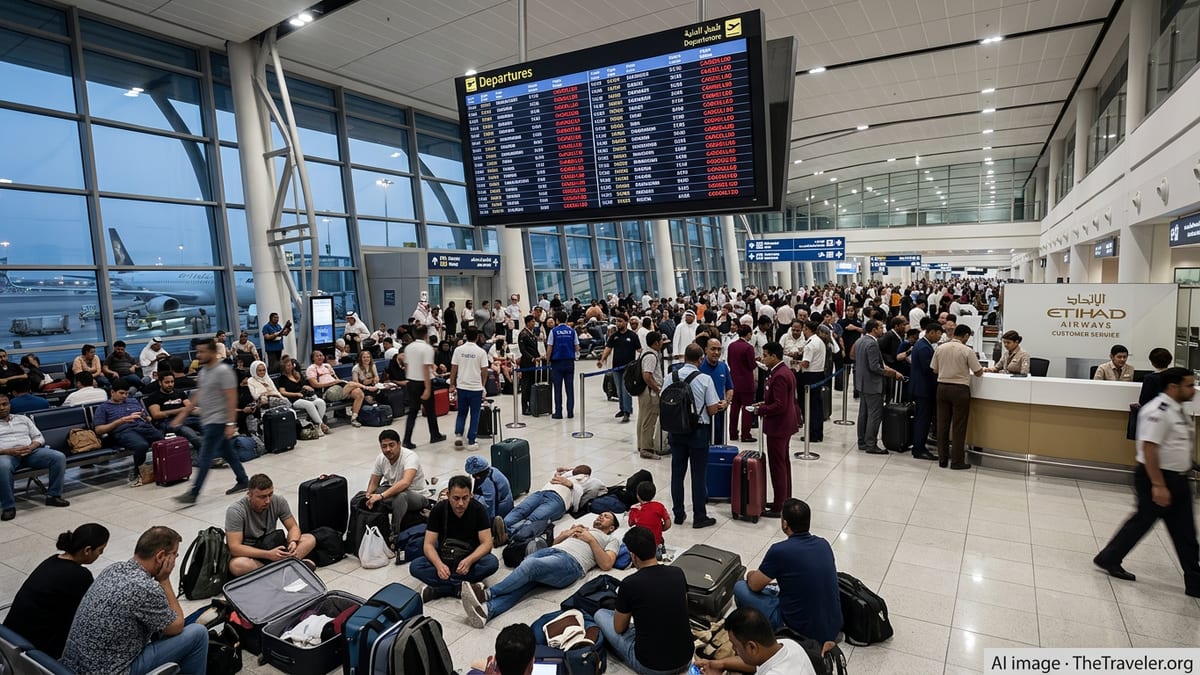
Thirty one abrupt cancellations on Middle East–Europe routes over the past 24 hours have left hundreds of travelers stranded across major European hubs, underscoring how quickly geopolitical tension and tight airline schedules can spiral into full-blown travel chaos.
Get the latest news straight to your inbox!
From Routine Connection to Overnight Ordeal
The latest wave of 31 cancellations appears small next to the tens of thousands of flights scrapped across the Middle East since late February, but its impact on individual passengers has been severe. The affected services are concentrated on routes linking Gulf and Levant hubs with Western and Central Europe, where already stretched summer operations are struggling to absorb further disruption.
Reports from aviation tracking platforms and European travel advisories show cancellations clustering around Frankfurt, Munich, Paris, Amsterdam and London, airports that sit at the heart of Europe’s long haul network. With many Middle East overflight corridors still restricted or closed, aircraft and crews are operating on thinner margins, leaving little flexibility when schedules slip.
Publicly available delay data points to a familiar pattern: a missed inbound aircraft from the Middle East in the early morning can cascade into multiple cancellations later in the day, especially on feeder flights that were meant to carry travelers onward to southern and eastern European destinations. For passengers originating in the Gulf, Jordan, Lebanon or Egypt, a single scrapped leg can now mean an unplanned night, or longer, in a European hub.
Travel forums and consumer-rights platforms across Europe and the Middle East are documenting a spike in last-minute gate cancellations and boarding-halt announcements described as “chaotic” and “confusing,” with rerouting options narrowing as the day progresses and seats on alternative services quickly disappear.
Airspace Closures and Operational Strain Converge
Current disruption comes on top of a structural shock to global aviation created by conflict-related airspace closures over Iran, Iraq, Syria and parts of the Gulf. Analysis published in recent weeks by industry observers and policy institutes indicates more than 10,000 flights have already been cancelled worldwide since the latest escalation, with over 52,000 cancellations reported for the broader Middle East region since late February.
Those closures have forced airlines to reroute many Europe to Asia services either far north via Turkey and the Caucasus or far south around the Arabian Peninsula. The result is longer flight times, higher fuel burn and tighter aircraft rotations. When a long haul aircraft arrives late into a European hub from Asia or Africa, the knock-on effect often lands on shorter regional sectors, including Middle East bound flights, which are more likely to be trimmed to protect flagship intercontinental services.
Carrier updates compiled by aviation news outlets and financial media show a patchwork of suspensions and schedule reductions. Major European airlines have extended pauses on services to Tel Aviv, Beirut, Baghdad and other Middle East cities into late spring and early summer, while Gulf and Levant carriers have restructured their networks to cope with ongoing airspace uncertainty. The 31 cancellations triggering the latest wave of complaints form part of this wider realignment rather than a stand-alone event.
European consumer agencies note that when cancellations are caused by war-related airspace closures or security restrictions, they are often treated as extraordinary circumstances under EU passenger rights rules. That can limit compensation even when disruption is severe, though travelers generally remain entitled to assistance such as meals, accommodation and rebooking where possible.
Frankfurt and Other Hubs Under the Microscope
Fresh data from independent flight statistics providers highlights how concentrated cancellations have become at a handful of major European airports. Recent analysis of EU operations indicates that nearly half of all cancelled flights in Europe over the past month originated from just five airports, with Frankfurt alone accounting for more than one quarter of all scrapped services.
Those same hubs are critical gateways for travelers from the Middle East. Routes connecting Dubai, Doha, Abu Dhabi, Riyadh and Jeddah to Frankfurt, Munich, Paris, Amsterdam and London typically feed onward services to the rest of the continent. When a cancellation hits one of these trunk flights, the impact ripples far beyond a single city pair, stranding passengers who were never scheduled to set foot in Germany, France or the Netherlands for more than a brief connection.
Operational strain is further amplified by crew time limitations and aircraft positioning issues. Public aviation briefings and schedule notices describe how crews that arrive late from extended rerouted flights can quickly run into legal duty-time limits, forcing carriers to cancel subsequent legs rather than risk regulatory breaches. In a tightly banked hub system, that can translate into multiple lost departures for every one delayed arrival.
For affected travelers from the Middle East, the result is a messy patchwork of partial itineraries. Many reach Europe on time only to discover that the shorter final sector to their holiday destination, business meeting or onward intercontinental connection has been pulled with little advance warning.
Human Cost: Stranded Families and Uncertain Itineraries
Behind the statistics, the 31 cancellations represent disrupted lives and plans. Social media posts and traveler forums are filled with accounts of families sleeping on terminal floors, workers scrambling to notify employers of missed start dates, and tourists watching prepaid hotel nights slip away while they wait for standby seats.
Some passengers originating in Gulf hubs report being rerouted via unfamiliar secondary European airports, sometimes with multiple connections replacing what was originally a single stop itinerary. Others describe long waits at transfer desks as ground staff attempt to rebook customers across a shrinking pool of available seats on partner airlines, which are themselves dealing with altered routings and crew shortages linked to the Middle East airspace situation.
Publicly available guidance from European consumer bodies and travel insurers stresses the importance of documenting expenses during such disruptions and retaining boarding passes, cancellation notices and receipts. Those records can be critical when seeking reimbursement for accommodation, meals, or alternative transport back to the Middle East or onward to final destinations.
Travel insurance providers are also flagging fine print. Many standard policies treat war and related airspace closures as exclusions, limiting coverage for cancellations and delays tied directly to the conflict. However, policies that include enhanced disruption protection or schedule-change benefits may still help offset some of the costs now being borne by stranded travelers.
What the Latest Cancellations Signal for Summer Travel
The shock of 31 cancellations in a short window is being read by industry analysts as a warning signal rather than a one-off anomaly. With European summer demand rising and Middle East connectivity still constrained, the system has little slack. Each additional schedule adjustment, missed crew connection or extended detour around closed airspace can trigger localized crises for travelers caught in the wrong place at the wrong time.
Forecasts from aviation consultancies and route-planning specialists suggest that, even if no further major airspace closures occur, higher operating costs and longer flight times between Europe, the Middle East and Asia are likely to persist well into 2027. That could mean leaner schedules, more aggressive capacity management and a greater willingness by airlines to cut marginal routes at short notice when disruptions strike.
Passenger advocacy groups in Europe are already calling for clearer real time communication from both airlines and airports. They argue that better integration of schedule changes into apps, departure boards and messaging systems could reduce the sense of sudden chaos described by many of the travelers affected by the latest cancellations.
For Middle East passengers planning European trips in the coming months, publicly available advice from regulators, travel advisors and airline notices converges on a similar theme: build in extra margin, avoid overly tight connections at busy hubs, and be prepared for itineraries to change with little warning as the region’s aviation network continues to adjust to an unsettled geopolitical map.